
Towards a comparative approach of regions in the medieval and early-modern Low Countries and its neighbouring territories
Rijksuniversiteit Groningen, 8-9 juni 2012
The recent publication of Bas van Bavel’s book Manors and markets, which provides an overview and a new interpretational framework of the social and economic history of the medieval Low Countries, has already evoked quite some debate. One of the main issues in this debate is whether differences in the socio-institutional arrangements (institutions like markets, property structures and socio-political power relations to name but a few) within pre-modern society can solely (or primarily) account for the divergent paths of economic development and the momentum of relative socio-economic growth and decline or stagnation which different regions within the Low Countries have witnessed during the late middle ages and early-modern period. Some scholars argue that Van Bavel has marginalized some of the more « traditional » explanatory factors, such as geography, demography, urbanization, technological development, capital accumulation, commercialization and trade networks and politico-economic systems as main factors or « prime movers » for economic developments in the Low Countries. In order to get to grips with these problems new research into the regional differences in both institutional and macro-economic developments should be conducted on a comparative basis, in which both central and more peripheral regions are studied equally, thus creating a much wider array of case studies which in turn can provide a much more diverse and articulated overview of regional differences (as well as similarities) within the Low Countries and its neighbouring territories.
Although the regional approach of the socio-economic history of the Low Countries now seems widely accepted among historians, so far a more comparative approach of regions has never really had a platform on which scholars can present their findings and integrate them into an ever growing body of knowledge on regional divergence of both institutions and socio-economic structures. By organizing this symposium we want to stimulate this development and create a podium on which research into economic development, socio-political structures and institutions from different regions within (or on the fringes of) the Low Countries can be presented and discussed in-depth, and to create useful comparisons between these case-studies, both chronologically, geographically as well as thematically.
The main theme of this symposium is the way and the degree to which differences in economic systems and their relative development and the impact of institutional change affected the political economy and fiscal systems of regions, or vice versa. One main problem which has to be tackled is the non-convergence of economic regions, socio-political networks, political borders and even fiscal systems. And in line with this problem: what to think about the question whether a set of variables is supra-regional, interregional, regional, local or even a mix of these? Furthermore, the almost exclusive focus of research on Flanders, Brabant and Holland brings with it a possible neglect of less dominant economic regions in the Eastern Low Countries and adjacent German territories. The question is whether the generalizing effects of the application of a « Flandro-Hollandocentric model » of economic, financial and institutional development as pars pro toto for the whole Low Countries deepens or actually threatens our understanding of the regional divergence in the interaction between economic and institutional developments?
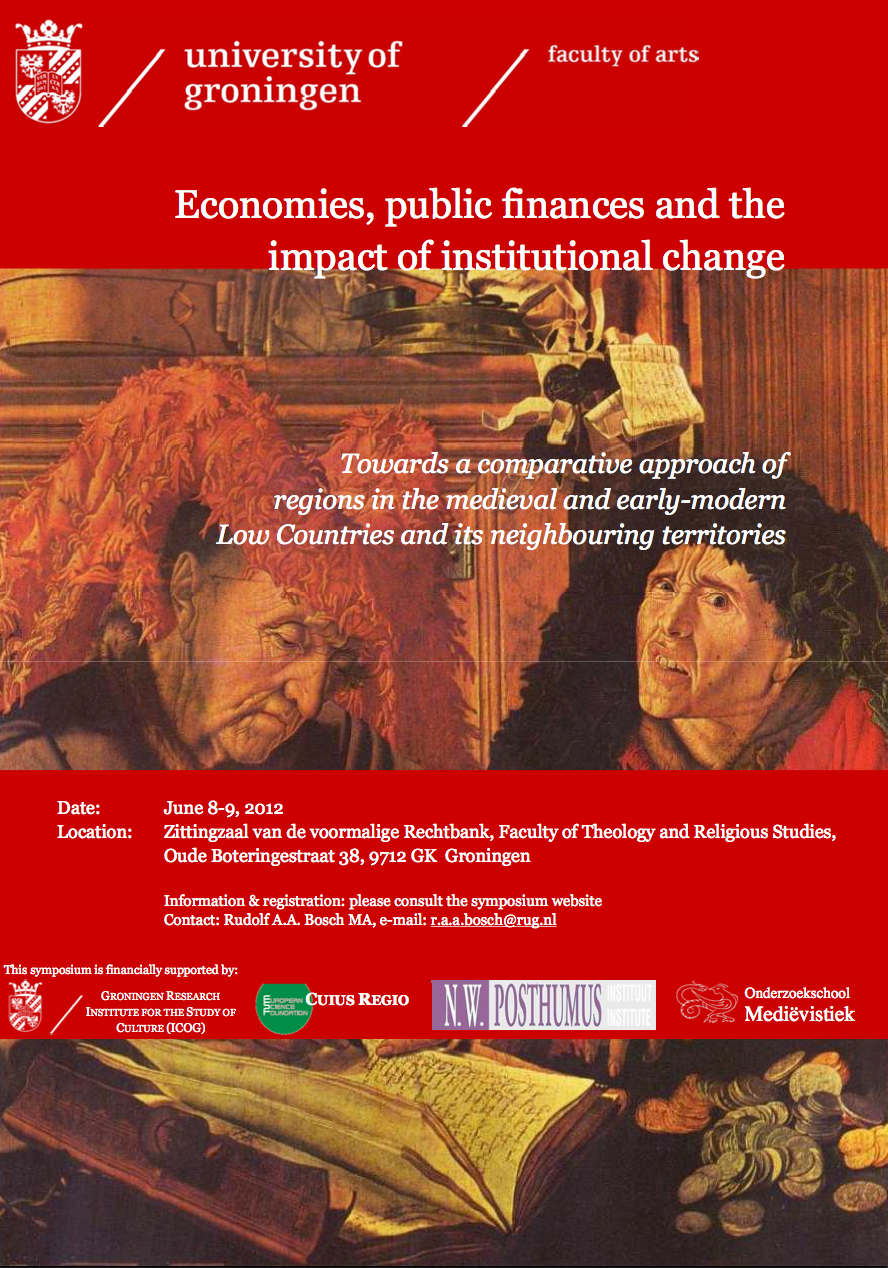
Programme : ici
June 8, 2012
11:00 – 11:30
Reception
11:30 – 11:40
Prof. Dr. Catrien Santing – Introduction
11:40 – 12:00
Dr. Marjolein’t Hart (University of Amsterdam) – Status questionis on state formation processes in the late Middle Ages and early modern period
12:00 – 12:20
Prof. Dr. Peter Hoppenbrouwers (Leiden University) – Socio-economic development in the medieval Low Countries: a comparative overview of long-term developments
12:30 – 13:30
Lunch
13:30 – 18:00
Session 1: Economy and social structures (chair: prof. dr. Dick E.H. de Boer)
13:30 – 14:15
Prof. Dr. Peter Stabel & Prof. Dr. Tim Soens (University of Antwerp) – Town in the countryside: Textile and agriculture around Ypres and Hondschoote in the late Middle ages and the 16th century
14:15 – 15:00
Dr. Job Weststrate (University of Groningen) – The institutional structures of river trade in the Lower Rhine region in the sixteenth and seventeenth centuries
15:00 – 15:30
Tea-break
15:30 – 16:15
Dr. Jord Hanus (University of Antwerp) – Living standards and real inequality in diverging economies: Brabant and Holland between 1500 and 1900
16:15 – 17:00
Drs. Bert Thissen (Stadtarchiv Kleve) – Regional dynamics of the urban brewing industries in Cleves and Guelders in the late Middle Ages and early-modern period
17:00 – 17:30
General discussion session 1
June 9, 2012
09:00 – 12:30
Session 2: Socio-political structures (chair: prof. dr. Raingard Esser)
09:00 – 09:45
Prof. Dr. Marc Boone (Ghent University) – The introduction of the French model of Rekenkamers in the Burgundian Low Countries
09:45 – 10:30
Dr. Kees Verkerk (Amsterdam) – Social dichotomy in towns and its implications for the management of towns and principalities
10:30 – 11:00
Coffee-break
11:00 – 11:45
Prof. Dr. Jelle Haemers (Katholieke Universiteit Leuven) – A financial revolution in Flanders? Fiscal innovation, urban resilience and public debt in the 1480s
11:45 – 12:15
General discussion session 2
12:30 – 13:30
Lunch
13:30 – 17:30
Session 3: Political economy & financial systems (chair: dr. Remi van Schaïk)
13:30 – 14:15
Dr. Jaco Zuijderduijn (Utrecht University/Geldmuseum Utrecht) – Medieval practice? The community responsibility system and foreign public debt in the Northern Low Countries
14:15 – 15:00
Rudolf Bosch MA (Groningen University) – Path-dependency or path-persistency? Urban finances, fiscal systems and urban public debt in the Eastern Netherlands and the Lower Rhine area (14th-16th centuries).
15:00 – 15:30
Tea-break
15:30 – 16:15
Dr. David Kusman (Université Libre de Bruxelles) & Dr. Jean-Luc Demeulemeester (Solvay Business School, Université Libre de Bruxelles) – New evidence on the circulation of financial instruments in the late-medieval Low Countries: from Lombard letters of obligation to transferable life-annuities (Brabant, Guelders, Flanders and Hainaut, ca. 1260-1355)
16:15 – 16:45
General discussion session 3
16:45 – 17:15
Prof. Dr. Wim Blockmans – Concluding remarks
17:15 – 18:30
Drinks & departure
N.B.: During the symposium, the majority of the presentations will be in Dutch. Discussions can be in either Dutch or English.
Informations pratiques :
The symposium is meant to place the current debate on the interaction between economies, institutions and public finances in the late-medieval and early-modern Low Countries in a wider, regional comparative framework.
Available places for this symposium are limited; registration via the online registration form on the symposium website
Organization: Rudolf A.A. Bosch MA & dr. Remi van Schaïk (University of Groningen)
This symposium is financially supported by: Groningen Research Institute for the Study of Culture (ICOG), ESF-project ‘Cuius Regio’, the N.W. Posthumus Institute and the Onderzoekschool Mediëvistiek.
Prior to the symposium, on Thursday afternoon, 7 June 2012 the Onderzoekschool Mediëvistiek organizes a Masterclass for Research Master and PhD students led by dr. Jord Hanus (University of Antwerp, Centre for Urban History), entitled ‘Regional comparisons of the interaction between economic and institutional developments’. For more information see the symposium website or contact the Onderzoekschool Mediëvistiek.






 L'Agenda des Médiévistes