
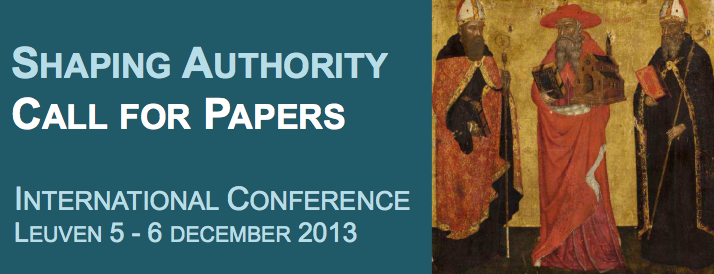
Shaping authority. How did a person become an authority in Antiquity, the Middle Ages and the Renaissance?
International conference
Leuven, 5-6 december 2013
The cultural and religious history from Antiquity through the Renaissance maybe read through the lens of the rise and demise of auctoritates. Throughout this long period of about two millennia, many historical persons have been considered as exceptionally authoritative. Obviously, this authority derived from their personal achievements. But one does not become an authority on one’s own. In many cases, the way an authority’s achievements were received and disseminated by their contemporaries and later generations, was the determining factor in the construction of their authority. We will focus on the latter aspect: what are the mechanisms and strategies by which participants in intellectual life at large have shaped the authority of historical persons? On what basis, why and how were some persons singled out above their peers as exceptional auctoritates and by which processes did this continue (or discontinue) over time? What imposed geographical or other limits on the development and expansion of a person’s auctoritas? Which circumstances led to the disintegrationof the authority of persons previously considered to be authoritative?
We invite interdisciplinary and innovative scholarly case studies that document these processes. They may focus on one (group of) source(s) to analyse its contribution to shaping the authority of a historical person or they may take a longue durée perspective on the rise (and demise) of a person’s auctoritas.
Thematic clusters one can think of may include (1) Biography, historiography and hagiography as grounds for authority; (2) The role played by manuscript transmission and production; (3) The contribution of non-textual sources; (4) Biblical characters as authorities. Papers are invited from fields as diverse as philosophy,classical studies, Oriental and Byzantine studies, history, theology and religion, art history, manuscript studies and hagiography.
The papers selected for presentation at the conference will preferably be case studies which contain the following elements in some combination: (1) Presentation and analysis of the sources and their context; (2) Analysis of the strategies for the “making of authority”; (3) Description of the long term success (or failure) of these enterprises.
Papers may be given in English, French of German and should be twenty minutes long. To submit a proposal, please send an abstract of your paper and a brief curriculum vitae (max one pag. each) by e-mail to marleen.reynders@ghum.kuleuven.be before 20 April 2013. The publication of selected papers is planned in a volume to be included in the peer-reviewed LECTIO Series (Brepols Publishers).
The keynote lecture will be delivered by Prof. John Van Engen (Notre Dame Indiana USA) Detailed information about the conference on http://ghum.kuleuven.be/lectio.
Scientific comitee :
Pieter De Leemans
Sylvain Delcomminette
Russell Friedman
Peter Gemeinhardt
Michèle Goyens
Johan Leemans
Brigitte Meijns
Jan Papy
Gert Partoens
Stefan Schorn
Steven Vanderputten
Peter Van Deun
Gerd Van Riel
Organizing comitee :
Johan Leemans
Brigitte Meijns
Gerd Van Riel
Shari Boodts
Marleen Reynders
Keynote lecture :
Prof. John Van Engen
(Notre Dame Indiana USA)
Registration :
Registration is required before 29 November 2013
Contact :
marleen.reynders@ghum.kuleuven.be
Source de l’information : Lectio





 L'Agenda des Médiévistes