
Politics and Texts in Late Carolingian Europe, c. 870–1000
Monday 8th – Tuesday 9th July 2013
University of St Andrews
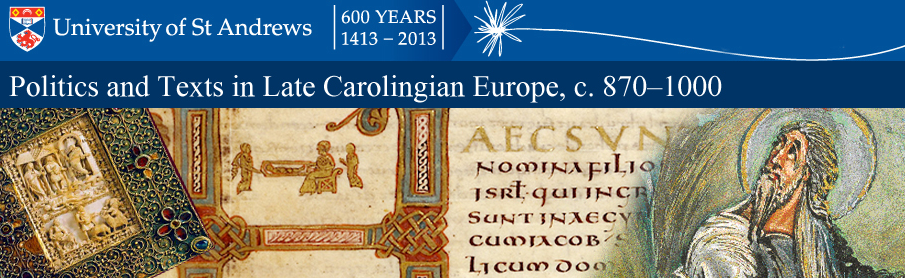
The Carolingian dynasty (751–987) ruled the last pan-European empire of the middle ages, a territory spanning over one million square kilometres at its height. In the late ninth century, however, this empire began to disintegrate, and the tenth century has long been depicted as a period of cultural and political decline. This two-day conference will explore the relationship between political authority and textual production in Europe during the late ninth and tenth centuries. It aims to contribute to a body of research which is increasingly bringing into question traditional notions and assumptions about the collapse of the Carolingian empire. This will be the first British conference devoted specifically not only to this subject, but also to this period. It will provide a forum for leading specialists, young researchers and postgraduate students from around the world to share ideas and forge new contacts in a friendly yet rigorous intellectual environment. By drawing together recent research about the interaction between written texts and attempts to exert political authority from across the late/former Carolingian world, this event promises to make a significant contribution to our understanding of this formative but neglected period of European history.
Programme :
Monday 8th July
9h00-9h50 : Registration / coffee
9h50-10h00 : Welcome
10h00-11h30 – Session 1
Shane Bobrycki – Gangs and Bands in Late Carolingian West Francia between Politics and Texts
Warren Brown – Traveling disputes: changing images of conflict in Carolingian formula books
Matthew Innes – Who made it ‘eine Quellenarme Zeit’? Textual production, interpretative control and the documentary sources of late Carolingian and post-Carolingian history
11h30-12h00 – Coffee
12h00-13h30 – Session 2
Roberta Cimino – An empress and her “wills”: Royal widowhood and political struggles in post-Carolingian Italy (c. 898 – 923)
Giacomo Vignodelli – Politics, prophecy and cryptic text: Atto of Vercelli’s Perpendiculum
Ross Balzaretti – Representations of Hugh of Arles (c. 885-948) and his family
13h30-14h30 – Lunch
14h30-16h00 – Session 3
Robert Evans – Politics, warfare, and morality in Abbo of Saint-Germain-des-Prés’ Bella Parisiacae Urbis
Christopher Heath – Audite omnes fines terre orrore cum tristitia: Louis II and the Rythmus de Captivitate
Charles West – The Lost Kingdom and the lost manuscript: the ‘Collection’ of Bishop Adventius of Metz
16h00-16h30 – Coffee
16h30-18h00 – Session 4
Fraser McNair – The politics of being Norman in the reign of Richard the Fearless
Edward Roberts – Justifying proprietary claims: Flodoard, Conrad the Red and the Remigiusland dispute
Geoffrey Koziol – Sacred History, Written Texts, and Young Girls’ Visions in Flodoard’s Histories
18h00-19h30 – Wine reception
20h00 – Conference dinner
Tuesday 9th July
9h00-9h45 – Coffee
9h45-11h15 – Session 5
Megan Welton – Three Emperors, Thirty Years, One Constant: Political Networks and Ottonian Charters for Venice, 967-992
Rob Houghton – The balance of power in tenth century Italy: A charter of Lothar II
Levi Roach – The Diplomas of Otto III and the Politics of Reform in the Regnum Italicum
11h15-11h45 – Coffee
11h45-13h15 – Session 6
Giovanni Isabella – Building the kingship: the legitimation of Otto I in Ottonian narrative sources (c. 955-975)
Paul Fouracre – Revisiting the Vita Dagoberti III
Philippe Depreux – Title TBC
13h15-14h15 – Lunch
14h15-15h45 – Session 7
Giorgia Vocino – From “Doctor Ambrose” to “Apostle Barnabas”. Strategies of legitimation and hagiographic literature in Late Carolingian Milan (9th-11th c.)
Frederik Keygnaert – Political Discourse on the Bishop’s Corrective Authority in Carolingian and Post-Carolingian Normative Texts
Conrad Leyser – Church without Empire: the Tenth-Century Take Off
15h45-16h15 – Closing remarks
Source de l’information : University of St Andrews




 L'Agenda des Médiévistes