
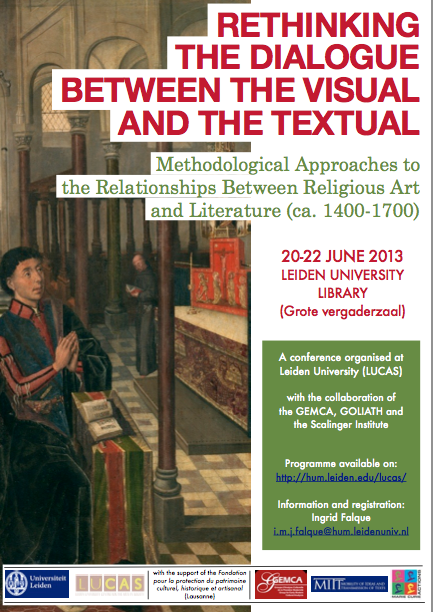
Rethinking the Dialogue between the Visual and the Textual.
Methodological Approaches to the Relationships Between Religious Art and Literature (ca. 1400-1700)
A conference at LUCAS (Leiden University Centre for the Arts in Society)
organised by Ingrid Falque and Geert Warnar
20-22 June 2013
In collaboration with
GOLIATH, GEMCA (Université Catholique de Louvain, Louvain-La-Neuve) and the Scaliger Institute (Universiteit Leiden)
And with the support of the “Fondation pour la protection du patrimoine culturel, historique et artisanal” (Lausanne)
Presentation :
In recent decades, the interactions between religious art(s) and literature(s) – and more generally between text(s) and image(s) – in the Late Middle Ages and Early Modern Period have been an important area of study for many scholars working in the field of the humanities. More particularly, the study of the interconnectedness of texts and images and of the contact zones between visual arts and literature constitute an emerging field that is particularly stimulating for both art historians and historians of literature. Growing awareness that texts and images functioned in the same community of discourse and were destined for the same audiences means that art historians frequently turn to texts to enlighten the functions and meaning of works of art. Similarly, historians of literature are increasingly bringing images in their analysis of literary works. Many scholars also consider texts and images together – as equivalent sources – in order to study cultural phenomena, concepts and notions.
These scholarly interests in the relations between art and literature generate a range of general methodological and theoretical questions: how can a text be used to understand an image? How can an image help to discern the meaning of a text? How do we interpret texts and images together in order to understand the religious culture of these periods? How do we consider them in relation to each other, without underestimating the specificities of each medium? What are the purposes and aims of the combined study of these sources?
During this conference, we would like to focus on the methodological approaches to the relationships between religious art(s) and literature(s) of the Late Middle Ages and the Early Modern Period, with special emphasis on the mystical traditions of these periods. The conference aims to explore not only the many forms of interactions between religious texts and images in this period, but also the methodological and theoretical issues they imply in order to sketch an overview of the different approaches used by scholars while studying texts and images together. Among others, the following forms of dialogue between the visual and the textual will be at the centre of this enquiry: the influence of spiritual authors on pictorial practices; the visual and textual discourses on images in mysticism; the impact of works of art on religious literary production; the complex text/image relationships in illuminated manuscripts, in printed books or in emblems books; the links between visual and biblical exegesis, the connections between painters and rhetoricians, etc. On a more general level, speakers will discuss how religious texts and images can work together in order to produce meaning, the capacity of a text not only to signify but also to represent, and the ability of a work of art (or an image) not only to depict but also to produce sense.
The invited speakers will address methodological issues while presenting case studies in order to reflect on the richness of seeing and reading in late Medieval and Early Modern literature and art, as well as the diverse ways in which scholars put the visual and the textual into dialogue with each other.
In collaboration with GOLIATH, GEMCA (Université Catholique de Louvain, Louvain-La-Neuve)
and the Scaliger Institute (Universiteit Leiden).
And with the support of the “Fondation pour la protection du patrimoine culturel, historique et artisanal” (Lausanne).
Programme :
Thursday 20 June
13h30-13h40 : Welcome by Kitty Zijlmans, director of LUCAS
Moderator : Wim van Anrooij (Universiteit Leiden, LUCAS)
13h40-14h10 : Ingrid Falque (Universiteit Leiden, Lucas) – Introduction
14h10-14h55 : Agnès Guiderdoni (Université Catholique de Louvain, GEMCA) – Locutiones figuratae: Neither Text Nor Image. Figurability of Mystical Experience in the Early Modern Period
Coffee break
15h15-16h00 : Paul Smith (Universiteit Leiden, LUCAS) – Rereading Dürer’s Representations of The Fall of Man
16h30-17h30 : Keynote Lecture (open to the public): Walter Melion (Emory University, Atlanta) – Devota anima sese oblectari in dies poterit: The Tropes of Pasting, Printing, and Engraving in Martin Boschman’s Paradisus precum selectarum of 1610
16h30-17h30 : Keynote Lecture (open to the public): Walter Melion (Emory University, Atlanta) – Devota anima sese oblectari in dies poterit: The Tropes of Pasting, Printing, and Engraving in Martin Boschman’s Paradisus precum selectarum of 1610
Friday 21 June
Moderator : Geert Warnar (Universiteit Leiden, LUCAS)
9h15-10h00 : Sanne De Vries (Universiteit Leiden, LUCAS) – All Roads Lead to Rome. The Mass of St. Gregory and its Prayers
10h00-10h45 : Kees Schepers (Universiteit Antwerpen) – The Draughtsman’s Library. Gielis vander Hecken, his Books and his Labyrinthi
Coffee break
11h15-12h00 : Aline Smeesters (Université Catholique de Louvain, GEMCA) – The Text/Image Relationship in Herman Hugo’s Pia Desideria (1624)
12h00-12h45 : Ralph Dekoninck (Université Catholique de Louvain, GEMCA) – « To Give Spirit to the Mute Figure ». The Enlivening Word and the Animated Image in the Early-Modern Spiritual Literature
12h45-14h15 : Lunch
14h15-15h00 : Stijn Bussels (Universiteit Leiden, LUCAS) & Bram Van Oostveld (Universiteit van Amsterdam) – Vondel’s Brethren: Defending the Performance of the Word of God
15h00-15h45 : Bart Ramakers (Rijksuniversiteit Groningen) – Looking Through, Seeing Clearly. Imagination, Meditation and Cognition in Cornelis Everaert’s play of Mary Compared to the Light
Coffee break
16h15-17h00 : Jürgen Pieters (Universiteit van Gent, GOLIATH) – title to be announced
Saturday 22 June
Moderator : Ingrid Falque (Universiteit Leiden, LUCAS)
10h00-10h45 : Elliott Wise (Emory University, Atlanta) – “Hidden Sons of God”: Baptism and Transfiguration in Rogier van der Weyden’s St. John Triptych
10h45-11h30 : Reindert Falkenburg (NYU Abu Dhabi) – Speculation as a Solid Mode of Interpretation: ‘Reading’ Hieronymus Bosch’s Garden of Earthly Delights
Coffee break
12h00-12h45 : Geert Warnar (Universiteit Leiden, LUCAS) – Elckerlijc and Provoost
12h45-13h15 : Concluding remarks
Informations pratiques :
Date: 20-22 June 2013
Venue: Leiden University, University Library (Grote vergaderzaal), Witte Singel, 26-27, Leiden
Information and Registration: Ingrid Falque (i.m.j.falque@hum.leidenuniv.nl)
Source de l’information : http://www.hum.leiden.edu/lucas/news-events/conferentie-rethinking-the-dialogue.html



 L'Agenda des Médiévistes