
The wild beast bares its fangs in a fearful grimace, flames spurt from its maw and sparkling in its bloodshot eyes is a look of the purest evil. While the monster towers above the people in front, in reality this devil is just a detail, viewed through a microscope, from Stefan Lochner’s Day of Judgement (c. 1435). This and other breath-taking sights are on show at the Wallraf-Richartz Museum in its forthcoming exhibition: Secrets of the Painters – Cologne in the Middle Ages. From 20 September 2013 till 9 February 2014, the famous masterpieces can be seen with fresh eyes.
For the first time the exhibition presents the fascinating findings that have been brought to light by a team of conservators, scientists and art historians in a project lasting several years. Like the hunt for clues in a criminal investigation, the researchers have used the latest equipment to analyse over thirty paintings that were all done some 600 years ago in Cologne. Apart from the originals, visitors will be able to study intriguing infra-red exposures and revealing x-ray images, as well as enormous blow-ups of details from the paintings, and even become acquainted with the painters’ sophisticated tricks and methods in a reconstruction of a workshop. This modern presentation will be rounded off by digital animations, film clips, digressions on the materials and techniques, and a special children’s circuit complete with interactive handbook.
Thanks to this exciting presentation, one will learn how the works came into being, how they originally looked, what purposes they fulfilled, how they were used, and how the painters worked together. The research team has even managed to reconstruct entire altarpieces that have been handed down in mere fragments. And other works could be given new, exact dates or attributed to other painters than those hitherto assumed.
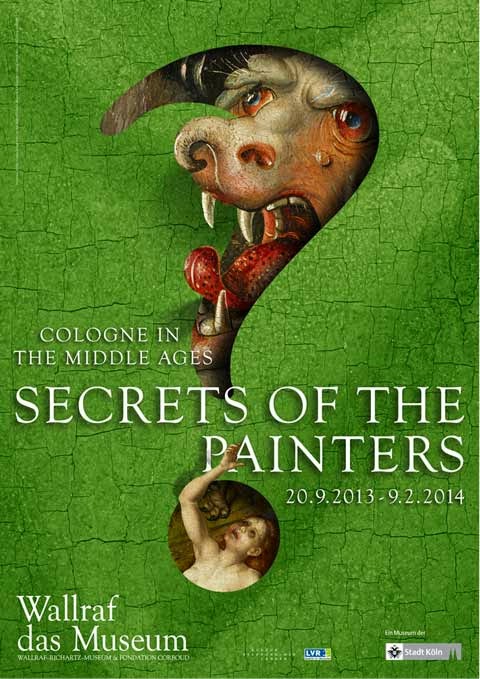
“Secrets of the Painters” takes the visitors into the little known world of the mediaeval masters in four chapters with three digressions. It begins by pinpointing where it all took place, because the majority of the painters lived and worked just a stone’s throw from the Wallraf-Richartz Museum, where now one of Germany’s most famous shopping streets is located. The painters were known in those days as “Schilderer”, which gave the street its name: “Schildergasse”. And they were astonishingly well organised, inventive and careful in all that they did. The ingredients they used for their at times highly poisonous paints had to be ground in a painstaking process by themselves. Cochineal beetles were used for instance to make a precious red. But despite the adverse circumstances in which they lived, they created enormous altarpieces with richly adorned gold backgrounds, or minutely painted furnishings, coats of arms and vessels. Even in their microscopic examinations the researchers found hardly a speck of dirt or other particles in the paintings – which is nothing short of a miracle given the standards of cleanliness at that time.
The second chapter of the exhibition gives a vivid insight into the long and complex story of the paintings. Originally commissioned by churches, chapels or pious benefactors, over the centuries they have lost their original context and in most cases their former pristine state. Because in order to make more money from panel paintings, after secularisation (1802) they were sawn apart, split up and divided from one another. All the more beautiful, then, are the moments in which scattered sections of paintings have been reunited: thus for instance the exhibition has brought two wings of a Lochner altar back together after many decades. Moreover, the experts have been able to identify a painting that was previously regarded as a single panel as the centrepiece of what originally was a triptych. The solid chain of evidence for this can be followed by a series of x-rays. And photos clearly demonstrate the traces where the old hinges were once attached to the outer edges of the ornamental frame. That was where two wing panels used to hang.
“Who did the work?” – this question is examined in the third section of the exhibition. Since the painters regarded themselves as craftsmen and not as artists, they never signed their works. So while the paintings are famous, with the exception of Stefan Lochner we are unable to attribute any of the works to concrete people. For this reason the research uses what are called “names of convenience”. The “Master of St Veronica”, for instance, takes his name from the most important work that he created. But a number of people or even an entire workshop may be hidden behind such a name. In the case of numerous paintings, the researchers have established that various hands worked on the panels. At times the painters worked with templates to improve efficiency and ensure that particular individuals are easier to identify when they appear throughout a series of paintings.
In the fourth and last chapter, the exhibition reveals the secrets of the brilliant painter Stefan Lochner. Infrared exposures, x-ray images and a look down the microscope have brought us closer than ever to the great genius of painting in historical Cologne. Even his underpaintings are unique artworks. For his meticulous Day of Judgement he first painted all of the figures in fine detail and fleshed them out with exquisite hatching. And Lochner’s magnificent way with paint and gold leaf is quite overwhelming. A beautiful example is the barely two centimetre large broach on the Madonna of the Rose Bower (c. 1440), whose pearls and gems still twinkle as if they were real. Lochner’s broach does not have to shy from comparisons with the gold work from his time, which is also on display.
Informations pratiques :
Secrets of the painters. Cologne in the Middle Ages
Wallraf-Richartz-Museum & Fondation Corboud
20 Sept. 2013 – 9 Feb. 2014
Obenmarspforten (am Kölner Rathaus)
D- 50667 Köln
Tel.: +49 (0) 221 221-21119
Fax: +49 (0) 221 221-22629
Info(at)wallraf.museum




 L'Agenda des Médiévistes