
Colloque international
Bruxelles–Bruges, 5–7 mars 2015
Bruxelles–Bruges, 5–7 mars 2015
Marie de Bourgogne (1457–1482), fille de Charles le Téméraire et héritière des États de ce dernier, a été jusqu’ici peu étudiée par les spécialistes du XVe siècle. Malgré une exposition, tenue à Beaune entre novembre 2000 et février 2001 (Bruges à Beaune. Marie, l’héritage de Bourgogne), ainsi que plusieurs biographies, souvent inégales, son règne bref – et pourtant déterminant pour l’histoire européenne – demeure éclipsé par la magnificence de ceux de son père Charles le Téméraire, de son époux Maximilien de Habsbourg et de ses fils et petits-fils, Philippe le Beau et Charles Quint. On s’explique d’autant plus mal ce désintérêt lorsque l’on considère l’attention que les chercheurs portent aujourd’hui au rôle des femmes à la cour de Bourgogne, en particulier à sa belle-mère, Marguerite d’York, et à sa propre fille, Marguerite d’Autriche.
Et en effet, si l’on se penche davantage sur la personne de Marie de Bourgogne, on ne peut que constater sa place dans tous les domaines de son temps. Sur le plan politique, si le Grand Privilège de 1477 et la crise qui l’a engendré sont bien connus, le rôle exact de la duchesse et de son entourage – notamment par le biais de l’éducation que celui-ci inculque à la princesse – au sein de cet enchevêtrement d’événements demeure assez obscur. Plus généralement, d’ailleurs, ce ne sont rien moins que les tractations diplomatiques et les campagnes militaires marquant son règne qui mériteraient de retenir davantage l’attention des chercheurs, la part qu’y prit la princesse devant y être décelée. Son rôle en tant que patronne des arts a, quant à lui, seulement commencé à être envisagé en détails et, si les Heures de Marie de Bourgogne sont aujourd’hui connues, un nombre important d’œuvres littéraires, historiographiques et iconographiques en rapport avec la princesse et son règne constitue toujours un vaste champ laissé en friche. Enfin, il nous semble crucial de considérer l’image de Marie dans l’historiographie et la mémoire collective de son temps et des périodes qui suivirent, jusqu’à nos jours, pour parvenir à comprendre la place qu’elle occupe – ou qu’elle n’occupe plus – dans l’imaginaire.
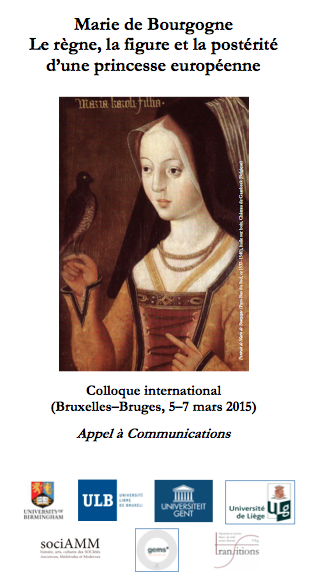
Ce colloque international vise à rassembler des spécialistes du XVe siècle et du règne de Marie, toutes disciplines confondues : littéraires, codicologues, spécialistes de l’histoire politique, sociale, culturelle et économique, historiens de l’art et du genre, afin de réévaluer la figure et le règne de Marie de Bourgogne ainsi que la place de cette princesse dans l’histoire et la culture bourguignonnes et européennes.
Le colloque se tiendra à Bruxelles et à Bruges, du 5 au 7 mars 2015. Les propositions de communication (25 minutes maximum, en français ou en anglais) pourront concerner, mais sans restriction, les thèmes suivants :
- Les aspects politiques, diplomatiques et militaires du règne de Marie et son rôle dans chacun de ses domaines ;
- Son rôle en tant que patronne des arts (littérature, historiographie, arts plastiques) ;
- Ses rapports avec les villes et leur culture ;
- Son entourage et son éducation ;
- Son impact dans la mémoire collective.
Les propositions (une quinzaine de lignes environ) doivent être envoyées avant le 15 mai 2014 à l’adresse suivante : jonathan.dumont@ulg.ac.be
Michael Depreter (FNRS-ULB)
Jonathan Dumont (FNRS-ULg)
Elizabeth L’Estrange (UBirmingham)
Samuel Mareel (FWO-UGent)
Comité organisateur :
Michael Depreter (FNRS-ULB)
Michel de Waha (ULB)
Jonathan Dumont (FNRS-ULg)
Elizabeth L’Estrange (UBirmingham)
Alain Marchandisse (FNRS-ULg)
Samuel Mareel (FWO-UGent)
Jürgen Pieters (UGent)
Comité scientifique :
Adrian Armstrong (Queen Mary, University of London)
Jean-Marie Cauchies (USL)
Michael Depreter (ULB)
Michel de Waha (ULB)
Jonathan Dumont (ULg)
Anne-Marie Legaré (ULille3)
Elizabeth L’Estrange (UBirmingham)
Alain Marchandisse (ULg)
Samuel Mareel (UGent)
Jürgen Pieters (UGent)
Kathleen Wilson-Chevalier (American University of Paris)
Jan Dumolyn (UGent)
Version anglaise de l’appel
Mary of Burgundy. The Reign, the ‘Persona’ and the Legacy of a European Princess
International Colloquium (Brussels–Bruges, 5–7 March 2015)
Mary of Burgundy (1457–1482), daughter of Charles the Bold and heir to the Burgundian States, has received relatively little scholarly attention from specialists. Despite an exhibition held at Beaune from November 2000 to February 2001 (Bruges à Beaune. Marie, l’héritage de Bourgogne) as well as a number of biographies of varying merit, her brief reign remains overshadowed by those of her father, Charles the Bold, her husband, Maximilian of Hapsburg, and those of her son and grandson, Philip the Fair and Charles V. Mary’s reign, however short, is nevertheless important in the history of Europe and her absence from scholarly research is all the more surprising given the current interest in the role of women at the Burgundian court, particularly in Mary’s stepmother, Margaret of York, and her own daughter, Margaret of Austria.
On closer inspection, however, it is clear that Mary of Burgundy was a key player in the most important spheres of her day, notably politics, diplomacy, and the arts. On the political front, her involvement in the Great Privilege of 1477 and the crisis which sparked it is well known. However, the precise role played by the duchess and those close to her in this tangled series of events – especially the lessons that she learnt from the experience – are less well understood. More generally, the diplomatic negotiations and military campaigns which had an impact on her reign deserve greater attention from scholars, and the princess’s own role in these needs to be brought to light. Her role as a patron of the arts has recently started to receive more interest beyond the notoriety of the Hours of Mary of Burgundy. However, a number of important works of literature, history and iconography associated with the duchess have yet to be explored. Finally, it also important to consider the image of Mary in historiography, both in the collective memory of her own time and in that of subsequent generations, in order to understand the place that she occupies – or not – in the collective, historical, imagination.
This international colloquium aims to bring together specialists working on the fifteenth century and on Mary’s reign from across the disciplines – literature, manuscript studies, political, social, cultural and economic history, art history, and gender studies – in order to reassess the ‘persona’, the reign and the legacy of Mary of Burgundy in the history of Burgundian and European culture.
The colloquium will take place in Brussels and in Bruges, 5–7 March 2015. Proposals for papers (25 minutes maximum, in English or in French) might consider, but are not restricted to, the following themes:
- The political, diplomatic and military aspects of Mary’s reign and her role in these areas;
- Mary’s role as a patron of the arts (literature, history/historiography, painting, sculpture etc.);
- Her links to and relationships with towns and their culture;
- Her entourage and her education;
- Her impact on collective memory.
Proposals of about fifteen lines (200–300 words) should be sent by 15 May 2014 to the following address: jonathan.dumont@ulg.ac.be
Michael Depreter (FNRS-ULB)
Jonathan Dumont (FNRS-ULg)
Elizabeth L’Estrange (University of Birmingham)
Samuel Mareel (FWO-UGent)
Organizing Committee :
Michael Depreter (FNRS-ULB)
Michel de Waha (ULB)
Jonathan Dumont (FNRS-ULg)
Elizabeth L’Estrange (UBirmingham)
Alain Marchandisse (FNRS-ULg)
Samuel Mareel (FWO-UGent)
Jürgen Pieters (UGent)
Advisory Board :
Adrian Armstrong (Queen Mary, University of London)
Jean-Marie Cauchies (USL)
Michael Depreter (ULB)
Michel de Waha (ULB)
Jonathan Dumont (ULg)
Anne-Marie Legaré (ULille3)
Elizabeth L’Estrange (UBirmingham)
Alain Marchandisse (ULg)
Samuel Mareel (UGent)
Jürgen Pieters (UGent)
Kathleen Wilson-Chevalier (American University of Paris)
Jan Dumolyn (UGent)
Version néerlandaise de l’appel
Maria van Bourgondië. Het bewind, de figuur en de nagedachtenis van een Europese prinses
Internationaal Colloquium (Brussel–Brugge, 5–7 maart 2015)
Maria van Bourgondië (1457–1482), dochter van Karel de Stoute en erfgename van diens landen, heeft tot op heden weinig aandacht gekregen van specialisten van de vijftiende eeuw. Ondanks een tentoonstelling in Beaune van november 2000 tot februari 2001 (Bruges à Beaune. Marie, l’héritage de Bourgogne) en verschillende biografieën, van ongelijke kwaliteit, blijft haar korte – maar voor de Europese geschiedenis niettemin bepalende – bewind overschaduwd door dat van haar vader Karel de Stoute, haar echtgenoot Maximiliaan van Oostenrijk, haar zoon Filips de Schone en haar kleinzoon Karel V. Dit gebrek aan interesse staat ook in scherp contrast met de bijzondere wetenschappelijke aandacht van de laatste jaren voor vrouwen aan het Bourgondische hof, in het bijzonder Maria’s schoonmoeder Margaretha van York en haar dochter Margaretha van Oostenrijk.
Bij nader toezien blijkt Maria van Bourgondië een belangrijke plaats te hebben ingenomen in alle aspecten van haar tijd. Op politiek gebied zijn het Groot Privilege en de crisis waaruit deze tekst is ontstaan grondig bestudeerd. De precieze rol van de hertogin en haar entourage – in het bijzonder via de opvoeding die de prinses hiervan ontving – in dit kluwen van gebeurtenissen is echter nog steeds onduidelijk. Meer algemeen verdienen ook de (geheime) politieke onderhandelingen en de militaire campagnes waardoor haar bewind bepaald is, en in het bijzonder de rol hierin van de prinses zelf, meer aandacht. Het onderzoek naar haar functie als patrones van de kunsten staat nog in de kinderschoenen. Het Getijdenboek van Maria van Bourgondië mag dan goed bekend zijn, een groot aantal literaire, historiografische en iconografische werken dat verband houdt met haar bewind vormt nog steeds een onontgonnen onderzoeksterrein. Het lijkt ons, ten slotte, eveneens cruciaal om aandacht te schenken aan het beeld van Maria in de historiografie en in het collectieve geheugen van haar eigen tijd tot vandaag, om tot een begrip te komen van de plaats die ze (al dan niet meer) inneemt in de collectieve verbeelding.
Dit internationale colloquium wil onderzoekers van de vijftiende eeuw en van Maria van Bourgondië uit alle disciplines samenbrengen : literatuur, codicologie, politieke, sociale, culturele en economische geschiedenis, kunstgeschiedenis en gender. De bedoeling is om de figuur en het bewind van Maria van Bourgondië en haar plaats binnen de Bourgondische en Europese cultuur te herevalueren.
Het colloquium zal plaatsvinden in Brussel en Brugge, van 5 tot 7 maart 2015. Papers (van maximum 25 minuten, in het Frans of het Engels) kunnen onder andere de volgende thema’s behandelen :
- De politieke, diplomatieke en militaire aspecten van het bewind van Maria van Bourgondië en haar rol in elk van deze domeinen ;
- Haar rol als patrones van de kunsten (literatuur, historiografie en beeldende kunsten) ;
- Haar relatie tot de steden en hun cultuur ;
- Haar entourage en opvoeding ;
- Haar impact op het collectieve geheugen.
Voorstellen voor papers (van ongeveer 15 regels) dienen voor 15 mei 2014 naar het volgende adres te worden gestuurd : jonathan.dumont@ulg.ac.be
Michael Depreter (FNRS-ULB)
Jonathan Dumont (FNRS-ULg)
Elizabeth L’Estrange (UBirmingham)
Samuel Mareel (FWO-UGent)
Organiserend Comite :
Michael Depreter (FNRS-ULB)
Michel de Waha (ULB)
Jonathan Dumont (FNRS-ULg)
Elizabeth L’Estrange (UBirmingham)
Alain Marchandisse (FNRS-ULg)
Samuel Mareel (FWO-UGent)
Jürgen Pieters (UGent)
Wetenschappelijk Comite :
Adrian Armstrong (Queen Mary, University of London)
Jean-Marie Cauchies (USL)
Michael Depreter (ULB)
Michel de Waha (ULB)
Jonathan Dumont (ULg)
Anne-Marie Legaré (ULille3)
Elizabeth L’Estrange (UBirmingham)
Alain Marchandisse (ULg)
Samuel Mareel (UGent)
Jürgen Pieters (UGent)
Kathleen Wilson-Chevalier (American University of Paris)
Jan Dumolyn (UGent)




 L'Agenda des Médiévistes