
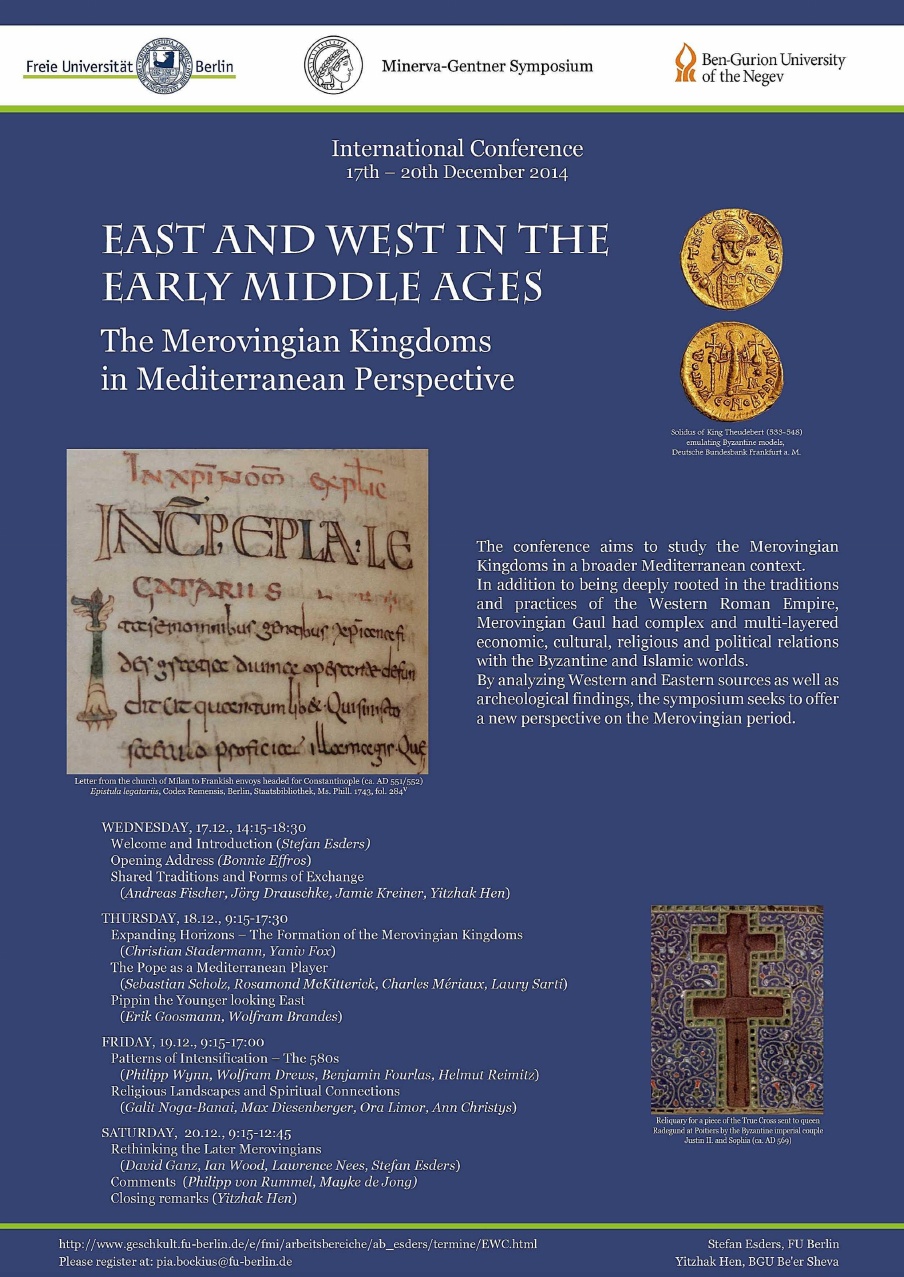
The conference aims to study the Merovingian Kingdoms in a broader Mediterranean context. In addition to being deeply rooted in the traditions and practices of the Western Roman Empire, Merovingian Gaul had complex and multi-layered economic, cultural, religious and political relations with the Byzantine and Islamic worlds. By analyzing Western and Eastern sources as well as archaeological findings, the symposium seeks to offer a new perspective on the Merovingian period.
Programme :
Wednesday, 17th December
14:15‒15.30: Opening Session
Stefan Esders (Berlin) – Welcome and introduction.
Bonnie Effros (Gainesville) – Merovingians and the Mediterranean – The enduring attraction of the Pirenne thesis
15:45‒18:30: Session I – Shared Traditions and Forms of Exchange
Andreas Fischer(Vienna) – Money for nothing – Franks, Byzantines and Lombards in the sixth and seventh century
Jörg Drauschke (Mainz) – Communication and trade between the Merovingians and the eastern Mediterranean – Archaeological perspectives
Jamie Kreiner(Athens/Ga.) – A generic Mediterranean – Hagiography in the early Middle Ages
Yitzhak Hen (Beer Sheva) – Defensor of Ligugé’s Liber scintillarum and the migration of knowledge
Thursday, 18th December
09:15‒10:30: Session II – Expanding Horizons: The Formation of the Merovingian Kingdoms
Christian Stadermann (Tübingen) – Passio sancti Vincentii Aginnensis – A different interpretation of the Franco-Visigothic war 507/508
Yaniv Fox (Ra’anana) – Anxiously looking east – Burgundian foreign policy on the eve of the reconquest
11:00‒15:45: Session III – The Pope as a Mediterranean Player
Sebastian Scholz (Zürich) – The papacy and the Frankish bishops in the 6th century
Rosamond McKitterick (Cambridge) – Perceptions of Rome and the papacy in late Merovingian Francia – The Cononian recension of the Liber pontificalis
12:15‒14:30 Lunch
Charles Mériaux (Lille) – From east to west – Constantinople, Rome and northern Gaul in the seventh century
Laury Sarti (Berlin) – Knowledge exchange and perception of the Eastern Empire in the late Merovingian west
16:15‒17:30: Session IV – Pippin the Younger looking East
Erik Goosman (Utrecht) – New dynasty, new frontiers? Pippin’s politics and the wider Mediterranean world
Wolfram Brandes (Frankfurt/M) – The Byzantine background to the so-called “Donation of Pepin”
Friday, 19th December
09:15‒12:15: Session V – Patterns of Intensification: The 580ies
Phillip Wynn (Beer Sheva) – Cultural transmission caught in the act – Gregory of Tours and the relics of St Sergius.
Wolfram Drews (Münster) – Hermenegild’s rebellion and conversion – Merovingian and Byzantine connections
Benjamin Fourlas (Mainz) – Early byzantine church silver offered for the eternal rest of Framarich and Karilos – Evidence of “the army of heroic men” raised by Tiberius II. Constantine?
Helmut Reimitz (Princeton) – Pax inter utramque gentem – The re-evaluation of Frankish identity in Merovingian encounters with the Empire during the last decades of the sixth century
12:15‒14:00 Lunch
14:00‒17:00: Session VI – Religious Landscapes and Spiritual Connections
Galit Noga-Banai (Jerusalem) – Relocation to the west – The relic of the True Cross in Poitiers
Maximilian Diesenberger (Vienna) – Martyrs and apostles from the Mediterranean in early medieval France
Ora Limor (Ra’anana) – Willibald in the holy places
Ann Christys (Leeds) – ‘Sons of Ishmael, turn back!’
Saturday, 20th December
09:15‒12:15: Session VII – Rethinking the late Merovingians
David Ganz (Notre Dame) – Getting to know the late Merovingians – What Bern 611 reveals
Ian Wood (Leeds) – Contact with the eastern Mediterranean in the late Merovingian period
Lawrence Nees(Newark) – ‘Merovingian’ illuminated manuscripts and their links with the eastern Mediterranean world
Stefan Esders (Berlin) – Unplugging the Merovingians from the Mediterranean – The case of Ebroin
12:15‒12:45: Closing words
Mayke De Jong (Utrecht) – Comment.
Philipp Von Rummel (Berlin) – Comment.
Yitzhak Hen (Beer Sheva) – Closing remarks.
Informations pratiques :
Place : Berlin
Date : 17.12.2014 – 20.12.2014
Host/Organizer : Yitzhak Hen, Department of General History, Ben-Gurion University of the Negev, Beer Sheva; Stefan Esders, Geschichte der Spätantike und des frühen Mittelalters, Friedrich-Meinecke-Institut, Freie Universität Berlin
Source de l’information : H-Soz-u-Kult




 L'Agenda des Médiévistes
Vous devez être connecté pour poster un commentaire.