
Bruges,
20-21 may 2015
Historians and literary historians in the past have repeatedly raised the question why the genre of the urban chronicle, widely popular in cities in the German Empire as well as in the densely urbanised region of northern Italy, failed to take root in the Low Countries. In spite of their high urbanisation in the late Middle Ages, boasting cities with high self-esteem and an often troubled relation with regional or central authority, the Low Countries apparently were no fertile ground for urban historiography. Or were they?
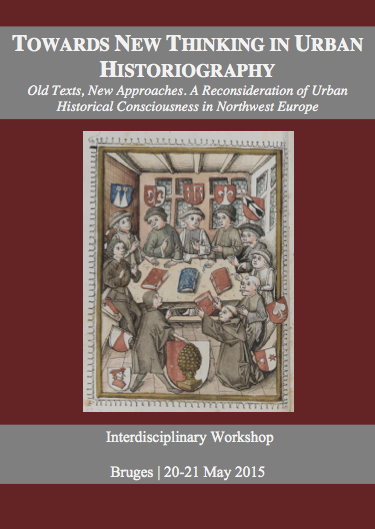 Very recently, historians have called to broaden our understanding of urban historiography, and to think less in the all too strict categories based on well- studied Italian or German examples of the genre. Indeed, urban identity and historical consciousness could very well be shown in other ways and through other channels than a typical urban chronicle. When looking closely at regional chronicles for example, it seems that these were sometimes written from a distinctively urban point of view. Also, manuscripts dealing with regional affairs sometimes contain lists of aldermen and other details that point towards an urban context. In other cases, a widely known regional chronicle sprouted urban chronicle offshoots which were not always recognised as such by scholars, or which were pushed aside for being impure versions of the regional chronicle. When from the sixteenth century onwards, the genre of the urban chronicle apparently did develop in full form, many of the texts did not make it to the printing press, and therefore received less attention, both by contemporaries and by later scholars, than the great regional chronicles that did appear in print.
It is mainly because of their hybrid guises, that many examples of urban historiography from the Low Countries succeeded in going unnoticed for a considerable amount of time. We believe it is time to look more closely at these texts from a broader, comparative perspective, unrestrained by typologies and genre definitions. In spite of gloomy reports by earlier scholars, this approach will no doubt unearth numerous examples of urban historiography from the Low Countries that still await scholarly attention.
The present workshop aims at taking the first steps towards a revaluation of urban historiography in the Low Countries, including rather than excluding texts that do not fit common definitions as proposed for other urbanised areas. It is the explicit aim to confront examples from the Low Countries to well-studied cases abroad, in order to develop new approaches to urban historiography in general. We welcome paper proposals (500 words) presenting cases of urban historiography from the Low Countries and abroad, and are interested in all forms of urban historiography, ranging from serial lists of aldermen to entire chronicles. We also encourage papers on urban aspects or urban viewpoints in regional chronicles, or more in general on the relation of urban and regional subject matter in larger chronicle bodies.
Authors are invited to provide a ‘fact file’ of the chronicles under scrutiny, so as to ease discussion from a comparative perspective. Aside from the discussion of the papers presented, we aim to introduce round table discussions on more general themes such as authorship, typology, historical context, manuscript and print, etc.
Organising committee :
Bram Caers (UAntwerpen) – bram.caers@uantwerpen.be
Lisa Demets (UGent) – lisa.demets@ugent.be
Tineke Van Gassen (UGent) – tineke.vangassen@ugent.be
Valerie Vrancken (K.U. Leuven) – valerie.vrancken@arts.kuleuven.be
Scientific committee :
Prof. dr. Marc Boone (UGent)
Prof. dr. Jan Dumolyn (UGent)
Prof. dr. Jelle Haemers (K.U. Leuven)
Prof. dr. Johan Oosterman (R.U. Nijmegen) Prof. dr. Graeme Small (Durham University)
Prof. dr. Anne-Laure Van Bruaene (UGent)






 L'Agenda des Médiévistes
Vous devez être connecté pour poster un commentaire.