
Dead Men Talking: 7th International Colloquium at Abbey Museum Of the Dunes
Organisation : Abdijmuseum Ten Duinen
Where : : abbey farm ‘Ten Bogaerde’
When : Wednesday, October 21, 2015 – Friday, October 23, 2015
Information
Interdisciplinary research into archaeological burial contexts in Northwest Europe (10th-16th centuries).
The 7th international colloquium highlights the latest research and scope with a focus on the broader approach of skeletons and their funerary context and the life of the dead, both community and individual
This new research is offering the means for an assessment, methodology and a broader study of medieval burial contexts and excavated individuals in Northwest Europe.
More information
Over 1,000 graves have been uncovered at the site of the medieval Abbey of the Dunes in Koksijde. The Cistercian abbey was the largest in Flanders, founded by the Count. In the 13th century, the community amounted up to 500 monks and lay brothers. The large number of well-preserved skeletons, found in one location and dating from a specific period (12th-16th centuries), is one of Northwest Europe’s largest collections of individuals.
The remains are now mainly kept at the Royal Belgian Institute of Natural Sciences in Brussels, where they are still being studied by physical anthropologists, medical examiners and students from all over the world. Unfortunately, incomplete excavation reports and gaps in the excavation archives complicate their interpretation and comparison with similar collections from our neighbouring countries.
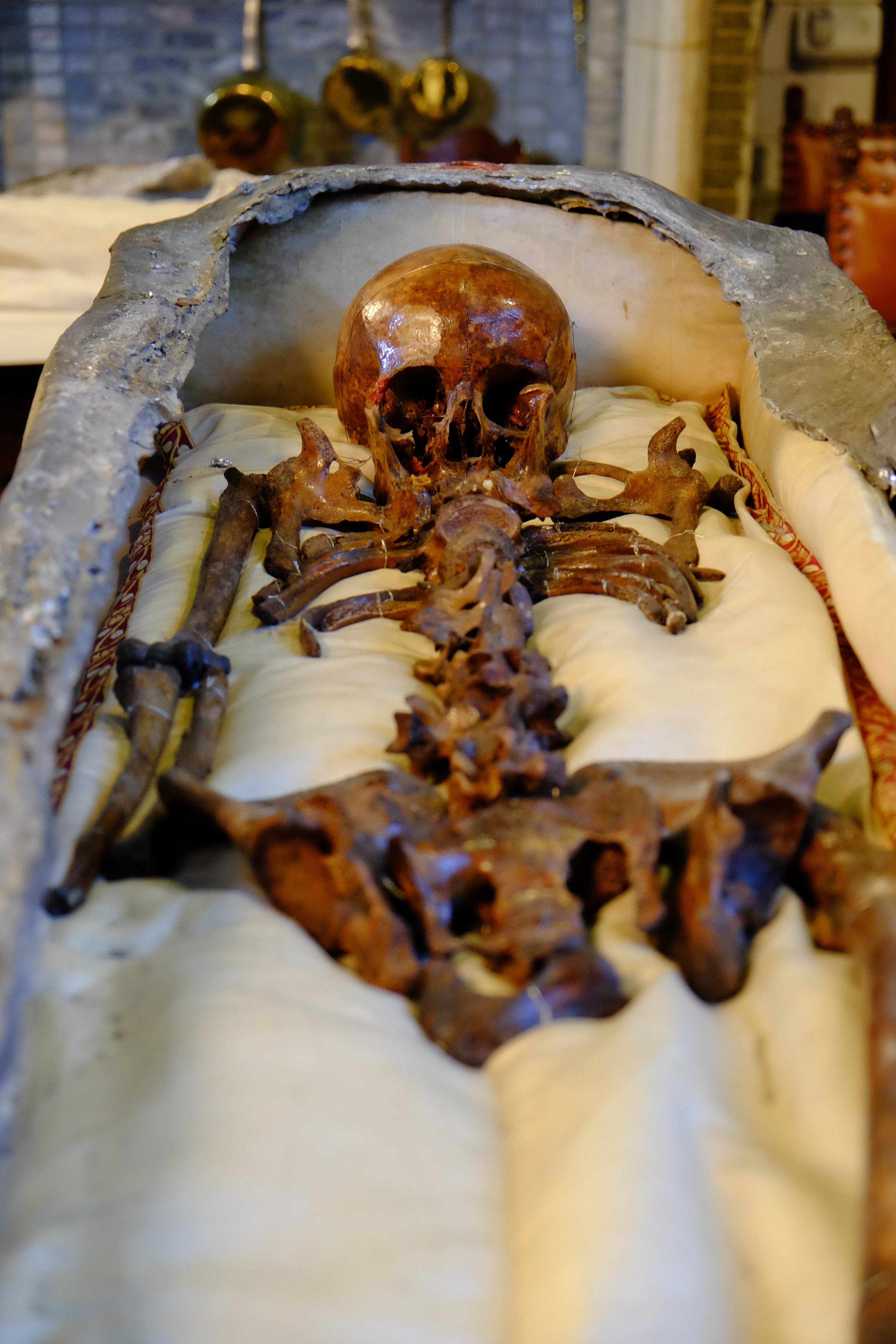
A thorough analysis of the relic of the Blessed Abbot Idesbald, held in Bruges, may be an important reference point in the research into the collection of individuals of the Abbey in Koksijde. The question is, however, to what extent interdisciplinary research into the best-documented individual, excavated in Koksijde, can fill in the gaps?
Call for poster sessions proposals
Are you involved in an interesting project or in an area of work that you would like to discuss with or show to other congress attendees? Why not present your work in one of the two poster sessions at the ‘Dead Men Talking’ congress of the Abbey museum of the Dunes? This is an ideal opportunity to present your work in an international conference and to get acquainted with the most recent developments in the research on medieval burial contexts and excavated individuals.
We are pleased to invite you to submit your proposal in one of the two following poster sessions:
October 22nd, 2015 – the broader approach of skeletons and their funeral context
What is the state of the art about archaeological research on medieval burial contexts in Northwest Europe? What do these collections tell about life and death in secular or clerical communities in both urban or rural contexts? What do they tell about changes in funeral rituals and clothing? Do collections tell us something about health, crafts, dietary habits, status and diseases in the past? How do you manage an amount of burials amidst an archaeological campaign? How can anthropology and the study of funeral contexts contribute to our knowledge of specific life within past communities and societies?
October 23th, 2015 – the life of the dead, both community and individual
In this session we try to work out personal life stories of some individuals from whom the only remains might be the bones found during archaeological campaigns. Most burials excavated yield unknown people of past societies. Exceptionally, buried individuals can be retraced to a historical figure, by which the individual obtains an identity and sometimes an image. But which individuals are identified? Who are they? Often, identification and personification is only possible after interdisciplinary research. What kind of historical sources do we have? In what way can applied scientific research contribute to broaden our knowledge – especially to the identification and personification – of the studied communities and individuals? What has been done in the past to commemorate these individuals and why has that been done?
The presented posters offer a possibility to discuss the assessment, the methodology of your study on medieval burial contexts and excavated individuals in Northwest Europe.
The deadline for the proposals for the poster sessions is August 1st, 2015.
Presentation:
Your topic should be described on a printed poster or by photographs, graphics, and pieces of text that you can attach to the presentation panel. The posters have to be made up in English.
Each presenter can only present one poster. Any organization that submits more than one application should indicate a priority to their submission.
Posters should be set up on the first day of the conference and will remain on display throughout the whole conference. Authors must be present at their poster station during the scheduled poster session and be prepared for individualized, informal discussion with congress attendees.
The conference will provide a poster board and whatever material which is required to secure items to the boards. Each presenter will be assigned to a specific board for his/her presentation. The maximum space for each poster is a 160 cm tall by 100 cm wide (oriented vertically). Presenters must prepare all materials in advance and bring illustrations needed including figures, tables, color photographs and/or charts. The material should be well labeled and legible form a distance of 2 meters.
How to submit a proposal for a poster session?
If you wish to present your poster at the congress poster session, submit the form to Alexander Lehouck (alexander.lehouck@koksijde.be) by August 1st, 2015.
Version française de la présentation du colloque
La voix des morts: 7ème Colloque International du Musée de l’Abbaye des Dunes
Organisation Abdijmuseum Ten Duinen
Où : Ferme abbatiale Ten Bogaerde
Quand : mercredi 21 octobre 2015 – vendredi 23 octobre 2015
Info
Recherche interdisciplinaire sur les contextes funéraires archéologiques en Europe du Nord-Ouest (du 10ème au 16ème siècle). Le 7ème Colloque international éclaire les résultats et les orientations des recherches actuelles en se focalisant notamment sur une approche plus ample des squelettes et de leur contexte funéraire et la vie des morts de la communauté à l’individu. Cette nouvelle recherche renforce les possibilités d’évaluation et la méthodologie utilisée et permet une étude plus ample des contextes funéraires médiévaux et des individus exhumés en Europe du Nord-Ouest.
Plus d’informations
Plus de 1000 tombes ont été découvertes sur le site de l’abbaye médiévale des Dunes à Coxyde. L’abbaye cistercienne était la plus grande de Flandre; le comte en était le fondateur. Au 13ème siècle, la communauté a compté jusqu’à 500 moines et frères lais. Le grand nombre de squelettes en bon état de conservation, trouvés en un seul endroit et datant d’une période spécifique (entre le 12ème et le 16ème siècle) a d’emblée constitué une des plus grandes collections d’individus dans toute l’Europe du Nord-Ouest.
Les restes des corps humains sont actuellement principalement conservés à l’Institut royal des Sciences naturelles de Belgique à Bruxelles. Ils y sont encore étudiés par des anthropologues physiques, des médecins légistes et des étudiants du monde entier. Les rapports de fouilles incomplets et les lacunes dans les archives du site archéologique compliquent l’interprétation et la comparaison avec des collections similaires dans les pays voisins.
Une analyse approfondie de la relique du Bienheureux Idesbald, abbé des Dunes, conservée à Bruges, pourrait devenir un point de référence important pour l’examen de la collection d’individus de l’abbaye des Dunes. Dans quelle mesure la recherche interdisciplinaire sur l’individu le mieux documenté, déterré à Coxyde, pourrait-elle éliminer les lacunes?
Source : Abbaye des Dunes






 L'Agenda des Médiévistes
Vous devez être connecté pour poster un commentaire.