
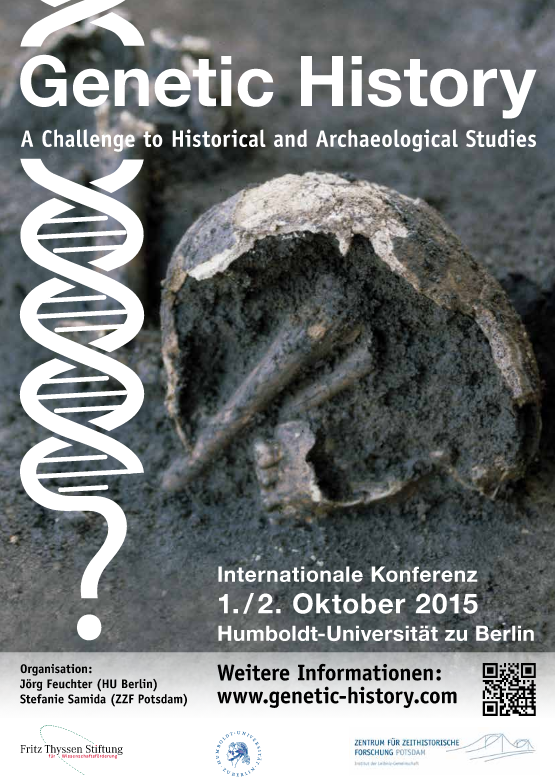
The purpose of the conference is an open exchange among the disciplines concerned with ‘Genetic History’ about the opportunities, problems and risks of this emerging field. We wish to provide an occasion for intense and fruitful dialogue between genetic, historical and archaeological research. Among the questions the conference wants to raise are the following: How do geneticists, archaeologists and historians work together? What kind of knowledge does DNA analysis add to historical and archaelogical research? Are the results relevant for cultural history? What is the importance of Genetic History in public discourses? How are questions of identity and memory influenced by Genetic History?
 Programme :
Donnerstag, 1. Oktober 2015// Thursday, 1. October 2015
9.00 Uhr:
Jörg Feuchter (Berlin)/ Stefanie Samida (Potsdam): Welcome and Introduction
9.45 Uhr: Genetics and History
Johannes Krause (Tübingen/Jena): Ancient Human Genomes Suggest Three Ancestral Populations for Modern Europeans
Veronika Lipphardt (Berlin): Pitfalls of Interdisciplinarity. Why Geneticists Need to Consider Four Different Sorts of History
11.15 Uhr: Kaffeepause/ Coffee break
11.45 Uhr: Genetic History: Past and Future of a Discipline
Marianne Sommer (Luzern): History of Genetic History
Krishna Veeramah (New York): Using 2nd Generation Sequencing Data to Model the Demographic History of European Populations from the Migration Period
13.15 Uhr: Mittagspause/ Lunch break
15.00 Uhr: Genetic History and Ethnic Identity
Yulia Egorova (Durham): New Directions in Genetic Research on Jewish History
Sebastian Brather (Freiburg i. Br.): Ethnic Identity and Genes? Remarks on a Non-Relationship
16.30 Uhr: Kaffeepause/ Coffee break
17.00 Uhr: Genetic History and Migration
Walter Pohl (Wien): Migration aus geschichtswissenschaftlicher Sicht am Beispiel der Langobarden
Stefan Burmeister (Kalkriese): Die archäologische Migrationsforschung als multidisziplinäre Herausforderung – das Beispiel der spätantiken germanischen Wanderungen
19.00 Gemeinsames Abendessen/ Conference Dinner
Freitag, 2. Oktober 2015// Friday, 2. October 2015
9.00 Uhr: Genetic History and Kinship
Kurt W. Alt (Krems/Basel): (Prä)Historische Gemeinschaften als soziale Systeme
Frank Siegmund (Düsseldorf): Verwandtschaft aus der Perspektive eines Archäologen
10.30 Uhr: Kaffeepause/ Coffee break
11.00 Uhr: Case Study I: The Vikings
Mark Jobling (Leicester): Fishing in the Gene Pool for Vikings
Kerstin P. Hofmann (Berlin): Mit víkingr in die Identitätsfalle. Wenn historiographische Akteure ein Eigenleben bekommen
12.30 Uhr: Mittagspause/ Lunch break
14.00 Uhr: Case Study II: The Bantu
Brigitte Pakendorf (Lyon): Molecular Anthropological Perspectives on the Bantu Expansion
Manfred K. H. Eggert (Tübingen): Genetizing Bantu: Historical Insights or Historical Trilemma?
15.30 Uhr: Abschlussdiskussion/ Final Discussion
Ende der Tagung/ End of Conference ca. 17.00 Uhr
Informations pratiques :
Ort : Berlin
Veranstaltungsort : Institut für Geschichtswissenschaften (R 5009) der Humboldt-Universität zu Berlin (Friedrichstraße 191–193)
Veranstalter : Dr. Jörg Feuchter, Humboldt Universität zu Berlin, Institut für Geschichtswissenschaften, Mittelalterliche Geschichte; Dr. Stefanie Samida, Zentrum für Zeithistorische Forschung Potsdam
Datum : 01.10.2015 – 02.10.2015
Bewerbungsschluss : 15.09.2015
If you wish to attend please register by 15 September via e-mail to
Robert Graef (ZZF Potsdam): graef[at]zzf-pdm.de
Die Teilnahme ist kostenlos/Attendance is free.
Weitere Informationen/More information: http://www.genetic-history.com
Source : H-Soz-u-Kult




 L'Agenda des Médiévistes
Vous devez être connecté pour poster un commentaire.