
Local churches were an established part of many towns and villages across early medieval Western Europe, and their continued presence make them an invaluable marker for comparing different societies. Up to now, however, the dynamics of power behind church building and the importance of their presence within the landscape have largely been neglected.
This book takes a comparative and interdisciplinary approach to the study of early medieval churches, drawing together archaeology, history, architecture, and landscape studies in order to explore the relationship between church foundation, social power, and political organization across Europe. Key subjects addressed here include the role played by local elites and the importance of the church in buttressing authority, as well as the connections between archaeology and ideology, and the importance of individual church buildings in their broader landscape contexts.
Bringing together case-studies from diverse regions across Western Europe (Italy, Spain, Portugal, Germany, France, the British Isles, Denmark, and Iceland), the seventeen contributions to this volume offer new insights into the relationships between church foundations, social power, and political organization. In doing so, they provide a means to better understand social power in the landscape of early medieval Europe.
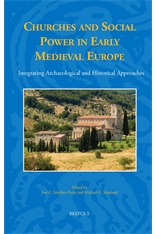
Table des matières :
Acknowledgements
José Carlos Sanchez-Pardo and Michael Shapland – Introduction: Churches and Social Power in Early Medieval Europe
Part I: Churches as Channels for Power Relations
Juan Antonio Quiros and Igor Santos – Founding and Owning Churches in Early Medieval Álava (North Spain): The Creation, Transmission, and Monumentalization of Memory
Alexandria Chavarria – Local Churches and Lordship in Late Antique and Early Medieval Northern Italy
Tomas O’Carragain – Local Churches and Social Power in Early Medieval Ireland: A Case Study of the Kingdom of Fir Maige
Roberto Farinelli – Churches and Social Elites in Early Medieval Tuscany: a Quantitative-Statistical Approach to the Episcopal Archive of Lucca
Part II: Churches and the Transition of Power
Aleksandra McClain – Patronage in Transition: Lordship, Churches, and Funerary Monuments in Anglo-Norman England
José Carlos Sanchez-Pardo – Power Strategies in the Early Medieval Churches of Galicia (711–910 ad)
Christofer Zwanzig – Heidenheim and Samos: Monastic Remembrance of the ‘Anglo-Saxon Mission’ in Southern Germany and the ‘Mozarabic Resettlement’ of Northern Spain Compared
David Petts – Churches and Lordship in Western Normandy, 800–1200 ad
Part III: Churches in Landscapes of Power
Anne Nissen-Jaubert – Early Medieval Religion and Social Power: a Comparative Study of Rural Elites and Church Building in Northern France and Southern Scandinavia
Duncan W. Wright – The Church and the Land: Settlement, Economy and Social Power in Early Medieval England
Luis Fontes – Powers, Territories, and Architecture in Northwest Portugal: an Approach to the Christian Landscapes of Braga Between the Fifth and Eleventh Centuries
Christine Delaplace – Local Churches, Settlements, and Social Power in Late Antique and Early Medieval Gaul: New Avenues in the Light of Recent Archaeological Research in South-East France
Part IV: Churches as Centres of Power
Gian pietro Brogiolo – Architecture and Power at the End of the Lombard Kingdom
Andreas Schaub and Tanja Kohlberger – On the Origins of the Great Carolingian Place of Power: Recent Excavations at Aachen Cathedral
Michael Shapland – Royal Churches and the Practice of Anglo-Saxon Kingship
Gudrun Sveinbjarnardottir – The Development of the Church in Iceland in the Eleventh and Twelfth Centuries, with reference to the Reykholt Church
Index of people, places, and subjects
Informations pratiques :
J. Sánchez-Pardo et M. Shapland (éd.), Churches and Social Power in Early Medieval Europe. Integrating Archaeological and Historical Approaches, Turnhout, Brepols, 2015 (Studies in the Early Middle Ages, 42).
Source : Brepols






 L'Agenda des Médiévistes
Vous devez être connecté pour poster un commentaire.