
Cambridge, MA
Barker Center, Room 113
29.04.2016 – 30.04.2016.
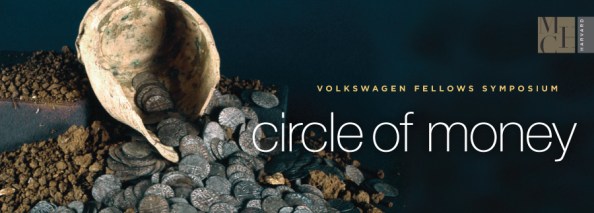
Money is at once elusive and concrete. As a mode of economic exchange, it exists within a relatively fixed playing field, with clearly delineated boundaries of benefits and costs. However, poor handling, bad advice, or even a bad turn at a game of chance can swallow money up in one fell swoop. Indeed, that money was a profoundly human endeavor was formulated in the mid-15th century, when Florentine Leon Battista Alberti claimed in his work on family (I libri della famiglia) that money, if well managed, was practically contingency proof; however, nothing was less stable, harder to hold onto, or easier to lose than the almighty coin. Alberti’s words, intended to serve as a guiding principle for household management, give us a glimpse into the variety of ways that Europeans theorized their own economic actions, and thought about money and its use. The workshop will investigate this wide array of pre-capitalist, western and non-western contexts from the English Isles, Flanders, France, Germany, Italy, and China between the Middle Ages and Early Modern times. Centrally, we will explore the social relationships that constituted the value of money and its role in economic practice. Key themes will include the relationship between money and other forms of capital, different ways of interaction, and the role of money in stabilizing or disturbing socio-economic forms of transformation.
See more at: http://mahindrahumanities.fas.harvard.edu/content/circle-money#sthash.SvT3yhXe.dpuf
Programme :
Friday, April 29
2:30 pm | Nils Bock (University of Münster and Harvard University) – Welcome / Introduction
3:00 pm | Panel One: Everyday Economies: The Role of Individual Actors in Making Premodern Money (Part 1)
Panelists
Martha Howell (Columbia University) – Credit Networks in a Late Medieval Commercial Giant: The Case of Ypres
Christopher Loveluck (University of Nottingham and Harvard University) – Of Ports, Peasants, and Money: The Archaeology of Specialist and Mercantile Agency in the Economic Development of Western Europe, c. AD 650-1150
Moderator :
Maryanne Kowaleski
Fordham University and the Radcliffe Institute
4:30 pm | Coffee Break
5:00 pm | Panel One: Everyday Economies: The Role of Individual Actors in Making Premodern Money (Part 2)
Panelist
Thomas Max Safley (University of Pennsylvania) – Of Private, Public Agents: Modern Categories, Premodern Economies, and Enduring Anachronisms
Moderator
Maryanne Kowaleski
5:45 pm | Panel Two: State Economies: The Role of Public Actors in Making Premodern Money (Part 1)
Panelist
Nils Bock – Templars and Lombards as Public Actors in Medieval France (12th to 14th Century): A Contribution to the History of Money and Capital
Moderator
Maryanne Kowaleski
Saturday, April 30
9:00 am | Panel Two: State Economies: The Role of Public Actors in Making Premodern Money (Part 2)
Panelists
Ling Zhang (Boston College) – Policy Maker, Money Lender, and Product Consumer: The Northern Song State During China’s « Medieval Economic Revolution »
Bruce Rusk (University of British Columbia) – Commodious or Commodity? Unminted Silver Money in Ming China (1368-1644)
10:30 am | Coffee Break
11:00 am | Panel Three: Market Economies: The Role of Commercial and Financial Actors in Making Premodern Money
Panelists
Jessica Goldberg (University of California, Los Angeles) – Notes for the History of Money and Credit in the Medieval Mediterranean: The Case of the Geniza Merchants
William Caferro (Vanderbilt University) – Anomaly and Florentine Wages at the Time of the Black Death
12:30 pm | Lunch Break
2:00 pm | Closing Remarks and Final Discussion
Martin Kintzinger (University of Münster) – A Return of Economic History? New Approaches to the History of Late Medieval Europe
See more at: http://mahindrahumanities.fas.harvard.edu/content/circle-money#sthash.SvT3yhXe.dpuf



 L'Agenda des Médiévistes
Vous devez être connecté pour poster un commentaire.