
Draws on Hungarian sources of the mendicant spiritual confraternity movement in order to explore the movement’s broader significance in late medieval piety in Central Europe and beyond.
By the late Middle Ages, mendicant spiritual confraternities had developed a poor reputation. Their spiritual status was ill-identified: somewhere between requests for intercession, necrological commemoration, and pious associations. ‘In the hands of the mendicants, they seemed to resemble what indulgences had supposedly become in the hands of the papacy: bait that was handed out to extort funds from the faithful while offering an apparently immediate access to Paradise. Thus, like indulgences, they seem to have been gradually emptied of their substance and denounced (even before Luther) as glaring evidence of the corruption of the Roman Church. Much recent scholarship has followed this negative portrait of spiritual confraternities — unless it has conflated them with other non-spiritual confraternities, or indeed ignored them altogether.
This volume draws on the abundant number of letters of confraternity available from Hungarian sources in order to provide a more nuanced picture of mendicant spiritual confraternities. It sheds new light on the links between the mendicants and their supports among the laity, and emphasises the broader significance of the confraternity movement in late medieval piety in Central Europe and beyond.
Marie-Madeleine de Cevins is professor of medieval history at University of Rennes, and is director of the Tempora research unit. She has published several books about Christianity in Central Europe (especially in Hungary) in the late Middle Ages.
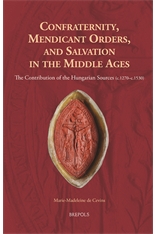
Table des matières :
Acknowledgements
Introduction
Chapter 1. Spiritual Confraternities of the Mendicant Orders – In a Blind Spot of Research
An Elusive Object of Study
The Link Between Confraternitas and the Monks
Do Mendicant Spiritual Confraternities Exist?
Established Historical Givens
Unresolved Questions
Central European Trajectories
Chapter 2. The Hungarian Documentary Corpus
Sources on The Spiritual Confraternities of the Mendicant Orders in the Middle Ages
The Documentation Pertaining to Hungary: Overview
‘Hungarian’ Letters of Confraternity
Chapter 3. The Success of Mendicant Spiritual Confraternities in Hungary until about 1530
The Hungarian Religious Context
The Infatuation with Mendicant Spiritual Confraternities
Sociography of the Affiliates
Chapter 4. The Process of Spiritual Affiliation to the Mendicants
A Nebula of Graces
The Letter in Spiritual Affiliation
From Individual to Confraternitas
Chapter 5. Mendicant Uses of Spiritual Confraternity
The Involvement of the Mendicants in the Development of Spiritual Confraternities
The Interest of Spiritual Association for the Friars
The Franciscans and Spiritual Confraternity
The Other Mendicants
Chapter 6. Confraternity and Salvation: The Affiliates’ View
The Value of Spiritual Confraternity on the Salvation Market
Why Affiliate Oneself with The Mendicants?
Three Itineraries of Spiritual Associates
Conclusion
Bibliography
Tables, Maps, Graphs
Appendix: Sixteen Letters of Confraternity
Figures (Letters Of Confraternity, Seals)
Index of Proper Names
Informations pratiques :
Marie-Madeleine de Cevins, Confraternity, Mendicant Orders, and Salvation in the Middle Ages. The Contribution of the Hungarian Sources (c.1270-c.1530), Turnhout, Brepols, 2018 (Europa Sacra, 23). XVII+365 p., 22 b/w ill. + 2 Maps, 14 Graphs, 2 b/w tables, 156 x 234 mm. ISBN: 978-2-503-57871-2. Prix : 100 euros.
Source : Brepols





 L'Agenda des Médiévistes
Vous devez être connecté pour poster un commentaire.