
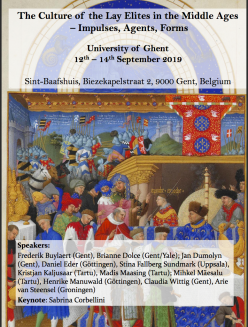
Laity, in the Middle Ages, tends to be seen as ‘the other’. When we encounter the term in our sources it often draws attention to what someone is not: ordained, Latinate, educated. However, no one would suggest that only clerics shaped medieval culture and partook in its expressions. This workshop will explore ‘the other culture’ and ask about the agents, forms and impulses that it incorporated.
Papers address the culture(s) of the lay elites from the 12th century until the end of the medieval period, covering political culture, devotional practice, and literary culture.
The workshop will bring scholars from different medieval disciplines into dialogue with one another and create a space for exchange and a test ground for new approaches.
The keynote lecture on Friday evening will be held by Sabrina Corbellini (Groningen) on « Crossing the Lay-Religious Divide: Spatial Approaches to Religious Literacies in Late Medieval Europe ». The whole event is funded by the U4-Network of the universities of Ghent, Goettingen, Groningen, Tartu, and Uppsala, and both the workshop and the keynote lecture are open to everyone. There will also be guided tours of Saint Pieters-Abbey and the Gravensteen – places for these are limited, so please register early if you want to join.
Funded by the U4-Network
Programme :
Thursday, 12/09/2019
11:00 – 12:30 Visit Saint Peter‘s Abbey
I Political Culture
14:00 – 14:30 Registration, Introduction
14:30 – 15:00 : Frederik Buylaert (Ghent), Framing Lay Lordship in Late Medieval Flanders, England, and France
15:00 – 16:00 : Arie van Steensel (Groningen), Crossing boundaries: clerical and lay nobles in late medieval Zeeland
16:00 – 16:30 Discussion
16:30 – 17:00 Coffee
17:00 – 17:30 : Kristjan Kaljusaar (Tartu), Ecclesiastical princes and lay vassals on a Catholic frontier – feudal strategies of Livonian bishops in the thirteenth century
17:30 – 17:45 Discussion
19:00 Dinner
Friday, 13/09/2019
9:30 – 10:00 : Mihkel Mäesalu (Tartu), The inclusion of the lay elite in elections and resignations of the Bishop of Tartu in the middle of the 15th Century
10:00 – 10:30 : Madis Maasing (Tartu), Osilian nobility at the end of Medieval Times – a lay elite group trying to dominate over clerical administration?
10:30 – 11:00 Discussion
11:00 – 11:30 Coffee
II Devotional Practice
11:30 – 12:00 : Henrike Manuwald (Göttingen), vita mixta as a model for lay elites? The German versions of De contemplatione et vita activa by Henricus de Bitterfeld
12:00 – 12:30 : Stina Fallberg Sundmark (Uppsala), Lay Elites’ Personal Belongings as Instruments of Devotion in the Late Middle Ages
12:30 – 13:00 Discussion
13:00 – 14:00 Lunch
14:00 – 15:30 Visit Gravensteen
III Literary Culture
15:30 – 16:00 : Daniel Eder (Göttingen), Forming a new kind of army. Concepts of ‘lay culture’ in medieval legends of Saint Ursula and her eleven thousand virgins
16:00 – 16:30 : Claudia Wittig (Ghent), Lay Elites as Readers and Owners of Educational Manuscripts in France and the Empire in the 13th Century
16:30 – 17:00 Discussion
17:00 – 18:00 : Keynote: Sabrina Corbellini (Groningen), Crossing the Lay-Religious Divide: Spatial Approaches to Religious Literacies in Late Medieval Europe
18:00 – 19:00 Wine Reception
19:30 Dinner
Saturday, 14/09/2019
9:30 – 10:00 : Jan Dumolyn (Ghent), Culture and Literacy of Craft Guilds in Late Medieval Flanders
10:00 – 10:30 : Brianne Dolce (Ghent/Yale), Ways of Being: Differentiating the Laity in the Confraternity of Jongleurs and Bourgeois of Arras
10:30 – 11:00 Discussion
11:00 – 11:30 Coffee
11:30 – 12:15 : Round Table: Lay Culture: Models, Intersections, Innovations
12:15 – 12:30 Wrap-up
Informations pratiques :
12-14 September 2019
Sint Baafshuis, Biezekapelstraat 2, 9000 Gent, Belgium
Dr. Claudia Wittig, Department of History, University of Ghent
Sint-Pietersnieuwstraat 33-35 Room 120.019 9000 Gent
+32 9 3310224
Claudia.Wittig@UGent.be
Source : U4-Network




 L'Agenda des Médiévistes
Vous devez être connecté pour poster un commentaire.