
Polyphony and the Modern asks one fundamental question: what does it mean to be modern in one’s own time? To answer that question, this volume focuses on polyphony as an index of modernity.
In The Principle of Hope, Ernst Bloch showed that each moment in time is potentially fractured: people living in the same country can effectively live in different centuries – some making their alliances with the past and others betting on the future – but all of them, at least technically, enclosed in the temporal moment. But can a claim of modernity also mean something more ambitious? Can an artist, by accident or design, escape the limits of his or her own time, and somehow precociously embody the outlook of a subsequent age?
This booksees polyphony as a bridge providing a terminology and a stylistic practice by which the period barrier between Medieval and Early Modern can be breached.
Jonathan Fruoco is a Reseearch Fellow affiliated to the CEMA, Sorbonne University. His research focuses on the linguistic and cultural evolution of medieval England, with a particular interest in the work of Geoffrey Chaucer and its connection with French and Italian courtly poetry. He has recently published Les faits et gestes de Robin des Bois (2017) and Chaucer’s Polyphony: The Modern in Medieval Poetry (2020).
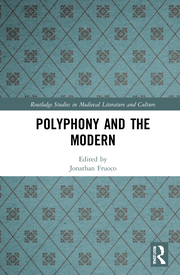
Table des matières :
Introduction: Towards Modernity – Jonathan Fruoco
Part One: Machaut and Musical Polyphony
Chapter I. The Polyphony of Function: Mixing Text and Music in Guillaume de Machaut – Uri Smilansky
Chapter II. The Multilevel Polyphony of Machaut’s Livre dou Voir Dit and its Afterlife – Rosemarie McGerr
Part Two: Polyphony in Medieval Europe
Chapter III. Cemeteries and Tombstones as Polyphonic Places in the French Medieval Quest of Lancelot – Laurence Doucet
Chapter IV. Polyphonic Effects in the Fixed-Form Verse of Eustache Deschamps: A Critical Practice – Laura Kendrick
Chapter V. ‘Galeotto fu il libro e chi lo scrisse’: Liminal Polyvocality in the Occitan Literary Use of Dante – Paola M. Rodriguez
Chapter VI. Novelistic Perspectivism in Béroul’s Roman de Tristan – Teodoro Patera
Chapter VII. Textual Voices in Compilation: Reading the Polyphony of Medieval Manuscripts – Amy Heneveld
Chapter VIII. Wolfram and the Ambiguity of the Religious Question in the Willehalm – Patrick del Duca
Part Three: From Medieval England to the Early Modern
Chapter IX. Chaucer’s Speech and Thought Representation in Troilus and Criseyde: Encoded Subjectivities and Semantic Extension – Yoshiyuki Nakao
Chapter X Chaucer and the Streams of Parnassus – Paul Strohm
Chapter XI. « ´Tis more ancient than Chaucer Himself »: Keats and Romantic Polyphony – Caroline Bertonèche
Part Four: Towards Modernity
Chapter XII. Evelina’s « Pollyphony » – Anne Rouhette
Chapter XIII. The Whirl of the Red, Green, and Blue: Christopher Anstey and the Particoloured Poem – Peter Merchant
Chapter XIV. Towards Modernity. Nova et vetera in Paul Claudel’s Book of Christopher Colombus – Jean-François Poisson-Gueffier
Informations pratiques :
Polyphony and the Modern, dir. Jonathan Fruoco, Abingdon-on-Thames, Routledge, 2021 (Routledge Studies in Medieval Literature and Culture). 272 Pages, 5 B/W Illustrations. ISBN : 9780367655150. Prix : GBP : 130.
Source : Routledge






 L'Agenda des Médiévistes
Vous devez être connecté pour poster un commentaire.