
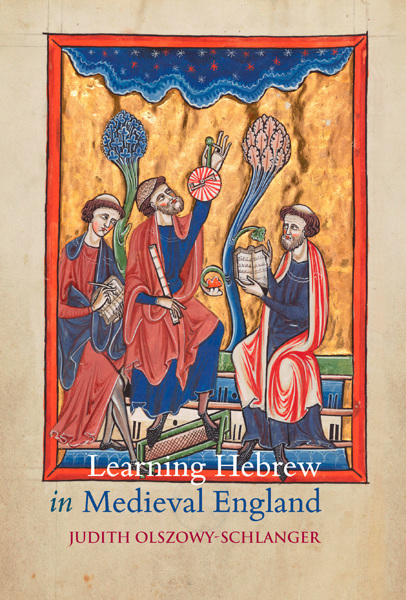
For inquisitive Christian minds in the Middle Ages, there were many reasons to learn Hebrew. The rediscovery of classical sources and Aristotelian philosophy and the engagement with Graeco-Arabic sciences that marked the renaissance of the twelfth century also brought about an acute awareness of the need for a philological understanding of the Hebrew language. In England in particular, various factors combined to encourage and facilitate the study of Hebrew texts, not only among well-known writers but also among English scholars whose names have not been preserved. They nevertheless produced bilingual Hebrew-Latin manuscripts in collaboration with Jewish scribes, along with manuals, textbooks, and reference aids to facilitate access to the sources. This volume presents an edition and analysis of one such learning tool: a thirteenth-century grammar written in Hebrew, Latin, and Anglo-Norman French (the vernacular language of the Jews of England) in a complex combination of Hebrew and Latin alphabets.
Judith Olszowy-Schlanger is President of the Oxford Centre for Hebrew and Jewish Studies and a Fellow of Corpus Christi College and Professor of Hebrew Palaeography at the École Pratique des Hautes Études, Paris-Sciences-Lettres. She is the author of numerous publications, including Les manuscrits hébreux dans l’Angleterre médiévale: étude historique et paléographique (2003) and Hebrew and Hebrew-Latin Documents from Medieval England, in two volumes (2015). With Anne Grondeux et al., she is the editor of Dictionnaire hébreu-latin-français de la Bible hébraïque de l’abbaye de Ramsey (XIIIe s.) (2008); she has also co-edited several collections, among them Books within Books: New Discoveries in Old Book Bindings (2013), with Andreas Lehnardt, and A Universal Art: Hebrew Grammar across Disciplines and Faiths (2014), with Nadia Vidro and Irene E. Zwiep.
Table des matières :
Abbreviations
Tables
Preface
Facsimile of the Longleat House Grammar
Introduction
Chapter 1
The Manuscript: Its Structure, Texts and Scribes
The Codicological, Textual and Palaeographical Units of LH MS 21
The Codicological and Textual Composition of the Longleat House Grammar
The Scribes of LH MS 21
Palaeographical Remarks
Page and Text Layout
Chapter 2
The Longleat House Grammar and Hebrew Scholarship at Ramsey Abbey
The Longleat House Grammar Among the Bilingual Hebrew-Latin Manuscripts
The Longleat House Grammar and Ramsey Abbey
Chapter 3
The Longleat House Grammar and Different Linguistic Approaches to Hebrew in Medieval England
Through the Latin Lens
Christian Hebrew Grammar and Jewish Linguistic Traditions
Chapter 4
The Edition of the Longleat House Grammar
Grammar Textual Unit 1: The Hebrew Grammar in Latin Characters
Grammar Textual Unit 2: The Essay on Hebrew Vowels and Accents
Grammar Textual Unit 3: The Hebrew Grammar in Hebrew Characters
Grammar Textual Unit 4: The Hebrew Verb Paradigms in Latin Characters
Chapter 5
Contents and Sources of the Longleat House Grammar
Grammar Textual Unit 1: The Hebrew Grammar in Latin Characters
Grammar Textual Unit 2: The Essay on Hebrew Vowels and Accents
Grammar Textual Unit 3: The Hebrew Grammar in Hebrew Characters
Grammar Textual Unit 4: The Hebrew Verb Paradigms in Latin Characters
Conclusions
Bibliography
Index of Quotations
Index of Manuscripts
General Index
Informations pratiques :
Judith Olszowy-Schlanger, Learning Hebrew in Medieval England: Christian Scholars and the Longleat House Grammar, Turnhout, Brepols, 2023 ; 1 vol., 204 p. (Studies and Texts, 230). ISBN : 978-0-88844-230-7. Prix : € 98,00.
Source : Brepols





 L'Agenda des Médiévistes
Vous devez être connecté pour poster un commentaire.