
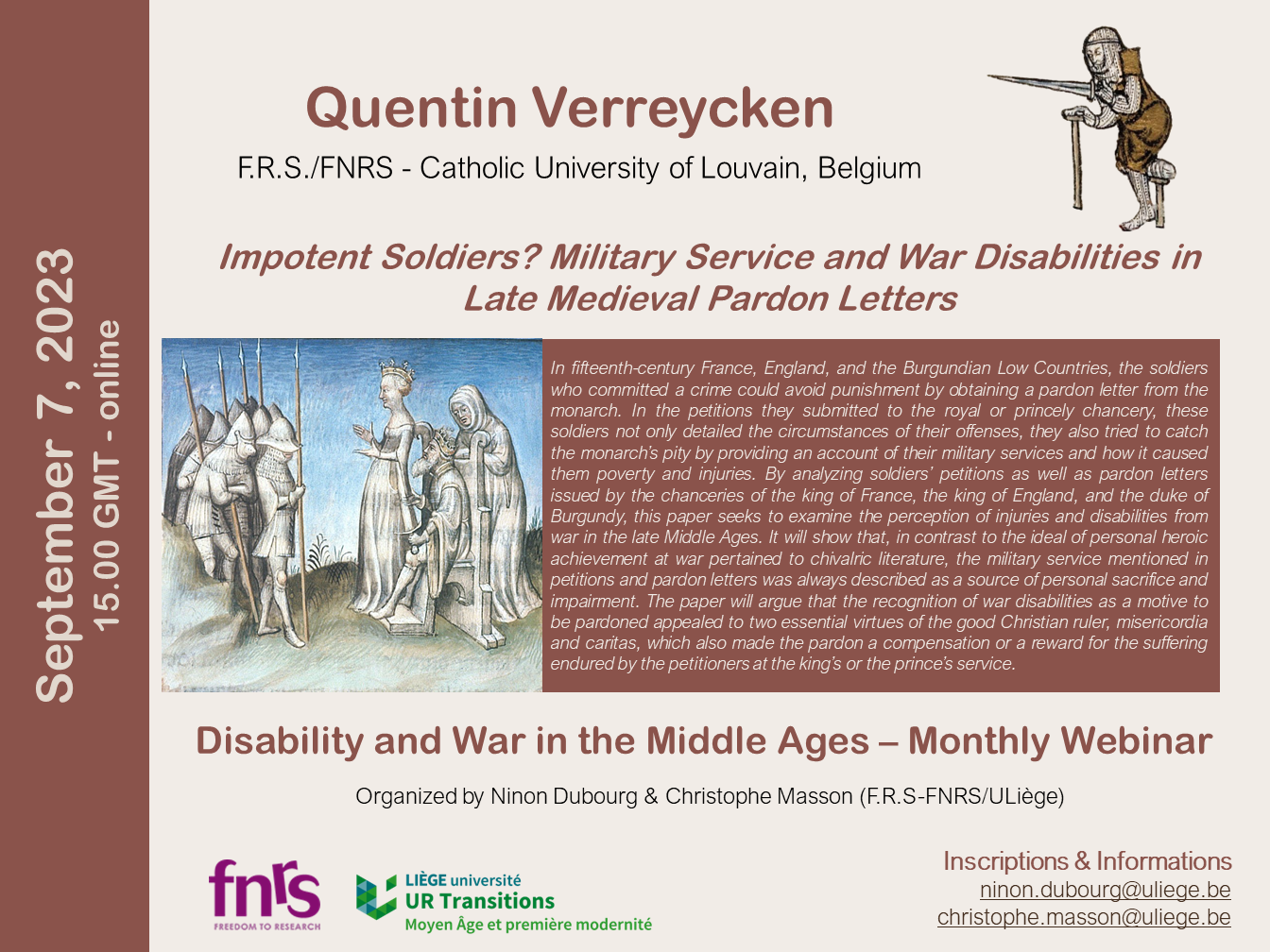
In fifteenth-century France, England, and the Burgundian Low Countries, the soldiers who committed a crime could avoid punishment by obtaining a pardon letter from the monarch. In the petitions they submitted to the royal or princely chancery, these soldiers not only detailed the circumstances of their offenses, they also tried to catch the monarch’s pity by providing an account of their military services and how it caused them poverty and injuries. By analyzing soldiers’ petitions as well as pardon letters issued by the chanceries of the king of France, the king of England, and the duke of Burgundy, this paper seeks to examine the perception of injuries and disabilities from war in the late Middle Ages. It will show that, in contrast to the ideal of personal heroic achievement at war pertained to chivalric literature, the military service mentioned in petitions and pardon letters was always described as a source of personal sacrifice and impairment. The paper will argue that the recognition of war disabilities as a motive to be pardoned appealed to two essential virtues of the good Christian ruler, misericordia and caritas, which also made the pardon a compensation or a reward for the suffering endured by the petitioners at the king’s or the prince’s service.
Informations pratiques :
Disability and Warfare in the Middle Ages – Monthly Webinar
September 7, 2023 15.00 GMT – online
Organized by Ninon Dubourg & Christophe Masson (F.R.S-FNRS/ULiège)
Inscriptions & Informations
ninon.dubourg@uliege.be
christophe.masson@uliege.be






 L'Agenda des Médiévistes
Vous devez être connecté pour poster un commentaire.