
Marsilius of Padua (c. 1275–c. 1342) was one of the most influential and controversial political thinkers of the Middle Ages. He is best known for his seminal text Defensor Pacis (1324) in which he attacks the papal theory of plenitude of power and defends an idea of political community based on the strict separation of political and religious authority. Marsilius’ work lies at the crossroads of different disciplines, ranging from political philosophy to civil and canon law, to medicine. Indeed, he presents an original synthesis of several contemporary themes and traditions such as Aristotelianism, Augustinianism, the debate on Franciscan property, the communal tradition of the Italian city-states, ecclesiology, medicine, and astrology.
This edited volume analyses the life and thought of Marsilius of Padua in his own context and beyond. Gathering many of the leading experts in Marsilian studies across different national and linguistic traditions working today, this volume has two main goals. First, it aims to bring together experts who come from distinct fields in order to investigate the many branches of knowledge present in Defensor Pacis without losing sight of Marsilius as a comprehensive theorist. Second, the volume aims to shed new light on one of the most neglected aspects in Marsilian studies: the Marsilian influence, i.e., his impact in the early modern period during the Renaissance, the Reformation and the Counter-Reformation, up to twentieth century.
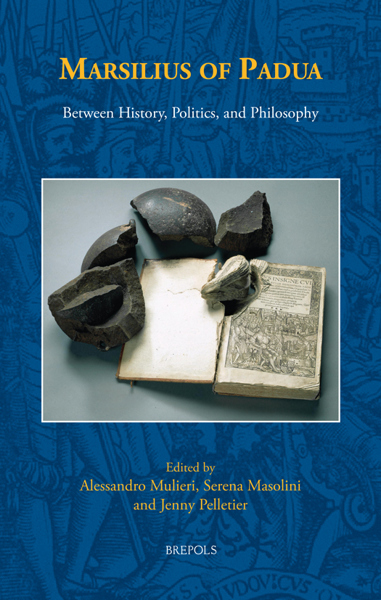
Table des matières :
Preface
Introduction — ALESSANDRO MULIERI
Part 1. Marsilius’s Sources
Marsilius of Padua: A Reader of Aristotle’s Politica — ROBERTO LAMBERTINI
‘What More do you want?’ The Use of the Roman Trial of Jesus by Augustine and Marsilius of Padua — GERT-JAN VAN DE VOORDE
The Early Politics Commentaries as the Missing Link between Marsilius and Aristotle — MARCO TOSTE
Marsilius of Padua on Human Acts, Law, and the (Strengthless) Law of Christ — IACOPO COSTA
Marsilius of Padua and Collective Prudence — ALESSANDRO MULIERI
Part 2. Marsilisus’s Thought and his Contemporaries
The Social and Political Functions of Emotions in Marsilius of Padua’s Defensor pacis (and Defensor minor) — JUHANA TOIVANEN
The Good Life and the Perfect Life in the Defensor pacis — FERDINAND DEANINI
Ghibelline Marsilius. Remarks on Marsilius of Padua’s Ghibelline Politico-Institutional Theory — GIANLUCA BRIGUGLIA
Defenders of the Peace: The Political Thought of Marsilius’s Italian Dominican Contemporaries — CHARLES BRIGGS
How History Happens: Contingency and Finality in the Political Philosophy of Marsilius of Padua, John Quidort of Paris, and Dante Alighieri — JACOB LANGELOH
‘The Great Refusal’: Pilate and Jesus in the Political Theologies of Dante, Valla, and Marsilius — DAVID LLOYD DUSENBURY
Part 3. The Marsilian Moment
Between Venice and Sant’Elmo: Tommaso Campanella, Marsilius of Padua, and a ‘Modern Theologian’ — SERENA MASOLINI
Papacy, Peace, and Political Science: Collective Action Problems in Marsilius of Padua — CARY J. NEDERMAN
The Defender of the Peace during the Third Reich — FRANK GODHARDT
Marsilius of Padua in The Name of the Rose. Between Historical Fiction and post-1968 Ideology — GREGORIO PIAIA
General Index
Informations pratiques :
Marsilius of Padua Between History, Politics, and Philosophy, éd. Alessandro Mulieri, Serena Masolini, Jenny Pelletier, Turnhout, Brepols, 2023 ; 1 vol., 440 p. (Disputatio, 36). ISBN : 978-2-503-60133-5. Prix : € 115,00.
Source : Brepols






 L'Agenda des Médiévistes
Vous devez être connecté pour poster un commentaire.