
Accès : ici
What is Mmmonk School?
free webinars on the medieval book
focus on manuscripts in Flanders
introductions to various perspectives and disciplines by experts
stimulating a holistic approach of medieval books
co-production with Henri Pirenne Institute for Medieval Studies (Ghent University)
open to everyone!
Mmmonk School 2023
The second edition of Mmmonk School took place in November and December 2023, with sessions by Elaine Treharne (Stanford University), Ann Kelders (KBR Royal Library Belgium), Élodie Lévêque (Université Paris 1 Panthéon-Sorbonne), Thomas Falmagne (Goethe-Universität Frankfurt am Main), Evelien Hauwaerts (Bruges Public Library), and Jeroen Deploige and Wim Verbaal (Ghent University). Find out more about the programme and the speakers here.
Podcasts disponibles :
Mmmonk School 2023 – The human experience as an integral part of the history and identity of a book
This session takes as its starting point an understanding that a medieval book is a whole object at every point of its long history. As such, medieval books can be studied most profitably in a holistic manner as objects-in-the-world. This means readers might profitably account for all aspects of the manuscript in their observations, from the main texts that dominate the codex to the marginal notes, glosses, names, and interventions made through time. This holistic approach allows us to tell the story of the book’s life from the moment of its production to its use, collection, breaking-up, and digitization–all aspects of what can be termed ‘dynamic architextuality’. By Prof. Elaine Treharne (Stanford University).
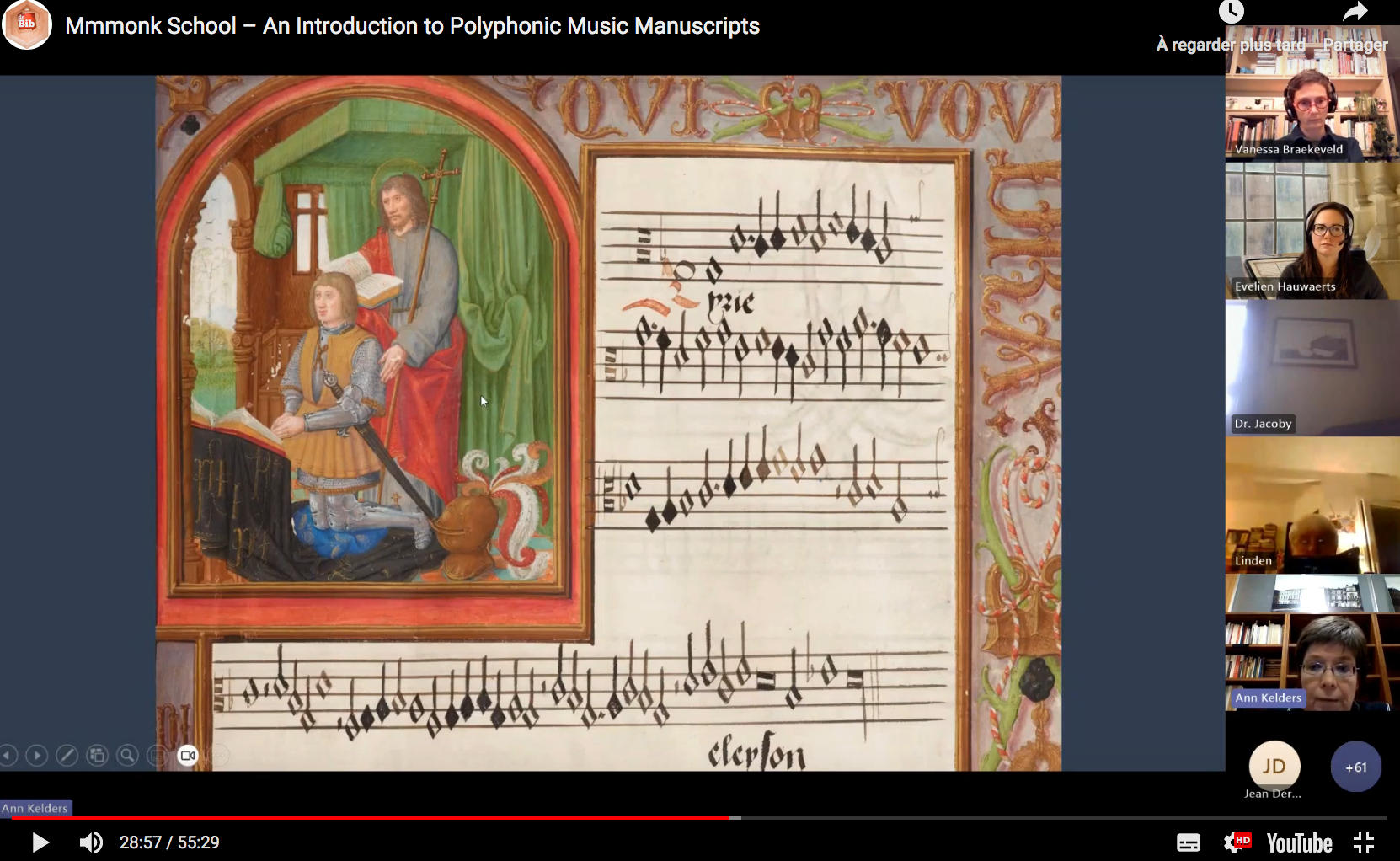
Mmmonk School 2023 – An Introduction to Manuscripts of Polyphonic Music in the Low Countries
At the transition from the Middle Ages to the Renaissance, the Low Countries set the tone on the European musical stage. With their polyphonic music, numerous Franco-Flemish composers built an international career. Even at the time they were created, the manuscripts in which their work is handed down, could be found in churches, chapels, as well as in the libraries of popes, princes, and citizens. The music copyist and entrepreneur Petrus Imhoff, who worked under the pseudonym Alamire, played an important role in the transmission of this musical heritage. The manuscripts produced under his direction and other sources of polyphony from the fifteenth and sixteenth centuries are the subject of this episode of the Mmmonk School. By Dr. Ann Kelders (KBR Royal Library Belgium).
Mmmonk School 2023 – An Introduction to Biocodicology
Biocodicology is the study of the biological information stored in manuscripts. Western Medieval manuscripts were, for the most part, written on parchment, a writing support whose origins are believed to be in Pergamon. Over the centuries parchment has been the foundation for a multitude of media from illuminated Gospels to the archival documents used in everyday life. Manuscripts can not only offer valuable information through their texts, but can also reveal information – that in many cases is invisible to the naked eye – about book production, livestock economies, handling, conservation and the historic use of the object by studying the materials they are made of. This talk presents three recent research projects that were carried out as part of the Beast to Craft ERC funded project, using proteomic and dna analysis. By Dr. Élodie Lévêque (Université Paris 1 Panthéon-Sorbonne).
Mmmonk School 2023 – An Introduction to Medieval Cistercian Reading Culture
Written culture and the practices that embody it in literary, historical, diplomatic, and scientific productions reflect the creative activity of an entire era. Authors and texts are inseparable from books and reading, and from the institutions that foster and disseminate culture. The Cistercian abbeys played a significant role in the ‘documentary revolution’ of the central Middle Ages, concurrently with the swift construction of several of their libraries between the second half of the 12th century and the end of the 13th century. The course explores the following questions related to Cistercian written culture: What are the sources of written culture, and where are they kept? What are the distinctive characteristics of monastic culture, and of Cistercian culture in particular? What are the aims and forms of the Cistercian book? Is there still something unique about Cistercian written culture after the 13th century? By Dr. Thomas Falmagne (Goethe-Universität Frankfurt am Main).
Mmmonk School 2023 – Practical Workshop on Digital Images in IIIF
IIIF stands for International Image Interoperability Framework. It is a digital innovation for more efficient and sustainable management, sharing, and use of digital images. A brief explanation of IIIF can be found here. It is applied by a growing number of institutions worldwide, for instance Bibliothèque nationale de France, Vatican Library, British Library, Getty Museum, university libraries (e.g. Ghent, Leiden…) and public libraries (e.g. Bruges). This workshop covers some easy tricks to unlock the potential of IIIF for end-users. For instance, you’ll learn how to share a detail on an image by means of a simple URL (e.g. take a look at this miniature of Galen and Hippocrates in a 13th-century manuscript!). No IT knowledge required. Suitable for anyone working with digital images of books, paintings, prints, etc. By Dr. Evelien Hauwaerts (Bruges Public Library).
Mmmonk School 2023 – Medieval Reading Strategies – The Liber Floridus as a circular enclosure of creation, history and incarnation
In the most recent issue of the journal Sacris Erudiri (DOI 10.1484/J.SE.5.133569), Jeroen Deploige and Wim Verbaal propose a new understanding of the composition Lambert of Saint-Omer’s famous Liber floridus (completed c. 1121). Their contribution focuses on the significance of the idealized city. To this end, they move from the historical and material reality of Saint-Omer, one of the most dynamic centres of urban development in early twelfth-century Flanders, to the autograph manuscript of the Liber (MS Ghent, University Library, 92). In doing so, they ask to what extent both the city as a general concept, and more specifically the town of Saint-Omer, are present in Lambert’s work of compilation. They argue that the key to answering this question lies in the Liber’s specific structure, more so than in its actual content. This insight requires them to read and approach the codex no longer solely as a linear composition, marked by an associative sequence of topics, chapters and illuminations dealing with salvation history and creation. Lambert’s work emerges as a markedly circular composition, consisting of different concentric layers and constructed around a specific central text. By Prof. Jeroen Deploige and Prof. Wim Verbaal (Ghent University).
Source : Mmmonk




 L'Agenda des Médiévistes
Vous devez être connecté pour poster un commentaire.