
Archives of the German Maritime Museum, Bremerhaven, Am Eichkamp 13, 27572 Bremerhaven
15.02.2024 – 16.02.2024
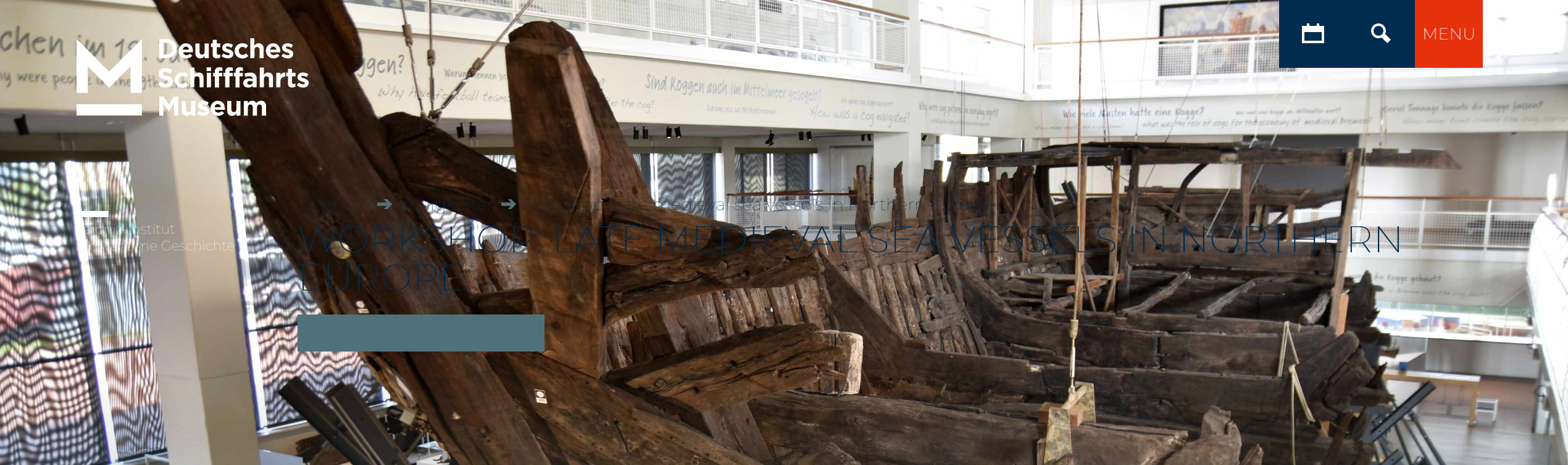
In 1962, one of the best-preserved examples of a late-medieval ship was discovered in Bremen. Its conservation and presentation has taken place at the German Maritime Museum (https://www.dsm.museum/en/museum/exhibits/bremen-cog). The so-called Bremen-Cog can be understood as both a repository of knowledge for various disciplines, such as materials science, and as a medium that processes a view of contemporary trade networks, forms of seafaring, ship/boatbuilding, shipyards, and the like.
With this international workshop as a starting event, the German Maritime Museum seeks to bring together scholars from an interdisciplinary range of research fields and topics for an up-date on the current state of research on such finds of our maritime cultural heritage. And it especially invites participants from institutions that would possibly be interested in collaborating in the development of a Digital Knowledge Platform on the above mentioned topics.
Programme :
15 February
Archives of the German Maritime Museum
9:00–9:30 Arrival
9:30–9:45 Welcome and introduction
Ruth Schilling/
Sebastian Vehlken (German Maritime Museum, Bremerhaven)
9:45–10:15 The concept of ship type deployed for pre-industrial times – an issue for archaeology
Marko Richter (German Association for Shipping- and Maritime History, Section Berlin-Brandenburg)
10:15–10:45 Seafaring vs Ocean Going:
an analysis of the performance and capabilities of medieval vessels
Pat Tanner (Swansea University)
10:45–11:15 Coffee break
11:15–11:45 Medieval shipfinds in Estonia
Priit Lätti (Estonian Maritime Museum, Tallinn)
11:45–12:15 The Svælget 2 Wreck, a cog-like vessel off Copenhagen
Otto Uldum (The Viking Ship Museum, Roskilde)
12:15–12:45 The Eyðanstovuskipið Wreck
Philipp Grassel (German Maritime Museum, Bremerhaven)/
Kevin Martin (University of Iceland)
12:45–14:00 Lunch
14:00–14:30 Northern Europe’s late medieval ships
from a dendroarchaeology perspective
Aoife Daly (Dendro.dk, Brønshøj)
14:30–15:00 Dendrochronological sampling of a shipwreck –
methods applied on Lübeck’s Hansa Ship from the mid-17th century
Felix Rösch (Department of Archaeology and Monument Preservation, City of Lübeck)/Daniel Balanzategui (DendroLab Technical University of Applied Sciences Lübeck)
15:00–15:30 The Bremen Ship‘s timbers –
a mirror of northern German forest resource management
Mike Belasus
(Lower Saxony Institute for Historical Coastal Research, Wilhelmshaven)
15:30–16:00 Coffee break
16:00–16:30 Harbors and ships in the Mediterranean and the North Sea during the Hanseatic period: written and pictorial sources
Tobias Daniels (University of Munich)
16:30–17:00 Silk Road trade and porcelain exchange: Ports, ships, and commerce from the East to Northern Europe during the late medieval period and beyond
Andi Esters (Haifa International University)
17:00–17:30 The medieval maritime transport geography of the Viken
region
Staffan von Arbin
(Department of Historical Studies, University of Gothenburg)
19:00–22:00 Conference dinner
16 February
Archives of the German Maritime Museum
9:00–9:30 An update on archaeological work in later medieval
London’s shipwright’s quarter just west of the Tower of London
Damian Goodburn (London)
9:30–10:00 The Teerhof in Bremen –
the place to built the so-called Bremen Cog?
Dieter Bischop (Bremen, Archaeology and Cultural Heritage)
10:00–10:30 Högholmen in Hiittinen –
a medieval harbor in the Finnish archipelago
Kalle Virtanen (The Finnish Heritage Agency, Helsinki)
10:30–11:00 Coffee break
11:00–11:30 What shall we do with the drunken sailor? Conspicuous con-sumption as cultural practice in ports in Southern Norway 1400–1700
Jørgen Johannessen (Norwegian Maritime Museum, Oslo)
11:30–12:30 Round table, sum-up, community building
12:30–14:00 Lunch and transfer to the German Maritime Museum, Hans-Scharoun-Platz 1, 27568 Bremerhaven
Cog-Hall of the German Maritime Museum
14:00–14:30 New analysis of material from the so-called Bremen cog:
oakum, rigging, wood
Volker Otte (Senckenberg-Museum of Natural History Görlitz)/Irina Ruf (Senckenberg-Museum Frankfurt)/Margarita Gleba (University of Padu-a)/Jana Gelbrich (Leibniz-IWT, Bremen)
14:30–15:00 The rigging of the so-called Bremen cog –
rethinking reconstructions
Damien Sanders (Dinan, France)
15:00–15:30 Condition monitoring of the so-called Bremen Cog
Heidi Hastedt (Jade University of Applied Sciences)/Silke Wiedmann (German Maritime Museum, Bremerhaven)
Source : H-Soz-Kult




 L'Agenda des Médiévistes
Vous devez être connecté pour poster un commentaire.