
Inscriptions & informations: ninon.dubourg@gmail.com and christophe.masson@uliege.be
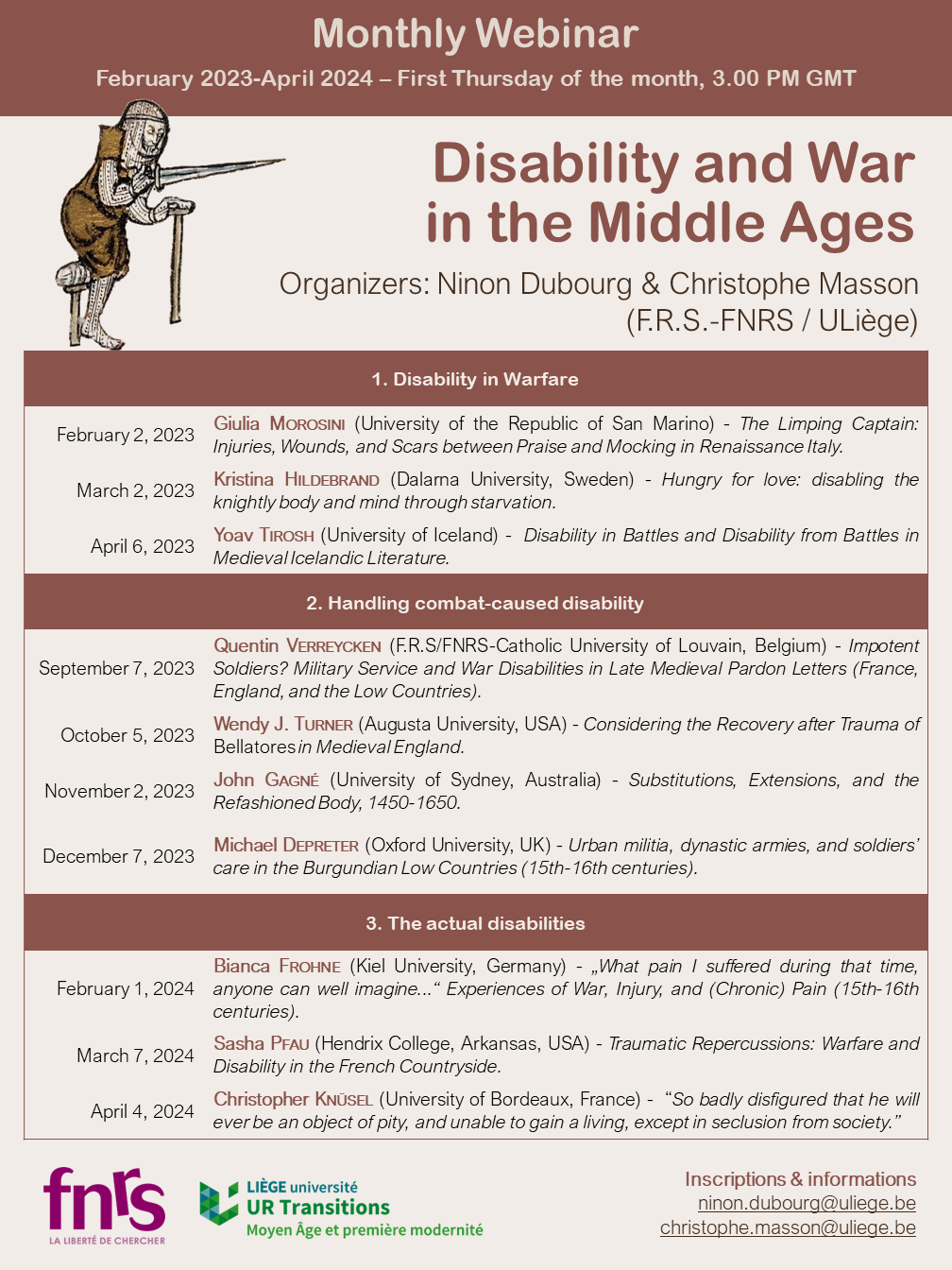
February 1, 2024 – Bianca FROHNE (Kiel University, Germany) – „What pain I suffered during that time, anyone can well imagine…“ Experiences of War, Injury, and (Chronic) Pain (15th-16th centuries).
In this paper I will discuss (chronic) pain experiences in the later Middle Ages from disability studies and crip perspectives, focusing on pain narratives in late medieval life writing and literary accounts. Descriptions of physical and/or emotional pain are hard to find in the context of war, injury, and violence, and those which can be accessed usually follow strict discursive norms. For example, knight Götz of Berlichingen, who lost his hand in battle, mentions the physical pain he suffered only briefly in his lengthy autobiography. Instead, he focuses on the emotional pain his perceived inability to fight and his imagined future as disabled knight caused him.
Based on this and other examples I am going to focus on pain narratives with emphasis on the temporalities of pain. Temporality is a valuable category of analysis in disability research. Among others, concepts such as crip time and futurity encourage us to look at experiences of disability, illness, and pain in premodern cultures from a new perspective.
March 7, 2024 – Sasha PFAU (Hendrix College, Arkansas, USA) – Traumatic Repercussions: Warfare and Disability in the French Countryside.
In four letters of remission from 1424, some residents of a town in the diocese of Bayeux explained to the English government of France how they had banded together to attack two English men in November of 1417, shortly after Henry V’s army had overtaken Caen. Their requests for pardon were written against the background of national events, where shifting loyalties on the level of the realm had repercussions in local communities. Between 1417 and 1424 the political landscape in France had transformed. Fundamental questions about the very constitution of the French realm, French identity, and the relationship between the French and the English were at stake. With an English king on the throne, actions that might in other contexts have appeared as a commendable and heroic defense of the village against enemies of the realm, were construed as the murder of loyal soldiers and subjects of the king. These conflicts over changing identities and shifting boundaries between enemy and friend were relatively common in this period. This presentation will consider the traumatic repercussions of warfare in the French countryside, focusing particularly on the way remission seekers characterized their responses in terms of mental stress, trauma, and illness.
April 4, 2024 – Christopher KNÜSEL (University of Bordeaux, France) – “So badly disfigured that he will ever be an object of pity, and unable to gain a living, except in seclusion from society.”
(Quotation from a medical description of a facially wounded soldier who had received and an early form of reconstructive surgery in Barnes, J.K. (1870). The Medical and Surgical History of the War of the Rebellion (1861-1865). Washington, D.C.: Government Printing Office, page 368.)
Conflict-related wounds leading to physical and mental impairment often entail social disability, social exclusion or reduced participation, especially for those injuries which have visible physical and behavioural manifestations. While physical impairments may more easily be ascertained from skeletal effects, mental impairment is more difficult to identify directly from the analysis of human remains, but are just as likely to lead to long-term disability that may have been recognized in the past and influenced community reactions. These can sometimes be inferred from grave contexts, their location, and funerary treatments. To identify mental impairment from head trauma requires argument from analogy with more recent cases documenting consequences of comparable injuries reported in the medical literature. Advancements in diagnosis, treatment and rehabilitation of modern cases weakens their use for the past, however. Historical documents, which are more prominent from the Classical and Medieval periods, and, especially, those of early modern date, are more germane due to the absence of antibiotics that alleviate post-injury and post-surgical infections—a great danger in the pre-antibiotic era— while facilitating healing. Survivors of head injury provide unique insights into the nature of long-term incapacity. This presentation considers some examples of conflict-related trauma from archaeological and historical perspectives.
Source : DisHist






 L'Agenda des Médiévistes
Vous devez être connecté pour poster un commentaire.