
In publishing this issue entitled “Race, Race-Thinking, and Identity in the Global Middle Ages,” the guest editors and I are aware that some readers might find this subject matter controversial. However, we take our mandate from Luke Wenger, former editor of Speculum, who inaugurated special issues for the journal. In his prefatory note to the first themed issue on “The New Philology” (January 1990), he wrote: “part of the mission of Speculum is to encourage forthright analysis of controversial issues in medieval studies.”
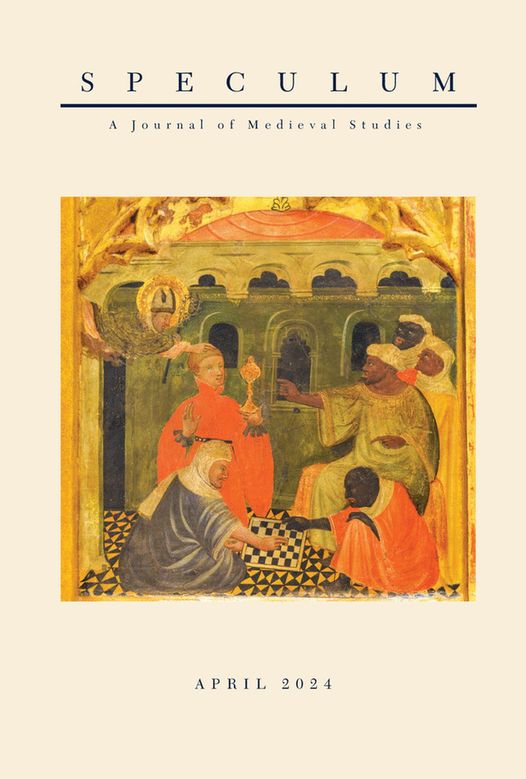
We would do well to remember that the study of women was also once a controversial issue in medieval studies and that it was also the subject of a Speculum themed issue. It was a game changer for me when I was a graduate student. I have a vivid memory from the spring of 1993, when I was writing my dissertation on a topic informed by women’s history and gender studies. That April, as I walked through the McCosh courtyard with my advisor, I excitedly remarked to him that the newly published issue of Speculum was dedicated to the theme of “Studying Medieval Women.” In his inimitable way, he harrumphed, “Finally something interesting in Speculum.” But for me, it was much more than something interesting; it seemed to come as a validation of my chosen field of study, a field which by that time had been cultivated for a generation by distinguished foremothers such as Jo Ann McNamara, Suzanne Wemple, Natalie Davis, Joan Kelly, Barbara Hanawalt, Joan Scott, Judith Bennett, and Caroline Bynum, to name just a few notable medieval and early modern scholars of the time. That issue helped me feel that my work might now be read and taken seriously. And furthermore, that the venerable journal of the Medieval Academy of America had finally, if belatedly, recognized the importance of this flourishing body of important scholarship.
With this experience in mind, when I became editor of this journal in 2019, it seemed to me that it was time for Speculum to engage with the ideas, topics, and methods of premodern critical race studies and how they have been reshaping medieval studies, an area which, as the guest editors of this themed issue note, was thriving, even if unappreciated by the flagship journal of the MAA. Thus, after discussion with the Editorial Board, and receiving an enthusiastic mandate to pursue the idea, we consulted with several stakeholders in the field about possibilities for a guest editor. It soon became clear that Cord J. Whitaker, who had just published Black Metaphors: How Modern Racism Emerged from Medieval Race-Thinking (2019), which would go on to win the MAA’s John Nicholas Brown Prize, was the obvious choice. Fortunately for us he accepted the invitation and quickly put together his editorial dream team of Nahir Otaño Gracia and François-Xavier Fauvelle. We owe this issue to their vision, organization, and editorial efforts.
As a cursory glance at the author bylines of these articles reveals, this issue is peopled by early career scholars who have taken up the subject of “Race, Race-Thinking, and Identity in the Global Middle Ages” and made it their own. In most cases, these articles are the first fruits of their research. Thus, unlike the majority of essays published in this journal, ordinarily from seasoned scholars, we might envision these articles as coming fresh from the field and straight to the table. The issue provides a snapshot of the current state of the field, which, no doubt, will continue to mature and develop in stimulating new ways.
In addition to the editorial team of Cord, Nahir, and F. X., who steered this issue into port, even against the headwinds created by some very challenging personal circumstances, my gratitude and thanks go to the members of the Editorial Board, whose members in 2020 approved the idea of an issue dedicated to this topic, and to the editorial staff at Speculum: Taylor McCall, managing editor, Carol Anderson, associate editor, Jane Maschue, editorial assistant, David Wilton, copyeditor, and Jennifer Ottman, proofreader, who each ensured that all the moving parts came together into one whole to form this exciting April issue.
We hope that it will serve to introduce those who don’t work in the field of premodern critical race studies to the important and timely questions, innovative methods, and wide variety of medieval topics it now embraces. And to those who are already plowing this field, we hope that the publication of this themed issue demonstrates that the Medieval Academy of America sees, hears, and takes this work seriously. Above all, we welcome this spirited chorus of new voices into the pages of Speculum.
Table des matières :
Editors’ Introduction
Speculum Themed Issue: “Race, Race-Thinking, and Identity in the Global Middle Ages” – Cord J. Whitaker, Nahir I. Otaño Gracia, and François-Xavier Fauvelle
Articles
On the Margins of “Alle”: Feminist Theologies of Enclosure in Julian of Norwich and Harriet Jacobs – Thai-Catherine Matthews
Lucifer’s Shadow: Racial Divides in the Yiddish Bovo d’Antona – Annegret Oehme
Queer Indigenous Relationality in Finnboga saga ramma – Basil Arnould Price
Rethinking “Domestic Enemies”: Slavery and Race Formation in Late Medieval Florence – Angela Zhang
Imagined Invasions: Muslim Vikings in Laȝamon’s Brut and Middle English Romances – Eduardo Ramos
Food, Contamination, and Race-Thinking: Culinary Encounters in Late Medieval Missionary Accounts of Asia – Soojung Choe
Chess and Race in the Global Middle Ages – Krisztina Ilko
Informations pratiques :
Race, Race-Thinking, and Identity in the Global Middle Ages (Speculum, 99, 2024). Accès : ici
Source : Speculum






 L'Agenda des Médiévistes
Vous devez être connecté pour poster un commentaire.