
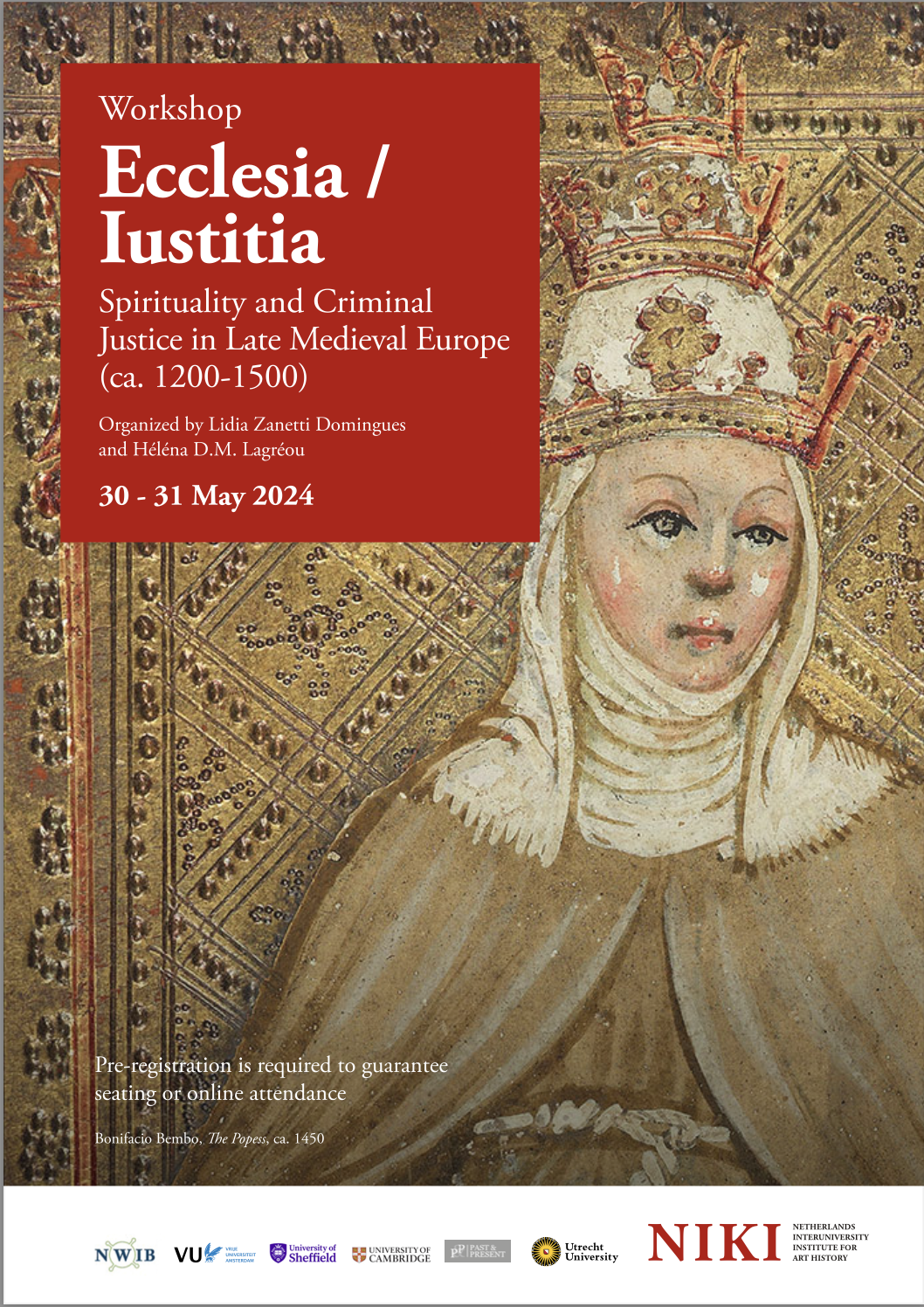
Organized by Lidia Zanetti Domingues and Héléna D.M. Lagréou
30 – 31 May 2024
Viale Torricelli 5
50125 Firenze, Italia
Pre-registration is required to guarantee seating or online attendance
Scholarship in mediaeval studies still lacks a thorough evaluation of the relationship between religious norms and criminal justice. Only recently have scholars started challenging the assumption that a rigid dichotomy between divine and human justice existed in late mediaeval Europe, by bridging the traditionally existing gap between studies on religion and culture on one hand and works on socio-political and legal systems on the other.
The concept of Ecclesia as a “total institution”, permeating every aspect of mediaeval society and signifying both the Church as an organisation and the community of Christians operating on principles of caritas (brotherly love) provides a good starting point to furthering the discussion. The extent to which reformers of criminal justice incorporated the values embedded in the concept of Ecclesia, or rather used the latter instrumentally to legitimise measures enacted to reach other goals, is indeed a question still very much open for debate.
More broadly, the workshop aims to investigate in depth how societies reconciled the growing expectations placed on the adherence to the norms of caritas, and the appearance of systems of criminal
justice using ever more radical forms of exclusion (e.g., corporal punishments, denial of burial, total destruction of the criminal’s possessions).
Programme :
Thursday, 30 May
9.00 : Coffee and tea
9.15 : Michael W. Kwakkelstein (NIKI) – Director’s Welcome
9.30 Panel 1
The legislating church
Lorenzo Caravaggi (University of Lancaster), ‘How far were the clergy involved in peacekeeping in late-medieval cities? The case of urban Italy in the age of Dante (c.1260-1320)’
Flocel Sabaté (Universidad de Lleida), ‘The application of justice in the ecclesiastical jurisdiction in Late-Medieval Catalonia’
Elizabeth Papp Kamali (Harvard University), ‘Eye Has Not Seen: Proof in Medieval English Felony Law’
Response by Raphaël Eckert
10.50 : Coffee and tea served in the garden
11.20 Panel 2
Justice for orthodoxy and orthopraxy
Alessia Trivellone (Université Paul-Valéry Montpellier 3), ‘Imagined heresy and condemned heretics in the work of Bernard Gui’
Daniela Müller (Radboud Universiteit), ‘The inquisitor as martyr. On the compatibility of new concepts of guilt and old models of sainthood’
Response by John H. Arnold
12.20 : Lunch
13.45 Panel 3
Christian temporalities for criminals
Héléna D.M. Lagréou (University of Cambridge), ‘Killing time: temporalities of the afterlife and their impact on practices of the death penalty between 1250 and 1350 in Toulouse and Pisa’
Mathieu Vivas (Université de Lille), ‘The Church and the penalty of burial deprivation in the medieval kingdom of France’
Response by Lidia Luisa Zanetti Domingues
14.45 : Coffee and tea served in the garden
15.15 Panel 4
Values of Christian justice
Jesse Harrington (Dublin Institute for Advanced Studies), ‘Divine and Secular Justice in the Latin Lives of St. Laurence of Dublin’
Roberta Marangi (University of St Andrews), ‘The (In)Justice of Camelot: Christian Values, Chivalry, and Violence in Thomas Malory’s Le Morte Darthur’
Response by Antonio Marson Franchini
16.15 : Closing remarks of the day
19.00 : Dinner
Friday, 31 May
9.00 : Coffee and Socializing
9.30 Panel 5
Categories of thought: sin and crime
Raphaël Eckert (Université de Strasbourg), ‘The Distinction between the Concepts of Sin and Crime in Medieval Law, an Introduction’
Corinne Leveleux-Teixeira (Université d’Orléans), ‘Blasphemy between Sin and Crime. From Reprobation to Sanction (13th-15th centuries)’
Response by Elizabeth Papp Kamali
10.30 : Coffee and tea served in the garden
11.00 Panel 6
Representing criminal justice
Lidia Luisa Zanetti Domingues (University of Sheffield and Vrije Universiteit Amsterdam) and Antonio Marson Franchini (Oxford) University, ‘Preaching a severe criminal justice: Ile-de-France and Tuscany in comparison (1250-1320)?’
Maria Alessandra Bilotta (Universidade NOVA de Lisboa), ‘The Exercise of Justice in the Miniatures of Manuscripts of Canon Law (XIII and XIV centuries)’
Response by Jesse Harrington
12.00 : Lunch
13.30 : Closing remarks | Héléna D.M. Lagréou and Lidia Luisa Zanetti Domingues
14.00 : Send off and thanks






 L'Agenda des Médiévistes
Vous devez être connecté pour poster un commentaire.