
English version below
Angers – 15 avril 2025
Org. Gaelle Bosseman (Université Rennes 2, Tempora)
Isabelle Mathieu (Université d’Angers, Temos)
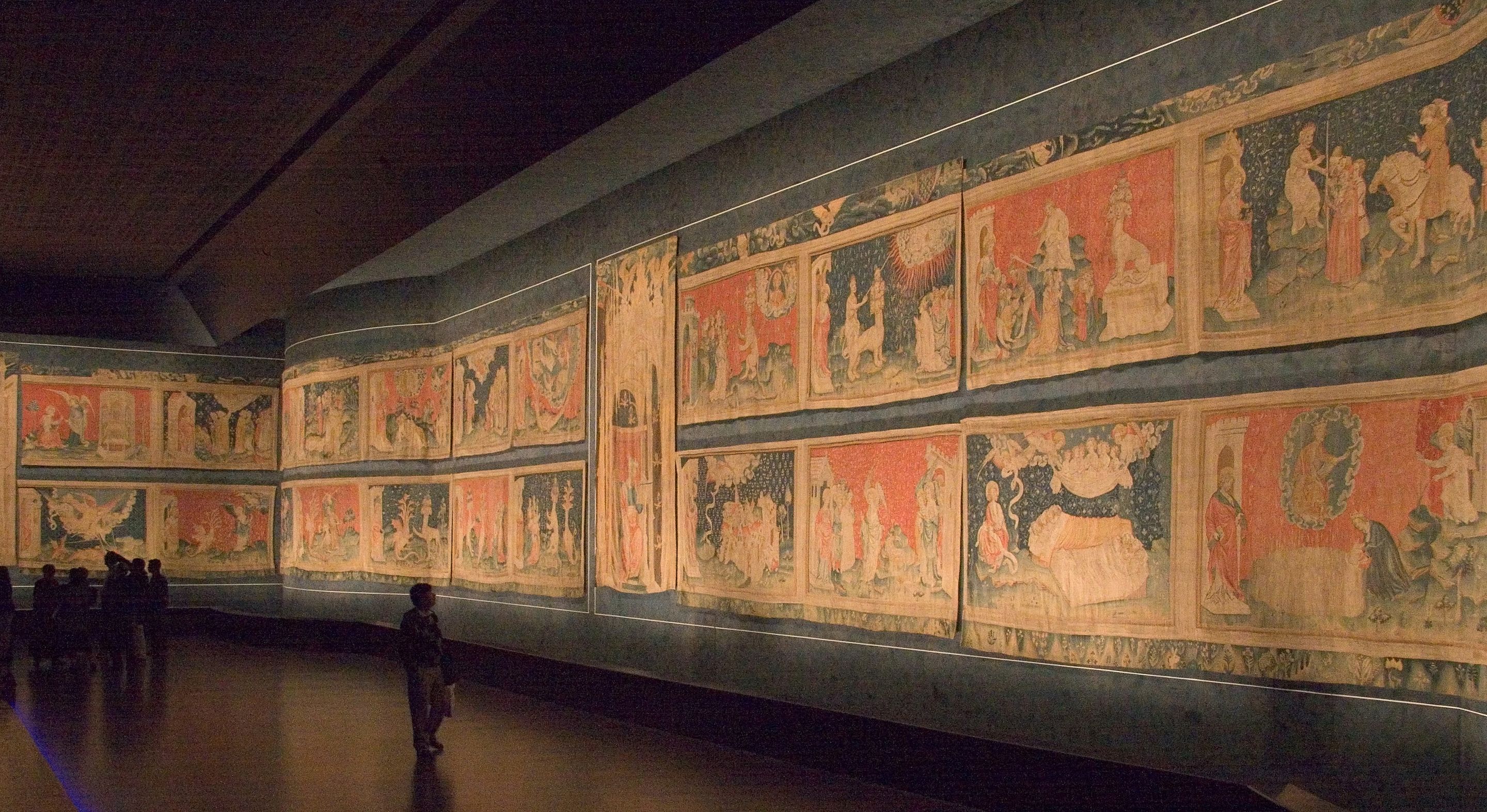
La tapisserie conservée au Château d’Angers est la plus ancienne et la plus grande tapisserie historiée conservée au monde. Cette œuvre monumentale illustre le dernier livre de la Bible, l’Apocalypse, un livre dont les lectures et les usages ont été pluriels au Moyen Âge. De fait, loin des grands mouvements de peurs populaires auxquels elle a pu être associée dans l’historiographie, l’Apocalypse nourrit, au Moyen Âge, des productions écrites et iconographiques érudites, émanant de milieux savants.
La tapisserie d’Angers fut commandée par un prince laïc, le duc Louis Ier d’Anjou (1339-1384), et était probablement destinée à être exposée lors de cérémonies publiques, bien que les circonstances exactes de cette exposition restent incertaines (cathédrale ? autres lieux ?). D’après l’hypothèse de certains chercheurs comme Laurent Hablot (EPHE, PSL Université), la tapisserie constituerait « un véritable théâtre médiéval » : disposées en plein air, ses pièces pourraient avoir été présentées sur des estrades éphémères et animées par un lecteur qui en déclamait le texte faisant ainsi vivre les scènes de l’Apocalypse. D’autres tapisseries comme celles de la Chaise-Dieu pourraient avoir été exposées d’une manière comparable.
Comment comprendre une telle commande ? Faut-il envisager que le message de l’Apocalypse résonnait de manière particulière pour son commanditaire et le public auquel il était destiné ?
La tapisserie a été achevée vers 1380/82, en pleine guerre de Cent Ans ; elle affirme sans nul doute les prétentions politiques de Louis Ier d’Anjou : deuxième fils du roi de France Jean II le Bon, frère du roi Charles V (1338-1380), Louis Ier obtient le titre de régent du royaume en 1380 et devient, peu de temps avant de mourir, roi de Naples, Sicile et Jérusalem. L’utilisation politique et idéologique de l’Apocalypse pour exalter les figures royales ou impériales est ancienne : Charlemagne, les empereurs byzantins ou ottoniens ont fait copier et peindre des Apocalypses enluminées et représenter certaines scènes des visions de Jean sur des lieux de pouvoir comme le plafond du palais d’Aix-la-Chapelle. Il ne faudrait pas pour autant sous-estimer la dimension religieuse de telles commandes : dans des sociétés dans lesquelles l’autonomie du fait religieux n’existe pas, choisir de mettre en scène(s) l’Apocalypse n’a pas qu’une forme d’instrumentalisation politique. Il s’agit bien d’un discours qui mêle étroitement croyance et vision du pouvoir et permet de questionner la responsabilité des souverains dans l’accession au salut du peuple dont ils ont la charge.Le projet de recherche « Mettre en scène l’Apocalypse » a été conçu en deux temps – un workshop au printemps 2025 suivi d’un colloque à l’été 2026 – avec pour objectif de remettre à plat nos connaissances sur la tapisserie de l’Apocalypse d’Angers et de proposer une étude globale et renouvelée de l’œuvre et de ses fonctions. En mobilisant des spécialistes issus de différents champs de recherche ayant travaillé sur d’autres objets ou d’autres thématiques, il s’agira d’analyser à nouveaux frais et collectivement les fonctions de cet objet et du discours dont il fut le support. À cet égard, toutes les propositions de comparaisons sont bienvenues.
Le workshop qui constitue le premier volet du projet aura lieu à Angers sera précédé d’une visite de la tapisserie. La journée sera organisée en trois sessions correspondants aux trois axes de réflexion suivants pour lesquels nous proposons quelques pistes d’interrogation, sans exhaustivité :
o Une approche matérielle et artistique : certaines des sources probables d’inspiration de l’artiste, Jean de Bruges, un peintre flamand, ont été identifiées ; parmi elles figurent le manuscrit Paris, BnF français 403, une des Apocalypses anglo-normandes, œuvre commandée vers 1250 par Charles V, le frère de Louis d’Anjou, ou encore le Cambrai (BM, 0422 (0397 bis)). Qu’en est-il des autres supports monumentaux ? Comment situer la tapisserie dans une histoire du gothique international ? Plus largement, dans quelle mesure le choix du support de la tapisserie entre-t-il en rupture ou marque-t-il au contraire une forme de continuité avec les précédentes productions iconographiques consacrées à l’Apocalypse ? Quelles techniques, quelles méthodes de tissage ont été utilisées et peut-être adaptées pour déployer une œuvre aussi monumentale ?
o Une approche politique, institutionnelle de la commande : Par son sang royal, Louis Ier d’Anjou a donné une renommée incontestable à son duché tout en s’engageant sans relâche dans les affaires du royaume. Dans le champ artistique, le château de Saumur, la tapisserie de l’Apocalypse ou quelques pièces de son imposante collection d’orfèvrerie donnent la mesure du cadre dans lequel évoluait ce prince. Dans les années 1360, Louis Ier d’Anjou possédait déjà plus de 70 tapisseries, collection qu’il a très certainement continué à enrichir jusqu’à envisager dans les années 1380 ce projet fou d’un « beau tapis » de 850 m2 qui viendrait mettre en images le livre de l’Apocalypse alors que jusque-là les thèmes retenus étaient éclectiques et pas systématiquement religieux (histoire, mythologie, fabliaux, romans héroïques…). À sa suite, son frère Philippe de Bourgogne en commanda une identique, mais l’inventaire des tapisseries dressé à sa mort en 1404 montre qu’elle était moins grande (environ 580 m2). Un fragment conservé dans les réserves au château d’Angers dit fragment de Goult traitant également de l’Apocalypse pourrait avoir appartenu à une tapisserie que possédait Jean de Berry. Pour ces grands seigneurs, comment l’art au sens très large du terme s’articule-t-il, nourrit-il, soutient-il les ambitions/projets/desseins politiques ? Comment opèrent- ils leurs choix en la matière ? Comparativement à ses frères, Louis Ier d’Anjou n’a pas fait l’objet de travaux de synthèse et encore moins d’une biographie ; cette remise en perspective globale pourrait contribuer à combler des pans de ce vide historiographique.
o Une approche littéraire, théologique et exégétique de l’œuvre : quelle est la part de la tradition exégétique dans la tapisserie ? Les Apocalypses enluminées et les commentaires enluminés médiévaux montrent que l’intégration du discours exégétique dans les images par les artistes était courante. Qu’en est-il pour la tapisserie ? D’autres sources textuelles ont-elles inspiré Jean de Bruges ? L’Apocalypse était lue au Moyen Âge comme une révélation sur l’histoire de l’Église au double sens d’institution ecclésiale et de communauté des fidèles et comme une invitation à faire pénitence sans attendre. Ces différentes dimensions apparaissent-elles dans la tapisserie ?
Pour respecter le format workshop, les communications ne devront pas dépasser 15 minutes maximum. Il s’agira lors de cette première rencontre de proposer individuellement des pistes de recherche pour engager une discussion collective. Le colloque de l’été 2026 permettra de présenter les résultats obtenus à la suite du workshop.
Les propositions (titre, résumé de 10/15 lignes) devront être adressées à Gaelle Bosseman (gaelle.bosseman@univ-rennes2.fr) et/ou à Isabelle Mathieu (isabelle.mathieu@univ-angers.fr) avant le 1er février 2025.
Les communications pourront être présentées en français ou en anglais avec une possibilité de participer en hybride. Nous vous remercions de nous indiquer, le cas échéant, si vous pouvez bénéficier d’une aide de votre laboratoire pour participer à cette journée.
English version
The tapestry in the Château d’Angers is the oldest and largest historiated tapestry in the world. This monumental work illustrates the last book of the Bible, the Apocalypse, a book that was read and used in many different ways in the Middle Ages. In fact, far from the great movements of popular fear with which it was associated in historiography, in the Middle Ages the Apocalypse was the subject of erudite written and iconographic productions emanating from learned circles.
The Angers tapestry was commissioned by a lay prince, Duke Louis I of Anjou (1339-1384), and was probably intended to be exhibited at public ceremonies, although the exact circumstances of this exhibition remain uncertain (cathedral? other places?). According to the hypothesis of certain researchers such as Laurent Hablot (EPHE, PSL Université), the tapestry constituted ‘a veritable medieval theatre’: laid out in the open air, its pieces could have been presented on ephemeral platforms and animated by a reader who recited the text, thus bringing to life the scenes from the Apocalypse. Other tapestries, such as those at La Chaise-Dieu, could have been displayed in a similar way.
How are we to understand such a commission? Should we assume that the message of the Apocalypse resonated in a particular way for its commissioner and the public for whom it was intended?
The tapestry was completed around 1380/82, at the height of the Hundred Years’ War; it undoubtedly asserts the political claims of Louis I of Anjou: second son of King John II the Good of France and brother of King Charles V (1338-1380), Louis I obtained the title of regent of the kingdom in 1380 and, shortly before his death, became King of Naples, Sicily and Jerusalem. The political and ideological use of the Apocalypse to exalt royal or imperial figures goes back a long way: Charlemagne and the Byzantine and Ottonian emperors had illuminated Apocalypses copied and painted, and depicted certain scenes from John’s visions on places of power such as the ceiling of the palace at Aachen. However, the religious dimension of such commissions should not be underestimated: in societies where religion is not autonomous, choosing to stage the Apocalypse(s) is not just a form of political instrumentalisation. It was a discourse that closely intertwined belief and a vision of power, and allowed us to question the responsibility of sovereigns in achieving the salvation of the people in their charge.
The ‘Mettre en scène l’Apocalypse’ research project has been conceived in two phases – a workshop in spring 2025 followed by a colloquium in summer 2026 – with the aim of reviewing our knowledge of the Angers Apocalypse tapestry and proposing a comprehensive and renewed study of the work and its functions. By bringing together specialists from different fields of research who have worked on other objects or other themes, the aim is to analyse the functions of this object and the discourse it was used to support in a fresh and collective way.
In this respect, all proposals for comparisons are welcome.
The workshop, which is the first part of the project, will take place in Angers and will be receded by a visit to the tapestry. The day will be organised into three sessions corresponding to the following three lines of enquiry, for which we propose a number of non-exhaustive directions:
o A material and artistic approach: some of the probable sources of inspiration for the artist, Jean de Bruges, a Flemish painter, have been identified; these include the manuscript Paris, BnF français 403, one of the Anglo-Norman Apocalypses, a work commissioned around 1250 byCharles V, the brother of Louis d’Anjou, and the Cambrai (BM, 0422 (0397 bis)). What about other monumental supports? How can we situate the tapestry in the history of international Gothic? More broadly, to what extent does the choice of medium for the tapestry represent a break with or, on the contrary, a form of continuity with previous iconographic productions devoted to the Apocalypse? What techniques and weaving methods were used, and perhaps adapted, to create such a monumental work?
o A political and institutional approach to the commission: By virtue of his royal blood, Louis I d’Anjou gave his duchy an undisputed reputation, while at the same time being relentlessly involved in the affairs of the kingdom. In the field of art, the Château de Saumur, the tapestry of the Apocalypse and a few pieces from his imposing gold and silverware collection give an idea of the context in which this prince lived. In the 1360s, Louis I d’Anjou already owned more than 70 tapestries, a collection that he undoubtedly continued to enrich until, in the 1380s, he envisaged the crazy project of a ‘beautiful carpet’ measuring 850 m2 that would depict the Book of Revelation, whereas until then the themes chosen had been eclectic and not systematically religious (history, mythology, fabliaux, heroic romances…). Following in his footsteps, his brother Philippe of Burgundy commissioned an identical tapestry, but the inventory of tapestries drawn up on his death in 1404 shows that it was smaller (around 580 m2). A fragment also depicting the Apocalypse, known as the Goult fragment, which is kept in the reserves at the Château d’Angers, may have belonged to a tapestry owned by Jean de Berry. For these great lords, how did art, in the broadest sense of the term, relate to, nurture and support their political ambitions/projects/goals? How did they make their choices in this area? Compared with his brothers, Louis I d’Anjou has not been the subject of any comprehensive studies, let alone a biography; this overview could help to fill in some of this historiographical gap.
o A literary, theological and exegetical approach to the work: what part does the exegetical tradition play in tapestry? The illuminated Apocalypses and medieval illuminated commentaries show that the integration of exegetical discourse into images by artists was commonplace. What about tapestry? Did Jean de Bruges draw inspiration from other textual sources? In the Middle Ages, the Apocalypse was read as a revelation about the history of the Church in the dual sense of ecclesial institution and community of the faithful, and as an invitation to do penance without delay. Do these different dimensions appear in the tapestry?
In keeping with the workshop format, papers should not exceed 15 minutes. The aim of this first meeting will be to propose individual lines of research for collective discussion. The results of the workshop will be presented at the conference in summer 2026.
Proposals (title, 10/15 line summary) should be sent to Gaelle Bosseman (gaelle.bosseman@univ-rennes2.fr) and/or Isabelle Mathieu (isabelle.mathieu@univ-angers.fr) before 1 February 2025. Papers may be presented in French or English, with the possibility of participating in a hybrid format.
We would be grateful if you could let us know if your research unit could help you to take part in this event.





 L'Agenda des Médiévistes
Vous devez être connecté pour poster un commentaire.