
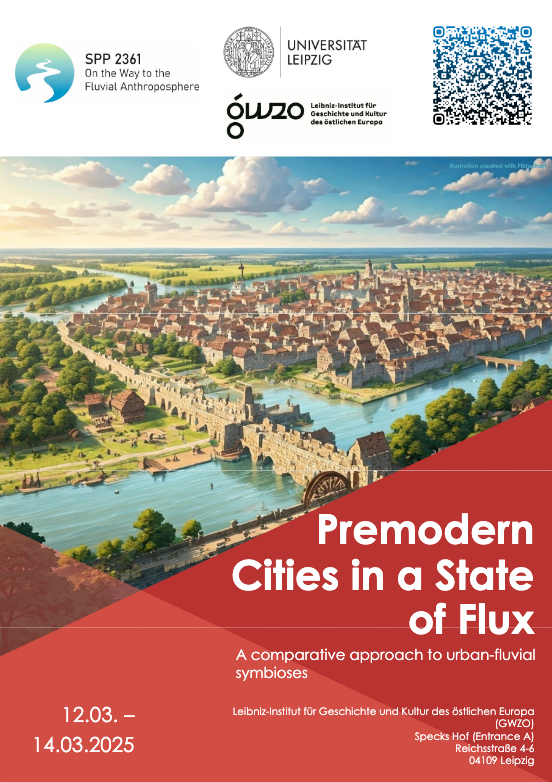
The history of cities and rivers is inextricably linked. As suppliers of water and energy, transport and traffic routes or waste disposal method, waterways were often the starting point and an indispensable prerequisite for the development of urban communities. In recent years, historians have therefore been focusing more intensively on the relevance of rivers for pre-modern cities. This research has shown that the relationship between cities and rivers cannot be understood as a dichotomous opposition of nature and culture. Instead, both are symbiotically intertwined as socio-natural sites.
The conference draws on these considerations by addressing the opportunities and challenges arising from the symbiosis of river and pre-modern city. To provide new research impulses, floodplains will also be taken into consideration. Despite their frequently emphasized importance, they remain an important desideratum, especially from the perspective of urban history. In the context of this conference, floodplains can be understood as a fluvial anthroposphere, i.e. as spaces in which, due to their intensive fluvial dynamics, a special concentration of socio-natural processes takes place. This causes far-reaching changes in the environment as well as the emergence of special patterns of human behavior and subsequently fluvial cultures.
The conference approaches the relationship between cities and rivers as well as floodplains from a transregional, comparative and cross-epochal perspective. Case studies from Western and Eastern-Central Europe will be discussed, covering the time period from the Middle Ages to the epochal threshold around 1800. Where possible, cities situated upon smaller waterways will also be included to broaden the focus of research, which is usually centered on large river metropolises.
Programme :
WEDNESDAY, March 12
13.00 : Welcome
13.15 : Erik Liebscher, Niels Lohse & Julia Schmidt-Funke, Leipzig – Introduction
14.00 : Michael Ruprecht, Leipzig – Von Fluten, Kälte und Hitze: Wetterereignisse in alten Chroniken Mitteldeutschlands
14.45 : Coffee break
15.15 : Briony McDonagh, Hull – tba
16.00 : Andrea Kiss, Wien – Large River, Small River – and the Medieval-Early Modern Hungarian Town
16.45 : Sylwia Lech, Wrocław – The Urbanistic Evolution of the Riverside Areas of Wrocław and Prague in the Medieval and Modern Periods (13th-18th Centuries)
17.30 : Coffee break
18.00 Keynote : Petra van Dam, Amsterdam – Blue Diversity. Drinking Water in the Netherlands, 1500-1850
THURSDAY, March 13
09.00 : Alexander Sembdner, Leipzig – Vertrauen ist gut, Kontrolle ist besser – Mühleninspektion im Raum Leipzig am Ende des 15. Jahrhunderts
09.45 : Matthias Hardt, Leipzig – Hochmittelalterlicher Mühlenbau an Elbe, Havel und Spree
10.30 : Coffee break
11.00 : Severin Hohensinner, Wien – Genug Holz für Stadt und Fluss? Wiens Holzressourcen in dynamischen Donau-Auen
11.45 : Sophie Lindemann, Leipzig – Die Bedeutung der Flurnamen für die mittelalterliche Auengeschichte
12.30 : Lunch
13.45 : Excursion
16.45 : Coffee break
17.15 : Johannes Schmidt, Leipzig – Leipzig‘s Urban Fluvial Dynamics – Multi Methodological Geoscientific Approaches and Interdisciplinary Perspectives
18.00 Keynote : Theo Spek, Groningen – Moving Mosaics: Landscape Biographies of River and Brook Systems in The Netherlands
FRIDAY, March 14
09.00 : Niels Lohse, Leipzig – Aquarum explorandum utilitas et necessitas – On the Informative Value of Early Modern Chemical Analysis of Water
09.45 : Davide Martino, Bern – The Emergence of Hydraulic Experts and Bureaucracies in Early Modern European Cities
10.30 : Coffee break
11.00 : Erik Liebscher, Leipzig – Urban Water Management in Times of War
11.45 : Marius Mutz, Dresden – A hydraulic technocracy? Dealing with water in early modern Dresden
12.30 : Martin Bauch, Leipzig – Conclusion and Discussion
Informations pratiques :
International Conference, Leibniz Institute for the History and Culture of Eastern Europe (GWZO), 12–13 March 2024
The conference takes place at the Leibniz Institute for the History and Culture of Eastern Europe (GWZO), Reichsstraße 4-6 (Entrance A), 04109 Leipzig.
Source : Universität Leipzig






 L'Agenda des Médiévistes
Vous devez être connecté pour poster un commentaire.