
22-23 May 2025
Organizers: Mariana Bodnaruk (Masaryk University, Brno), Stephan Bruhn (GHIL) and Michael Eber (University of Oxford)
Venue: German Historial Institute London
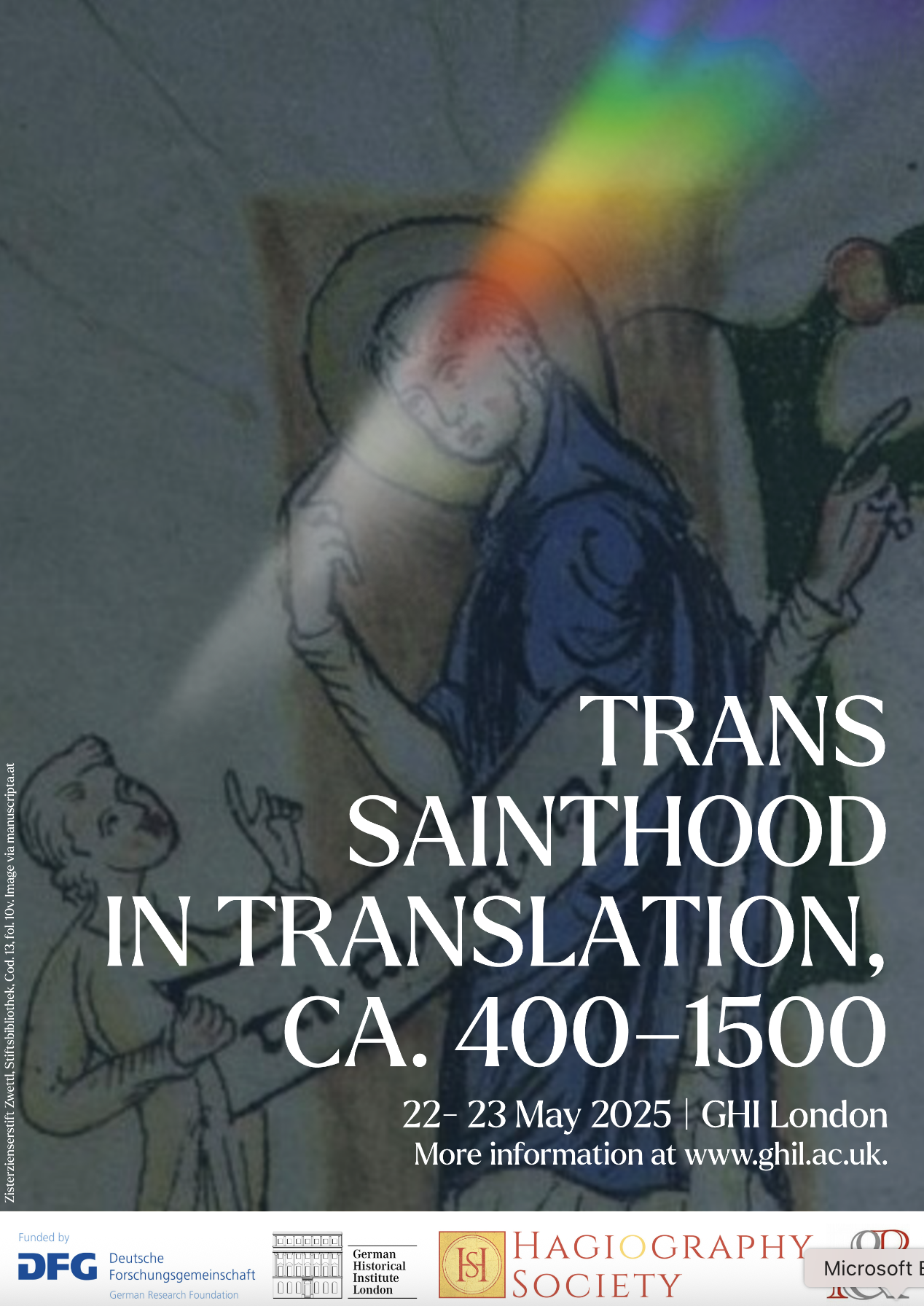
Trans saints – monachoparthenoi, saints who are initially described as female by their hagiographers, but transition to a male (often monastic) identity – are present in every late antique and medieval Christian tradition. The textual and artistic renderings of these figures offer a comparative key to conceptualizing trans bodies and trans souls across geographical and chronological boundaries. Binary cis-heteronormativity has long been portrayed as unchanging and unchangeable, as outside of the scope of history. This is a central plank in the playbook followed by transphobes worldwide, in the ever-escalating “culture war” against trans and queer people. Highlighting both the ubiquity and multivalence of premodern trans monks, and connecting across disciplinary divides to do so, is urgent work, not least because it provides a necessary counterpoint to such historically inaccurate rhetoric.
Following the insights of the “performative turn” in queer and trans studies that underscores the enactment and negotiation of gender identity through lived experiences, social practices, and narratives, we welcome explorations of gender and sexuality in the textual traditions in both East and West and in their translation. We also take into consideration aspects related to the ”performative turn” in visual studies in the last decade, as relevant for both medieval Eastern and Western hagiographic iconographies of trans saints, focusing on visual representations actively shaping identities and power dynamics and incorporating the embodied experience of the ritual practices.
While texts regarding fifteen trans saints are attested in the Eastern Mediterranean, this conference will focus on those whose vitae were available in Greek as well as in Latin: Eugenia*us, Euphrosyne*Smaragdus, Marina*us, Pelagia*us and Theodora*us. However, we particularly invite papers covering linguistic and artistic traditions beyond Greek and Latin, from Coptic to Old Norse. Taking seriously the connectivity of the Latin West, the Orthodox East, and the Islamic World in the Middle Ages, we adopt a trans-cultural comparative approach. Thus, contributions with a multilingual perspective are particularly welcome, as are those covering both textual and iconographic representations. Conference proceedings may be published as an edited volume.
This conference will take place at the GHIL (speakers only). It is open to external visitors online via Zoom. In order to attend this event online, please register via Eventbrite to take part on Day 1 and/or Day 2
Programme :
22 May
Welcome and Introduction: 9:00–9:30
Stephan Bruhn (German Historical Institute, London)
Session 1: 9:30–11:00
Jenny Albani (Greek Ministry of Culture, Athens): The Holy Memory of a Transgender Saint in the Christian East: The Cult and Image of Pelagia the Penitent
Julie Van Pelt (Universiteit Gent): Trans Sainthood and Metaphrasis: Re-writing Gender in the Metaphrastic Life of Theodora/-us of Alexandria (BHG 1730)
Charles Kuper (University of Tennessee, Knoxville): Translating the Lives of Trans Saints. Crossing Time and Space in the Greek, Latin, and Syriac Lives of Euphrosyne/Smaragdos
Coffee Break: 11:00–11:30
Session 2: 11:30–12:30
Michael Eber (Universität zu Köln): Lost in Translation? Defusing the Lives of Trans Saints in Latin Translation
Mariana Bodnaruk (Masarykova Univerzita, Brno): Pelagia∗us’ Gender Performance in Church Slavonic Versions of the Life
Lunch Break: 12:30–14:00
Session 3: 14:00–15:30
Gabrielle Bychowski (Case Western Reserve University, Cleveland): Imago Transvesti: St. Marinos, the Images of a Transgender God
Arietta Papaconstantinou (Aix-Marseille Université): Authorial authority. Who defines the gender of Marina/Marinos (and others)?
Luis Josué Salés (Scripps College, Claremont): Exporting Greco-Roman Androprimacy? Perils of Translating Trans Saints Lives into Ethiopian and Syrian Contexts
Coffee Break: 15:30–16:00
Keynote 1: 16:00–17:00
Roland Betancourt (University of California Irvine): Trans In/visibility in Byzantium: Resistance, Resilience, Refusal
23 May
Session 4: 09:00–10:30
Juliette Vuille (Université de Lausanne): “We are Family”: Familial Ties as Gender Correction in Old English Trans Lives
Clovis Maillet (Villa Medici, Rome): Eugeni/e, Hiacynth and Prothus between Genders: Images and Texts in Latin, Greek and Old English
James Davison (University of Liverpool): Ælfric, Eugenia/us, and Euphrosyne/Smaragdus: Trans saints in early Medieval England
Coffee Break: 10:30–11:00
Session 5: 11:00–12:00
Robert Mills (University College London): Eugenia∗us in Translation: Art, Liturgy, and Landscape in Iberia
Leticia Ding (Université de Lausanne): Dieudonnée, Marine and Eufrosine: Three Shades of Gender Crossing
Lunch Break: 12:00–13:00
Session 6: 13:00–14:00
Johannes Traulsen (Freie Universität Berlin): Age and Asceticism in the Medieval German Vitae of Trans Saints
Natasha Bradley (Lincoln College, University of Oxford): Cross-Dressing Saints in Old Norse Translation: Marina the Monk and Pelagia the Penitent
Keynote 2: 14:00–15:00
Alicia Spencer-Hall (University College London): Trans Monasticism and the Trans Hagiographic Impulse: Genders, Texts, Lives
Concluding Remarks: 15:00–15:15
Michael Eber (Universität zu Köln)
Source : German Historial Institute London






 L'Agenda des Médiévistes
Vous devez être connecté pour poster un commentaire.