
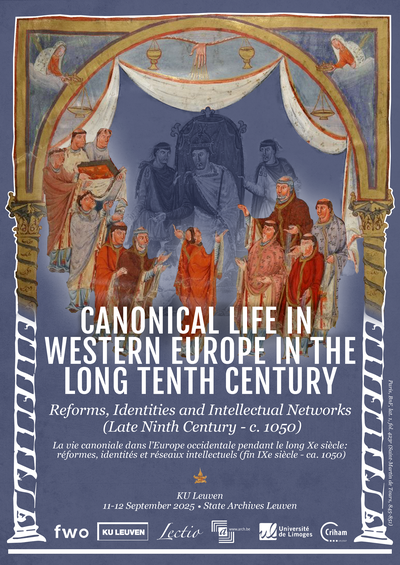
KU Leuven, 11-12 September 2025
Sou can register until Monday August 18 via the registration form. The registration fee is €25.
Traditionally, the history of canonical life in the Middle Ages is narrated through two foundational periods of reform. On the one hand there are the Carolingian reforms, which resulted in the composition of the Institutio canonicorum Aquisgranensis (816) as a rule of conduct for canons. On the other hand there is the broad canonical reform movement of the second half of the eleventh century and the first half of the twelfth century, which led to the emergence of a new type of canons, the canons ‘regular’, who inspired their way of life on the Rule of Saint Augustine. Past research has been heavily focused on these two reform moments, whereas canonical life during the intervening period – from the late ninth century until c. 1050 – has been largely underexposed. Although current scholarship does begin to pay attention to the long tenth century, a general overview of canonical life is as yet lacking, and the traditional opinion of a period of decline between two vibrant reforms is still prevalent. Recent scholarship on reforms in monastic milieus prior to the eleventh-century Church Reform has convincingly demonstrated that the image of decline in the preceding period is largely the result of the rhetoric of the eleventh-century reformers. There are reasons to believe that this is also the case for the ordo canonicus and that the ardent eleventh-century innovators deliberately portrayed canonical life in the preceding period in dark colours, without paying attention to prior attempts to improve the quality of religious life.
The aim of this conference is to shed light on the nature of canonical life in the long tenth century so as to challenge the paradigm of decline still persistent in scholarship on post-Carolingian canons. We welcome papers on the following topics: 1) reforms or transformative processes in canonical milieus and/or initiatives taken to guarantee the quality of canonical life in particular communities; 2) the search for canonical identities and/or tensions between the vita canonica and the vita monastica; 3) the procuring, diffusing and use of normative texts in canonical communities; 4) the representation of canonical life in hagiographical and narrative sources; 5) the participation of canonical communities in intellectual networks: the mobility of persons, objects and ideas or the interactions between religious communities.
Programme :
Thursday 11 September (10h30-17h00)
10h30 Welcome with coffee and tea
11h00 Brigitte Meijns (KU Leuven) – Introduction
11h15 Rutger Kramer (Utrecht University) – The Grass and the Flowers: (Re)Presenting Authority at the Carolingian Court
Lunch break
Session 1: Religious Institutions and Canonical Life between Two Reform Movements I – Institutions religieuses et vie canoniale entre deux mouvements de réforme I
13h30 Anna Trumbore Jones (Lake Forest College) – Houses of Canons in the Religious Landscape of Aquitaine, 9th-11th centuries
14h00 Hervé Chopin (docteur de l’Université Lumière Lyon 2) – La vie canoniale au Xe siècle dans le quart sud-est de la Gaule : moines, chanoines et transformations internes
14h30 Robin Moens (Université de Namur / RWTH Aachen University) – What if Notger Had Not Been There? Founders and ‘Reformers’ of Canonical Houses in Liège in the 10th and 11th Centuries Beyond the Enigmatic Bishop
Coffee break
Session 2: Religious Institutions and Canonical Life between Two Reform Movements II – Institutions religieuses et vie canoniale entre deux mouvements de réforme II
15h30 Charles Mériaux (Université de Lille) – La perception de la vie canoniale dans un milieu « réformateur » autour de l’an mil : Gérard de Cambrai et les monasteria canonicorum de ses dioceses
16h00 Qianyu Wang (Ghent University) – “Rogo obnixe ne in loco suprascripto abbas ponatur”: Revival of canonical life and the threat of monastic autonomy in Besançon, 1031-1066
16h30 Charles de Miramon (Université Paris Panthéon-Assas) – From commune to cathedral: the metamorphosis of collegiate communities in the 11th century
Conference dinner for speakers and chairs
Friday 12 September (9h00-16h00)
Session 3: Normative Texts, Manuscripts and the Regulation of Canonical Life – Textes normatifs, manuscrits et réglementation de la vie canoniale
9h00 Matthias M. Tischler (Universitat Autònoma de Barcelona) – Carolingian Canonical Life beyond Catalonia? Deciphering the Religious Contexts of Iberian Copies of the Institutio canonicorum Aquisgranensis between the Tenth and Eleventh Centuries
9h30 Lene ten Haaf (KU Leuven) – Declining Interest or Continued Engagement? The Production, Use and Exchange of Manuscripts Containing the IC in West Francia during the Long Tenth Century
10h00 Catherine Cubitt (University of East Anglia) – The Canonical Life in Long Tenth-Century England: Reform, Regulation and Education
Coffee break
Session 4: The Representation of Canons and Canonical Life in Contemporary Sources – La représentation des chanoines et de la vie canoniale dans les sources contemporaines
11h00 Ido Kons (University of Cambridge) – Canons and the Scholarship of the English Benedictine Reform Movement: A Reassessment
11h30 Felix Timmer (Universität Münster) – Canonical Life in the Ottonian Empire as Reflected in Contemporary Charters (919-1024)
12h00 Sébastien Peigné (UR Tempora) – Comment nommer les chanoines des cathédrales ? Approche lexicométrique d’une fabrique identitaire. Province ecclésiastique de Tours (IXe-XIe siècle)
Lunch break
Session 5: Canonical Communities and Their Interactions with Other Religious Institutions – Les communautés canoniales et leurs interactions avec d’autres institutions religieuses
13h30 Anne Massoni (Université de Limoges) – Les évêques, les établissements religieux canoniaux et monastiques en Limousin au Xe siècle
14h00 Moritz Vogelbacher (Albert-Ludwigs-Universität Freiburg) – Canonici et sanctimoniales. Observations on the Canons of Female Convents from Hagiographical Sources
14h30 Warren Pezé (Université Paris-Est Créteil) – Entre vie canoniale et vie monastique à la fin du IXe siècle : la Narratio de monacho Cenomanensi et son contexte politique
Coffee break
15h30 Julia Barrow (University of Leeds) – Conclusions
Source : KU Leuven





 L'Agenda des Médiévistes
Vous devez être connecté pour poster un commentaire.