
The history of peacemaking has traditionally been reduced to isolated case studies and seen as the prelude to the presumed ‘universal’ and ‘modern’ international order. Countering this one-dimensional and Eurocentric narrative, this multi-authored volume reconceptualizes peace treaties as a range of successful and failed agreements, settlements, truces, leagues, and other forms of conflict resolution, thus recovering their multilayered history throughout the medieval and early modern period. Rather than a series of ‘great’ treaties, peacemaking is reframed as a flexible phenomenon; a ‘political grammar’, whose complexity is reflected in its variety of forms and sources. Drawing on both diplomatic history and international relations studies, this volume traces the central role that peacemaking has played in the political history of the Western World.
Isabella Lazzarini is Full Professor of Medieval History at the Department of Historical Studies at the University of Turin and a member of the board of the PhD in ‘Historical and Archaeological Sciences’, of the DISCI department of the University of Bologna. Her research interests focus on the political, social, and cultural history of late medieval Italy and the Mediterranean, with an emphasis on Renaissance diplomacy, the growth of different political languages in documentary sources, and gender studies. She is currently working at the EOS project DiplomatiCon: a Connected History of Medieval Mediterranean Diplomacy. The Mamluk Sultanate, Italy, and the Crown of Aragon (14th-15th centuries) (Liège, Antwerpen, Barcelona, Torino/Bologna, 2022-2027).
Luciano Piffanelli is Associate Professor of Early Modern History and Archival Science at the University of Upper Alsace and member of the board of the PhD in ‘European History and Cultures’ at the University of Rome ‘Sapienza’. Spanning from the 15th to the 18th century, his research deals with European politics, cultures, and societies, focusing on diplomatic practices, archival strategies, and intersections between politics, philosophy, and science. He is member of the editorial boards of the journal Legatio and of the book series In margine: Exploring Pre-modern Paratexts, and he has recently been awarded a PIR grant for his project Faire la paix. Édition et textualité des collections diplomatiques de l’époque moderne (XVIIe-XVIIIe s.).
Diego Pirillo is Professor of Italian Studies at the University of California, Berkeley, where is also affiliated with the History Department. His work focuses on early modern Italy, Europe, and the Atlantic world, with a strong interest in intellectual history, the history of books and reading, refugee studies, colonialism, the history of news and information.
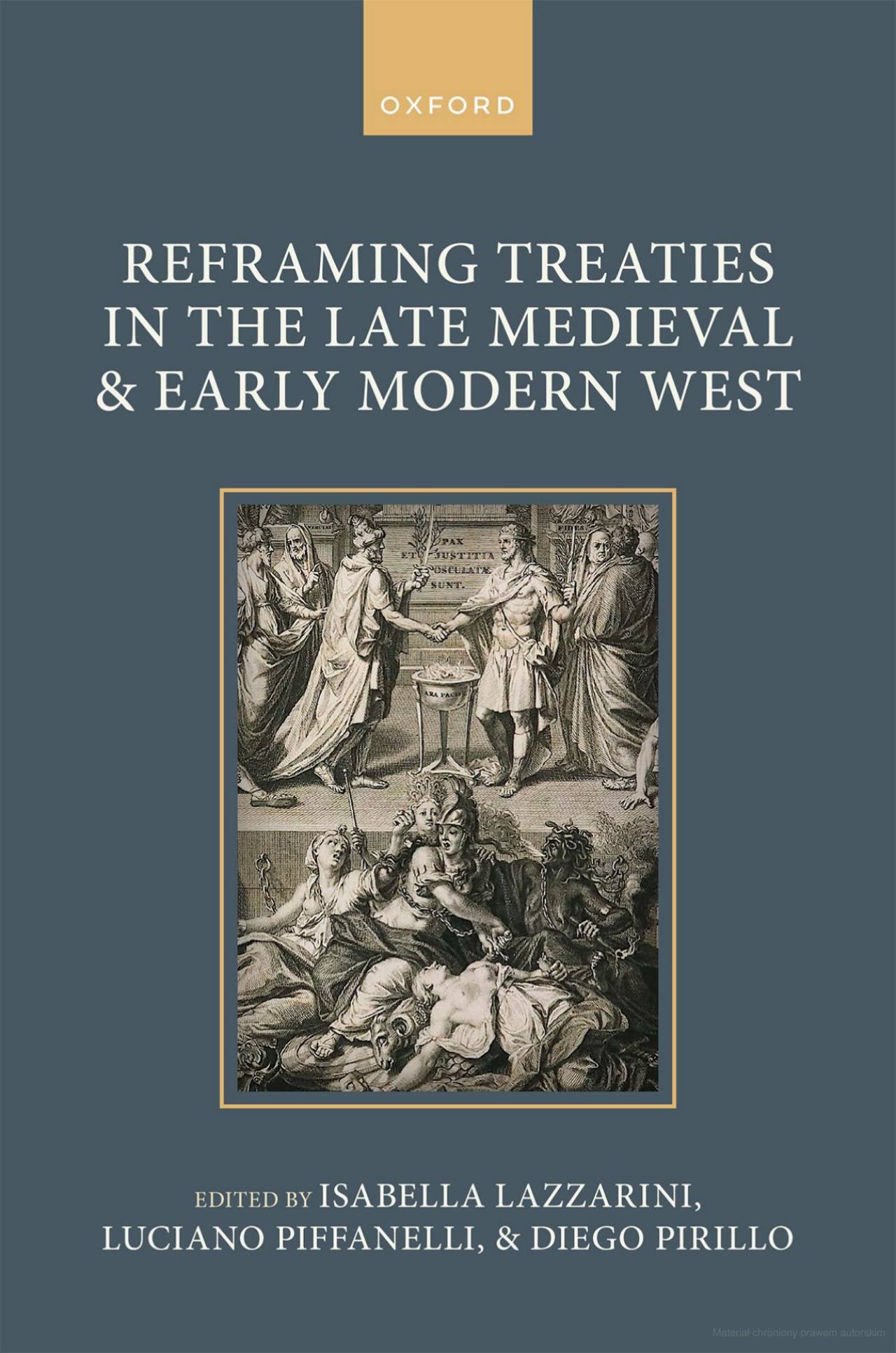
Table des matières :
The Political Grammar of Agreements in the Late Medieval and Early Modern West: An Introduction, Isabella Lazzarini, Luciano Piffanelli, and Diego Pirillo
Prologue: Sources and Text Tradition
1:Diplomatic Sources on Peacemaking in the Late Medieval and Early Modern West (14th-16th Centuries): Letters-Acts-Treaties, Néstor Vigil Montes
2:At the Roots of the History of Diplomacy: Writing, Preserving, and Publishing a Peace Treaty (1454/5-1735), Isabella Lazzarini
Peacekeeping: Political and Confessional Pacts
3:Keeping the Peace and Defending Christendom: The Shaping of the Holy Roman Empire as a Treaty-Based Multilateral Order (14th-16th Centuries), Duncan Hardy
4:Peace and Territory in the Burgundian and Habsburg Low Countries: The Post-Revolt Settlements of 1421-1427 and 1576-1577, Bram De Ridder
5:Giving the Heretics a Stand: The ‘Compacts’ and ‘Concordats’ of Jihlava (Basel) in the Long Struggle for a Peace Agreement between the Roman Church and Bohemian Hussites (1436), Klára Hübner
6:Peacemaking as a Written Work in Progress: Texts and Players (Italy, 15th-16th Centuries), Francesco Senatore
7:Dealing with a Discordant Hydra: Members of the Swiss Confederation in a Constant Struggle for Good Neighbourly Relations, Heinrich Speich
8:Peacemaking in the Context of Religious Violence: The Edict of Nantes and the Fragility of Conflict Resolution, Brian Sandberg
Peacemaking: Foreign Relations and Religious Treaties
9:From Tlemcen to Pisa: Negotiating the Peace in 1358, Mohamed Ouerfelli
10:A Century of Failure? Making Peace in the Hundred Years War, David Green
11:Negotiating for Peace and Trade with the Mamluks: From Truce to Decree, Frédéric Bauden
12:Invisible Treaties: The Governors of Algiers and the Strategic Use of Peace Negotiations during the 16th-Century Ottoman-Habsburg Mediterranean Struggle, Francesco Caprioli
13:On the Diplomatistic Nature of the Treaties of Cateau-Cambrésis (1559): Rule or Exception?, Roseline Claerr
14:On the Failure of Treaties: Bristol 1575, John Watkins
Intersections: Law, Literature, Ethics, Philosophy, and Peacemaking
15:Negotiation, Peacemaking, and Treaties: An Early Medieval Perspective, Jenny Benham
16:Peacemaking in Late Medieval Ius Commune, Dante Fedele
17:Signed, Sealed, Delivered: Ratification, Delay, and the Time of Tragedy, Timothy Hampton
18:The Bridge of Peace: Religious Peace, Oblivion, and the Sovereign’s Clemency, Michaela Valente
19:Peace and Treaties in the Political Thought of Francis Bacon, Samuel Garrett Zeitlin
20:’The Resurrection of a Body Whose Limbs Were Extremely Dispersed’: Reframing Peace and Peace Treaties in Leibniz’s Work (17th-18th Centuries), Luciano Piffanelli
21:Negotiating on the Frontier: Indian Treaties and the Republic of Letters, Diego Pirillo
Epilogue: Afterlives
22:Remembering Westphalia: Rights Talk in Times of ‘Domestic Jurisdiction’, 1648 and 1948, Jane O. Newman
Informations pratiques :
Reframing Treaties in the Late Medieval and Early Modern West, éd. Isabella Lazzarini, Luciano Piffanelli, Diego Pirillo, Oxford, Oxford University Press, 2025 ; 1 vol., 512 p. ISBN : 978-0-19895-847-5. Prix : GBP 119,00.
Source : Oxford University Press





 L'Agenda des Médiévistes
Vous devez être connecté pour poster un commentaire.