
The 22th Meetings of Medieval History in Najera want to expose how people with disabilities were perceived and treated in medieval society, as well as the forms of integration from a comparative perspective between European and Islamic world cities.
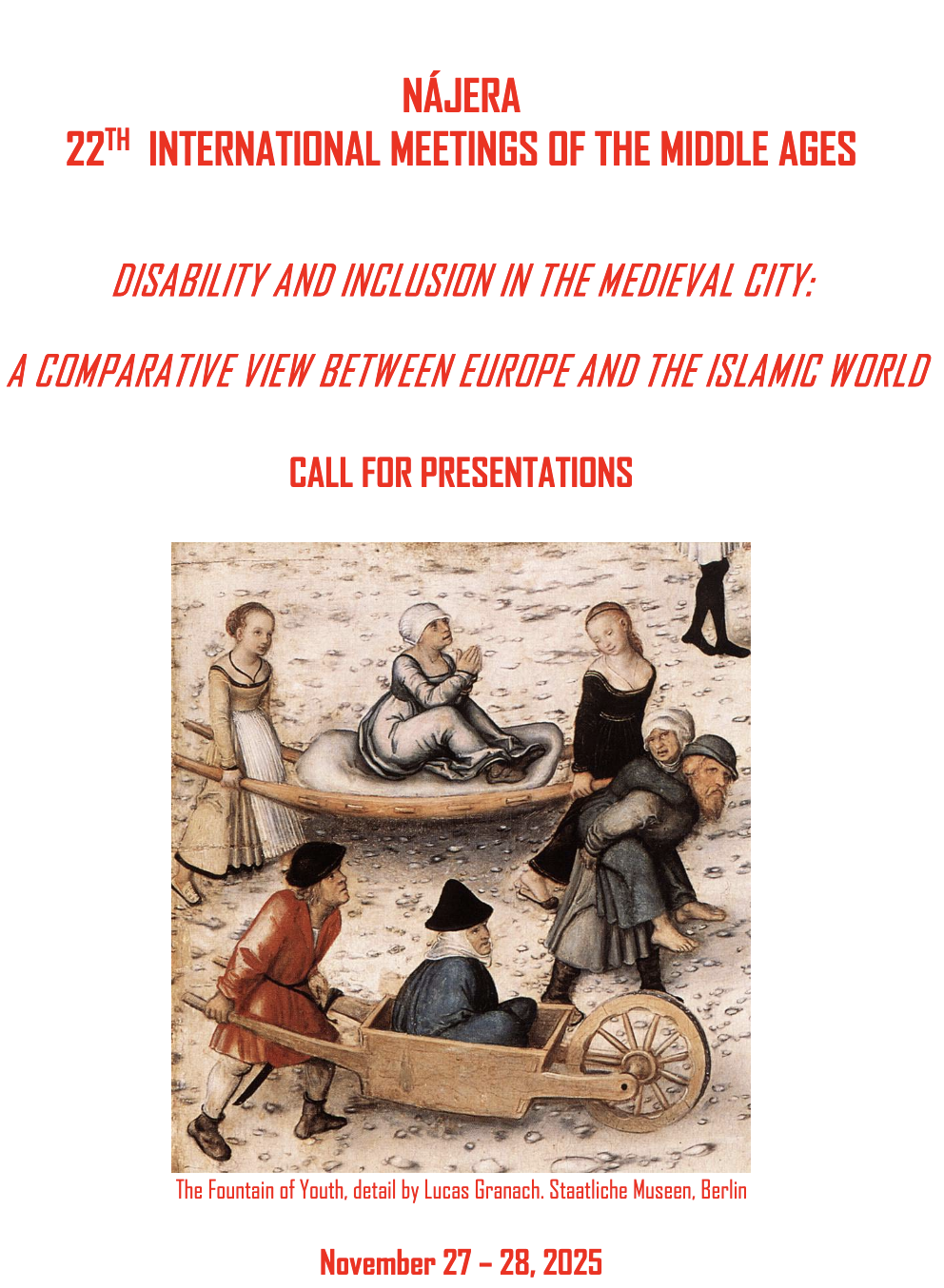
In the Middle Ages, the lives of people with disabilitiespresented unique challenges. These 22th Meetings want to expose how these people were perceived and treated in medieval society, as well as the forms of integration from a comparative perspective between European and Islamic world cities.
In the Middle Ages, the perception of disability was influenced by religious beliefs and superstitions. Disability was often seen as divine punishment or a test of faith. However, there were also attitudes of compassion and charity, promoted by the religious and secular institutions, that urged society to care for the most vulnerable.
Despite social barriers, people with disabilities found ways to integrate into urban life. Some of the ways they participated in the economy and society included:
- Work and job opportunities: People with disabilities often engaged in trades that did not require great physical mobility, such as artisans, weavers, teachers, sellers, buffoons …
- Begging and charity: Begging was a common form of subsistence for many people with disabilities who were unable to work. Charity was seen as a religious virtue, and citizens were encouraged to help those in need.
- Sense of belonging: Charitable institutions provided not only material assistance, but also a sense of community and belonging.
Even though the forms of inclusion, people with disabilities faced numerous barriers and challenges:
- Stigmatization: Disability often carried a social stigma. Persons with disabilities could be mocked or discriminated, and in some cases, were marginalized from public life.
- Limited access to resources: People with disabilities relied heavily on charity, resulting in unsafe lives.
- Mobility and accessibility: Medieval cities were not designed to be accessible. The cobblestone streets, stairs and lack of adequate infrastructure made it difficult for people with disabilities to move around.
Thus, people with disabilities and their social inclusion in the medieval city was a complex and multifaceted process. Although they faced numerous challenges and barriers, they also found ways to integrate into urban life through work, charity, and religious institutions. The perception of disability was influenced by religious and social beliefs, which could be both limiting and facilitating inclusion. At these meetings we also intend to analyse the similarities and differences of the social inclusion of people with disabilities in European and Islamic cities.
Among thetopics that will be discussed in the meetings are:
- Legislation and rights: Laws and regulations affecting persons with disabilities and their inclusion in society.
- The historical, literary and iconographic sources for the knowledge of disability in the Middle Ages.
- Charitable and welfare institutions: The role of hospitals, churches, mosques and monasteries in the care of people with disabilities.
- Guilds and social assistance: guilds provided support to their disabled members, such as financial aid or care in case of illness.
- Economy and work: The job opportunities and works that people with disabilities could access.
- Everyday life and mobility: The difficulties and adaptations in daily life and mobility within medieval cities.
- Stigmatization and discrimination: Social attitudes towards persons with disabilities and mechanisms of exclusion and discrimination.
- Disability and social group: The differences between people with disabilities in the elites and those in the rest of urban society were marked due to access to better medical care, food, and economic resources.
- Disability and gender: The gender of women and affective sex minorities interacted with disability to face a double stigma and shape their lives differently
- Support and solidarity networks: The forms of community support and solidarity networks that helped people with disabilities.
- Education and training: The educational and training opportunities available to people with disabilities.
- Religion and spirituality: The role of religion in the lives of persons with disabilities and how it influenced their social inclusion.
- Specific case studies: Analysis of specific cases of people with disabilities and their integration in different medieval cities from a comparative European and Islamic perspective. Instituciones laicas.
- Ports and persons with disabilities: In the dynamic and competitive environment of ports, persons with disabilities often faced a double exclusion: because of their status and because of their inability to actively participate in maritime or commercial activities, but they were also points of departure and arrival for pilgrimages to holy places in search of healing or in the hope of accessing spiritual or material resources elsewhere.
Presentation proposals (face-to-face and virtual modalities)
The deadline for submission of proposals for presentations will end on October 13, 2025.
Participants must send the presentation proposal with the following information: name and surname, email, thematic axis, abstract of the communication of maximum 250 words, which must include objectives, sources, methodology and contribution, as well as a brief CV (250 words), The proposal and the brief CV must be sent to the email address: neim@unican.es
The Directorate of the International Medieval Meetings of Nájera adheres to the Helsinki Initiative (2019) on multilingualism in Scientific Communication. The scientific languages of the meetings are Spanish, French, German, Portuguese, Italian and English, although communications in other languages may be accepted, depending on the quality of the communication proposal.
The Meetings will be held in person. The virtual modality will only be reserved for those communicators who reside outside the Iberian Peninsula.
Each speaker will have 20 minutes to make their presentation and, mandatorily, the Power Point must be written in English.
The criteria for the selection of proposals will be based on quality, originality, and those presented in person.
Presentations, which are approved by external peer-reviewers, will be published in a monographic book.
Award
The « Prof. Teófilo F. Ruiz Medieval History Award » will be granted to the best presentation.
Grants
PROF. TEÓFILO F. RUIZ GRANTS (UCLA) and SPANISH SOCIETY OF MEDIEVAL STUDIES (SEEM) grants
Speakers and attendees in person may request the following grants:
- Prof. Teófilo F. Ruiz (UCLA) Grants: neim@unican.es
- SEEM Grants: info@medievalistas.es
Registration and attendance
Registration for attendees (except speakers) must be made
before November 25,
sending the name and surname, address and email to: neim@unican.es.
Face-to-face attendance will entitle you to a diploma of attendance, which may be validated for 1 ECTS credit (25 hours) according to the regulations of each university.
Virtual attendance will only entitle you to the diploma of participation.
Secretariat
- University of Cantabria. Dpt. Ciencias Históricas. Office 160. Av. de los Castros s/n. 39005. Santander. Cantabria. Spain. E-mail: neim@unican.es
Source : Calenda






 L'Agenda des Médiévistes
Vous devez être connecté pour poster un commentaire.