
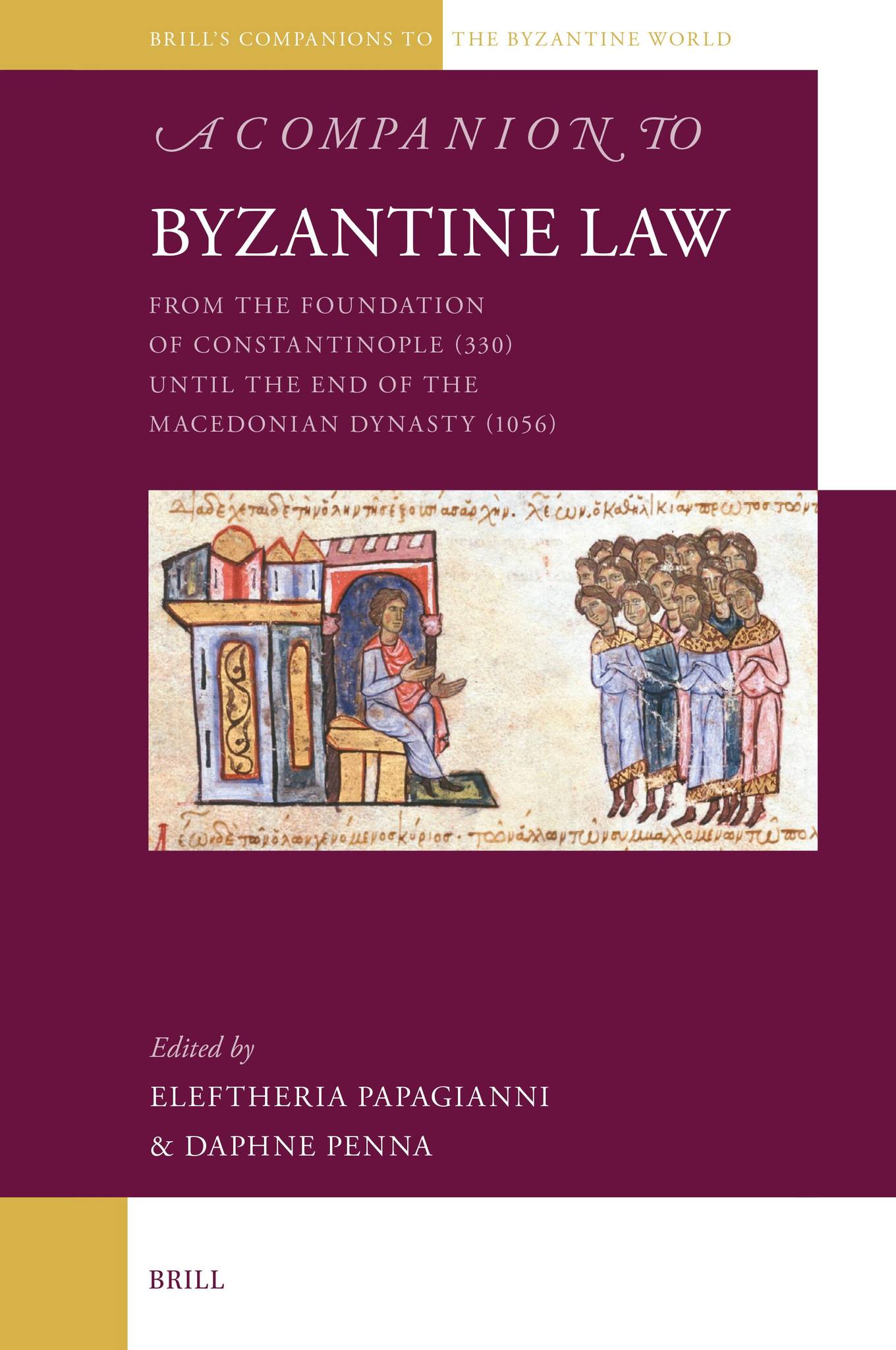
The so-called Byzantine Empire, which existed for more than a thousand years with Constantinople as its capital, demonstrates the birth of a new world with the wedding of Western and Eastern traditions. This study of Byzantine legal texts, mainly from the 6th to the 11th centuries, illustrates this clearly, following the evolution of Roman law into Byzantine law. By outlining and analysing the influence of various historical, social, and religious factors on this progression, the present handbook not only presents a condensed picture of the evolution of law in the area beyond the Adriatic Sea, but also indirectly sheds light on Byzantine society more broadly.
Table des matières : ici
Eleftheria Papagianni is Professor Emerita of Legal History at the National and Kapodistrian University. She participated in an international research project at the Max Planck Institute for European Legal History to republish the Byzantine legal sources of the Göttingen Academy of Sciences and served as the project’s director from 2008 to 2011. She is the author of numerous books and articles, mainly on Byzantine civil law.
Daphne Penna is Assistant Professor of Legal History at the University of Groningen and Associate Professor of Roman Law at KU Leuven. She is the author of The Byzantine Imperial Acts to Venice, Pisa and Genoa, 10th-12th Centuries: A Comparative Legal Study (The Hague, 2012) and co-author of A Sourcebook on Byzantine Law: Illustrating Byzantine Law through the Sources (Leiden, 2022). She has published extensively on Roman and Byzantine law, and especially on their influence on the European legal tradition.
Informations pratiques :
A Companion to Byzantine Law. From the Foundation of Constantinople (330) until the End of the Macedonian Dynasty (1056), éd. Eleftheria Papagianni, Daphne Penna, Boston–Leyde, Brill, 2025 ; 1 vol., XXI–392 p. (Brill’s Companions to the Byzantine World, 15). ISBN : 978-90-04-73191-2. Prix : € 236,00.
Source : Brill






 L'Agenda des Médiévistes
Vous devez être connecté pour poster un commentaire.