
In the fifteenth century, Renaissance humanists were not the only ones to think about time differently from previous generations. Time and Governance examines how and why late medieval townspeople – those who bought, sold, and manufactured for a living – reconceptualized time and applied their new understanding of it to politics and to economics. In doing so, this book reconstructs and analyses a place and time both unexpectedly familiar and deeply alien. Blending institutional history with the history of mentalities, Philip Daileader engages with issues of state building, finance, production, social conflict, national identity, and demography. He addresses the question of whether late medieval Europe deserves its often-grim reputation by recapturing and prioritizing the life experiences, thoughts, and opinions of those who lived then and there.
- Shows that burghers, merchants, and tradespeople adopted a relativistic view of time during the fifteenth century and demonstrates its application in the areas of government and economics
- Sheds light on what tradespeople did with political power acquired not through insurrection, but through political manoeuvre
- Blends traditional institutional history with the history of mentalities
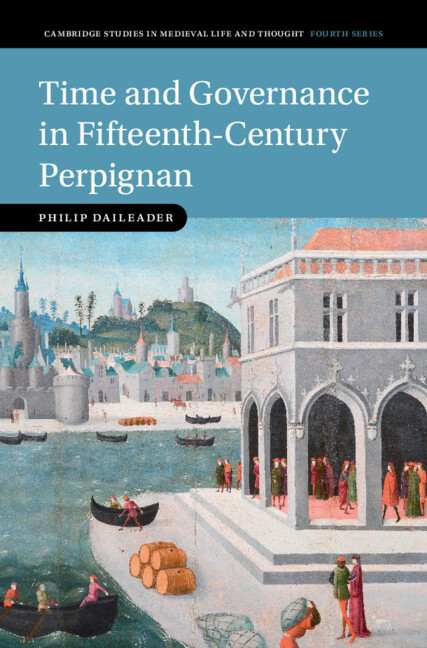
Table des matières :
List of tables
Acknowledgments
A note on names
List of abbreviations
Introduction
1. Depopulation, debt, and distrust
2. Representation, choice, and rule
3. Production and prosperity
4. Municipal citizens, royal subjects, and Catalans
5. Conquest and repatriation
Conclusion
Informations pratiques :
Philip Daileader, Time and Governance in Fifteenth-Century Perpignan, Cambridge, Cambridge University Press, 2025 ; 1 vol., 258 p. (Cambridge Studies in Medieval Life and Thought: Fourth Series). ISBN : 978-1-00960-180-1. Prix : GBP 95,00.
Source : Cambridge University Press






 L'Agenda des Médiévistes
Vous devez être connecté pour poster un commentaire.