
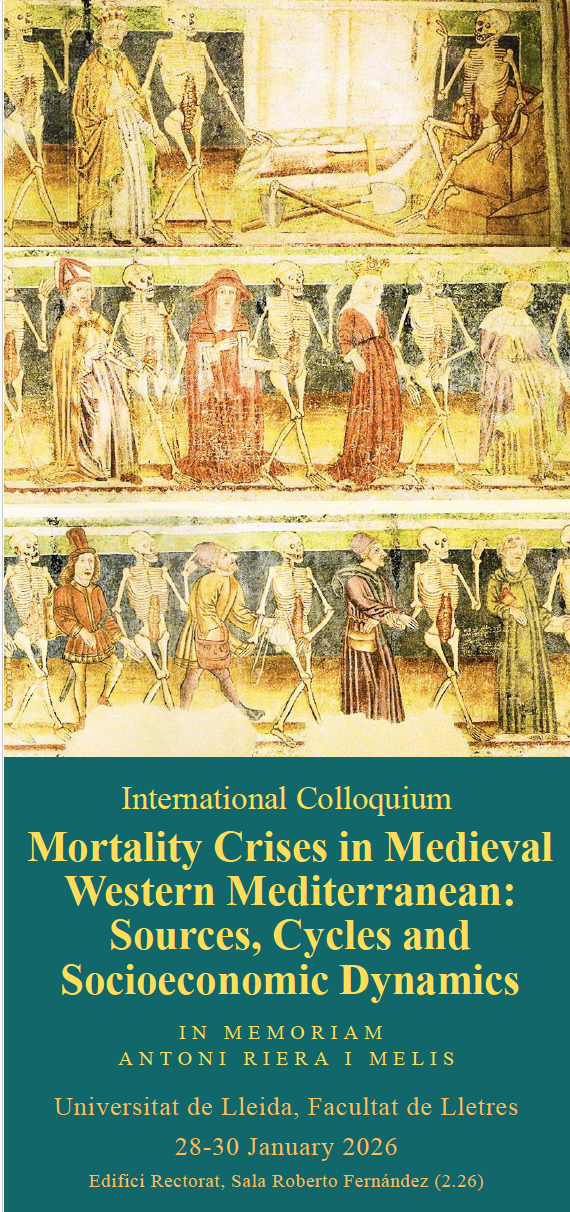
This colloquium will focus on some of the fundamental aspects of mortality crises recorded in the western Mediterranean during the medieval period. More specifically, it will address the sources and the initial results of the reconstruction of those cycles in which mortality exceeded ordinary levels as a consequence of sudden events such as epidemics, famines, wars, or natural disasters.
To this end, the scope and limitations of primarily documentary sources providing either direct or more indirect evidence of this sequence of phases of abnormal mortality from the late thirteenth century to the early sixteenth century will be assessed, with particular attention paid to those arising from plague outbreaks and other diseases. This will include obituary books, burial records, and death registers, as well as series of wills and other types of documents such as official correspondence and narrative and iconographic sources. These materials come from a wide range of territories across the northwestern Mediterranean arc, extending from the Italian peninsula to Iberia.
At the same time, the analysis of the factors and dynamics involved in these mortality crises in these same territories will be initiated, alongside an examination of their effects on various socio- economic phenomena. The latter encompasses from the general functioning of the economy to specific markets such as labour and slave markets, levels of inequality, and even the impact of excess mortality as a driver of cultural change.
Programme :
28 January
16h00 — Welcome and Introduction.
1st Session
Chairs: Pere Benito i Monclús (Universitat de Lleida) and Sandrine Victor (Institut Nationale Universitaire Champollion, Albi)
16h45 — Vicente Pérez-Moreda (Universidad Complutense de Madrid – Real Academia de la Historia)
Topics deserving further research: a reexamination of primary sources and modern studies on the arrival and spread of the Black Death in Europe, 1347-48
17h30 — Folco Vaglienti, Carolina Manfredini, Mirko Mattia, Cristina Cattaneo (Università degli Studi di Milano)
The Milan Death Registers (1451-1524). The nature of the source, an overview of the situation and research prospects
18h15 — Break
18h45 — Lorenzo Freschi (Scuola Normale Superiore, Pisa)
Obituary books between general and local perspectives. The overview of northern Italy and the Friuli case study (14th- 16th centuries)
19h30 — Claire Clément (Université Avignon)
Des testaments pour faire l’histoire de la peste : retracer les vagues épidémiques à Marseille au XVe siècle
29 January
2nd Session
Chair: Pere Verdés Pijuan (Institució Milà i Fontanals – CSIC)
9h00 — Abigail Agresta (The George Washington University)
Plague, News, and Rumor in the Crown of Aragon: The 1510 ‘Plague of Bugia’
9h45 — Milena Viceconte (Universitat de Lleida)
‘Fue esta imagen prodigiosa remedio a tanta dolencia’: Devotional Images of Our Lady against the Plague in Early Modern Valencia
10h30 — Break
11h30 — Guided visit to the Cathedral (Seu Vella) of Lleida by Joan Josep Busqueta Riu (Universitat de Lleida)
13h30 — Lunch
3rd Session
Chairs: Vicente Pérez-Moreda (Universidad Complutense de Madrid – Real Academia de la Historia) and Marcelo Cândido da Silva (Universidade de São Paulo)
15h30 — Alberto Barber Blasco, Joan Busoms Cabanas, Pere Benito i Monclús, Albert Reixach Sala (Universitat de Lleida)
Sources for the study of mortality crises and epidemics in the Late Medieval Crown of Aragon (1): burial records and last wills
16h15 — Carmel Ferragud Domingo (Universitat de València), Ignacio Nebot Segarra (Universitat de Lleida)
Sources for the study of mortality crises and epidemics in the Late Medieval Crown of Aragon (2): The Chancellery registers and other royal sources
17h00 — Break
17h30 — André Filipe Oliveira da Silva (CIDEHUS – Universidade de Évora)
From ‘Finis terrae to Caput mundi’: Mortality crises in Portugal from the 11th to the 16th Centuries. Sources, methods and challenges
18h15 — Sandrine Victor (Institut Nationale Universitaire J. F. Champollion, Albi)
Des pratiques testamentaires particulières en temps de crise? Le cas des artisans géronais
19h00 — Lucas Fassio (LaMOP, Université Paris 1 Panthéon- Sorbonne/CNRS)
Demography and Memory of the Black Death: A Case Study (Ganges, Languedoc, 1348 and Beyond)
30 January
4th Session
Chairs: Alexis Wilkin (Université Libre de Bruxelles) and Albert Reixach Sala (Universitat de Lleida)
9h00 — Samuel K. Cohn (University of Glasgow)
New Evidence of the Black Death’s impact on popular culture and piety
9h45 — Philip Slavin (University of Stirling)
Plague Reservoirs and Waves in the Mediterranean during the Earlier Stages of the Second Pandemic, c.1347-1520: A New Database Approach
10h30 — Break
11h00 — Pere Verdés Pijuan (Institució Milà i Fontanals – CSIC, Barcelona), Laura Miquel Milian
Epidemics, inequality, and social mobility in Catalonia (fourteenth-sixteenth centuries)
11h45 — Alberto Luongo (Università degli Studi di Roma Tor Vergata)
Mortalilty crises, economy and society: the case of Italy after the Black Death (1350-1400)
12h30 — Iván Armenteros Martínez (CAIMMed, Institució Milà i Fontanals – CSIC, Barcelona)
Epidemics and Slave Markets in the Christian Western Mediterranean (ca. 1350-1500)
13h15 — Conclusive round table:
Marcelo Cândido da Silva (Universidade de São Paulo) Alexis Wilkin (Université Libre de Bruxelles), Carmel Ferragud Domingo (Universitat de València) Guillem Roca Cabau (Universitat de Lleida)
Informations pratiques :
Faculty of Arts of the University of Lleida
Wednesday 28 to Friday 30 January 2026




 L'Agenda des Médiévistes
Vous devez être connecté pour poster un commentaire.