
Barcelona
May 13t h · 15t h 2026
Open until
February 14 2026
arditcongress2026@gmail.com
At the end of the 11th century, Guilhem de Peitieu inaugurated troubadour lyric poetry with a verse of dreit nein, that is, a composition about absolutely nothing, pushing the boundaries of language under the sign of paradox, enigma, and emptiness. In this way, the first troubadour echoed a problem that obsessed
medieval theology: the creatio ex nihilo described in the first verse of Genesis. Surely, the most famous
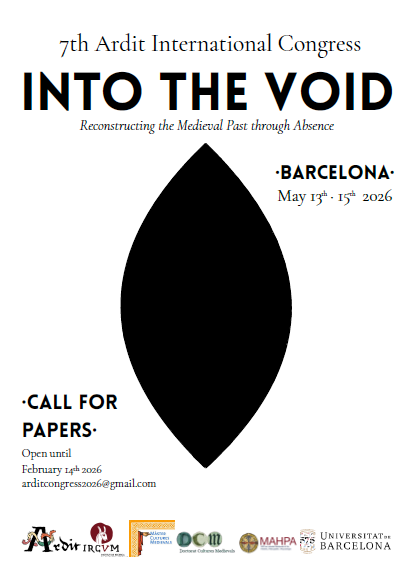
example of this controversy is the treatise De substantia nihili et tenebrarum, in which the Carolingian cleric Fredegisus of Tours (9th century) defended the existence of Nothingness as an ontological entity from which God had created the world. In illuminated bibles, this primordial emptiness could be represented, as in the Kaisheim Bible (c. 1275), as an unpainted, empty, and perfect medallion that stands out amidst the folio’s decorative profusion and inevitably draws the reader’s attention. This absence, paradoxically, is full of meaning, for it exists between silence and word, between emptiness and substance, between aniconism and figuration.
Absence, therefore, is not a fatality. Today, historians, philologists, and archaeologists have found in
absence a valuable element for studying and understanding the Middle Ages. Far from being an obstacle
or impediment to research, absence has boosted our knowledge of the material culture, visual and textual discourses, mentalities, social organization, and documentary production of this period. Besides, absence is not a neutral concept, since it can be the result of chance or deliberate intent. Thus, gaps intentionally left in manuscripts and works of art reveal the artistic sensibility of their creators, while the destruction of documents in medieval archives betrays a subtle construction of a particular narrative.
On the other hand, the groups that are absent, rendered invisible, or marginalized in official sources allow us to delve into the deep inequalities of medieval society, its prejudices, and its identities. Likewise, the omission of certain genres, themes, or languages in the great songbooks and literary manuscripts offers a new perspective on the textual transmission of medieval literature, which is never a neutral process nor detached from hegemonic ideologies. In this sense, the presence of « vestiges » or traccie in known texts has led some scholars to reconstruct lost or poorly preserved literary traditions, a process not without risks and controversies. Finally, absence is a problem that also affects the contemporary world, since medieval heritage is continually threatened by processes of destruction and manipulation driven by political, economic, or identity-related motives. Ultimately, absence serves to create new meanings, new clues, and new ways of understanding the past and the present.
The organizers of the VII ARDIT International Congress welcome submissions of papers related to the
uses, effects, and meanings of absence in the Middle Ages. Participants are encouraged to submit
proposals on Medieval History, Art History, Archaeology, Philology, and Philosophy. Proposals may
relate to the following thematic areas: see File
Proposals must be submitted by February 14, 2026, in Word format, to the following address: arditcongress2026@gmail.com. All proposals will be reviewed by the scientific committee, and presenters will be notified by the end of February 2026 whether their proposal has been accepted.
Structure of the proposals
Name and surname
Academic affiliation
Contact information (email, phone)
Brief presentation of the researcher (50-75 words)
Title of the communication
Abstract of the proposal (150-200 words)
*This abstract should include a specific description of the topic to be addressed and should clearly explain how it relates to the theme of the conference.
Keywords (maximum 5)
Mode
All presentations will be held in person at the University of Barcelona. They will last 20 minutes.
Online presentations will not be accepted.
Languages
English, Catalan, Spanish, French, Italian.






 L'Agenda des Médiévistes
Vous devez être connecté pour poster un commentaire.