
International Conference
Madrid, October 26-28, 2026
Versión en español: Congreso Vasallos y Señores Call for Papers
PRESENTATION
Although the study of the Middle Ages has traditionally been approached through the prism of kingship and influenced by a State-centric nationalist logic, the decentralized nature of medieval power obliges the historian to broaden the scope of analysis, add nuance to conceptual terminology and remain mindful of this inherent trait. The conference focuses specifically on examining the relations between vassals of different religions and their lords, rather than the more common focus of relations between nobility and monarchy, although this interdependent dynamic must not be ignored as it also conditions interactions with vassals.
The geographical framework of the conference will consist of the Iberian kingdoms: Portugal, Castile, Navarre, as well as the Crown of Aragon with its extensive Mediterranean possessions. Despite important variations in jurisdiction and lordly authority throughout these regions, they offer certain common historical features that allow for a coherent comparison. Furthermore, the conference focuses on the late Middle Ages –from the thirteenth to the fifteenth centuries– to encompass the period in which the seigneurial system came to fruition.
In the context of the late medieval western Mediterranean, there were many types of lordships –noble, ecclesiastical, military orders– and the jurisdiction vested in the lords varied considerably by kingdom and according to royal concessions. Similarly, the social and legal standings of vassals were also shaped by various parameters, notably religious identity and the authority the town councils exerted over them. The category of vassals encompasses both rural peasantry and town-dwellers who were structured hierarchically, with a Christian elite that slowly came to monopolize most offices in municipal councils and took precedence over the Muslim and Jewish communities. These town councils functioned as institutionalized actors that –at least in theory– represented the interests of the vassals while simultaneously mediating the commands of their lords. Similar dynamics are to be found in the relationship between lords and their Muslim and Jewish vassals –where these exist, as well as within their political organizational entities known as aljamas or comunas. Collectively, these factors defined the complex relationships between lords and their subjects that are still insufficiently studied.
Debating the dynamics that arose between vassals of different religions and their lords can shed light on the multifaceted nature of power in the late medieval western Mediterranean. What constituted the legal and symbolic foundations of lordly power in this period? Through what mechanisms and rituals did lords display and enforce their authority? How did lords negotiate authority with Christians, Muslims and Jews? To what extent did vassals of each religion exercise agency, whether individually or collectively? To what degree were community institutions –be they Christian, Jewish or Muslim– vehicles for community representation or instruments of seigneurial control? How did horizontal dynamics –including cooperation and conflict between town councils and minority communities– shape or constrain lordly authority over their vassals?
This international conference aims to explore these issues and establish a dialogue among senior scholars and early-career researchers from various disciplines privileging a multidisciplinary focus.
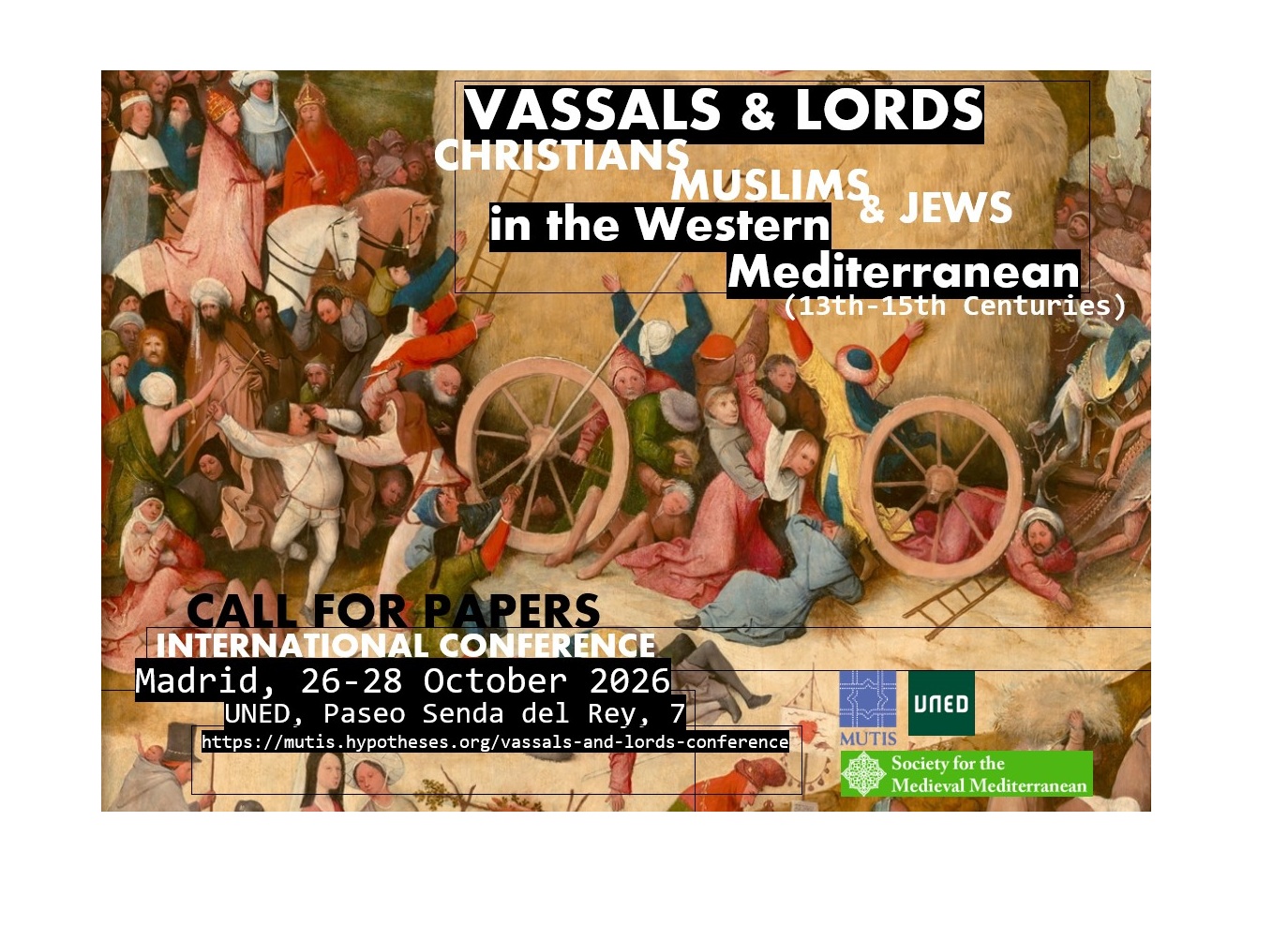
CALL FOR PAPERS
Main Thematic Sections
The congress will focus on the following issues concerning the relationships among vassals and lords:
1. LATE MEDIEVAL VASSALAGE AND LORDSHIP. THEORY AND METHOD
This thematic block examines the main theoretical issues concerning medieval lordship. Furthermore, it will also cover the origins of seigneurial lordships in the Iberian kingdoms and its Mediterranean realms and how they took on various forms.
-Foundations of Vassalage and Lordship
-Divergences and Convergences among the Seigneurial Models in the Different Kingdoms
-Devolution of Authority over Religious Minorities from Monarchs to Lords
2. REPRESENTING THE LORD AND THE VASSAL: DISCOURSES, IMAGES AND SYMBOLISM
This section examines the exercise of power within lordships through its ceremonial, textual and artistic manifestations. It explores communicative strategies employed by both the lord and those vassals capable of self-representation, such as through municipal, guild or confraternity commissions.
-Charters, Rituals, and Ceremonies
-Literature, Art, and Architecture
3. DYNAMICS AND EXERCISE OF POWER IN LORDSHIPS
This session focuses on the ability of lords to exercise their authority over their vassals in a delegated political system.
-Gender and Lordship: Ladies as Lords of Vassals
-Lords, Vassals (Christian, Jewish, Muslim) and Royal Power
-War and Auxilium: Obligations of Vassals towards their Lords
4. CHRISTIAN, MUSLIM AND JEWISH MUNICIPAL BODIES AND AGENTS IN THE LORDSHIP
In this session, the multidirectional relationships between the lord, municipal institutions and other interlocutors will be examined. These include conflicts, negotiations and joint actions.
-Justice and Legal Pluralism
-Interferences and Appeal to Royal Power by Lordship Vassals
-Agency, Resistance, and Negotiation of Vassals in Lordships
-The Economics of Vassalage: Rents, Tributes and Toil
Date and Place: October 26-28, 2026.Faculty of Geography and History,Humanities Building, Hall B, UNED. Paseo Senda del Rey 7. Madrid
Guidelines for Proposals
Papers shall have a duration of 20 to 30 minutes, and may be presented in English, Spanish, French, Catalan, Portuguese and Italian. Each panel will include a discussion of 30 minutes on the papers.
The proposals should be written in such languages and must contain approximately 300 words as well as 3-5 keywords. A short one paragraph biography is also recommended (max. 150 words). The deadline for the submission of proposals is 30 June 2026.
Please send the attached form to the following email address: congreso.medieval.uned@hotmail.com, specifying in the subject line of the email (Proposal – Vassals and Lords).
Proposals should include the following sections:
- Surname, Name:
- Research Institution:
- Email Address:
- Short Bio (max. 150 words):
- Title of Proposal:
- Keywords (3-5 words):
- Abstract (max. 300 words):
- Language of the paper:
- Bursary Application for Expenses: YES / NO
- Justification for Bursary, if applicable (max. 200 words):
Acceptance of proposals will be notified by 31 July 2026.
Proportional gender representation among seminar participants will be considered. Furthermore, proposals that take into consideration interdisciplinary approaches will be positively assessed.
Bursaries
We are hoping to receive financing to cover travel costs for early career researchers (ECR). In case of applying for the bursary, please provide a statement to justify that you lack other sources of funding.
ORGANISING COMMITTEE
- Marina Girona Berenguer. Postdoctoral Researcher at the Department of Medieval History and Palaeography, UNED (Madrid). mgirona@geo.uned.es
- Gonzalo Carrasco García. Postdoctoral Researcher at the Department of Medieval History and Palaeography, UNED (Madrid). Funded by the Research Project MUTIS, “Muslims in Lordship Lands in Medieval Iberia.” gonzalo.felix@geo.uned.es
SCIENTIFIC COMMITTEE
- Alice Kadri. Associate Professor. Université Paris-Nanterre (Francia)
- Ana Echevarría Arsuaga. Professor. Universidad Nacional de Educación a Distancia (UNED)
- Clara Almagro Vidal. Senior Postdoctoral Fellow. UNED
- Enrique Cantera Montenegro. Professor. UNED
- Juan Luis Carriazo Rubio.Professor. Universidad de Huelva
- M.ª Teresa Chicote Pompanin. Assistant Professor. Universidad Complutense de Madrid
- Thomas W. Barton. Professor. University of San Diego (USA)
- Víctor Muñoz Gómez. Associate Professor. University of Las Palmas de Gran Canaria
Source : MUTIS




 L'Agenda des Médiévistes
Vous devez être connecté pour poster un commentaire.