
Wars do not end when the weapons fall silent. Therefore, when dealing with war and armed conflict, it is necessary to consider their consequences. These can be divided broadly into the following three stages:
a) The immediate impact of armed conflicts
b) The mid- and long-term consequences of warfare
c) The long-term consequences.
The social groups to be examined in detail include not only soldiers, but also non-combatants affected by war, for instance women and children. The summer school therefore aims to shed light on aspects of war that are less frequently depicted in historical sources.
Three main focal points will be explored:
The immediate consequences in the course of war. These include, above all, issues such as quartering, impoverishment, displacement, captivity, hostage-taking and enslavement. It is also revealing to examine the fate and support of war widows and orphans from social and everyday historical perspectives, as well as from a legal point of view. This perspective also highlights those population groups which, although not directly involved in the fighting, are nevertheless affected by war.
The medium- and long-term aftermath of war. Combatants and invalids are reintegrated into society, victory or memorial celebrations are held, and monuments are erected. In the postwar period, different societal discourses on victory and defeat also emerge. At the same time, there exist longer-term consequences, such as those resulting from military occupation; this may include the settlement of new groups (e.g. veterans), which can have significant repercussions for societies and may in turn lead to rebellions against the conquerors. The aftermath of war also encompasses its impact on natural and environmental conditions.
Effects of war on the collective formation of groups and territories. Long-term consequences include institutional and ideological transformations, such as changes in taxation or landholding or the emergence of new shared identities, as well as the construction of new fortifications and the adoption of new military technologies shaped by wartime experience
The Summer School will include several thematic workshops, conducted by experts from Mainz University, the University of Cyprus and LEIZA (Leibniz-Zentrum für Archäologie). The workshop will consist of lectures and group work on relevant literature and source texts (in modern translation).
In addition, a number of short excursions in and around Mainz are planned.
APPLICATIONS
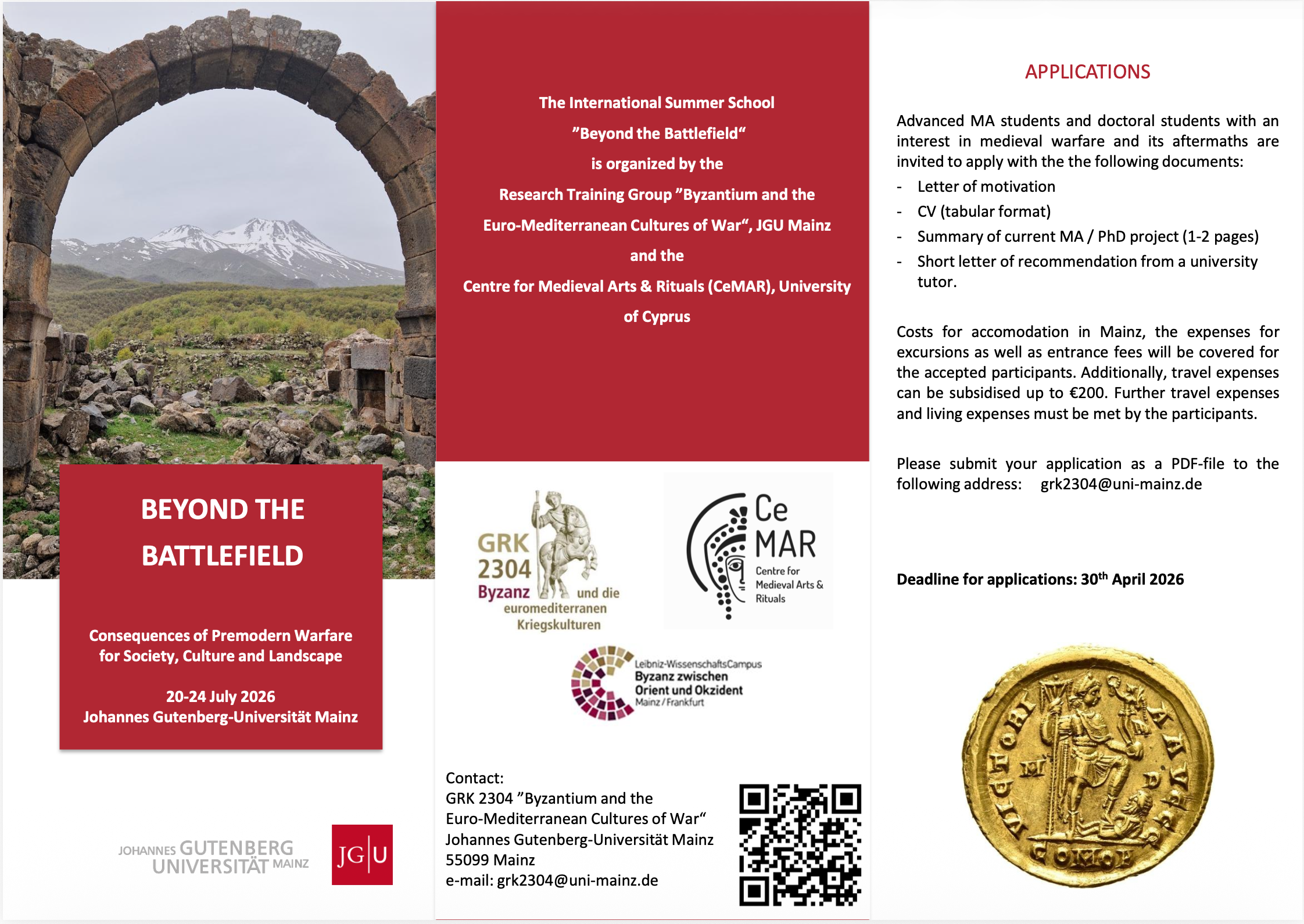
The International Summer School ˮBeyond the Battlefield“ is organized by the Research Training Group ˮByzantium and the Euro-Mediterranean Cultures of War“, JGU Mainz and the Centre for Medieval Arts & Rituals (CeMAR), University of Cyprus Advanced MA students and doctoral students with an interest in medieval warfare and its aftermaths are invited to apply with the the following documents:
– Letter of motivation
– CV (tabular format)
– Summary of current MA / PhD project (1-2 pages)
– Short letter of recommendation from a university tutor.
Costs for accomodation in Mainz, the expenses for excursions as well as entrance fees will be covered for the accepted participants. Additionally, travel expenses can be subsidised up to €200. Further travel expenses and living expenses must be met by the participants.
Please submit your application as a PDF-file to the following address: grk2304@uni-mainz.de
Deadline for applications: 30th April 2026
Source : Universität Mainz






 L'Agenda des Médiévistes
Vous devez être connecté pour poster un commentaire.