
Women played a crucial role in medieval and early modern urban economies, yet their labor opportunities varied greatly depending on local institutions. This book compares the guild-structured labor markets of Antwerp and Mechelen in Brabant with Bilbao’s informal economy in Biscay during the fifteenth and sixteenth centuries. By analyzing these distinct institutional contexts, it offers a multifaceted understanding of women’s economic roles in premodern Europe. Drawing on a wide range of legislative and judicial sources, Vandeweerdt demonstrates how legal frameworks, socioeconomic structures, and individual strategies shaped women’s activities in small-scale trade. Bridging institutional analysis and personal agency, Women and Work through a Comparative Lens sheds new light on the interplay between labor organization and everyday practices in premodern Europe.
Nena Vandeweerdt is a postdoctoral researcher who studies gendered socioeconomic interactions in late medieval and early modern towns. She holds a PhD in History from the KU Leuven and the University of Cantabria. Her work focuses on urban labor markets, everyday life, and the use of digital humanities in historical research.
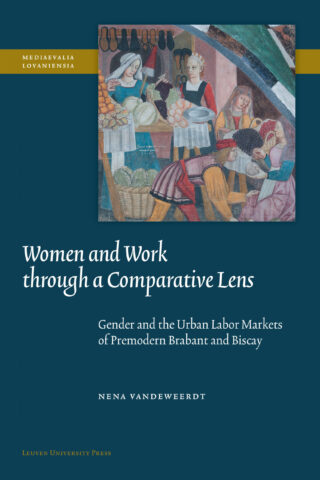
Table des matières :
List of Figures
List of Tables
Acknowledgements
Abbreviations
A Note on Numbers
Introduction. Comparing Women’s Work
1. Institutions and Their Impact: The Guild Debate
2. “How Society Worked”
3. A North-South Comparison
4. Mapping the Terrain: Biscay and Brabant
Bilbao
Antwerp
Mechelen
5. Sources
6. Chapter Organization
Chapter 1. Tracing Women’s Work
1. Female Labor Sectors, Women’s Work, and Town Ordinances
Bread Trade
Fish Trade
Itinerant Informal Traders
Merchants
Artisan Workers
The Hidden Workforce
2. Women’s Financial Status
3. Conclusion
Chapter 2. Shaping the Framework
1. The Household Economy in Brabant and Biscay
Widows
Spousal Cooperation
Never-Married Household Members
Shifting Away from the Household Paradigm
2. Craft Guilds: The Stronghold of the Brabantine Urban Economy
3. Operating Informally: Main Street or Margins?
4. Conclusion
Chapter 3. Limiting Women’s Work
1. Bilbao’s Council and the “Protection of the Consumer”
2. Brabantine Guilds and Town Councils
Economic Motivations, Gendered Outcomes
The ‘Guild Effect’
3. Growing Restrictions?
4. Conclusion
Chapter 4. Wielding the Framework
1. Influencing Regulation
Wielding Authority
Direct Influence
Consent, Bargaining, and Leverage
2. Going to Court
Biscayan Tradeswomen in Court
Risk-Taking and Forum Shopping
The ‘Poverty Argument’
Group Recognition
3. Conclusion
Understanding Women’s Work
Bibliography
1. Archival sources
Biscay
Brabant
2. Printed sources
Brabant
Biscay
3. Secondary sources
4. Digital sources
Index
Informations pratiques :
Nena Vandeweerdt, Women and Work through a Comparative Lens. Gender and the Urban Labor Markets of Premodern Brabant and Biscay, Louvain, Leuven University Press, 2026 ; 1 vol., 250 p. (Mediaevalia Lovaniensia 52). ISBN : 978-9-46270-494-7. Prix :€ 29,50.
Source : Leuven University Press






 L'Agenda des Médiévistes
Vous devez être connecté pour poster un commentaire.