Publication – C. Gaullier-Bougassas (ed.), « La fascination pour Alexandre le Grand dans les littératures européennes (Xe-XVIe siècle). Réinventions d’un mythe »

Cet ouvrage est la première étude d’ensemble du corpus européen médiéval sur Alexandre le Grand, de l’Espagne à la Russie, de la Grande-Bretagne à la Grèce byzantine.
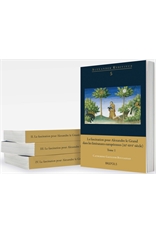
dIS-9782503549309-1La destinée d’Alexandre le Grand est à l’origine de l’un des mythes historico-littéraires qui a joui de la plus remarquable diffusion dans le temps et dans l’espace. Dans ce champ d’investigation très vaste, l’objet des trois premiers tomes de notre ouvrage n’est pas d’étudier la naissance de l’écriture sur le Macédonien, mais d’analyser comment la transmission et la réécriture des textes antiques en Europe, à partir du Xe siècle et jusque dans la première moitié du XVIe siècle, sont à l’origine d’une floraison d’œuvres littéraires qui montrent la création d’une figure médiévale et renaissante d’Alexandre, à la fois une et multiple. Le corpus choisi s’inscrit donc dans une longue durée – six siècles et demi– et il prend en compte les littératures de l’Europe occidentale (médio-latine, française, italienne, hispanique et aljamiada, hébraïque, anglaise, allemande, néerlandaise et scandinave) et celles de l’Europe orientale (slaves, avant tout tchèque, serbe et russe, byzantine avec son développement arménien). La nécessité s’impose en effet de dépasser les frontières entre les langues et les littératures, pour comprendre le sens des réinventions du mythe d’Alexandre à l’échelle du continent européen. Nos recherches ont permis d’analyser les modalités et les ressorts de cette effervescence créatrice sans précédent autour du souvenir d’Alexandre, de comparer les couleurs spécifiques de chacune des littératures européennes et de mettre au jour leurs interactions, en lien avec la naissance d’un vaste espace littéraire européen.

Le quatrième tome de notre ouvrage constitue un répertoire des principaux textes du corpus européen sur Alexandre, qui rassemble les données factuelles les plus importantes sur chacun d’entre eux, notamment la liste des épisodes narrés, les manuscrits conservés, les éventuelles traductions, adaptations ou continuations, et la bibliographie.

Cet ouvrage, réalisé par une équipe internationale et pluridisciplinaire de dix-sept chercheurs littéraires et historiens, dans un programme sélectionné par le Contrat Plan État Région (CPER), puis par l’Agence nationale de la recherche française (ANR), est la première étude d’ensemble du corpus européen médiéval sur Alexandre le Grand, de l’Espagne à la Russie, de la Grande-Bretagne à la Grèce byzantine.

Ouvrage publié avec le soutien de l’Agence nationale de la Recherche (ANR-O9BLANC-0307-01, projet CREAMYTHALEX), de la Région Nord Pas de Calais (CPER 2009-2010), de la Maison européenne des sciences de l’homme et de la société – MESHS (USR 3185), du CNRS et de l’Université de Lille 3.

Catherine Gaullier-Bougassas, ancienne élève de l’École Normale Supérieure, est professeur de langue et de littérature médiévales françaises à l’Université de Lille 3 et membre de l’Institut universitaire de France. Elle a publié de nombreuses études sur Alexandre le Grand et sur l’Orient dans la littérature française médiévale.

Informations pratiques :
C. Gaullier-Bougassas (ed.), La fascination pour Alexandre le Grand dans les littératures européennes (Xe-XVIe siècle). Réinventions d’un mythe, Turnhout, Brepols, 2015 (Alexander redivivus, 5). 4 vol., 2572 p., 156 x 234 mm. ISBN: 978-2-503-54930-9. Prix : 350 euros.

Source de l’information : Brepols
Publié dans Publications | Laisser un commentaire

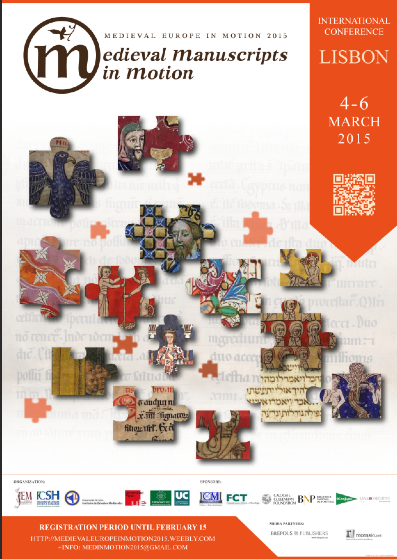
Colloque – Medieval Manuscripts in Motion

This International Conference aims to follow up the initiative « Medieval Europe in Motion: the circulation of artists, images, patterns and ideas, from the Mediterranean to the Atlantic coast », held in Lisbon in 2013 and organized by the Institute for Medieval Studies of the Nova University Lisbon.

With the aim of creating academic, scientific and organizational synergies, this second edition will be organized in collaboration with two other international institutions, the University of Cantabria and the University of León.

The main scientific of the event, as it was the previous conference, is to analyse the phenomenon of circulation, motion and mobility of people, forms and ideas during the Middle Ages. This time, however, the kind of works under consideration will be illuminated manuscripts. This three-day Conference aims thus to conduct a critical and constructive revision of research on Iberian Book Illumination in the Middle Ages, proposing new questions to be discussed.

Medieval Mss in motion

The works to be surveyed are manuscripts of all kinds, both in form and in content. Our intention is to discuss the following topics:

1) The phenomenon of mobility in Medieval times:
Why did it happen? Who travelled? Where did they travel? What reasons motivated the circulation of people? How did mobility influence, stimulate and condition the production of manuscripts?

2) Clients and promoters, both individual and institutional:
To what extent did their own travels and vital experiences influence their decisions when ordering new works? How did fashion and taste influence the promoters’ choices?

3) Material authors:
How did their itinerant lives influence their creations? To what extent was the production of new works conditioned by the presence of foreign scribes/illuminators in specific geographical contexts? How did they transfer models to new places/media? To what extent were they influenced by the models they saw when passing through other places/contexts and by the tradition they found when arriving at new places?

4) Models:
The concepts of copy, reinterpretation, reuse and re-elaboration will under discussion, as well as the confluence of several graphic languages in the same work; we will also address the influence of old models in later works.

5) Image performance:
Analysis of several concepts regarding the influence of the phenomena of circulation and mobility on the image performance – the agency, efficiency, effectiveness and power of the image, both in Medieval and later times.

6) Manuscript acquisition:
Regarding the postproduction process, that is the sale and circulation of already finished works, several matters will be approached, such as the artistic market, the existence of a luxury market in Medieval times, and the act of collecting manuscripts both in the Middle Ages and in later periods.

Programme : here

Informations pratiques :
March 4-6, 2015

Fundação Calouste Gulbenkian
Calouste Gulbenkian Foundation
Avenida Berna 45, 1067-001 Lisbon

Biblioteca Nacional de Portugal
National Library of Portugal
Campo Grande 83, 1749-081 Lisbon

Faculdade de Ciências Sociais e Humanas
Universidade Nova de Lisboa
Avenida Berna 26 C, 1069-061 Lisbon

Source de l’information : Medieval Manuscripts in Motion

Publié dans Colloque | Laisser un commentaire

Appel à contribution – The Church and War. Between the Early and Late Middle Ages

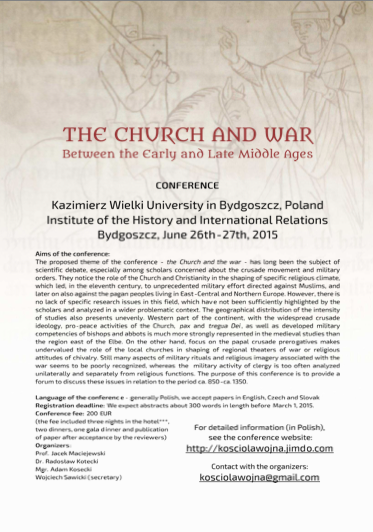
The Church and War. Between the Early and Late Middle Ages, to be held at Kazimierz Wielki University in Bydgoszcz, Poland, Institute of the History and International Relations, Bydgoszcz: June 26th-27th, 2015.

Church and WarAims of the conference:
The proposed theme of the conference – the Church and the war – has long been the subject of scientific debate, especially among scholars concerned about the crusade movement and military orders. They notice the role of the Church and Christianity in the shaping of specific religious climate, which led, in the eleventh century, to unprecedented military effort directed against Muslims, and later on also against the pagan peoples living in East-Central and Northern Europe. However, there is no lack of specific research issues in this field, which have not been sufficiently highlighted by the scholars and analyzed in a wider problematic context. The geographical distribution of the intensity of studies also presents unevenly. Western part of the continent, with the widespread crusade ideology, pro-peace activities of the Church, pax and tregua Dei, as well as developed military competencies of bishops and abbots is much more strongly represented in the medieval studies than the region east of the Elbe. On the other hand, focus on the papal crusade prerogatives makes undervalued the role of the local churches in shaping of regional theaters of war or religious attitudes of chivalry. Still many aspects of military rituals and religious imagery associated with the war seems to be poorly recognized, whereas the military activity of clergy is too often analyzed unilaterally and separately from religious functions. The purpose of this conference is to provide a forum to discuss these issues in relation to the period ca. 850-ca. 1350.

Language of the conference – mostly Polish, papers in English are welcome
Registration deadline: We expect abstracts about 250 words in length before March 1, 2015.
Conference fee: 200 EUR
(the fee included three nights in the hotel***, two dinners, one gala dinner and publication of paper)

For detailed information (in Polish), see the conference website:
http://kosciolawojna.jimdo.com

Additional informations:
Number of presentations: about 20 in two days
Time of the presentation: 20 minutes

Contact with the organizers:
kosciolawojna@gmail.com

Preferred topics of papers are:

– direct and indirect participation of the clergy in warfare
– Church armed clientele and fortified settlement in the light of written sources
– the use of weapons and armies by the clergy
– military service of the bishops to the rulers in the context of the servitium regis model
– bishops as defenders of the fatherland (defensio patriae) and the Church (defensio ecclesiae)
– clergy as war counselors and experts in military affairs
– military chaplains and their duties
– religious military rites or rituals
– imploring the favor of God by the clergy during battles
– saints as helpers in battles (Schlachtenhelfers) and other miraculous phenomena during battles
– crosses, relics and ecclesiastical banners as arma victricia / signa victoriae
– military liturgical equipment: portable altars, tents-capellae, carroccios
– war / battle as judicium Dei
– rituals of purification of the soul before and after battles
– the ritual of benediction of knights, soldiers and military equipment
– the Church and the Christian ethics of war
– the Church as an originator or enhancer of armed conflicts
– ecclesiastical idea of the social order as a concept legitimizing the use of violence
– crusade against the « evil Christians »
– categories of wars in the notion of the Church (bellum justum, bellum sacrum, bellum civile)
– references to the war and military campaigns in liturgical sources
– theological concepts of war and peace
– the preaching of the Crusades
– military aspect of the mission to the pagans
– war in canon law
– portray of war in medieval hagiography and ecclesiastical historiography
– religious motifs on the armor
– military connotations of clerical ministry and monastic identity (Deo Militare, arma spiritualis, etc.)
– war seen through the biblical history

Publié dans Appel à contributions | Laisser un commentaire

Cycle de conférences – Philosophie politique et pensée utopique

Université Catholique de Louvain
Louvain-la-Neuve, Place Cardinal Mercier 14
Le mardi de 16h15 à 18h15

En guise de préparation intellectuelle à l’Année Louvain des Utopies pour le temps présent (2015-16), le cours de Questions approfondies de philosophie politique (responsable: Philippe Van Parijs) accueillera cinq séances ouvertes au public intéressé.

Programme :

10/02/2015 (SOCR -240)
L’utopie dans la pensée antique et médiévale
Pierre Destrée et Jean-Michel Counet

17/02/2015 (SOCR 43)
L’Utopie de Thomas More et son contexte
Paul-Augustin Deproost et Hélène Haug

24/02/2015 (SOCR 43)
L’utopie d’Ernst Bloch à Hans Jonas
Mylène Baum et Nathalie Frogneux

3/03/2015 (SOCR 43)
L’utopie dans la littérature
Véronique Bragard et Pierre Piret

10/03/2015 (SOCR -240)
«Utopistes» et «anti-utopistes dans le débat sur la prostitution au début du 20e siècle
Jean-Michel Chaumont

Publié dans Colloque | Laisser un commentaire

Offre d’emploi – Chercheur postdoctoral : L’Édition italienne dans l’espace francophone à la première modernité

Un chercheur postdoctoral (CDD 12 mois)
Projet de recherche L’Edition italienne dans l’espace francophone à la première modernité
ANR-13-BSH3-0010-01

CESR_honorat-240x300

Missions et activités

La mission principale du post-doctorant sera de réaliser des enquêtes, pendant la durée du contrat (12 mois), essentiellement dans des bibliothèques françaises, bien que de missions ponctuelles en Suisse et en Belgique soient possible.

Le post-doctorant retenu aura également pour mission :
– d’adapter et d’être force de propositions sur les modalités d’enquête déjà mises en œuvre et à venir,
– de participer à la rédaction d’articles et de communications scientifiques issus de ces enquêtes,
– de concourir à la diffusion des résultats des recherches auprès de la communauté scientifique et du grand public, notamment par le biais de la base de données EDITEF (un outil biographique qui élabore les données relatives aux acteurs de l’essor de l’édition en italien dans l’espace francophone, mais aussi de la commercialisation de ces livres et de leur conservation)
– de façon ponctuelle, de collaborer à la gestion du projet et à l’échanges scientifiques avec les autres membres du consortium

Compétences demandées

Pour conduire à bien son activité postdoctorale, le candidat retenu devra être en capacité de mener des enquêtes dans des bibliothèques et des archives, et donc avoir un bon sens de l’organisation et une bonne autonomie. Il/elle devra en outre être capable de mener des recherches documentaires et bibliographiques en italien et en français ; il saura manier les outils informatiques et bibliographiques les plus courants, ainsi que les méthodologies propres à tout travail en histoire de livre et des idées ; il/elle aura une formation et une expérience scientifique dans le domaine concerné et il/elle sera à même d’intégrer l’équipe EDITEF et de participer à sa dynamique, tout en travaillant dans une optique pluridisciplinaire.

Profil recherché

  • Diplôme de Doctorat
  • Connaissances approfondies du livre ancien, de l’histoire de la lecture et des bibliothèques
  • Connaissance de la bibliographie matérielle, ainsi que des principaux outils bibliographiques et biographiques
  • Excellente maîtrise de la paléographie
  • Excellente maîtrise de l’expression écrite et orale de l’italien et du français (anglais souhaité)
  • Expérience (professionnelle ou académique) dans la recherche (expérience d’enquête en bibliothèque et archives)
  • Expérience dans l’analyse bibliologique, documentaire et des corpus divers
  • Capacité à interpréter des résultats d’enquêtes, à analyser et à synthétiser
  • Connaissance des principaux outils informatiques (bureautique, bases de données, web, etc.)
  • Notions des langages de catalogages et des métadonnées XML-TEI, MARC-XML, EAD
  • Maîtrise des techniques de présentation orale ou écrite
  • Capacités d’organisation
  • Disposition à un bon relationnel, sens du travail en équipe, autonomie
  • Rigueur de travail indispensable
  • Expérience de projets internationaux/européens appréciée
  • Disponibilité à des déplacements réguliers y compris hors-France

Contrat

Contrat de 12 mois, à partir du 1er mai 2015 (prise de fonction le 4 mai).
Lieu de travail : Centre d’Études Supérieures de la Renaissance situé, 59 rue Néricault-Destouches – Tours (déplacements réguliers y compris hors-France)

Modalités de candidature

Envoyer un CV, une lettre de motivation, un résumé de la thèse et les travaux réalisés par e-mail uniquement avant le 16 mars 2015 à : editef@univ-tours.fr

Les candidats retenus seront conviés à un entretien au CESR situé au 59 rue Néricault-Destouches – Tours entre le 24 et le 31 mars 2015.

Pour tout renseignement supplémentaire, contactez SVP : editef@univ-tours.fr

Contrat à partir du 1er mai 2015 (prise de fonction le 4 mai).

Télécharger l’offre en format PDF : ici

Source de l’information : Éditef

Publié dans Offre d'emploi | Laisser un commentaire

Exposition – Le haut Moyen Âge dans le nord de la France

17 janvier > 2 juin 2015

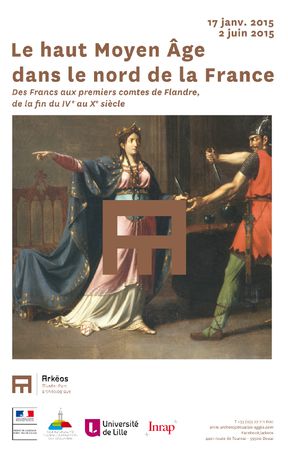
Cette exposition, fruit des recherches, études, découvertes et collaboration entre universitaires, chercheurs et archéologues du Nord – Pas-de-Calais et des régions voisines de la Belgique, témoigne de ce que fut le Nord au haut Moyen Âge, de la fin du IVe au Xe siècle.

csm_affiche_HMA_0d16ae81a6

Arkēos Musée-Parc archéologique accueille, du 17 janvier au 2 juin 2015, l’exposition « Le haut Moyen Âge dans le nord de la France. Des Francs aux premiers comtes de Flandre, de la fin du IVe au Xe siècle. ». Née de la volonté partagée de la Communauté d’Agglomération du Douaisis, l’Inrap, l’Université de Lille 3 (Sciences Humaines et Sociales) et la Direction régionale des affaires culturelles du Nord- Pas-de-Calais, cette exposition met en avant l’apport de l’archéologie dans le renouvellement des connaissances sur une période trop souvent méconnue.

Les fouilles archéologiques menées par l’ensemble des opérateurs en archéologie préventive sur notre territoire ont permis de mettre en lumière le rôle clé de notre région au haut Moyen Âge, dans la dynamique commerciale, la circulation des hommes, la diffusion des techniques et des modes de vie, ainsi que son implication dans le renouveau culturel et religieux des époques mérovingienne et carolingienne.

La muséographie offre un panorama de cette période à travers six thématiques. La première est consacrée au passage entre la fin de l’Antiquité et le début du haut Moyen Âge : deux siècles de transition, de transformations ponctués de crises et de réformes. Le parcours se poursuit avec la naissance et l’évolution des villes ainsi que l’occupation des campagnes, entre changements et continuités. La vie quotidienne est ensuite évoquée à travers la culture matérielle, premier témoin – quand ce n’est pas le seul – à la disposition de l’archéologie préventive. Enfin sont présentés les rites funéraires et la place du christianisme dans la société.

Des conférences et visites guidées sont programmées pendant toute la durée de l’exposition.

Le haut Moyen Âge n’apparaît plus comme une époque en devenir ou, encore moins comme un âge sombre mais bien comme une période d’innovations, riches en expériences, dont certaines furent décisives pour l’histoire de l’Europe.

Informations pratiques :
Musée – Parc ARKEOS
4401 route de Tournai
59500 Douai Tel : 03 27 71 18 00 Fax : 03 27 08 88 88

Horaires :

Janvier / Février / Mars / Novembre / Décembre :
le musée ouvrira ses portes tous les jours de 10h à 12h et de 14h à 18h sauf le mardi.
Avril / Mai / Septembre / Octobre :
le musée sera ouvert tous les jours de 10h à 18h sauf le mardi.

Source de l’information : Musée – Parc ARKEOS

Publié dans Exposition | Laisser un commentaire

Bourse – IHR Doctoral Fellowships

Scouloudi, Thornley, RHS

The Institute of Historical Research administers up to six full-year and one half-year IHR Research Fellowships in History, which are drawn from several sources: The Royal Historical Society funds up to two Fellowships per year, the Centenary Fellowship and the Marshall Fellowship, the latter thanks to the generosity of Professor P. J. Marshall, former President of the RHS. Both are open to candidates without regard to nationality or academic affiliation; The Scouloudi Foundation offers up to three full-year Fellowships and one half-year Fellowship, which are all open to UK citizens or to candidates with a degree from a British university; The Isobel Thornley Bequest offers one Fellowship which is open to candidates regardless of nationality but only to those registered for a PhD at the University of London.

Area of research: History

Eligibility requirements:
The Fellowships are intended as writing-up awards. They will be awarded to doctoral students who are engaged in the completion of a doctorate in history (broadly defined) and who will have completed at least three years of full-time or four years of part-time research on their doctoral programme (and not more than four years’ full-time or six years’ part-time) at the beginning of the academic year in which the awards will be held. Fellowships will normally be tenable for up to one year, but may be awarded for six months to candidates who expect to submit a thesis within that timescale.

It is the responsibility of the award holder and the supervisor to inform the Director as soon as the thesis is submitted for examination. Further instalments of the Fellowship will not be payable for the quarter or quarters following the submission of the thesis. These awards cannot be held in conjunction with any other substantial maintenance grant.

At the discretion of the Director of the Institute, Fellows may engage in teaching or other paid work for up to six hours per week.

Amount awarded: £15,726 – full year (Scouloudi); £7863 – half year (Scouloudi); £12,500 (Thornley); £15,726 (Royal Historical Society)

Applications open: 23 Jan 2015 to 20 Mar 2015

Source de l’information : Institute of Historical Research

Publié dans Bourse | Laisser un commentaire

Appel à contribution – Saint Louis Conference on Manuscript Studies

The Vatican Film Library invites paper submissions or session proposals for the 42nd Saint Louis Conference on Manuscript Studies, to be held at Saint Louis University in St. Louis, MO, 16–17 October 2015. The conference is organized annually by the Vatican Film Library and its journal, Manuscripta, and is the longest running conference in North America devoted exclusively to medieval and Renaissance manuscript studies. The two-day program each year offers sessions on a variety of themes relating to medieval book production, distribution, reception, and transmission in such areas as paleography, codicology, illumination, textual transmission, library history, cataloguing, and more.

Guest Speaker for 2015: Stella Panayotova, Keeper, Department of Manuscripts and Printed Books, Fitzwilliam Museum, Cambridge

Papers or session proposals should address the material aspects of late antique, medieval, or Renaissance manuscripts. Submissions may address an original topic or a session theme already proposed. Papers are 20 minutes in length and a full session normally consists of three papers. If you are interested in organizing one of these sessions, or wish to suggest a paper or session of your own, please contact us as soon as possible.

Proposed sessions :

Submissions are welcome for any of the following sessions already proposed.

1) Old Book, New Book: Refurbished Manuscripts in the Middle Ages

Even when they were tailored to the taste of specific patrons, it was understood that manuscripts would outlast their owners: they were future family heirlooms, to be circulated in networks of gift exchange, inheritance, and resale. In what ways did the patrons and producers of manuscripts anticipate the inevitable change of hands? Under what circumstances did new owners expand or alter legacy manuscripts, and how did they respond to the taste of previous owners? This session calls for papers that examine the social, political, and intellectual import of secondhand medieval books.

2) Gravity vs. Levity

“Man is a rational, moral animal, capable of laughter.” (Notker Labeo, d. 1022).

While this may be considered a truism by some, the question of the role played by humor in medieval manuscripts remains somewhat indistinct. Is a joke in a manuscript ever just a joke? Subversive, witty, parodic, didactic, and broadly entertaining imagery is the focus of this session. What role did humor play in society and how is that displayed in a concrete fashion within the pages of books?

3) A Good Read: The Production of Vernacular Texts in Thirteenth- and Fourteenth-Century Italy and their Public

While there is a great deal of documentary evidence for the production and readership of vernacular texts in Italy in the fifteenth century, we know relatively little about their thirteenth- and fourteenth-century patronage and the process of their production. Nonetheless, a considerable number of prose and verse manuscripts written in French, Franco-Italian, or Franco-Venetian survives, often resplendently illustrated and obviously produced for wealthy patrons. See the Fordham University website created to explore this topic.

This panel seeks papers that consider the thirteenth- and fourteenth-century production and circulation of these manuscripts in Italy, discuss their patrons and readers; and examine the organization of their production by individuals or workshops based in urban, court, or private milieus. At this time university textbooks were being produced under university supervision for quality control; what evidence can we find for the regulation of quality in this manuscript genre?

Please send a title and an abstract of not more than 200 words to Susan L’Engle (lengles@slu.edu) by 1 March 2015. Those whose proposals are accepted are reminded that registration fees and travel and accommodation expenses for the conference are the responsibility of speakers and/or their institutions.

Source de l’information : The Medieval Academy Blog

Publié dans Appel à contributions | Laisser un commentaire

Appel à contribution – The Influences of the Dominican Order in the Middle Ages

Oxford
10th-12th September 2015
CFP Deadline: 1st March 2015

From the modest group of St Dominic and his sixteen followers, the Dominican Order grew rapidly in the first century of its existence, establishing itself across Europe as a learned Order of Preachers. This interdisciplinary conference will seek to explore the influences of the Dominican Order on all aspects of medieval life. The conference theme of ‘influence’ can be interpreted in its broadest sense, encompassing the large-scale influences of the Order and the legacy of its prominent figures, or can be examined on the personal level, such as the impact that the Order had on those that came into contact with it, both within and outside the Order.

Papers might address topics such as:

  • how the Dominican Order influenced other religious orders and medieval life more generally (papers may consider this influence with regard to art, architecture, universities and education, book-making, theology, liturgy, legislation, or other relevant disciplines);
  • influential Dominicans, such as St Dominic, Humbert of Romans and Thomas Aquinas, and their legacy to the Dominican Order or the use of their teachings outside of the Order;
  • preaching and other means by which Dominicans sought to influence the local populations they encountered;
  • controversies resulting from Dominican influence (e.g., in the universities, in ecclesiastical government, etc.);
  • Dominican education and the training of novices: the shaping of the Dominican religious life.

The conference will be held at Lincoln College, Oxford and Blackfriars, Oxford from Thursday 10th to Saturday 12th September 2015. This conference is interdisciplinary and open to scholars working in any field of medieval studies. Papers of 20 minutes are welcomed, although other formats may be considered. Please submit an abstract of no more than 300 words, and include with it your paper title, name and affiliation (if any), contact email, AV requirements, and a short biography (this has no bearing on the evaluation; it is simply for distribution to chairs). All abstracts should be submitted by 1st March 2015. All enquiries and proposals should be sent to Eleanor Giraud: eleanor.giraud@lincoln.ox.ac.uk

Source de l’information :  Medieval Art Research

Publié dans Appel à contributions | Laisser un commentaire

Bourse – Bourse post-­doctorale (Université de Nice)

Appel à candidature
Nature : Bourse post-­doctorale de 9 mois (2.400€ par mois)
Lieu : Université de Nice Sophia-Antipolis
Contact : A. Zucker (zucker@unice.fr)

Titre : Constitution d’un thésaurus de zoologie antique et médiévale par fédération de données hétérogènes et annotation d’un texte de Pline (Histoire Naturelle, livres 8-­11)

Contexte :
GDRI
Zoomathia

Résumé du projet :
L’objectif est la réalisation d’un thésaurus de zoologie antique et médiévale, élaboré à partir de la fédération de sources de données hétérogènes sur les connaissances zoologiques anciennes (antiquité/moyen-âge) et de l’annotation de textes latins, dans une perspective anthropologique et épistémologique, prenant en compte toutes les dimensions de ce savoir : taxinomie, anatomie, physiologie, éthologie, exploitation économique, thérapeutique…. Il s’inscrit dans un projet général porté par le CEPAM et soutenu par le CNRS à travers le GDRI Zoomathia (2014-2017) sur la transmission des connaissances zoologiques. Le chercheur sera co-encadré par un binôme de chercheurs appartenant à deux UMR de l’UNS (notées A+ et A par l’AERES) : le CEPAM (INEE, INSHS), et l’I3S (INS2I). L’ontologie produite devra intégre à la fois le vocabulaire et les concepts originaux (dans le domaine de la classification, de la physiologie, de l’analyse des comportements, etc.) et ceux de la biologie contemporaine. Restituer la conception biologique ancienne manifestée dans l’ouvrage de Pline, à travers les descripteurs choisis, constitue un des défis de ce travail d’annotation. Ce thesaurus « expérimental » constituera le tout premier repère méthodique pour l’annotation des ressources littéraires en zoologie. Le travail consistera donc à conduire, à partir d’un corpus numérisé disponible, les deux phases
fondamentales du « cycle de vie de l’information historique » défini par Boonstra et al. (2006) : enrichissement et édition (tagging), afin de permettre l’extraction de données et l’analyse textuelle du corpus annoté.

Le post-doctorant expert en philologie classique sera hébergé au CEPAM et co-encadré par deux experts en zoologie antique : Arnaud ZUCKER (CEPAM, UNS) et Catherine JACQUEMARD (CRAHAM, Caen, engagée dans le projet ICHTHYA de mise en ligne d’un corpus annoté de traités d’ichtyologie et dans le projet BIBLISSIMA), et deux experts en ingénierie des connaissances et web de données : Andrea TETTAMANZI et Catherine FARON-ZUCKER (I3S, UNS), tous quatre partenaires du GDRI Zoomathia. Les missions du post-doctorant au CRAHAM ou de Catherine JACQUEMARD au CEPAM seront prises en charge sur le budget du GDRI. Andrea TETTAMANZI et Catherine FARON-ZUCKER fourniront au postdoctorant des outils et méthodes d’ingénierie des ontologies lui permettant de construire une ontologie de zoologie antique et médiévale. Il sera formé à l’utilisation d’un gestionnaire de thésaurus (OpenTheso), conçu pour les ressources antiques, par un ingénieur du CEPAM, spécialisé dans la gestion de bases de données. Le projet ayant une portée internationale et le thésaurus étant multilingue, l’IR sera recruté par appel d’offres international et procèdera à l’annotation dans une langue européenne, en fonction de ses compétences linguistiques (français, anglais, allemand, italien).

Tâches :

  • Formation personnelle à un gestionnaire de thésaurus par un IE du CEPAM, et à un outil de « tagging » intuitif fourni par les encadrants de l’I3S
  • Annotation des livres 8-11 de Pline, Historia Naturalis
  • Structuration du vocabulaire des annotations en une ontologie
  • Documentation de l’ontologie (définitions, labels, …)
  • Alignement de l’ontologie produite avec les ontologies de la biologie moderne, liage au web de données
  • Présentation de l’ontologie produite, de son expressivité et de son évolutivité
  • Formalisation d’un guide méthodologique pour l’utilisation du thesaurus à l’annotation d’autres textes de zoologie antique ou médiévale
Publié dans Bourse | Laisser un commentaire