Appel à contribution – William of Malmesbury and his Legacy

3–5 July 2015
The Ioannou Centre for Classical and Byzantine Studies, University of Oxford

The organizing committee of the conference ‘William of Malmesbury and his Legacy’ invites paper proposals from prospective speakers. This three-day conference, supported by Oxford’s Faculties of History, English and Classics and The Oxford Research Centre for Humanities (TORCH), is timed to coincide with the completion of Michael Winterbottom’s and Rodney Thomson’s edition of William of Malmesbury’s Miracles of the Virgin. When this volume is printed, all works of William will have been published in modern scholarly editions—a momentous occasion which our conference intends to celebrate. In bringing together scholars working on all aspects of William’s works, the goal of the conference is twofold: 1) to review and reflect on existing scholarship, and 2) to encourage further research on one of the most important authors of twelfth-century Europe.

Keynote lectures will be given by Rod Thomson, Michael Winterbottom and John Ward.

The conference welcomes papers on a range of topics, including but not limited to:

  • making sense of William’s oeuvre as a whole
  • thematic studies of the works of William and his contemporaries
  • William as an individual; a historian; a hagiographer; a biblical commentator; a literary artist
  • William and his sources: information, preservation, revision
  • William and early twelfth-century politics and patronage
  • manuscripts of William’s works: text and transmission
  • connections and dialogues among twelfth-century historians
  • William in his English and continental contexts
  • the future of William’s oeuvre in Anglo-Norman scholarship and beyond
  • William of Malmesbury: medieval and modern

Prospective speakers are invited to submit abstracts of 200–300 words. Submissions should include name, affiliation and durable contact details. The deadline for submissions is 1 December 2014. For more information about the conference, to join the conference mailing list or to submit an abstract, please email the committee at: william.malmesbury@history.ox.ac.uk.

Organizing committee: Rod Thomson, Ilya Afanasyev and Emily Winkler

Source de l’information : University of Oxford

Publié dans Appel à contributions | Laisser un commentaire

Colloque – Le marché des matières premières dans l’Antiquité et au Moyen Âge (2). La circulation des matières premières : routes, moyens, acteurs

Le deuxième atelier du programme commun Casa de Velázquez-École française de Rome, Le marché des matières premières dans l’Antiquité et au Moyen Âge, s’intéressera, après « Les lieux des échanges » (Rome, octobre 2013), à la circulation des matières premières, c’est-à-dire aux produits naturels bruts (pierres et roches décoratives, terres, laine, bois, argile, etc.) ou issus d’une première phase de traitement (alun, métaux, terres cuites architecturales, etc.).

En effet, avant d’être utilisées dans un cycle production ou échangées, les matières premières étaient parfois déplacées sur de longues distances. En raison de leur nature, de leur poids ou encore de leur encombrement, certaines, comme les matériaux de construction, les métaux, le bois ou encore les matières textiles, ont pu exiger des transports spécifiques et des structures ou des compétences particulières. L’objectif de la rencontre est donc de restituer, en mobilisant, ensemble ou séparément, toutes les sources disponibles – textes, inscriptions, données archéologiques mais aussi archéométriques –, une étape fondamentale de la chaîne opératoire du marché des matières premières, celle de leur mise en circulation.

Programme :

Jeudi 23 octobre

9h30-10h : Ouverture – Michel Bertrand, Director de la Casa de Velázquez

Introduction – Didier Boisseuil, Université de Tours, y Christian Rico, Université Toulouse Jean-Jaurès

10h-13h30 : Sources et problèmes
President – Sauro Gelichi, Università di Venezia

Marie-Brigitte Carré, UMR 7299 (Centre Camille Jullian, Aix-en-Provence) – Transports de matières premières par voie d’eau : les données des épaves antiques
Pinuccia Simbula, Università di Sassari – Cuoi e pelli: fonti e problemi per lo studio del mercato sardo
Guillermo Garcia-Contreras Ruiz, Universidad de Granada – Lugares de producción, almacenamiento y venta de la sal en la Edad Media: de al-Andalus a Castilla
Discussion

15h30-18h – Le transport par eau
President : Philippe Bernardi, UMR 8589 (LAMOP-CNRS, Paris)

Oliva Rodriguez, Universidad de Sevilla, Salvador Ordonez, Universidad de Sevilla, et et Carlos Cabrera Tejedor, Oxford University – « De perdidos, al río ». En torno a las esquivas evidencias de transporte y comercio de materias primas no perecederas por vía fluvial en época romana
Catherine Verna, Université Paris 8, y Sandrine Victor, UMR 5136 (Centre Universitaire d’Albi) – Pratiques du flottage (Têt, Conflent, XIVe-XVe siècle)
David Djaoui, Musée Départemental de l’Arles antique – L’acheminement des matières premières (et/ou produits semi-transformés, métal, pierre, etc.) aux embouchures du Rhône à l’époque romaine

Vendredi 24 octobre

9h-13h30 : Le transport des pondéreux : chaux, fer et soufre
Presidence : Marie-Brigitte Carré, UMR 7299 (Centre Camille Jullian, Aix-en-Provence)

Christophe Vaschalde, UMR 7298 (LA3M, Aix-en-Provence) – Pratiques du stockage et du transport chez les chaufourniers provençaux (XIIIe-XVIIe siècles)
Gaspard Pagès, UMR 7041 (ArScAn, Paris), et Maxime L’Héritier, Université Paris 8 – La circulation du fer sous ses formes brutes dans la Gaule antique et la France médiévale à travers l’analyse archéométallurgique des vestiges archéologiques
Luca Zambito, Archéologue, Reggio di Calabria – Lo zolfo in Sicilia in età romana. Dalla miniera ai mercati

Table ronde et conclusion

Informations pratiques :
23-24 octobre 2014

Coord.: Didier Boisseuil (Université de Tours), Christian Rico (Université Toulouse Jean-Jaurès)
Org.: École des hautes études hispaniques et ibériques (Casa de Velázquez, Madrid), Ecole française de Rome
Coll.: UMR 8589 (LAMOP, Paris), UMR 7323 (CESR, Tours), UMR 7299 (Centre Camille Jullian, Aix-en-Provence

Lieu de célébration:
Casa de Velázquez
C/ de Paul Guinard, 3
28040 Madrid

Entrée libre et gratuite

Source de l’information : Casa de Velazquez

Publié dans Colloque | Laisser un commentaire

Offre d’emploi – Digital Humanities Research Coordinator

Ghent University is currently looking for a Digital Humanities Research Coordinator, starting at the earliest possible date. The successful candidate will coordinate the Ghent Centre for Digital Humanities and DARIAH-BE (consisting of the Flemish consortium DARIAH-VL and DARIAH-Wallonie Bruxelles). The Ghent Centre for Digital Humanities develops DH collaboration and supports research projects, teaching activities and infrastructure projects across the faculties and libraries. The GhentCDH is also coordinating the Belgian activities within the DARIAH-EU consortium network. The candidate will report to the GhentCDH steering committee and to the national coordinator (alternating chairmanship).

The successful candidate will be responsible for:

  • Coordinating the development of the Virtual Research Environment Service Infrastructure (VRE.SI), a Hydra/Fedora Commons based VRE within the framework of DARIAH-VL. This Service Infrastructure will provide researchers in the Humanities with user-friendly applications for processing (data ingest, quality assurance, asset management, annotation, analysis) and dissemination of digitized research data. DARIAH-VL VRE.SI will be set up by a consortium of work groups at Ghent University, Antwerp University and KU Leuven, in collaboration with the Flemish Institute for Archiving (VIAA) and federal scientific institutions (CEGESOMA, State Archives, ..). The coordinator will monitor and coordinate the development teams involved, the participating pilot research projects, report to DARIAH and will take care of project partners communication within DARIAH and with other projects and institutions;
  • Establishing and enhancing a sustainable and coordinated network infrastructure and user community on top of partly existing and unlinked DH infrastructures, at Ghent University and at the DARIAH-VL level;
  • Coordinating the communication between national and international partners of DARIAH-BE;
  • Organizing and sustaining an interdisciplinary, sustainable and much-needed Belgian network of Digital Humanists that operates within a larger European network;
  • Supporting the planning of and application writing for participation in (inter)national research projects;
  • Functioning as a representative interlocutor to stakeholders with interests in the Digital Humanities;

GhentCDH and DARIAH-BE have as joint objective the aim to support, aggregate and accelerate research in the broad field of the digital humanities; to improve the digital literacy of researchers in the humanities, to install more efficient research methodologies and to unlock new research questions; to unlock the research potential of digitized analogue and born digital sources provided by cultural heritage institutions by making them interoperable and by creating virtual research environments;

Preferred qualifications:

  • Ph.D. in humanities or social sciences and a documented interest in fields such as: corpus linguistics, digital research in literature, historical network analysis, data visualization
  • Experience with historical spatial and/or textual analysis is an asset
  • Experience with the use or development of web-based DH scholarly working environments (e.g. VRE’s) would be an asset
  • Participation in grant writing and applications for national and international research funds
  • Project management experience
  • Fluency in English, other languages are a plus
  • The candidate is an enthusiastic and inventive team player and must be willing to travel abroad

What we offer:

  • A full-time appointment will be renewed and extended after an initial six months contract.
  • Contact with interdisciplinary national and international research groups
  • The salary (100% postdoctoral researcher) depends on qualifications and experience.
  • More information can be found here. Besides working in stimulating and innovative surroundings, Ghent University offers several other benefits such as: free public transport between home and work place; biking fee; access to university sports facilities and university restaurants. More information: https://www.ugent.be/en/work
  • The post comes with a travel expenses budget

Applying

  • If you are interested in joining us, please send your CV and cover letter with a short motivation explaining your application, until October 24th, 2014 to: Prof. Dr. Christophe Verbruggen (christophe.verbruggen@ugent.be) and Prof. Dr. Gunther Martens (gunther.martens@ugent.be) . Please mention “DH Research coordinator” in the subject line.
Publié dans Offre d'emploi | Laisser un commentaire

Bourse – Séjour comme chercheur résident auprès de l’École française de Rome

Les Écoles françaises à l’étranger ont mis en place depuis la rentrée 2012 le statut de chercheurs résidents dans leurs établissements.

À l’École française de Rome (EFR), ce titre est accordé à des enseignants-chercheurs, des chercheurs statutaires ou des post-doctorants sous contrat qui sont accueillis pour une durée de six mois renouvelable, pour contribuer à la réalisation d’un programme scientifique en collaboration avec l’EFR1. L’accueil est réglé par convention entre l’EFR et l’organisme de rattachement de ces chercheurs. L’École met à leur disposition tous ses moyens matériels et scientifiques pour faciliter la réalisation de leur programme.

Une aide pour favoriser leur séjour hors de leur résidence peut en outre être proposée par l’EFR lorsque le programme ne bénéficie pas de financements extérieurs propres :

  • pour ceux qui se logent par eux-mêmes dans Rome, une aide de 2000€ mensuels est octroyée ;
  • pour ceux qui sont logés dans l’immeuble de la Piazza Navona, l’aide mensuelle est de 1200€ sur lesquels est effectué un prélèvement de 600€ pour le loyer du studio (chambre-cuisine-salle d’eau) ;
  • pour tous, remboursement d’un voyage par semestre vers leur résidence principale, sur la base du tarif économique.

L’EFR propose pour 2015, sans préjuger d’autres demandes susceptibles d’être prises en compte sans aide financière, un total de 30 mois d’aide à la mobilité. Une attention particulière sera portée aux dossiers s’inscrivant dans les champs disciplinaires relevant des Sciences Sociales.

Les dossiers, comportant un bref CV avec bibliographie sélective, une lettre de motivation précisant la période de séjour sollicitée, une copie du contrat ou de l’arrêté de nomination dans l’institution d’appartenance ainsi qu’une autorisation de séjour à Rome émanant de cette même institution, peuvent être envoyés, par mail, au secrétariat du directeur des études concerné par le programme de recherches dans lequel s’insère la mobilité, dans les délais suivants :

  • au plus tard le 4 novembre 2014 pour les dossiers sollicitant une aide financière ;
  • au fil de l’eau pour les autres dossiers.

Les chercheurs sollicitant une aide à la mobilité seront informés de l’issue de leur demande au plus tard le 25 novembre 2014.

Source de l’information : École française de Rome

Publié dans Bourse | Laisser un commentaire

Offre d’emploi – 2015-2016 Getty Residential Grants

Grants and Fellowships:
2015-2016 Getty Residential Grants
Los Angeles, CA, USA
Deadline: 3 November 2014

The Getty Research Institute and the Getty Villa invite proposals for the 2015–2016 academic year residential grants and fellowships.

The Getty Research Institute theme, “Art and Materiality,” aims to explore how the art object and its materiality have enhanced the study of art history. Scholars, working with conservators and scientists, are gaining insight into the process of art making from raw material to finished object, as well as the strategic deployment of materials both for their aesthetic qualities and for their power to signify. The Getty Research Institute seeks proposals from scholars and fellows on these and other issues related to the materiality of art.

The Getty Villa theme, “The Classical World in Context: Egypt,” will focus on relations between the cultures of the classical world and Egypt from prehistory to the coming of Islam. Through trade, warfare, diplomacy, and other methods of exchange, these civilizations had a crucial, and often reciprocal, impact on cultural trajectories in both spheres. Priority will be given to research projects that are cross-cultural and interdisciplinary, utilizing a wide range of archaeological, textual, anthropological, and other evidence.

Deadline: November 3, 2014.

The Getty Scholars Program strongly encourages to share this information with colleagues.

Detailed application guidelines are available online at:
http://www.getty.edu/foundation/apply

For more information about each theme please visit:
http://www.getty.edu/research/scholars/years/future.html

Please address inquiries to:
Phone: (310) 440-7374
E-mail: researchgrants@getty.edu

Source de l’information : Medieval Art Research

Publié dans Offre d'emploi | Laisser un commentaire

Appel à contribution – Kings & Queens 4: Dynastic Changes and Legitimacy

24-27 June 2015
University of Lisbon (Portugal)

In 1366, Enrique, count of Trastamara, was proclaimed and crowned king of Castile and Léon, thus defeating his half-brother Pedro, son of Alfonso XI by his legitimate wife Maria of Portugal. Three years later, he would definitively avoid the shadow of the rightful king by murdering him. The problem of Trastamara legitimacy would only be solved two decades later with the marriage of Enrique’s grand-son with a grand-daughter of Pedro, who was also grand-daughter of Edward III, king of England.

In 1387, another one of Edward III’s grand-daughters married João I, founder of a new dynasty in Portugal, after the death of King Fernando, his half-brother. Though the new king of Portugal had been born out of wedlock and there were severe doubts about his rights to the throne in face of other candidates, João and his wife Philippa of Lancaster were able to raise a numerous and popular family, and build a successful royal court, that soon cleared up the concern over the legitimacy of the dynasty.

In 1399, Henry of Bolingbroke, the heir of the Duchy of Lancaster and brother to the aforementioned queens of Castile and Portugal, confronted his cousin the king of England, Richard II. After the imprisonment and death of the king without descendants, Henry was enthroned as Richard’s successor.

While these three examples involving three siblings make an excellent example of the key themes of the conference, other examples could be added, in these kingdoms and many others, with diverse causes and very different resolutions in all periods of History.

Our aim will be to examine dynastic changes’ processes in all historical moments and primarily to scrutinize ways of legitimating new dynasties or rulers in every part of the world. This theme, though obviously connected to political, institutional and legal studies, also allows participants to look at a wide range of topics including court studies, women’s and gender studies, especially by the examination of family structures and connections.

Other possibilities include analyzing the transmitted memory of those processes in historiography, literature or other forms of art.

We welcome proposals of sessions of three papers and also individual papers. Panel proposals should be presented in about 500 words and abstracts of single papers should be approx 250-300 words. All abstracts must be sent to the organizers via email to monarchyconference@gmail.com by 30 November 2014.

Publié dans Appel à contributions | Laisser un commentaire

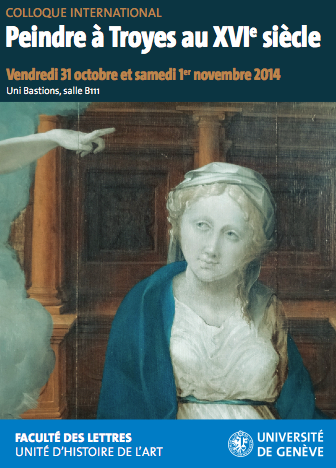
Colloque – Peindre à Troyes au XVIe siècle

Amorcé en 2010, le programme « Peindre en France à la Renaissance » vise à mieux comprendre la peinture produite dans le royaume de France durant le XVIe siècle, en tenant compte de toutes les techniques liées au métier du peintre. Il a généré jusqu’ici trois volumes publiés aux éditions Silvana: les deux premiers ont fixé le cadre (2011 et 2012), tandis que le troisième (2014), consacré à Lyon, a inauguré une série sur les foyers artistiques les plus actifs.

Dans cette dynamique, le colloque se focalise cette fois sur le foyer troyen, dont la production picturale, relativement bien conservée, reste moins étudiée que la sculpture. Introduit par une réflexion sur le métier du peintre et ses rapports avec les autres techniques, il cherchera à le replacer dans une géographie des styles, en mettant en évidence un courant hollandais et un axe qui relie la ville à Paris et à Fontainebleau.

Peindre à TroyesProgramme :

Vendredi 31 octobre 2014

14h : Accueil et introduction par Frédéric Elsig (Université de Genève)

I. Le métier du peintre et les techniques
Président de séance: Guy-Michel Leproux (École pratique des Hautes Études)

14h30 : Audrey Nassieu Maupas (École pratique des Hautes Études, Paris) – Le métier de peintre à Troyes au XVIe siècle
15h : Michel Hérold (centre André Chastel, Paris) – La recherche sur le vitrail troyen du premier XVIe siècle: bilan général et essai de perspectives
15h30 : Marianne Grivel (Université de Paris-Sorbonne) – Gravure et livres illustrés à Troyes au XVIe siècle: état de la question
16h : Discussions et pause

II. Un courant hollandais
Président de séance: Mauro Natale (Université de Genève)

16h30 : Frédéric Elsig (Université de Genève) – La carrière troyenne de Grégoire Guérard
17h : Françoise Auger-Feige (restauratrice indépendante habilitée Musées de France, Bourgogne) – Grégoire Guérard: observations techniques
17h30 : Cécile Scailliérez (musée du Louvre, Paris) – Autour du Maître de Dinteville
18h : Discussions

Samedi 1er novembre 2014

III. L’axe Paris-Fontainebleau-Troyes
Président de séance: Eric Blanchegorge (musées de Troyes)

9h : Guy-Michel Leproux (École pratique des Hautes Études, Paris) – Une famille d’artistes entre Troyes et Paris: les Bachot
9h30 : Maxence Hermant (Bibliothèque nationale de France, Paris) – Autour d’Étienne de La Vallée. L’art troyen et Jean Cousin
10h : Discussions et pause

10h30 : Marion Boudon-Machuel (Université François Rabelais, Tours) et Dominique Cordellier (musée du Louvre, Paris) – Primatice et la sculpture troyenne

Épilogue :
11h30 : Clara Marsal (musée du Louvre, Paris) – La peinture troyenne dans le «Recensement de la peinture française du XVIe siècle»
12h : Discussions et conclusions

Informations pratiques :
31 octobre-1er novembre
Uni Bastions
Salle B101
5 rue De-Candolle
1205 Genève
L’accès au colloque est libre et ouvert à toute personne intéressée.

Source de l’information : blog de l’ApAhAu

Publié dans Colloque | Laisser un commentaire

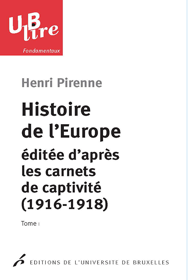
Publication – Henri Pirenne (préface et édition critique par Jean-Pierre Devroey et Arnaud Knaepen), « Histoire de l’Europe, éditée d’après les carnets de captivité (1916-1918), suivie des Souvenirs de captivité »

Le 18 mars 1916, Henri Pirenne et son collègue Paul Fredericq sont arrêtés et déportés en Allemagne, parce que tous deux incarnent, aux yeux de l’Occupant, la résistance des universitaires gantois à la réouverture de leur Alma Mater. Incarcéré dans des camps de prisonniers militaires et civils, puis assigné à résidence dans la ville universitaire d’Iéna, l’historien belge est finalement relégué à Creuzburg, une bourgade rurale de la Thuringe. Il y passe presque deux ans, du 29 janvier 1917 jusqu’à l’Armistice. Afin de résister intellectuellement et moralement à un isolement difficile à supporter, Henri Pirenne se lance, du 31 janvier 1917 au 7 août 1918, dans l’écriture de l’esquisse d’une histoire de l’Europe. Interrompu en pleine histoire de la Renaissance par l’arrivée à Creuzburg de sa femme et de son plus jeune fils, l’historien abandonne son manuscrit, qui sera publié à titre posthume, en 1936, par son fils Jacques. Accueillie comme un véritable tour de force intellectuel, parce que rédigée avec l’aide d’un « simple manuel scolaire », l’Histoire de l’Europe connaît un immense retentissement dans le contexte d’inquiétude et d’incertitude suscité par les succès des régimes totalitaires, ainsi que par l’exacerbation des tensions internationales qui précède immédiatement la deuxième guerre mondiale.

UB Lire - PirenneL’œuvre présentée ici méritait une triple révision scientifique. Il convenait en effet (1) de la restituer en tant qu’exercice de résistance quotidienne, mais aussi d’analyse de la diversité des parcours historiques des nations européennes – parcours qui avaient abouti à la guerre ; (2) d’éclairer ses conditions de production scientifique ; et (3) d’en restaurer le texte inachevé et inabouti, qui avait pâti de nombreuses coupes et révisions, ainsi que de l’accumulation, lors de son édition, d’une multitude d’erreurs factuelles concernant tant les événements et les personnages historiques, que les localisations et les datations.

Traduite en anglais, en néerlandais, en allemand, en italien, en japonais et en croate, et régulièrement rééditée, l’Histoire de l’Europe est un classique de l’histoire intellectuelle du xxe siècle. Cette nouvelle édition inclut plus de soixante pages restées inédites, rétablit le texte des carnets de captivité et y ajoute des informations factuelles dont l’auteur ne disposait pas lors de sa rédaction. Elle est complétée par la réédition des Souvenirs de captivité en Allemagne (mars 1916-novembre 1918), publiés par Henri Pirenne en 1920, qui restitue le climat et les conditions d’existence du savant durant sa déportation en Allemagne.

Table des matières : ici

Informations pratiques :
Henri Pirenne, Histoire de l’Europe, éditée d’après les carnets de captivité (1916-1918), suivie des Souvenirs de captivité, préface et édition critique par Jean-Pierre Devroey et Arnaud Knaepen, Bruxelles, Éditions de l’Université de Bruxelles, 2014 (UB Lire). 1040 pages. ISBN: 978-2-8004-1573-4. Prix: 17,5 € (les 2 vol.).

Source de l’information : Éditions de l’Université de Bruxelles

Publié dans Publications | Laisser un commentaire

Offre d’emploi – Four PhD positions ‘Arts in Society’

Faculty of Humanities, Leiden University Centre for the Arts in Society (LUCAS), vacancy 14-250

The Faculty of Humanities hosts a wealth of expertise in fields including art history, film, religion, literature, media, linguistics, philosophy, history and area studies, covering practically the entire world. The Leiden University Centre for the Arts in Society (LUCAS), one of six research institutes within the Faculty of Humanities, focuses on the study of art, literature, culture and media.

LUCAS invites applicants for:

Four PhD Positions ‘Arts in Society’

Vacancy number: 14- 250

The PhD students will work within a research programme funded by the Netherlands Organisation for Scientific Research (NWO Graduate Programme 2014), entitled: Arts in Society . The supervisor of this research programme is the Director of LUCAS, Professor Anthonya Visser.

Description of the research programme Arts in Society

LUCAS pools expertise in the fields of literary history and theory, book, film and media studies, and art history. Exploring cultural production in Europe, Latin America and Africa, the institute’s research programme focuses on the continuous interconnectedness of the Arts and Society in both the textual culture of literature, learning and public debate and the visual culture of art, architecture, film, photography and the digital media. The institute hosts a variety of academic disciplines, covering the period from classical antiquity to contemporary culture. LUCAS is therefore uniquely placed to study the broad concept of the Arts, with its rapidly changing ideas and theories of cultural production, as a response to societal challenges.

LUCAS aims to develop its research programme further in four domains which are of particular interest for the interaction of the Arts and/in Society: (1) religion, (2) science & technology, (3) law & justice and (4) politics. Cultural production and cultural practices shape and are shaped by the debates, ideologies and beliefs in these fields of human agency – no matter what period or art form. New PhD projects in these four domains will further enhance LUCAS’s research in the Arts:

Through the ages texts, images and objects of all kinds have been instruments of religious self-formation, vehicles for confronting, commenting on and confirming theological doctrine or artistic expressions of piety.

Although, after centuries of collaboration, the humanities and the sciences seem to have gone their separate ways as academic disciplines, art interacts continuously with new technologies and fields of learning in social and cultural practices.

Literature and law, both being language based, are mutually inspiring and also mutually critical sister disciplines with regard to issues of justice. Fundamental concepts, such as personhood, are shared by the domains of law and literature. Literature and art, in general, have been – and still are – keen to dwell within and beyond the limits of the law.

For this domain politics should be understood in a broad sense: as the collective process of practices, choices and acts that determine the realisation of one world or another. Possible focus areas for research could be strategies of power, institutions, aesthetics, etc.

LUCAS invites candidates to submit a research proposal in the field of arts in society. The proposal should address a concrete research question concerning one of the domains mentioned above. Projects will be highly significant for further positioning LUCAS for future research. For a description of the research programme: http://www.nwo.nl/financiering/onze-financieringsinstrumenten/nwo/graduate-programme/graduate-programme.html and http://www.hum.leiden.edu/lucas/research/research-projects/research-projects2.html#nwo-graduate-programme.

Activities

The candidates are expected to carry out the following activities:

  • writing a PhD thesis;
  • submitting research results for publication in peer-reviewed academic journals;
  • presenting papers at (international) conferences;
  • some teaching in the second and third year of the appointment;
  • co-organising workshops and an international conference, together with the supervisor of the programme;
  • participating in the PhD training programme of a national research school, e.g. OSK, OSL, NICA, OIKOS, NOG, OSZMED, RMeS or WTMC;
  • participating in reading and discussion groups, seminars and workshops within the GP grant group and the LUCAS Research Institute, as well as the wider Faculty of Humanities.

Requirements

  • The successful candidate will have a Master’s or Research Master’s degree and will have obtained this degree no longer than four years ago. The MA thesis must be of a high quality, with a grade of at least 8.0 on a ten-point scale, or comparable assessment (revised);
  • The applicant’s MA thesis will testify to well-developed research skills, including the ability to formulate relevant and creative research questions and hypotheses, descriptive and analytical skills, and a clear and persuasive style of writing;
  • The applicant’s CV will illustrate familiarity with and experience in research on the study of one of the LUCAS disciplines;
  • The applicant will have a good reading competence in the language of the object of study, in addition to an excellent command of English in reading, writing and speaking;
  • The applicant will be able to work both independently and as part of a team;
  • The applicant should already have a LUCAS supervisor;
  • The applicant undertakes to finish the proposed PhD research within 4 years (1.0 FTE or within 5 years (0.8 FTE);

The PhD research should result in a doctor’s degree from the Faculty of the Humanities of Leiden University under the supervision of two LUCAS supervisors.

Terms of employment

The successful applicant will be appointed initially for a period of 12 months, with the preferred starting date of 1 December 1 2014. After positive evaluation of capabilities and compatibility and providing progress is satisfactory, the appointment will be extended by a further 3 years. The appointment must lead to the completion of a PhD thesis. Appointment will be under the terms of the CAO (collective labour agreement) of Dutch Universities.

The gross monthly salary is set at € 2.083 in the first year, increasing to € 2.664 gross per month in year four. This is based upon a full-time employment and in conformity with current salary scales under the collective employment agreement (CAO) for Dutch Universities.

An appointment with Leiden University includes pension accrual and other benefits such as an annual holiday premium of 8% and an end-of-year premium of 8.3%. Candidates from outside the Netherlands may be eligible for a substantial tax break.

Information

For more information, please contact Professor Anthonya Visser (e-mail: a.visser@hum.leidenuniv.nl) or Dr Korrie Korevaart (LUCAS manager; e-mail: kjj.korevaart@hum.leidenuniv.nl)

For information about LUCAS see http://hum.leiden.edu/lucas/

Applications

Please submit your application letter via e-mail (indicating the vacancy number mentioned in your motivation letter and in the subject line of your e-mail) and Curriculum Vitae before 20 October 2014, to vacaturesLUCAS@hum.leidenuniv.nl and kjj.korevaart@hum.leidenuniv.nl. You are also requested to add two reference letters from two scholars familiar with your work. We may contact these referees directly if we need further information.

Please add to your application the following appendices: a) your MA thesis, b) a copy of relevant course assessments and c) your MA degree certificate, and other relevant documentation such as certificates of relevant language courses, plus d) a short research proposal concerning the topic of one of the PhD positions (max. 3000 words, incl. bibliography and summary (max. 500 words).

Please note that the procedure will include interviews. Selected candidates will be invited for an interview in Leiden. Interviews are scheduled to take place 27-29 October 2014.

Source de l’information : Universiteit Leiden

Publié dans Offre d'emploi | Laisser un commentaire

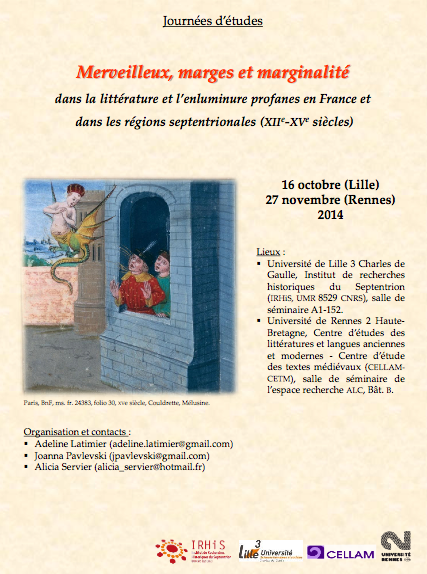
Journées d’étude – Merveilleux, marges et marginalité dans la littérature et l’enluminure profanes en France et dans les régions septentrionales (XIIe-XVe siècle)

La représentation du merveilleux est peu étudiée car les travaux portant sur ce sujet émanent principalement de chercheurs en littérature. Pourtant, celui-ci étant par essence indicible et fondamentalement lié à la vue, une approche iconographique s’avère nécessaire : dans quelle mesure et par quels moyens figuratifs et conceptuels le merveilleux est-il représentable ? L’objectif des journées est, d’une part, d’étudier la figuration des lieux, des personnages et des objets merveilleux dans les miniatures et initiales enluminées, et la façon dont leur caractère marginal est signifié dans l’image. D’autre part, nous nous intéresserons au développement de thèmes et motifs merveilleux dans les marges des manuscrits profanes, les recherches s’étant concentrées jusqu’à présent sur les manuscrits sacrés. Il semble également important d’étudier conjointement les évolutions de la représentation du merveilleux dans la littérature et dans l’iconographie ainsi que l’influence de l’histoire des mentalités sur le travail des enlumineurs et les auteurs. Ces journées d’études entrent dans une démarche interdisciplinaire, réunissant autour d’un axe de recherche commun littéraires, historiens et historiens de l’art.

Marges - LilleRennesProgramme :

Journée de Lille, 16 octobre 2014
Université de Lille 3 Charles de Gaulle, laboratoire IRHiS – 3 Rue du Barreau
Villeneuve-d’Ascq, France (59)

09h : Accueil
09h15 : Introduction

Président de séance : Christian Heck (Professeur en Histoire de l’art médiéval, Université de Lille 3 Charles de Gaulle, IRHiS).

09h30-12h30 : Matinée d’étude

Hybridité et métamorphose de la merveille.

09h30 : Irène Fabry-Teranchi (Lecturer in French Studies, Université de Reading) – Les transformations de Merlin et l’illustration marginale du manuscrit BnF fr. 95 (1290).

10h05 : Aude-Lise Barraud (Master en Histoire de l’art médiéval, Université de Bordeaux 3 Michel de Montaigne) – Mélusine. Étude des représentations de la fée dans le manuscrit français 24383 de la Bibliothèque Nationale de France (XVe siècle).
10h40 : Pause

11h : Lucie Blanchard (Master en Histoire de l’art médiéval, Université de Bordeaux 3 Michel de Montaigne) – Hybridité et merveilleux dans les marginalia des manuscrits profanes (fin du XIIIe-première moitié du XIVe siècle).
11h35 : Jacqueline Leclercq-Marx (Professeur d’Histoire de l’art médiéval, Université Libre de Bruxelles) – Chevaliers marins et poissons-chevaliers. Origine et représentations d’une « merveille » dans et hors des marges (régions septentrionales du monde occidental, XIIe-XIVe siècles).
12h10 : Discussion
12h30 : Pause

14h-17h30 : Après-midi

Territoires de la merveille.

14h : Jeff Rider (Professeur de Langue et littérature françaises, Université de Wesleyenne, Connecticut)  – Le merveilleux, le pseudo-merveilleux et l’énigme.
14h35 : Quentin Vincenot (Doctorant en Littérature médiévale, Université de Rennes 2 Haute-Bretagne, CELLAM) – Cynocéphale et loup-garou : deux anthropophages aux marges de l’humanité.
15h10 : Pause

15h30 : Florent Pouvreau (Docteur en Histoire médiévale, Université de Grenoble 2) – Le corps velu et les merveilles de l’Orient dans la littérature et l’iconographie de la fin du Moyen Âge.
16h05: Maud Pérez-Simon (Maître de Conférences en Littérature médiévale, Université Sorbonne Nouvelle, Paris 3) et Pierre-Olivier Dittmar (Ingénieur d’études à l’EHESS, Paris) – « Les monstres des hommes ».

Communication de clôture :
16h40 : Alison Stones (Professeur émérite d’Histoire de l’art médiéval, Université de Pittsburgh) – Les motifs du cerf, du lion et du Graal dans l’iconographie des manuscrits du Lancelot-Graal.
17h15-17h30 : Discussion et fin de la journée

Journée de Rennes, 27 novembre 2014.
Université de Rennes 2 Haute-Bretagne, CELLAM / CETM – Rue du Recteur Paul Henry
Rennes, France (35)

09h30 : Accueil
09h45 : Introduction

Présidentes de séance : matin : Adeline Latimier et Joanna Pavlevski (Doctorantes en Littérature médiévale, Université de Rennes 2 Haute-Bretagne, CELLAM/CETM) ; après-midi : Christine Ferlampin-Archer (Professeur de Langue et littérature françaises médiévales, Université de Rennes 2 Haute-Bretagne, CELLAM/CETM).

10h-12h : Matinée d’étude : Merveilles arthuriennes.

10h : Christine Ferlampin-Acher (Professeur de Langue et littérature françaises médiévales, Université de Rennes 2 Haute-Bretagne, CELLAM/CETM) – Imager et imaginer la merveille dans Artus de Bretagne (manuscrit BnF fr. 761, Carpentras BM 104 et New York Spencer 34).
10h35 : Juliette Thibault (Master en Histoire et Littérature médiévale, Université de Poitiers, CESCM) – Une danse merveilleuse et un danseur marginal : la carole magique et le fou dans les enluminures arthuriennes.
11h10 : Alicia Servier (Doctorante en Histoire de l’art médiéval, Université de Lille 3 Charles de Gaulle, IRHiS) – La Dame du lac dans les images enluminées du roman de Lancelot du Lac (XIIIe-XVe siècles).
11h45 : Discussion
12h : Pause

14h-17h30 : Après-midi : Frontières herméneutiques : Perméabilité des genres dans le traitement textuel et iconographique du phénomène merveilleux.

14h : Martina Di Febo (Université de Gênes) – Les enluminures des manuscrits de l’Ovide moralisé entre réalisme et allégorie.
14h35 : Lucile Jaeck (Doctorante en Histoire médiévale, Université de Limoges, CRIHAM) – Le merveilleux dans un récit en marge de la littérature profane : narration et iconographie du Voyage de saint Brandan.
15h10 : Pause

15h30 : Pierre Levron (Docteur en Littérature médiévale, Université de Paris 4) – Le cierge et l’épée, ou le miracle à répétition : étude d’un motif narratif.
16h05 : Sonia Maura Barillari (Professeur de Philologie romane, Université de Gênes) – Arbre de vie, arbre de vits : à rebours à partir du ms. Paris, BnF, fr. 25526.

Communication de clôture :
16h40 : Myriam White-Le Goff (Maître de Conférences en Langue et littérature médiévales, Université d’Artois) – De quelques images de merveilles dans les Romans d’Alexandre médiévaux : déplacement des marges.

17h15-17h30 : Discussion et fin de la journée

Source de l’information : Calenda

Publié dans Colloque | Laisser un commentaire