Conférence – Laurence Moulinier-Brogi, « L’amour vu par les médecins au Moyen Âge »

L’amour vu par les médecins au Moyen Âge

Conférence donnée par Laurence Moulinier-Brogi, professeur d’histoire médiévale (Université Lyon 2), dans le cadre de l’exposition « L’amour au Moyen Âge » (Tour Jean sans Peur).

Le mercredi 24 septembre 2014 à 19h
Tour Jean sans Peur – 20, rue Etienne Marcel – 75002 Paris
Réservation conseillée : tjsp@wanadoo.fr

Source de l’information : EHESS

Publié dans Colloque | Laisser un commentaire

Formation – Paléographie française : appronfondissement

Présentation :
Approfondissement théorique et pratique des écritures françaises médiévales et modernes, XVe-XVIIe siècle.

Responsable pédagogique : Marc Smith (École nationale des chartes)

Objectif :
Approfondir les notions de base en paléographie et la méthode de lecture et de transcription de documents d’archives

Contenus :
Perspectives historiques sur l’écriture française.
Normes scientifiques de transcription.
Exercices de lecture sur fac-similés.

Pré-requis :
Bonnes connaissances en histoire de France ; expérience pratique de lecture de documents médiévaux et/ou modernes.

Date : 29, 30, 31 octobre 2014
Horaires : 9h30 – 12h30 / 13h30 – 17h
Lieu : Hôtel de Rohan, 87, rue Vieille du Temple, 75003 Paris
Tarifs : 540 € public, 1080 € privé

Informations pratiques :
Toutes nos formations sont éligibles au titre du droit individuel à la formation (DIF) ou dans le cadre d’un congé individuel de formation et peuvent être prises en compte dans le plan de formation de votre institution ou organisme de rattachement.

Par ailleurs, nous proposons au titre de la formation continue des formations donnant accès aux diplômes nationaux (master et doctorat) reconnus par l’État et inscrits au RNCP.

S’inscrire : ici

Contact :
Service de la formation continue
Direction des études
École nationale des chartes
19, rue de la Sorbonne
75005 Paris

tél. : 01 40 27 67 69
formation.continue@enc.sorbonne.fr

Source de l’information : École nationale des chartes

Publié dans Enseignement | Laisser un commentaire

Appel à contribution – Senses and sensuality in the Middle Ages

Barcelona
20­-22 May 2015

All this was shewde by thre partes, that is to sey by bodyly syght, and by worde formyde in my vnderstondyng, and by goostcly syght.
(Juliana de Norwich, Shewings, Long Version, 9, 29­30).

The rose’s red hue, its intoxicating scent and its thorns show us the many faces of this flower’s truth. Senses are the ways through which humans interact with the world and develop their life learning.

For its connection to pleasure and joy, senses have been dually interpreted as sources of sin and immorality yet also as paths of knowledge, since through them we can reach a universe of perceptions which encourage experimentation ­and thus, relation­ with our surroundings and with our inner self. Julian of Norwich, an English theologian and mystic, expressed with simplicity in the words cited above how she had knowledge of the divine: three types of visions connected to different senses.

In this new researchers’ encounter we seek to open the door to the multiples insights and reflections about senses and sensuality in the Middle Ages, offering a wide range of aspects linked to the multiple narratives which this issue inspires: the ways of knowledge, sensory and spiritual pleasure, or artistic and literary forms which have captured the sensorial universe in the Middle Ages.

With a distinctly interdisciplinary intention, the congress aims to give voice to innovative researches on multiple and corresponding fields, such as History, Philosophy, History of Art or Philology, among others. Our main objective with this call is to help build new spaces of creation and of transmission of knowledge, thus confronting the specialization and compartmentalization of expertises usually attributed to the academic world. The accepted papers will define the final sections in which the congress will be divided.

Call for papers

Proposals will be accepted until October 31st 2014. You can send your texts in a word or OpenDocument text format, to the address arditcongress2015@gmail.com. You will receive an acceptance/refusal answer from the scientific committee before November 30th.

Abstracts extension: maximum 300 words.

Key words: maximum 5 concepts.

Languages accepted: The congress’ official languages are Catalan, Spanish and English. Likewise, we welcome proposals in French, Italian and Portuguese as well. Selected presentations in any Romanic language should include an English presentation (*ppt) or a handout in English including a summary of the content.

Personal details required:

  • Name and surname.
  • Institution.
  • Title of the paper or poster.
  • Contact details: email, phone number (optional).

Inscription price for participants: 25 euros (free of charge for ARDIT members).

Lecture timing:
Papers: 20 minutes
Posters: 5 minutes

Publication:

One of the main aims of our meeting is to spread the scientific results of the congress, publishing a selection of the best contributions. We will propose to ways of publication, as we did in the past edition of the congress:

Spaces of Knowledge: Four Dimensions of Medieval Thought (Cambridge Scholars Publishing, in press).
SVMMA. Revista de Cultures Medievals, N. 3, primavera 2014 (Institut de Recerca en Cultures Medievals ­ Universitat de Barcelona). [link to journal]

Organizing Committee
ARDIT Medieval Cultures Coordinator: Carme Muntaner

Contact details
arditcongress2015@gmail.com
http://arditculturesmedievals.weebly.com

Information related to the accommodation in Barcelona and other useful information coming soon on ArditCongress’ website: http://arditcongress.weebly.com

With the support of:
Institut de Recerca en Cultures Medievals (IRCVM)
Màster en Cultures Medievals de la Universitat de Barcelona Societat Catalana de Filosofia (filial of Institut d’Estudis Catalans)

Publié dans Appel à contributions | Laisser un commentaire

Colloque – Appréhender le passé par le bâti. Enjeux et méthodes de l’étude historique des sources architecturales

La journée d’études doctorales du Laboratoire de Recherche Historique Rhône-Alpes (LARHRA) est organisée annuellement par une équipe de doctorants mais n’est pas réservée aux membres du laboratoire et se veut une occasion de rencontres avec des chercheurs appartenant à d’autres structures et d’autres disciplines. Nous souhaitons aborder cette année une thématique architecturale : « Appréhender le passé par le bâti : enjeux et méthodes de l’étude historique des sources architecturales ».

Qu’il s’agisse des palais de la cour de France (Chatenet, 2002), des constructions architecturales de l’époque fasciste en Italie (Cantelli, 1981) ou même des ensembles scolaires (Derouet-Besson, 1998), les fonctions des bâtiments sont multiples et ne se limitent pas à leur utilité pratique : au-delà de leur valeur d’usage, ils possèdent une valeur symbolique. A ce titre, ils constituent une source particulièrement riche pour le chercheur adoptant une perspective historique. Objet inscrit dans le territoire, le bâtiment participe à sa constitution et peut devenir un enjeu de pouvoir ainsi que le reflet d’un projet idéologique. Le bâtiment est également le support d’appropriations successives: il peut être réaménagé, réhabilité et ou réapproprié, voire démoli. Entre projet architectural et usages effectifs, il peut en effet exister un écart qui transforme le vécu du bâti de même que, inversement, un projet architectural peut infléchir des normes d’usages préexistantes.

Cette journée d’études doctorales se consacrera aux enjeux et méthodes de l’étude des sources architecturales dans une perspective historique. Comment nous parviennent-elles et quels usages le chercheur peut-il en faire ? Comment faire apparaître et prendre en compte les enjeux liés à la maîtrise d’ouvrage et à la maîtrise d’œuvre ? Quel impact les bâtiments et leur agencement ont-ils sur les usages qu’en fait le public?

Trois axes de réflexion sont proposés :

  • Le bâtiment comme source et les enjeux des sources architecturales
  • Le bâti, reflet de l’identité et l’activité des groupes sociaux
  • L’architecture comme moyen d’inscrire dans l’espace des normes sociales

logo-larhraProgramme :

9 heures 30 : Accueil des participants
9 heures 45 : Introduction

10h – 12h : Le bâti comme source

Célia Condello (Université Lyon 2 – CIHAM) – Appréhender le subsistant et le disparu par le croisement des sources : le cas du château des ducs de Bourbon de Moulins (Allier), 1375-1523
Anelise Nicollier (Université Lyon 2 – Laboratoire Archéométrie et Archéologie) – Les églises romanes du Brionnais : étude d’un territoire de Bourgogne du Sud au travers de son paysage bâti
Stéphane Weiss (Université Lyon 2 – LARHRA) – Un clocher gothique, source lapidaire sur le siège de Royan en 1944-1945
11h15 : discussion

12h -13h30 : Repas

13h30 – 15h30 : Habitat et groupes sociaux

Florent Mérot (Université Paris 13 – PLEIADE) – Un miroir social : la transformation de l’habitat paysan en vallée de Montmorency (XVIIe – XVIIIe siècles)
Thibaut Bechini (Université Paris 1 – MASCIPO) – Étudier le bâti populaire dans les villes euro-américaines (XIXe – XXe siècles)
Louise Dorignon (ENS de Lyon) – Melbourne, ville éclectique : la construction de culture(s) urbaine(s) au travers son palimpseste architectural
14h55 : discussion

15h30 – 15h45 : Pause

15h45 – 17h30 : Le bâti comme vecteur de normes

Julie Piront (Université Catholique de Louvain – GEMCA-CRULH) – Enjeux, idéaux et réalités de l’architecture conventuelle féminine à l’époque moderne au travers de l’exemple des annonciades célestes
Célia Miralles Buil (Université Lyon 2 – LARHRA) – L’architecture au service de la santé : l’exemple du dispensaire antituberculeux de Barcelone (1934-1936)
Julien Defillon (Université Lyon 2- LARHRA) – Comprendre le sentiment patrimonial d’une époque par le vecteur de l’architecture d’accompagnement : le cas du quartier Mercière à Lyon au XXe siècle

17 h : discussion
17h30 : Conclusions

Informations pratiques :
23 septembre 2014

Institut des Sciences de l’Homme
Espace Marc Bloch – 14 avenue Berthelot
Lyon, France (69007)

Inscription souhaitée avant le 19 septembre à l’adresse jedlarha@gmail.com

Source de l’information : Calenda

Publié dans Colloque | Laisser un commentaire

Appel à contribution – Breaking the Rules! Cultural Reflections on Political, Religious and Aesthetic Transgressions

Leiden University Centre for the Arts in Society
29–30 January, 2015

Keynote speakers:
Lorraine Daston, Professor and Executive Director of the Max Planck Institute for the History of Science (MPIWG) in Berlin
Barbara H. Rosenwein, Professor of History at Loyola University Chicago

The Conference:
Society, religion and art have always been defined and governed by certain (un-)written rules. Yet there have always been those who willingly transgressed communal norms. Throughout history, from Antiquity, through the Middle Ages, up to the present day, these transgressors have met with either praise or disapproval. Some have been heralded as heroes, great thinkers or revolutionary artists, while others have been branded as exiles, sinners or outcasts. In Greek mythology, Prometheus was punished for defying the Gods and gifting humanity with fire; Christianity, Judaism and Islam condemn Adam and Eve’s transgression of divine command. The legacy of prominent rule-breakers, such as Socrates, Jeanne d’Arc, Pablo Picasso and Martin Luther King, can still be felt today.

This multi-disciplinary conference focuses on the wide range of cultural reflections on the violation of laws, traditions and conventions in the political, religious and aesthetic domains. Central questions, applicable to all three domains, include: Who breaks the rules? What are the aims of the offender: identification, protest or innovation? How can the authority of rules be undermined? How has transgression been perceived through the ages? Is the rule breaker punished or praised? To what extent is an act of rule breaking a confirmation of the existence of certain rules? What role does gender play in rule breaking? How do various cultures define transgression?

Papers in the political domain may focus on artistic perspectives on social taboos, the ethics of rule breaking, revolt, emancipation, disobedience, identity through rule breaking, the absence of rules (anarchy, freedom), protest through art or any other topic related to this domain. Papers in the religious domain may deal with cultural perspectives on the various aspects of religious rule breaking, such as sin, confession, penance, damnation, redemption, heresy and inquisition, as well as iconoclasm and idolatry. Other topics include, but are not limited to, sin as a political instrument, religious taboos and forbidden pleasures. Papers in the aesthetic domain may focus on boundaries of what is considered to be art, changing perceptions of beauty/ugliness in art, deviations from stylistic conventions and artistic traditions, plagiarism, the tension between resisting convention and embracing innovation or any other topic related to this domain. Creative and engaging ideas which fall outside the three domains described above will also be considered.

The LUCAS Graduate Conference aims to reflect the institute’s interdisciplinary and international character. As such, this two-day conference will provide a platform for PhD students in the humanities, from Leiden as well as other universities in the Netherlands and abroad, to present and exchange their ideas in an international and interdisciplinary environment. The organising committee invited two internationally renowned senior academics from different disciplines to act as keynote speakers, participate in the discussions and provide feedback to the papers presented at the conference.

Proposals

The LUCAS Graduate Conference welcomes papers from all disciplines within the humanities. The topic of your proposal may address the concept of rule breaking/transgression from a cultural, historical, classical, artistic, literary, cinematic, political, economic, religious or social viewpoint. Possible themes for papers may revolve around, but are not limited to, the following concepts:

  • Heresy, Agnosticism, Sin, Adultery, Immorality, Redemption
  • Rebellion, Revolt, Revolution, Conflict, Anarchy, Emancipation
  • Corruption, Criminality, Outlawry, Oath Breaking
  • Innovation, the Sublime, Supernaturalism, Ugliness, Obscenity
  • Illegal Migration, Crossing Borders, Exile, Nomadism, Exclusion
  • Cultural or Sexual Hybridity, Creolization
  • Exoticism, Orientalism Barbarism, Savagism

Please send your proposal (max. 300 words) to present a 20-minute paper along with a brief bio (150 words) before 15 October, 2014 to lucasconference2015@gmail.com. You will be notified whether or not your paper has been selected by 1 November, 2014.

A selection of papers will be published as conference proceedings in the Journal of the LUCAS Graduate Conference http://www.hum.leiden.edu/lucas/jlgc/. For those who attend the conference, there will be a registration fee of €50 to cover the costs of lunches, coffee breaks, excursions and other conference materials. Unfortunately we cannot offer financial support for travel or accommodation expenses.

If you have any questions regarding the conference and/or the proposals, please do not hesitate to contact the organizing committee at:lucasconference2015@gmail.com.

The Organizing Committee
Nouzha Baba
Cui Chen
Katarzyna Durys
Wieneke Jansen
Thijs Porck

Source de l’information : Universiteit Leiden

Publié dans Appel à contributions | Laisser un commentaire

Appel à contribution – Animaux dans la ville

Journées de la Société Française d’Histoire Urbaine
15 et 16 janvier 2015

Ecole nationale vétérinaire d’Alfort (7 avenue du général de Gaulle, 94700 Maisons-Alfort)
Animaux dans la ville, de l’Antiquité à l’époque contemporaine

La présence animale en ville a longtemps été négligée par les études urbaines en dehors des travaux portant sur des activités spécifiques liées à « l’agglomération des hommes » comme les transports, l’alimentation, les sacrifices ou l’exhibition et les jeux. Pour autant elle est bien attestée et il serait aberrant d’opposer la ville d’autrefois peuplée d’animaux à la ville humanisée d’aujourd’hui dont ils auraient été exclus. Les nombreux animaux familiers qui vivent avec les habitants des villes comme les animaux « non désirés ne fais[ant] pas partie de l’ordre urbain »1 suffisent à le prouver. Si la disparition progressive de certaines catégories d’animaux fournisseurs de viande et de lait ou d’énergie dans les villes occidentales, à coup de règlements de police destinés à éviter la « divagation » des troupeaux dans les rues ou à assainir leurs produits, est évidente, son remplacement par d’autres l’est tout autant. C’est cette forme de substitution – limitée dans cet exemple puisqu’elle ne concerne que les animaux domestiques ou familiers – qui pose question aujourd’hui au chercheur : ne suggère-t-elle pas un changement profond des rapports entre les hommes et les animaux en ville ? Et qu’en est-il de ceux que la réglementation ne parvient pas à évacuer comme les blattes, les rats ou les moustiques ? Ou encore des animaux tolérés mais volontiers contrôlés comme les pigeons ? Les travaux récents en histoire du vivant et de l’environnement urbain permettent de faire évoluer l’observation des rapports entre l’homme et l’animal dans une dimension élargie aux relations nature/ville.

Plusieurs entrées sont possibles dont ne sont évoquées ici que quelques unes :

  • Les inventaires archéozoologiques d’un lieu donné et les questions qu’ils soulèvent (comment évaluer la part des animaux domestiques et des animaux sauvages ? ces animaux vivent-ils en ville ou n’y entrent-ils qu’incidemment ou n’y arrivent-ils que morts pour être consommés ou utilisés ? …)
  • Les politiques publiques en ce qui concerne la « nature » en ville comme l’interdiction faite aux animaux de boire aux fontaines publiques à Rome, l’autorisation au cochon de saint Antoine de circuler librement en ville à la fin du Moyen Âge, l’introduction des abeilles dans les parcs publics aujourd’hui ou la réflexion contemporaine sur les corridors écologiques ;
  • Les pratiques sociales ou culturelles comme l’élevage des porcs sur les terrains vagues et dans les cours des maisons au Moyen Âge ou à l’Epoque moderne ou les visites aux zoos du XIXe siècle. etc.

C’est pour tenir compte des acquis de cette historiographie récente appuyée sur une approche essentiellement pluridisciplinaire et ouverte à toutes les périodes historiques, que la SFHU, l’UPEC (CRHEC et Laburba), l’ENVA lancent cet appel à communications pour un colloque qui se tiendra les 15 et 16 janvier prochain à L’UPEC et à l’Ecole nationale vétérinaire d’Alfort, Les animaux dans la ville de l’Antiquité à l’époque contemporaine. Les interventions dureront 20 mn.

Les propositions de communication peuvent être envoyées en français ou en anglais.

Elles comporteront un titre et un résumé d’environ 1500 signes, les coordonnées de l’intervenant (nom, prénom, fonction et rattachement institutionnel, courriel, adresse postale)

Les propositions de communication devront être adressées avant le 15 octobre à bourillon@u-pec.fr et à cdegueurce@vet-alfort.fr

Comité scientifique : Denis Menjot, Laurence Buchholzer, Natacha Coquery, Laurent Coudroy de Lille, Thibault Tellier, Vincent Lemire, Mélanie Traversier, Jean-Pierre Guilhembet, Florence Bourillon, Youri Carbonnier, Elisabeth Crouzet-Pavan, Catherine Denys, Stéphane Frioux, Philippe Guignet, Laurence Jean-Marie, Gilles-Antoine Langlois, Frédéric Moret, Dominique Poulot, Charlotte Vorms, Christophe Degueurce, Jérôme Bazin, Virginie Mathé, Jean Estebanez.

Comité d’organisation : Jérôme Bazin, Florence Bourillon, Laurent Coudroy de Lille, Christophe Degueurce, Jean Estebanez, Stéphane Frioux, Virginie Mathé, Denis Menjot.

Source de l’information : Le Ruche

Publié dans Appel à contributions | Laisser un commentaire

Offre d’emploi – Postdoctoral Fellowship: The Columbia Society of Fellows in the Humanities (2015-16)

Postdoctoral Fellowship: The Columbia Society of Fellows in the Humanities
Deadline: 6 October 2014 (postmark)

 The Columbia Society of Fellows in the Humanities, with grants from the Andrew W. Mellon Foundation and the William R. Kenan Trust, will appoint a number of postdoctoral fellows in the humanities for the academic year 2015-2016. We invite applications from qualified candidates who have received their PhD between 1 January 2013 and 1 July 2015. Fellows are appointed as Lecturers in appropriate departments at Columbia University and as Postdoctoral Research Fellows. The fellowship is renewable for a second and third year.

In the first year, Fellows teach one course per semester. At least one of these courses will be in the undergraduate general education program: Contemporary Civilization, Literature Humanities, Music Humanities, Art Humanities, Asian Civilizations, Asian Humanities, or Global Cultures, including those of Africa, Latin America, and the Middle East. For more information on Columbia’s Core Curriculum please visit www.college.columbia.edu/core/.

The second course may be a departmental course, the design of which will be determined jointly by the Fellow and the Fellow’s academic department. In the second year, Fellows teach one course: either a Core course (if only one of the two first-year courses was in the Core) or a departmental course. This will leave one semester in the second year free of teaching responsibilities. In the third year, Fellows again teach one course, either a Core course or a departmental course (to be decided jointly by the Fellow and the Fellow’s department), leaving one semester again free of teaching responsibilities. Please note that all teaching—whether a Core class or a department one—is to be arranged by the Fellow through the Fellow’s home academic department. Please also note that at least two of the three courses taught in the first two Fellowship years must be in the Core.

In addition to teaching and research, the duties of Fellows include attendance at the Society’s lectures and events as well as active participation in the intellectual life of the Society and of the department with which the Fellow is affiliated. The annual stipend will be $61,000. Each Fellow will also receive a research allowance of $6,000 per annum.

For information on how to apply, please visit the society’s website.

Source de l’information : Medieval Art Research

Publié dans Le réseau | Laisser un commentaire

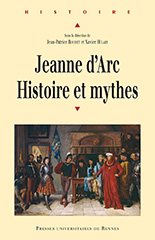
Publication – Jean-Patrice Boudet et Xavier Hélary (dir.), « Jeanne d’Arc : histoire et mythes »

Tout a-t-il été dit sur Jeanne d’Arc ? On le pense souvent, même chez les historiens. Que resterait-il de neuf à dire sur un personnage qui a suscité tant d’études sérieuses et tant de théories farfelues ? Tirées d’un colloque international tenu à Orléans en mai 2012, à l’occasion du 600e anniversaire de la naissance de la Pucelle, les contributions réunies dans ce volume illustrent le profond renouvellement des recherches sur Jeanne d’Arc. En mettant à profit les acquis récents de l’historiographie de la justice, les médiévistes revisitent différents aspects du fascinant procès de condamnation de 1431 et mettent en évidence la figure de frère Jean Bréhal, le maître d’œuvre de la procédure d’annulation de 1456. Mais depuis longtemps, les études autour de Jeanne d’Arc ne sont plus le domaine réservé des historiens médiévistes. Les spécialistes des époques postérieures se penchent ainsi sur la postérité de Jeanne jusqu’à nos jours, dans l’histoire, la littérature, les arts et la politique, en France, en Europe et même au Japon.

Tous les champs actuels de la recherche johannique se trouvent ainsi couverts. Décidément, la Pucelle d’Orléans n’a pas fini de susciter l’intérêt des historiens ! C’est cette passion sans cesse renouvelée que le volume espère faire partager aux lecteurs.

Boudet et Helary - JDAJean-Patrice Boudet est professeur d’histoire médiévale à l’université d’Orléans. L’un de ses axes de recherche porte sur l’histoire culturelle et politique des derniers siècles du Moyen Âge.

Xavier Hélary est maître de conférences en histoire médiévale à l’université Paris-Sorbonne. Il a publié, avec Philippe Contamine et Olivier Bouzy, Jeanne d’Arc. Histoire et dictionnaire, Paris, Robert Laffont, coll. « Bouquins », 2012.

Table des matières : ici

Informations pratiques :
Jean-Patrice Boudet et Xavier Hélary (dir.), Jeanne d’Arc : histoire et mythes, Rennes, Presses Universitaires de Rennes, 2014 (Histoire). Format : 15,5 x 24 cm, 292 p. ISBN : 978-2-7535-3389-9. Prix : 20,00 €.

Source de l’information : Presses Universitaires de Rennes

Publié dans Publications | Laisser un commentaire

Bourse – I Tatti Fellowship

Fifteen I Tatti Fellowships, each for twelve months, are available annually for post doctorate research in any aspect of the Italian Renaissance.

Eligibility

Fellows are selected by an international and interdisciplinary committee that welcomes applications from Italian Renaissance scholars from all nations. The committee aims to assess the ability of candidates to contribute in a collegial way to the intellectual life of the Harvard Center. It pays special attention to the candidate’s curriculum vitae, the strength of the proposed project, and its potential to yield original results.

At the time of application, scholars must hold a PhD, dottorato di ricerca, or an equivalent degree. They must be conversant in either English or Italian and able to understand both languages. They should be in the early stages of their career, having received a PhD between 2004-2013 and have a solid background in Italian Renaissance studies. (NB: The PhD certificate must bear a date between 1 January 2004 and 31 December 2013, inclusive.)

The project must represent advanced research in the Italian Renaissance, broadly defined as the period ranging from the 13th to the 17th centuries. Subjects covered include the architecture, history, literature, material culture, music, philosophy, religion, science, or visual arts of Italy. Scholars can also apply to work on the transmission and circulation of ideas, objects, and people during the Renaissance, into and beyond the Italian peninsula, or the historiography of the Italian Renaissance, including the rebirth of interest in the Renaissance in later periods. It must be possible for applicants to carry out most of their research in Florence with the resources available in the city and at I Tatti. Applicants should discuss how their project relates to their earlier work and note that preference is given to scholars embarking on a new project rather than polishing a dissertation. Special consideration may be given to candidates without regular access to research materials and facilities available in Italy.

The Fellow is responsible to obtain a visa, permesso di soggiorno, and health coverage (and, if appropriate, for accompanying family members). The Fellow must determine if a visa is required and, if necessary, obtain one before travel.

Renewals or repeats of an I Tatti Fellowship are not granted. Scholars can apply to only one I Tatti fellowship.

Terms

The Fellowship year runs from 1 July to 30 June. Starting 1 September, Fellows are expected to spend at least three days a week at the Villa and are required to live in Florence or the surrounding area. They may not take on any other obligations such as teaching positions, even part-time ones, during any part of their Fellowship year.

Fellows are offered a study, use of the Biblioteca Berenson, lunches on weekdays, and various other privileges. The maximum stipend is $50,000, plus a supplement towards relocation expenses. There are several apartments on I Tatti property, rent free, but with charges for utilities. A housing subsidy is made available for Fellows who cannot be accommodated within the I Tatti Estate.

If the candidate receives partial salary or outside grants, this must be explained on the application or in subsequent correspondence with the Director.

Application

Applications for the I Tatti Fellowship are accepted exclusively online. These applications can be written in English or Italian and must be submitted electronically by midnight (Cambridge, MA time) on 15 October 2014. Late applications will not be accepted. Notification will be made at the beginning of February.
To apply click here.

Letters of Recommendation

Applicants must have two scholars who know their work well submit recommendations online by 22 October 2014. These recommendations can be written in English or Italian. When applicants enter the online application system, they will be asked to provide the names of their referees. After the applicant registers the referees and submits a completed application, the referees will receive an email explaining how to access the system and submit their letters electronically. It is the applicants’ responsibility to inform the scholars writing on their behalf of the nature of the project and the deadline.

Source de l’information : Villa I Tatti

Publié dans Bourse | Laisser un commentaire

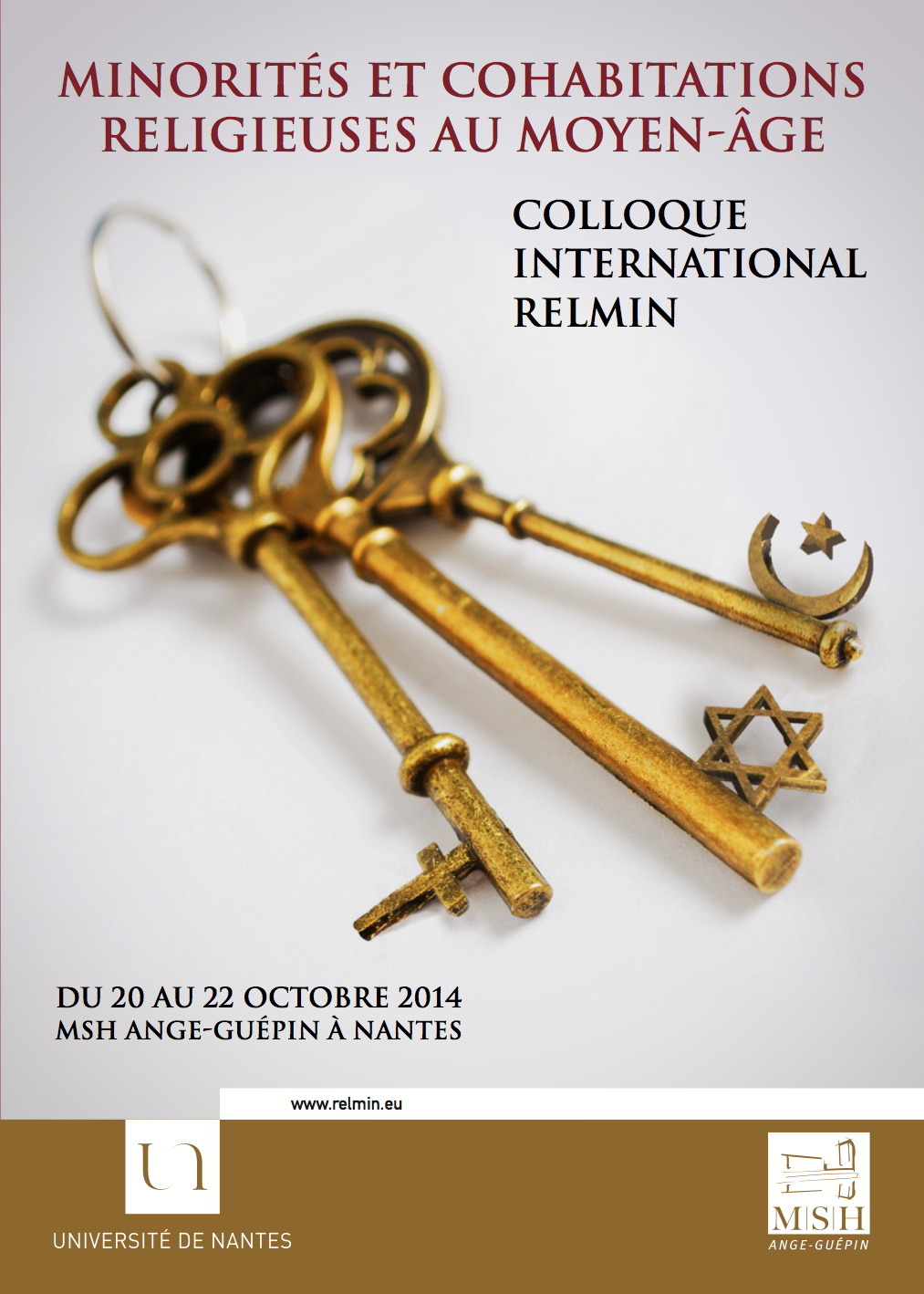
Colloque – Minorités et cohabitions religieuses du Moyen Âge à nos jours

La diversité religieuse en Europe s’enracine dans les pratiques des sociétés médiévales. Les dirigeants du Moyen Âge, chrétiens et musulmans, accordèrent des statuts protégés et inférieurs à certaines minorités religieuses. L’étude des sources juridiques montre que les sociétés médiévales, comme la nôtre, ont subi des changements constants en matière religieuse et que la cohabitation, certes pas toujours pacifique, a été la règle plutôt que l’exception dans l’histoire européenne. Le programme de recherche RELMIN, qui travaille depuis 2010 sur l’étude sur le statut légal des minorités religieuses dans les sociétés médiévales, dresse le bilan d’une recherche scientifique approfondi et livre, à l’occasion de ce colloque international, ses observations pour une meilleure compréhension de l’héritage multi-religieux européen.

RELMINProgramme :

Lundi 20 octobre

9h : MSH Ange Guépin

Ouverture : Allocutions d’ouverture et présentation du projet

10h30 – 13h : MSH Ange Guépin
Le statut juridique des minorités religieuses : un statut d’étrangers ? Table ronde 1

Capucine Nemo-Pekelman,
Tomaso Perani,
Ahmed Oulddali,
Anna Matheson,
Nadezda Koryakina,
Benjamin Delee,
Géraldine Jenvrin.

14h – 15h30 : MSH Ange Guépin
Law as a source for the social historian : possibilities and pitfalls. Conférence plénière par Kenneth Pennington

20h30 : Le lieu unique
Chrétiens, juifs, musulmans : 15 Siècles de cohabitation en Europe. Et demain ? Conférence-débat grand public avec John Tolan, Dominique Avon, Esther Benbassa, Jean Baubérot.

Mardi 21 octobre

9h – 12h : MSH Ange Guépin
Espace et frontières, entre intégration et exclusion. Table ronde 2

Youna Masset,
Farid Bouchiba,
Luca Fois,
Mohamed Hendaz,
Marisa Bueno,
Josep Muntane.

13h30 – 16h : MSH Ange Guépin
Loi, persécution et discriminations des minorités religieuses : contextualiser la violence du monde médiéval. Table ronde 3

Nora Berend,
Paola Tartakoff,
Jessie Sherwood,
Clara Maillard.

18h – MSH Ange Guépin

From sacred to legal : normative texts and the textual communities. Conférence plénière par Talya Fishman et Jonathan Brown

Mercredi 22 octobre

9h – 12h : MSH Ange Guépin
When law confronts reality: religious minorities and the functioning of justice in the middle ages. Table ronde 4

Jerzy Mazur,
Adam Bishop,
Uriel Simonsohn,
Aleida Paudice,
Delfina Serrano.

13h30 – 15h – MSH Ange Guépin
Usages et enjeux du numérique dans les sciences humaines et sociales. Table ronde 5

Stéphane Loret,
John Tolan,
Cyril Masset,
Pascale Kuntz

15h30 – 17h30 – MSH Ange Guépin
Perspectives modernes. Table ronde 6

John Tolan,
Antonio de A. Mendes,
Tijana Krstic,
Rita Hermon-Belot.

17h30 – MSH Ange Guépin

Conclusions

Informations pratiques :
Date à venir lundi 20 octobre 2014 09:00
Lieu MSH Ange-Guépin | Ville Nantes, France
Évènement du lundi 20 octobre 2014 09:00 au mercredi 22 octobre 2014 20:00

Source de l’information : Calenda

Publié dans Colloque | Laisser un commentaire