École d’été – Scuola storica nazionale per l’edizione delle fonti narrative

La Scuola storica nazionale per l’edizione delle fonti narrative va a integrare la già proficua attività della Scuola storica nazionale per l’edizione delle fonti documentarie, interessandosi della produzione più prettamente narrativa e letteraria, che ha bisogno di essere affrontata con metodi di indagine specifica, sia per quanto riguarda le edizioni, sia per quanto riguarda lo studio, perché presenta spesso tradizioni complesse o riferimenti culturali che vanno correttamente riconosciuti e contestualizzati.

Il Corso annuale della Scuola è organizzato in incontri da tenersi a Roma, presso la sede dell’Istituto storico italiano per il medio evo, con cadenza mensile da novembre a giugno, per complessive sessanta ore circa di attività didattica in lingua italiana.

L’attività didattica è strutturata in due livelli, uno pratico e uno teorico, strettamente interrelati.

La frequenza alle lezioni è obbligatoria. Per l’intera durata del Corso, inoltre, ciascun iscritto è tenuto a svolgere l’attività assegnata dai docenti. Alla fine del Corso gli iscritti che hanno seguito assiduamente le lezioni e svolto per intero l’attività prevista, con risultato giudicato positivamente dai docenti, ricevono un attestato rilasciato dall’Istituto storico italiano per il medio evo.

Possono accedere ai corsi coloro che sono in possesso di un diploma di laurea quadriennale oppure della laurea specialistica, di quella magistrale o di un analogo titolo accademico conseguito all’estero, equiparabile per durata e contenuto al titolo italiano.

Direttore della Scuola è il Presidente dell’Istituto storico italiano per il medio evo, prof. Massimo Miglio.

Del Consiglio scientifico della Scuola fanno parte i proff.:
Gian Mario Giusto Anselmi;
Francesco Bruni;
Fulvio Delle Donne (con funzioni di coordinamento scientifico);
Mario De Nonno;
Paolo Garbini;
Giorgio Inglese;
Marco Mancini;
Alberto Varvaro.

Segretario della Scuola è il prof. Giampaolo Francesconi coadiuvato da un altro collaboratore dell’Istituto.

Il corpo docente della Scuola è costituito dai componenti del Consiglio scientifico, coadiuvati ogni anno da altri docenti selezionati tra i migliori e più esperti studiosi italiani e stranieri.

Bando di concorso – corso 2014-2015 (scad. 19 luglio 2014)
Scarica il file

Presentazione Scuola storica nazionale per l’edizione delle fonti narrative
Scarica il file

Attività 2014-2015
Scarica il file

Bibliografia essenziale
Scarica il file

Source de l’information : Istituto storico italiano per il Medioevo

Publié dans École d'été | Laisser un commentaire

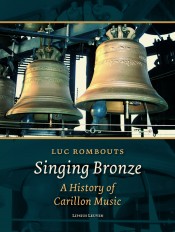
Publication – Luc Rombouts, « Singing bronze. A history of carillon music »

The fascinating history of bell music

The carillon, the world’s largest musical instrument, originated in the 16th century when inhabitants of the Low Countries started to produce music on bells in church and city towers. Today, carillon music still fills the soundscape of cities in Belgium and the Netherlands. Since the First World War, carillon music has become popular in the United States, where it adds a spiritual dimension to public parks and university campuses.

Singing Bronze opens up the fascinating world of the carillon to the reader. It tells the great stories of European and American carillon history: the quest for the perfect musical bell, the fate of carillons in times of revolt and war, the role of patrons such as John D. Rockefeller Jr. and Herbert Hoover in the development of American carillon culture, and the battle between singing bronze and carillon electronics.

Richly illustrated with original photographs and etchings, Singing Bronzetells how people developed, played, and enjoyed bell music. With this book, a fascinating history that is yet little known is made available for a wide public.

def_cover_singing_bronze

Table des matières :

Part 1 – Bell cultures in Antiquity and the Middle Ages
Chapter 1 – The magic of old bells
Chapter 2 – The time of God
Chapter 3 – The time of man
Chapter 4 – The bondage of time

Part 2 – The old carillon art
Chapter 5 – A new musical instrument
Chapter 6 – Carillon music in a divided land
Chapter 7 – Pure bells
Chapter 8 – Carillon music at the court
Chapter 9 – The Bach of the carillon
Chapter 10 – Panorama of the old carillon art

Part 3 – The new carillon art
Chapter 11 – National Carillon
Chapter 12 – The carillon as romantic symbol
Chapter 13 – In search of the sound of the past
Chapter 14 – A soul in peace, among the stars
Chapter 15 – The broken bells of Flanders
Chapter 16 – Memorial bells
Chapter 17 – New carillon construction in the Old Country
Chapter 18 – ‘The bells fight with us’
Chapter 19 – Dutch manufacture versus Carillon Americana
Chapter 20 – Innovations in the Old and the New World
Chapter 21 – Panorama of the new carillon art

Sources and acknowledgements
Notes
Bibliography
Origin of the illustrations
Indices

Informations pratiques :
Luc Rombouts, Singing bronze. A history of carillon music, Louvain, Leuven University Press, 2014. 368 p., 170 x 230 mm. ISBN : 9789058679567. Prix : 39,50 euros.

Source de l’information : Leuven University Press

Publié dans Publications | Laisser un commentaire

Journée d’étude – Les comptables au Moyen Âge : parcours collectifs et individuels

Table ronde le 13 juin 2014

Université Lille 3
Salle de séminaire de l’IRHiS (A1 – 152)
Domaine du Pont de Bois
59653 Villeneuve d’Ascq

Contact : Jean-Baptiste SANTAMARIA
jeanbaptiste.santamaria@gmail.com

Programme :
9h15 : Accueil

9 h 30 : Introduction
9 h 45 : Jean-Marie Yante, Université Catholique de Louvain – « Receveurs et agents comptables princiers ou urbains en Luxembourg (1443-1506). Recrutements et carrières »
10 h 15 : Daniela Cereia, CRISM – Università di Torino – « La carrière de Jean Vagnone di Trofarello, trésorier de Bresse ».

Discussion, pause

11 h 30 : Christelle Loubet, Université de Lorraine – « Les comptables de Mahaut d’Artois (1302-1329) »
12 h 00 : Jean-Baptiste Santamaria, Université Lille 3 – « Des officiers dans la ville : les receveurs d’Arras et Saint-Omer, de Marguerite de France aux ducs Valois de Bourgogne (mi XIVe-mi XVe siècles »).

Discussion, pause déjeuner

14 h 30 : Valeria Van Camp, Université de Namur – « Les clercs de la ville de Mons, leurs fonctions, leurs carrières et leur impact sur la tenue des comptes de la ville aux XIVe et XVe siècles ».
15 h : Mélanie Dubois-Morestin, Université Paris-1 – « Le parcours comptable d’un particulier au XIVe siècle, le cordier avignonnais Jean Teisseire »
15 h 30 : Marco Conti, Université Lyon-2 et Rome La Sapienza – « La charge de depositarius des comptes à Bologne, XIIIe-XVe siècle »

Discussion, pause

17 h 00 : Table ronde. Conclusions et perspectives

Source de l’information : IRHiS

Publié dans Colloque | Laisser un commentaire

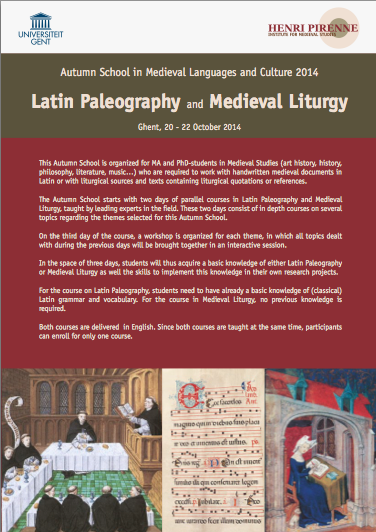
École d’automne – Latin Paleography and Medieval Liturgy. Autumn School in Medieval Languages and Culture 2014

This Autumn School is organized for MA and PhD-students in Medieval Studies (art history, history, philosophy, literature, music, etc.) who are required to work with handwritten medieval documents in Latin or with liturgical sources and texts containing liturgical quotations or references.

The Autumn School starts with two days of parallel courses in Latin Paleography and Medieval Liturgy, taught by leading experts in the field.

The sessions about Medieval Liturgy focus, after an elaborate introduction to the various liturgical books, on the liturgical conventions in France and Germany, on liturgy and music, on liturgy and architecture and on books of hours.

The sessions about Latin paleography explain the interactions between paleography, Diplomatics and Codicology, and will then focus on different scripts, the evolution and layout of the page and reading practices, the organisation of the scriptoria and the position of the scribe.

On the third day of the course, workshops are organized for each theme, in which all topics dealt with during the previous days will be brought together in an interactive session.

In the space of three days, students will thus acquire a basic knowledge of either Latin Paleography or Medieval Liturgy as well the skills to implement this knowledge in their own research projects.

For the course on Latin Paleography, students need to have already a basic knowledge of (classical) Latin grammar and vocabulary. For the course in Medieval Liturgy, no previous knowledge is required.

Both courses are delivered in English. Since both courses are taught at the same time, participants can enrol for only one course.
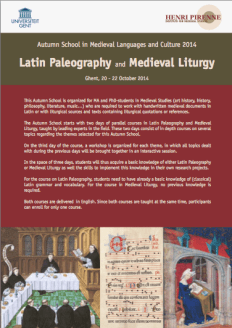
HP Autumn SchoolProgramme :

Latin paleography

Monday, 20 october 2014
Ghent, Blandijnberg, Meeting Room English (130.007)

8.30-9.00: registration in Faculty Room
9.00-10.45: Julia Crick (King’s College, London) – General introduction
10.45-11.00: coffee break

11.00-12.45: Julia Crick – The scripts of the early middle ages
Lunch

13.45-15.30: Erik Kwakkel (University of Leiden) – The development of medieval script, 1000-1500 (Part I)
15.30-15.45: coffee break
15.45-17.30: Erik Kwakkel – The development of medieval script, 1000-1500 (Part II)

Tuesday, 21 october 2014
Ghent, Blandijnberg, Meeting Room English (130.007)

9.00-10.45: Marilena Maniaci (University of Cassino) – The archaeology of the manuscript book: materials, tools, techniques
10.45-11.00: coffee break

11.00-12.45: Marilena Maniaci – Page layout and text formatting: constraints, tendencies, rules
lunch

13.45-15.30: Peter Stokes (King’s College, London) – Paleography and the digital humanities (Part I)
15.30-15.45: coffee break

15.45-17.30: Peter Stokes – Paleography and the digital humanities (Part II)

Wednesday, 22 october 2014
Ghent, Blandijnberg, Meeting Room English (130.007)

9.00-10.45: Els De Paermentier (Ghent University) – Workshop
10.45-11.00: coffee break

11.00-12.45: Els De Paermentier – Workshop

Medieval Liturgy

Monday, 20 october 2014
Ghent, Blandijnberg, Faculty Room (110.009)

8.30-9.00: registration
9.00-10.45: Éric Palazzo (University of Poitiers) – General introduction (part I)

10.45-11.00: coffee break
11.00-12.45: Éric Palazzo – General introduction (part II)
Lunch

13.45-15.30: Barbara Haggh (University of Maryland) – Liturgy and Music I: Chanted Texts for the Mass and the Sacraments
15.30-15.45: coffee break

15.45-17.30: Barbara Haggh – Liturgy and Music II: Chanted Texts for the Office and Votive Services

Tuesday, 21 october 2014
Ghent, Blandijnberg, Faculty Room (110.009)

9.00-10.45: Charles Caspers (Titus Brandsma Instituut, Nijmegen) – Liturgical practices in the Low Countries
10.45-11.00: coffee break

11.00-12.45: Allan Doig (University of Oxford) – Liturgy and Architecture
Lunch

13.45-15.30: Rowan Watson (Victoria and Albert Museum, London) – Books of Hours – introduction
15.30-15.45: coffee break

15.45-17.30: Youri Desplenter (Ghent University) – Middle Dutch Books of Hours

Wednesday, 22 october 2014
Ghent, Blandijnberg, Faculty Room (110.009)

9.00-10.45: Nils Holger Petersen (University of Copenhagen) – Workshop
10.45-11.00: coffee break

11.00-12.45: Nils Holger Petersen – Workshop

Informations pratiques :

Application
The application deadline for the entire course (three days) is August 31, 2014. There will be a maximum of 20 participants per course. Applications should be sent to Martine.DeReu@UGent.be and must contain the following informa- tion: course applied for, university where your MA or PhD will be obtained, mother tongue, level of English, research topic for your master’s or doctoral thesis and, only for those applying for the course on paleography, previous knowl- edge of paleography (yes/no). Remember: knowledge of Latin is required for the course on Latin paleography.

Accomodation and transport
Participants need to provide for their own accommodation and transport. Useful information can be found on the following websites:

for accommodation:
http://www.jeugdherbergen.be/en/youth-hostels/city-hostels/gent-de-draecke (Youth Hostel) http://www.hosteluppelink.com/en/welkom (Youth Hostel)
http://www.backstayhostels.com/ (Youth Hostel)
http://www.visitgent.be/
http://www.gent-hotels.eu/en http://www.hostelbookers.com/hostels/belgium/ghent/ http://www.hotelspecials.be/be/oost-vlaanderen/gent.html

for trains:
http://www.b-rail.be/nat/E/

Meals
Lunches on Monday and Tuesday will be organized by the H. Pirenne Institute for Medieval Studies. Evening meals and lunch on Wednesday are not provided by the organizers.

Registration fee
There is a registration fee of 100 EUR. This fee is to be paid – after confirmation has been received of acceptance in the Autumn School – into the account of Ghent University, Sint-Pietersnieuwstraat 25, B-9000 GHENT. Account details: IBAN: BE59-3900-9658-0026 – SWIFT: BBRU BE BB 900. The VAT-number of Ghent University is BE 0248.015.142. The bank transfer should mention “Medieval Languages and Culture 2014”. Payment of this fee is considered as confirmation of registration.

The registration fee is waived for MA and PhD students from Ghent University, from the Onderzoekschool Mediëvistiek (Netherlands) and from the University of Oxford.

This project is organized by the Henri Pirenne Institute for Medieval Studies at Ghent University and funded by the Ghent Doctoral School for Arts, Humanities and Law, by the Dutch Research School for Medieval Studies, by the Society for the Study of Medieval Languages and Literature and by the Ghent educational project Internationalisation@home.

Organizing committee :
Youri Desplenter (Ghent University, vice-chair of the Henri Pirenne Institute for Medieval History) Helen Swift (University of Oxford, Faculty of Medieval and Modern Languages)
Catrien Santing (University of Groningen, Faculty of Arts, Chair Group Medieval History)
Martine De Reu (Ghent University, coordinator of the MA in Historical Linguistics and Literature)

Source de l’information : Henri Pirenne Institute for Medieval Studies

Publié dans École d'été | Laisser un commentaire

Appel à contribution – Formes du texte latin au Moyen Âge et à la Renaissance

IVe congrès de la Société d’Études Médio et Néo-Latines (Semen-l)
Université de Grenoble – site de Valence
4, 5, 6 juin 2015

Organisation : Martine Furno, Christiane Louette, Valérie Méot-Bourquin

L’étude de la mise en forme des textes a fait ces dernières années l’objet de travaux importants depuis ceux, pionniers, de Henri-Jean Martin. On sait désormais qu’une même œuvre acquiert des significations différentes quand sa mise en texte et en page se transforme, que le texte apparaît bien souvent comme une « forme de l’intention » qui fait intervenir plusieurs « co-élaborateurs » (l’auteur, le typographe, le destinataire ou lecteur) et dont la réalisation définitive sur la page est le produit d’une tension, plus ou moins reconnue, plus ou moins avouée, entre un projet et les difficultés qu’il rencontre.
L’intérêt de ces questions est actuellement ravivé par la réflexion sur la page numérique qui invite à reconsidérer une nouvelle fois la représentation matérielle du texte. Mais il faut l’inscrire aussi dans le développement des recherches rhétoriques et poétiques sur la dispositio ou le dispositif (voir l’ouvrage récent d’Ugo Dionne, La Voie aux chapitres, Seuil, 2009, sur la disposition romanesque).

Au croisement de l’histoire du livre, de la rhétorique et de l’histoire des idées, le IVecongrès de la Semen-l ambitionne d’étudier dans quelle mesure la mise en forme matérielle et intellectuelle des textes latins conditionne leur réception. On considérera forme et texte au sens large : forme renvoyant à une disposition matérielle aussi bien que rhétorique ; texte pouvant s’entendre comme un ensemble de caractères sur une page, mais aussi comme ouvrage, recueil, collection, dans le cadre du manuscrit comme de l’imprimé, de la poésie comme de la prose fictionnelle ou docte.

La réflexion pourra se développer dans plusieurs directions :

  • la mise en forme matérielle : construction visuelle de la page ou de l’ouvrage, numérotations, divisions, rubrications du texte, rapports du texte et de l’image ;
  • la disposition ou le dispositif rhétorique : découpage en paragraphes ou en ensembles organisés (chapitres, parties, livres), stratégies mises en œuvre pour construire la réception du texte ;
  • la spécificité de la mise en forme du texte latin par d’éventuelles comparaisons avec des textes en langue vulgaire (traductions, adaptations).

Modalités de participation :
Les propositions de communication (un titre et quelques lignes de présentation) sont à envoyer avant le 15 juin 2014 à Martine Furno (Martine.Furno@u-grenoble3.fr), Christiane Louette (Christiane.Louette@u-grenoble3.fr) ou Valérie Méot-Bourquin (Valerie.Meot-Bourquin@u-grenoble3.fr). Les participants à ce IVe Congrès de la Semen-l seront naturellement priés d’être à jour de leur cotisation 2015 (pour tous renseignements, contacter Alice Lamy (lamy.alice@freefr)).

Source de l’information : Fabula

Publié dans Appel à contributions | Laisser un commentaire

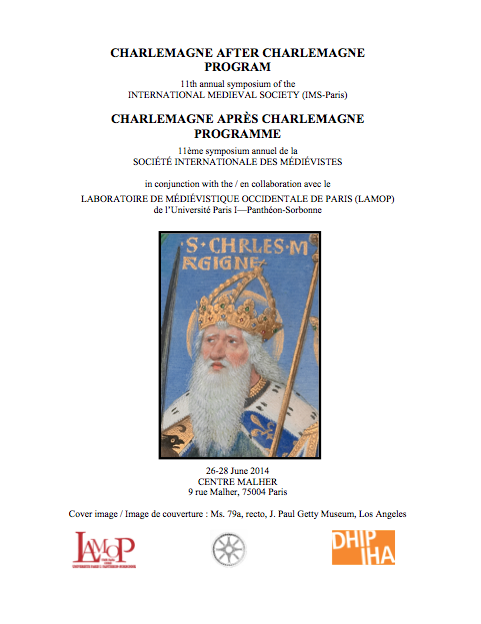
Charlemagne après Charlemagne

Le personnage historique du roi franc devenu empereur en 800 et mort en 814 a connu au Moyen Age et au-delà une fortune qui dépasse sans doute celle de tout autre personnage historique médiéval. Le Symposium se propose d’examiner ces traditions en s’intéressant aux représentations après 814 de ce Charlemagne qui allait devenir un souverain modèle, un personnage littéraire, mais aussi un saint à la vénération complexe car limitée. Cela nécessita un discours hagiographique spécifique ainsi que la composition d’un office liturgique.

La fortune littéraire de Charlemagne, mise en relief par Gaston Paris déjà en 1865 a subi des différenciations multiples. Les littératures latines et vernaculaires (dans les domaines français, italien, allemand, anglais, etc.) ont mis en œuvre des liens supplémentaires et des développements distincts, des écrits historiques aux chansons de geste. Les représentations littéraires vont de pair avec les représentations artistiques développées dans le champ des manuscrits, du vitrail, de la sculpture ou encore de l’architecture. Enfin, le personnage de Charlemagne a connu un succès remarquable comme pèlerin et comme fondateur effectif ou imaginé de monastères, de villes et même d’universités par le biais de récits et de faux actes intitulés en son nom. La figure de Charlemagne servait visiblement à remplir, mais aussi à définir un idéal en fonction des époques et des besoins respectifs.

ILS - CHarlemagne

Programme:

Jeudi 26 juin

8.45 – 9.15 : Inscription
9.15 – 9.45 : Introduction – Katherine Baker, Kristin Hoefener
9.45 – 11.00 : Keynote: Elizabeth A.R. Brown

11.30-13.00 Session 1: Genèse d’un personnage littéraire
Présidence : Philippe Faure (Université d’Orléans)

Jeanette Beer – Nithard’s personal contribution to Charlemagne’s legacy
Enimie Rouquette – La figure de Charlemagne dans la poésie carolingienne: de 814 à la mort de Charles le Chauve
Anne Latowsky – Poésie et chronologie: la Terre sainte, l’Espagne et les vies de Charlemagne

14.00-15.30 Session 2: Après Charlemagne, avant la canonisation
Présidence : Fanny Madeline (Paris I – LAMOP)

Richard Landes – Charlemagne, Otto III et Adémar de Chabannes: l’empereur de l’an 6000 dans la pensée de l’an Mil
Matthew Gabriele – The Ghost of Charlemagne and King Philip I of Francia at the End of the Eleventh Century
Claire Tignolet – Charlemagne au temps des premiers Capétiens: une figure de référence dans l’historiographie (Xe – XIIe siècles)?

16.00-17.30 Session 3: Charlemagne dans la France Capétienne
Présidence : Julian Führer (DHI Paris)

Jace Stuckey – The Memory of Charlemagne, Kingship, and the Uses of the Past in Capetian France Christopher
Patrick Flynn – Speculum Caroli: The Representation of Charlemagne in the Speculum Historiale of Vincent of Beauvais
Chris Jones – King and Emperor? Perceptions of Charlemagne in Later Capetian France

17.45-19.15 : Visite à l’Institut historique allemand, Vin d’honneur et remise des prix de l’IMS
19.30 : Dîner (préinscription requise)

Vendredi 27 juin

10.00-11.00 Session 4: Vues de l’extérieur
Présidence : Amélie Sagasser (DHI Paris)

Cesare Mascitelli – Charlemagne et la Geste Francor de Venise: l’empereur aux cours de Vérone et Mantoue
Vaclav Zurek – Saint patron et ancêtre: Charlemagne dans la politique de Charles IV de Luxembourg

11.30-13.00 Session 5: Le culte de Charlemagne
Présidence : Kristin Hoefener (Universität Würzburg)

Patricia Kroschwald – A reinvented tradition? The veneration of Charlemagne at Halberstadt Cathedral
Eric North Rice – Charlemagne and the Consciousness of France in the Medieval Liturgy of Aachen (Aix-la-Chapelle)
Joan Molina Figueras – La mémoire de Charlemagne à Gérone à la fin du Moyen Age. Culte, objets et images

14.00-15.00 Session 6: Le monument Charlemagne
Présidence : Katherine Baker (INHA Paris)

Clark Maines – Charlemagne Iconography at Chartres Cathedral
Jürg Goll – La statue en stuc de Charlemagne à Müstair

16.00-18.00 Visite gratuite: Basilique de Saint-Denis (préinscription requise)

Samedi 28 juin

9.30-10.45 : Keynote: Dominique Boutet

11.15-12.45 : Session 7: L’exemple de Charlemagne
Présidence : Irène Fabry-Tehranchi (University of Reading)

Luke Sunderland – Charlemagne in Medieval French Chronicles: ‘les bienfaits qu’il avoit fais pesoient plus que le mal’
Daisy Delogu – « Comment on conquiert Dieu » : Charlemagne as a Devotional Guide in L’Istoire le roy Charlemaine
Jade Bailey – Le Livre de Charlemaine: The Emperor Charlemagne as a Didactic Exemplar in a Late-Medieval « Chivalric Textbook »

14.00-15.30 Session 8: Charlemagne en Angleterre
Présidence : Raeleen Chai-Elsholz (IMS Paris)

Phillipa Hardman – Carolingian Onomastics: Naming and Meaning in Middle English Narratives of Charlemagne
Marianne Ailes – La Chanson de Roland d’Oxford: remaniement anglo-normand?
Gernot Wieland – « Charlemagne » in Anglo-Saxon England

16.00-16.45 : Julian Führer (DHI Paris) – Conclusion et discussion
18.00-20.00 : Apéritif

Informations pratiques :

Jeudi 26 – samedi 28 juin 2014

11e symposium annuel de la Société Internationale des Médiévistes – Paris, en collaboration avec le Laboratoire de médiévistique occidentale de Paris (LAMOP, Université Paris I – Panthéon-Sorbonne)

Centre Malher, 9 rue Malher
Paris, 75004

Formulaire d’inscription : ici

Source de l’information : International Medieval Society

Publié dans Colloque | Laisser un commentaire

Séminaire – New Approaches to Tenth and Eleventh Century Reform

New Approaches to Tenth- and Eleventh-Century Reform. A Workshop
Friday 20th June
Centre for Medieval Studies University of York

This workshop is part of a collaborative project funded by the universities of York and Leeds and is convened by Katy Cubitt and Julia Barrow. It sets out to question the ideas of reform from the 8th to the 11th centuries and to seeks to explore some new avenues of research.

Registration (including lunch and refreshments): £25/£20 (students)
Reduced rate for those from White Rose Universities (Leeds, Sheffield, York) £20/£15 (students)

Please return registration form (with cash or cheque payment) to: Brittany Scowcroft
Centre for Medieval Studies
University of York
The King’s Manor
York
YO1 7EP brittany.scowcroft@york.ac.uk

Séminaire - York

Programme :

10.00 : Welcome by Katy Cubitt, Centre for Medieval Studies, York

10.15-12.15pm

Brigitte Meijns, University of Leuven – Charters and institutional change in canonical milieus in Flanders and in the North of France (c. 950-c.1150)
Steven Vanderputten, University of Ghent – Imagining Richard of Saint-Vanne: religious leadership and the conversion of the world in the early eleventh century
Charles West, University of Sheffield – Turbulent priests and the “reformed’ papacy”
12.15-1.15 lunch

1.15-3.15pm

Jesse Billett, Trinity College, University of Toronto – What do we mean by “liturgical reform”? The Divine Office in later Anglo-Saxon England’
Sarah Hamilton, University of Exeter – Liturgical reform? The evidence of the Exeter martyrologies
Anne-Marie Helvétius, University of Paris 8 – Monastic Reform and Hagiography: some reflections and new perspectives
3.15-3.35pm : Tea

3.35-4.55pm

Ludger Koerntgen, University of Main – Fighting against long-lasting evils or contemporary enemies?’
Julia Barrow, University of Leeds – The Vikings and Reform
4.55 – 5.45pm : Roundtable and close

Source de l’information : University of York

Publié dans Colloque, Séminaire | Laisser un commentaire

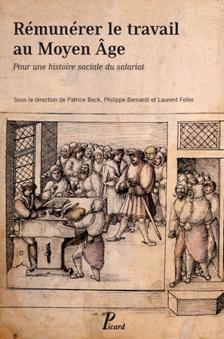
Publication – Patrice Beck, Laurent Feller et Philippe Bernardi (dir.), « Rémunérer le travail au Moyen Âge. Pour une histoire sociale du salariat »

Cet imposant ouvrage collectif rassemble les contributions de médiévistes européens et américains qui abordent la question du salaire au Moyen Âge et de la rémunération réelle du travail à travers l’ensemble de l’Europe. Ils traitent successivement de l’historiographie du salariat au Moyen Âge, de la désignation du paiement du travail, des formes de l’embauche et la composition du paiement, et enfin de l’évaluation des rémunérations.

Picard - image002

Cette question a longtemps été abordée sous l’angle exclusif de l’étude du binôme prix/salaire afin de traiter de la question du niveau de vie. Or, le salaire est aussi une question d’histoire sociale, qui relève d’une forme d’anthropologie économique. Il fournit en effet l’essentiel du revenu d’une partie importante de la population urbaine et d’une fraction non négligeable de la population rurale dès le xiiie siècle. La négociation du salaire, son montant, les modalités de son versement structure la vie d’un nombre croissant de personnes, hommes et femmes.

Ainsi, c’est au moment de l’embauche que se détermine le montant et la nature du salaire : selon que la négociation porte sur un prix ou sur des journées, sur une tâche ou sur du temps, les rapports entre employeurs et employés ne sont pas les mêmes. De même, la valeur de ce qui est offert en contrepartie du travail, qu’il s’agisse d’argent ou de prestations en nature, de même que les modalités du versement, varient d’un métier à un autre et d’une région à une autre.

C’est de ces diversités que les auteurs se sont efforcés de rendre compte en décrivant les nombreuses approches de la rémunération à travers les différentes professions, milieux urbains ou ruraux, périodes concernées. L’importance de cet ouvrage, qui regroupe des historiens comme des spécialistes de l’histoire économique, en fera un ouvrage clef pour la compréhension de la question des rapports de travail dans l’Europe médiévale.

Ouvrage collectif sous la direction de :
Patrice Beck est professeur d’histoire et d’archéologie médiévale à l’université de Lille 3.
Laurent Feller est professeur d’Histoire du Moyen Âge, à l’université de Paris I Panthéon-Sorbonne.
Philippe Bernardi est directeur de recherche au CNRS, spécialiste d’histoire économique, sociale et technique de la construction à la fin du Moyen Âge.

Informations pratiques :
Patrice Beck, Laurent Feller et Philippe Bernardi (dir.), Rémunérer le travail au Moyen Âge. Pour une histoire sociale du salariat, Paris, 2014. 16 x 24 cm, 528 pages. Broché. Parution : juin 2014. Prix : 39 euros. ISBN : 978-2-7084-0971-2.

Source de l’information : Picard

Publié dans Publications | Laisser un commentaire

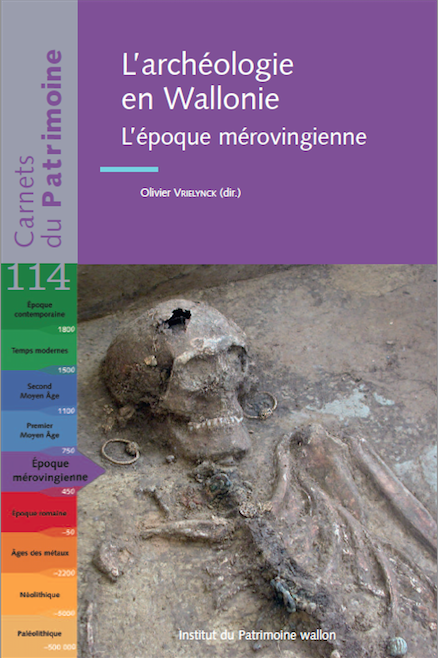
Publication – Olivier Vrielynck (dir.), « L’archéologie en Wallonie : l’époque mérovingienne »

Lorsque l’Empire romain d’Occident s’effondre à la fin du Ve siècle, les populations gallo-romaines et germaniques cohabitent depuis longtemps dans nos régions. Les Mérovingiens, dynastie de rois francs descendant de Clovis, prennent alors le pouvoir sur un vaste territoire correspondant globalement à l’ancienne Gaule. Ce sixième Carnet sur l’archéologie en Wallonie présente les découvertes concernant cette période mérovingienne (476-751 ap. J.-C.). Après une brève mise en situation historique, les principaux sites archéologiques fouillés sont décrits par catégorie : agglomérations urbanisées, habitats ruraux, cimetières, églises et abbayes. Les informations apportées par ces sites sur la vie quotidienne, les croyances, l’art, l’artisanat et le commerce sont ensuite abordés.

Vrielynck IPW

Table des matières :

Avant-propos
Introduction

Cadre historique
L’établissement germanique
de Nereth
Le cimetière de Vieuxville
Le sarcophage de Chrodoara

Les agglomérations

L’habitat rural
L’habitat du Haut Moyen Âge de Villers-le-Bouillet

Les cimetières
Un cimetière rural classique : Bossut-Gottechain
Le cimetière mérovingien tardif de Matagne à Haillot
Du cimetière familial au cimetière paroissial : l’exemple de Froidlieu

Églises et abbayes
Du cimetière au village : Wellin et Quaregnon

Vie quotidienne, art et croyances

Artisanat et commerce
L’archéométrie au service des archéologues : la méthode PIXE/PIGE
L’atelier de verrier de Huy « Aux Ruelles »
Un cas particulier : le commerce des sarcophages

Conclusion et perspectives
Sites et musées
Orientation bibliographique
Remerciements
Crédits photographiques
Liste des auteurs

Informations pratiques :
Olivier Vrielynck (dir.), L’archéologie en Wallonie : l’époque mérovingienne, Namur, 2013 (Carnets du Patrimoine, 114). Format : 16 x 24 cm, couverture souple et intérieur en quadrichromie. 68 pages, 100 illustrations. ISBN : 978-2-87522-113-1. Prix : 6 €.

Contact :
Institut du Patrimoine wallon. Service Publications. Rue du Lombard, 79 – B-5000 Namur.
publication@idpw.be
s.langohr@idpw.be (04/250 93 76)

Vente :
en librairie ;
via le site internet de l’IPW : http://www.institutdupatrimoine.be/index.php/services/publications | boutique en ligne accès direct).

Source de l’information : Institut du Patrimoine wallon

Publié dans Publications | Laisser un commentaire

Conférence – Claire Billen, « Culture, Fêtes et politique à Bruxelles sous le règne de Charles Quint »

Claire Billen, « Culture, Fêtes et politique à Bruxelles sous le règne de Charles Quint »
Coudenberg – Nocturnes historiques

Il serait anachronique de considérer qu’une cour comme celle de Charles Quint, quand elle exerce la chasse ou qu’elle assiste à des spectacles, se livre à des loisirs. Cette dernière notion ne peut être utilisée telle quelle pour les sociétés d’Ancien Régime. La chasse, les fêtes et les performances publiques sont avant tout des événements politiques soigneusement mis en scène par le pouvoir. En privilégiant, dans la mesure du possible, le cadre bruxellois, nous explorerons l’outillage festif avec lequel la cour et les élites urbaines entraient en dialogue et avec quels objectifs.

Capture d’écran 2014-05-31 à 12.05.19

Informations pratiques :
Jeudi 5 juin 2014, 19h00

Renseignements pratiques :
Coudenberg – Ancien Palais de Bruxelles (souterrains de la place Royale)
Entrée par le 10 place Royale à 1000 Bruxelles
Infos et réservation du lundi au vendredi de 9h à 17h : info@coudenberg.com ou 02 563 61 79

Tarif unique | € 6 par soirée
Masereelfonds-Davidsfonds | 5€
Ce tarif comprend l’entrée au Coudenberg, la conférence et la participation à l’activité.

Source de l’information : Coudenberg

Publié dans Le réseau | Laisser un commentaire