-
Avec le soutien du FNRS, du CRHiDI (UCLouvain – Saint-Louis, Bruxelles), d'INCAL (UCLouvain), de PraME (UNamur), de sociAMM (ULB) et de Transitions (ULiège)
-

-

-

-

-

-

- Activités du RMBLF Appel à contributions Appel à projet Audio Bande dessinée Banque de données Bourse Colloque Documentaire Débat et historiographie Enquête Enseignement Excursion Exposition Le réseau Les journées Musique Mécénat Médias News Nécrologie Offre d'emploi Podcast Prix Publications Réseau de recherche Stage Séminaire Web École d'été
- Follow L'Agenda des Médiévistes on WordPress.com
-
Colloque international – Medieval Documents as Artefacts, 1100-1600
Preliminary Program – International Conference ‘Medieval Documents as Artefacts, 1100-1600’
Maastricht, The Netherlands, February 5-6, 2014
organized by the working group ‘Writing and Writing Practices in the Medieval Low Countries’, (Schrift en Schriftdragers in de Nederlanden in de Middeleeuwen – SSNM) in collaboration with the Huygens Institute-ING and the Regional Historic Centre Limburg
This conference is devoted to the physical appearance of documents in the High and Late Middle Ages. Artefacts that survive from medieval written culture can roughly be divided into two categories. On the one hand there are manuscripts – historical, literary and other – which are usually kept in libraries. These objects are carefully catalogued, not just for their contents but also for their material features. Moreover, they frequently feature in studies that are exclusively interested in their physical appearance, discussing, for example, the codicology or palaeography of manuscripts from the same genre (liturgical books, Bibles), location (monastic house, region, country) or scribe. On the other hand, a wide range of documentary material survives from the Middle Ages, which is kept in the archives – charters, registers, cartularies, account books and rolls, and the like. Of these archival documents, mainly charters have been traditionally studied in much detail, quite often combining the research of the external features – palaeography, writing supports, tags and seals – with the study of the internal features, such as language and text structure.
Hitherto, scholars studying the material forms of documents kept in libraries and those researching the records preserved in archives seem to have been living in separate worlds. This conference aims to bring them together by encouraging a material-based focus in the study of documentary sources. Through a broad range of papers it will be shown what kind of studies may be most fruitful, what methods may be used, and how the physical features of documentary sources may impact our understanding of their production and use.
Key lectures will be given by:
Prof. dr. Peter Gumbert (Leiden University)
Prof. dr. Benoît-Michel Tock (Université de Strasbourg)
Programme :
Day 1 (February 5)
9.30-10.15 : Registration and coffee
10.15-10.30 : Welcome and introduction – Drs. L. Wiggers, director of the Regional Historic Centre Limburg & Em. Prof. Th. de Hemptinne (Ghent University), member of SSNM
10.30-11.30 : Keynote: Prof. B.-M. Tock (University of Strasbourg) – The making of a charter.
11.30-12.00 : Coffee/tea
11.45-13.00 : Excursion for foreign participants to the St Servaas church
12.00-13.00 : Public lecture (Auditorium, in Dutch language) – Erik Kwakkel (Leiden University) and Truus Roks (Regional Historic Centre Limburg)
13.00-13.50 : Lunch for the participants of the conference (coffee area)
13.50-14.50 : Session 1 A (Auditorium) – Writing support (1)
E. Dijkhof (Huygens ING) – Sheep and goatskin as material for parchment in the thirteenth and fourteenth century.
A. Stuckens (University of Namur) – The first uses of paper in the government of the county of Flanders (end of the 13th – early 14th c.). New thoughts.
Session 1 B (Chapel) – Archival practices: shaping ecclesiastical and monastic identities (1)
A. Smith (independent scholar, Bonn Germany) – Rethinking Medieval Cartulary Production through an Exploration of Forgery in the Kelso Abbey Charter Collection.
D. Belmonte Fernàndez (University of Sevilla) – Material strategies for the chaplaincy endowments management in the Cathedral of Seville (15th century).
14.50-15.15 : Coffee/tea
15.15-16.45 : Session 2 A (Chapel) – Scribal practices (1)
E. Danbury (University of London) – Medieval English illuminated charters: scripts, scribes and illuminators.
A.-M. Van Egmond (University of Amsterdam) – Clerks and illuminators working the same pages: decorated initials in the The Hague account books (1414-1421).
J. Berenbeim (University of Oxford) – Documents and Decoration.
Session 2 B (Auditorium) – Material aspects of production, purpose and transmission of documents and manuscripts (1)
J. Keßler (Radboud University Nijmegen) – The reading culture of Xanten monastery.
M. Williams (University of Groningen) – Ad Regem: Diplomatic Documents as Artefacts of Early Modern Foreign-Policy Making.
T. Hodel (University of Zürich) – Dorsal notes: Looking at backs of charters as a mode of analyzing use and transmission of written documents (Königsfelden Abbey, 1300-1600).
16.45-18.00 : Reception at the RHCL
19.00 : Dinner at ‘Le Petit Bonheur’
Day 2 (February 6)
9.00-9.30 : Registration and coffee
9.30-10.30 : Keynote: Em. Prof. P. Gumbert
10.30-11.00 : Coffee/tea
11.00-12.00 : Session 3 A (Auditorium) – Writing support (2)
J. Burgers (University of Amsterdam/Huygens ING) – Ruling the registers: a codicological aspect of the registers of the counts of Holland 1299-1345.
J. Vnoucek (Royal Library of Copenhagen) – The language of parchment – learning the history of manuscripts with the help of visual assessment of the parchment.
Session 3 B (Chapel) – Archival practices: shaping ecclesiastical and monastic identities (2)
A. Puglia (University of Siena-Arezzo) – The episcopal power in western Tuscany between acts and books (XI-XII centuries).
C. Rey (University of Dijon) – Jean de Cirey, abbot of Cîteaux (1476-1501) and the reorganization of archives and manuscripts: archival filing, cataloguing, binding and printing.
12.00-13.00 Lunch
13.00-14.30 : Session 4 A (Auditorium) – Scribal practices (2)
J. Biemans (University of Amsterdam) – Monastic scriptorium or municipal workshop?
B. Van Hofstraeten (Maastricht University) – The emergence, use and nature of the humanistic cursive in the Southern Netherlands (ca 1600).
M. J. Oliveira e Silva (University of Porto) – Traces of (mis)use: practicing writing in medieval Portuguese documents.
Session 4 B (Chapel) – Computer-aided methodological approaches
M. Driscoll / T. Lanzing (University of Copenhagen) – Text density: quantification and application.
J. Smit (University of Amsterdam) – A good hand is hard to find? Automatic writer identification and the chancery of Holland, 1299-1345.
P. Samara (University of Amsterdam/Huygens ING) – Constructing a medieval palaeographic scale.
14.30-15.00 : Coffee/tea
15.00-16.30 : Session 5 A (Auditorium) – Material aspects of production, purpose and transmission of documents and manuscripts (2)
E. Ramos Rubert (Archdiocese of Granada) – Some observations about non original material in illuminated manuscripts.
K. Strinnholm Lagergen (Catholic University of Leuven) – The Birgittine abbey Maria Refugie – manuscript production during five hundred years.
J. Love (University of Copenhagen) – Árni’s Archives: Medieval Documents from the Copenhagen Arnamagnæn Collection.
Session 5 B (Chapel) – Archival practices: shaping secular (urban) identities
V. Van Camp (University of Namur) – From rotulus to codex. The layout of the accounts of the massard of Mons, 1279-1500.
F. Roldão (University of Coimbra) – A municipal archive in the late Middle Ages (Évora, from 1415 to 1536): methodological approaches for a reflection on
the documents.
T. Van Gassen (Ghent University) – City cartularies in late medieval Ghent: a sign of urban identity?
16.30-16.45 : Conclusion (Auditorium) – Prof. dr. J.W.J. Burgers (University of Amsterdam/Huygens ING), chair of SSNM
Informations pratiques :
February 5-6, 2014
Maastricht, The Netherlands
Regional Historic Centre Limburg
Sint Pieterstraat 7
6211 JM Maastricht
T +31 (0)43 328 55 00
Scientific and organizing committee :
Prof. dr. Olivier Guyotjeannin (École Nationale des Chartes, Paris)
Prof. dr. Marco Mostert (University of Utrecht)
Prof. dr. Jan Burgers (University of Amsterdam)
Dr. Jean-François Nieus (University of Namur)
Em. Prof. dr. Walter Prevenier (Ghent University)
Em. Prof. dr. Thérèse de Hemptinne (Ghent University)
Prof. dr. Els De Paermentier (Ghent University)
Dr. Erik Kwakkel (Leiden University)
Dr. Geertrui Van Synghel, Dr. Eef Dijkhof (Huygens Instituut voor Nederlandse Geschiedenis)
Dr. Hildo Van Engen (Streekarchief Langstraat Heusden Altena).
Executive commission :
Jan Burgers (University of Amsterdam)
Eef Dijkhof (Huygens Instituut voor Nederlandse Geschiedenis)
Els De Paermentier (Ghent University).
Publié dans Colloque
Laisser un commentaire
Appel à contribution – Sources on Art Technology
The sixth symposium of the ICOM-CC Working Group Art Technological Source Research, Monday 16th and Tuesday 17th of June 2014 at the Rijksmuseum in Amsterdam.
After five earlier successful symposia in Amsterdam, Madrid, Glasgow, Vienna and Brussels the biennial ATSR symposium returns to Amsterdam in 2014 for discussion about the working group’s base: the art technological sources themselves and their research. The context for the 2014 symposium is the large collection of art technological sources from the Middle Ages until today in the library of the Rijksmuseum. Discussions will therefore concern: artist’s notebooks, practical treatises, studio interiors, workshop inventories, documents on the trade in artists materials, and databases for art technological sources.
The preceding symposia showed that the profound disclosure of such material is of paramount importance for both art historical as well as material-technical research. This concerns insight into the coherence between the style of a work of art and the materials and techniques used in its production. Knowledge of documents containing information on production methods and knowledge of the conservation of art works are also indispensable. A better understanding of source material is therefore basic to all further study of art objects.
We wish to bring together members of the ATSR working-group again, but very much welcome and encourage all professionals interested in art technological source research to submit abstracts. We emphatically invite art historians to contribute, but also welcome relevant contributions from other disciplines, such as conservation science, book history, and the history of science and technology.
Contributions to the symposium are considered, either as oral presentations or as poster, on the assumption that they are not planned for publication elsewhere. They should be original material that has not been published. Contributions should be related to the research of art technological sources – printed or written, texts or images – through all times and places.
Call for papers and time table
- It is intended that all papers presented will be published as postprints.
- We invite abstracts of maximum 500 words in English, both for oral presentations and posters. The conference will be in English.
- Abstracts can be submitted from 1 December 2013.
- Deadline for abstract submission: 6 January 2014
- Notification of acceptance/ rejection: 6 February 2014
Contact information
Email: ATSR6@rijksmuseum.nl
Mail address: Hobbemastraat 22, 1071 ZC Amsterdam
Telephone: +31 (0)20 674 70 00
Source of the information: arthist.net ; rijksmuseum.nl
Publié dans Appel à contributions
Laisser un commentaire
Appel à contribution – Peuple(s) et pouvoir(s) en représentation. Espaces nordique et germanique
Ce colloque se fonde sur l’étude des représentations telles qu’elles ont été définies comme concept de l’histoire culturelle du politique. En France, Roger Chartier a souligné leur rôle dans la construction des hiérarchies sociales, le « découpage social objectivé » se révélant être « la traduction du crédit accordé à la représentation que chaque groupe donne de lui-même » (Chartier, Roger : Au bord de la falaise: l’histoire entre certitudes et inquiétude, Paris: Albin Michel 2009(1997), p. 11). Situées à l’intersection entre pratiques et théories, émergeant dans un contexte de concurrence entre différentes formes de pouvoir, les représentations font l’objet d’une réception active, qui transforme leur sens, leur impact et en génère de nouvelles. Or la question des communications à l’intérieur d’un État est un point central de leur production. La communication politique est une importante source de pouvoir, que les autorités utilisent à des fins de propagande, pour justifier les conflits et mobiliser d’importantes ressources d’énergie.
Peuple(s) et pouvoir(s) dans la formation de l’État et de la nation
Dans le sillage d’une histoire des nationalismes qui s’est efforcée d’en proposer une vision différenciée (patriotisme, régionalisme, sentiment national, sentiment impérial…), s’intéresser aux représentations mettant en scène peuple et pouvoir politique peut permettre de mieux saisir les phénomènes d’appartenance dans la spécificité de l’espace scandinave, tout en les rattachant au contexte baltique, voire européen. D’un point de vue chronologique, ces phénomènes s’inscrivent dans un mouvement de multiplication des entités politiques au Moyen-Âge, puis de réduction de leur nombre à l’époque moderne.
Tout comme le concept de nation évolue au cours de la période, la notion de « peuple » s’enrichit de sens nouveaux – englobant la paysannerie, l’aristocratie pour la période médiévale, le paysan de franc-alleu scandinave, le sujet, le simple soldat. En jouant entre ces différentes acceptions et en tissant des liens entre elles, les instances du pouvoir forgent des représentations du peuple d’où elles tirent leur légitimité. C’est à travers cette perspective que certains événements de l’histoire scandinave peuvent être abordés, par exemple l’accession au trône de Suède par Gustave Vasa en 1520-1523, ou la chute de Friedrich Struensee au Danemark en 1772.
Les épisodes de conflit apparaissent ainsi comme des moments tout à fait propices à l’étude des liens ambigus existant entre les représentations du pouvoir politique et celles du peuple. Le pouvoir royal s’appuie sur ou entre en compétition avec d’autres formes de pouvoir (élites intermédiaires, pouvoir religieux, communautés paysannes…) créant un jeu d’images concurrentes.
D’une perspective nationale à une perspective transnationale
Le positionnement du pouvoir royal par rapport au pouvoir commercial et urbain de la Hanse, le rôle des noblesses transfrontalières, la présence de populations germanophones dans le sud du Jutland et la Poméranie suédoise, celle des noblesses et élites étrangères, comme en Islande, ainsi que l’existence de communautés nationales à l’intérieur de l’État en Poméranie et Livonie ou encore le rayonnement culturel de Copenhague à travers l’université de Kiel,constituent autant de points d’accroche pour l’histoire transnationale des appartenances identitaires. Cette dernière voudrait retracer l’émergence des nationalismes et des idées de nation, tout d’abord dans une perspective scandinave, puis en s’intéressant à la porosité des frontières. Ce colloque soulignera les nombreux contacts mais aussi les conflits identitaires avec les espaces de l’Europe continentale que sont la France, les Pays-Bas et le Saint-Empire Romain germanique, et leur rôle dans la transmission de modèles culturels.
À travers ces diverses configurations, il sera possible de porter un regard critique sur l’historiographie nationale scandinave, par trop centrée sur la figure des grands souverains, pour mieux souligner la complexité de l’assise géographique, culturelle et populaire de leur pouvoir.
Axes de réflexion
- la « création » ou construction du « paysan national » par le pouvoir en place, la construction des identités nationales (peuple contre élites « étrangères » etc…) et les rapports entre individus et pouvoir (conflits, négociations, pétitions, services, etc…)
- peuple et pouvoir dans l’historiographie nationale et dans l’imaginaire royal : l’historiographie nationale comme facteur de la continuité des règnes; la réécriture de l’histoire nationale et des mythes fondateurs
- la mise en scène nationale du souverain et du pouvoir à travers les arts, les représentations picturales, l’iconographie, les spectacles
- les médias en temps en conflit entre propagande nationale et enthousiasme patriotique
- la perception de la Scandinavie et de ses souverains dans l’Europe du Nord (France, Allemagne, Pays-Bas, espace baltique) à travers les relations diplomatiques, les découpages territoriaux et les conflits frontaliers
- les différents modes de souveraineté (État-nation, union personnelle, absolutisme, empire, colonie, hégémonie, domination, etc.) par rapport au peuple, les indépendances régionales et les soulèvements populaires
- la place des colonies scandinaves et de leurs habitants par rapport au pouvoir en place et leur utilisation dans la rivalité Scandinavie-Europe
Modalités de soumission
Ce colloque se veut délibérément interdisciplinaire. Les études de cas sont les bienvenues. L’exploitation de tous types de sources est encouragée : chartes, traités de paix, historiographie, portraits, littérature, iconographie, arts visuels, tradition orale, etc. Les propositions de communication seront à envoyer au plus tard le 15 janvier 2014 à l’adresse peuplesetpouvoirs@gmail.com. Elles ne devront pas dépasser 500 mots et seront accompagnées d’une courte biographie du chercheur.
Les langues de travail sont le français, le suédois, l’allemand et l’anglais. Nous vous informerons de notre décision dans le courant du mois de février.
Comité scientique :
Christina Folke Ax (Musée national danois – Open Air Museum, Université de Copenhague)
Rainer Babel (Institut historique allemand de Paris)
Martin Krieger (Université de Kiel)
Gérard Laudin (Université Paris-Sorbonne)
Marie-Thérèse Mourey (Université Paris-Sorbonne)
Jonas Nordin (Bibliothèque royale de Stockholm, Université de Stockholm)
Karin Sennefelt (Université de Stockholm)
Comité organisateur :
Muriel Marchal
Pauline Pujo
Virgile Reiter
Gaëlle Reneteaud
avec le soutien de l’équipe REIGENN, de l’UFR d’études germaniques et nordiques (Paris-Sorbonne) et du département d’histoire de l’Université de Stockholm.
Source de l’information : Peuple(s) et pouvoir(s) en représentations
Publié dans Appel à contributions
Laisser un commentaire
Appel à contribution – Actualité de la recherche en histoire de l’art italien
L’Association des historiens de l’art italien (A.H.A.I.) souhaite organiser une journée d’études consacrée à la présentation de travaux universitaires liés à l’art italien, du Moyen Âge à nos jours. Cette initiative doit permettre à de jeunes chercheurs de faire connaître leurs travaux, qu’il s’agisse de thèses récemment soutenues ou en voie d’achèvement.
Les communications présentées pourront faire l’objet d’une publication dans la revue de l’A.H.A.I (ArtItalies).
Cette rencontre aura lieu le samedi 29 mars 2014.
Les propositions de communication, présentées sous la forme d’un résumé d’une page et accompagnées d’un bref C.V., devront être adressées avant le 1er janvier 2014 par courrier électronique
à :
Michel Hochmann : michel.hochmann@wanadoo.fr
Veronique Meyer : vero-meyer@wanadoo.fr
Et à
Estelle Leutrat : estelleleutrat@wanadoo.fr
Source de l’information : blog de l’ApAhAu
Publié dans Appel à contributions
Laisser un commentaire
Offre d’emploi – KHI-RCAC Joint Fellowship (Florence / Istanbul)
Florence / Istanbul, September 15, 2014 – June 15, 2015
Application deadline: 15 janv. 2014
The Kunsthistorisches Institut in Florenz – Max-Planck-Institut (KHI) and the Research Center for Anatolian Civilizations of Koç University (RCAC, in Istanbul) offer a joint, one-year fellowship. The successful candidate will spend the fall semester at one institution, and the spring semester at the other. She/he will carry out projects that represent advanced research on any aspect of the study of visual culture from antiquity to early 20th century.
The fellowship will be awarded, at one of two levels: one junior fellowship for advanced doctoral candidates who are writing their PhD dissertation, or one senior fellowship for candidates who have received a PhD within a decade of the year of application (PhD certificates not earlier than January 1, 2003). Candidates must be conversant in English. Fellows may not take on any other obligations such as teaching positions, even part-time ones, during any part of their Fellowship term.
The fellowship period will be one academic year, which will be spent as one term at KHI and one term at RCAC (fall semester: September 15 to January 31; spring semester: February 01 to June 15). The successful candidates can express a preference for spending the fall semester in Florence or Istanbul. During both semesters, it must be possible for fellows to carry out most of their research with the resources available in the city where they are resident.
Details relating to the RCAC can be found at http://rcac.ku.edu.tr/fellowships/terms
Details relating to KHI:
The KHI can offer for junior fellowships (PhD Students) a monthly net basic amount of minimum EUR 1.365,00 and for senior fellowships (postdoctoral fellows) a monthly net basic amount of EUR 2.100,00.
KHI fellowships (including additional allowances and reimbursements) have to follow the funding guidelines of the Max Planck Society (in their current version) to promote scientific cooperation with foreign countries.
KHI does not offer accommodation.
Further information:
All applicants should complete the online application form at https://rcacapp.ku.edu.tr
Publié dans Offre d'emploi
Laisser un commentaire
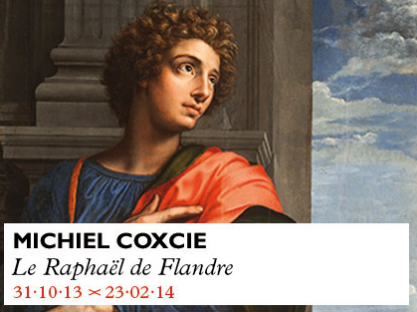
Exposition – Michel Coxcie. Le Raphaël de Flandre
M van Museum (Louvain, Belgique)
31 octobre 2013-23 février 2014
« Le Raphaël de Flandre », voilà le surnom donné à Michiel Coxcie (1499 -1592) par ses contemporains, ce qui illustre bien la haute estime dans laquelle était tenu son talent. À juste titre, car Coxcie est l’un des peintres les plus influents du XVIe siècle.
Au XVIe siècle, Michiel Coxcie est un artiste estimé, chargé de commandes prestigieuses par des personnalités de renom. Il passe une dizaine d’années à Rome, où il étudie l’Antiquité et l’art des maîtres de la Renaissance tels que Raphaël, Michel-Ange et Léonard de Vinci. De retour au pays, Coxcie réalise des pièces d’autel, vitraux et tapisseries pour des clients à Bruxelles, Anvers et Malines. Le point culminant de sa carrière est sa nomination en tant que peintre de cour de Charles Quint et Philippe II.
Les contemporains de Coxcie s’inspirent de son style novateur et de ses compositions d’un nouveau genre. Après sa mort, les artistes continuent pendant plusieurs siècles à admirer ses œuvres ; même Pierre Paul Rubens se laisse inspirer par elles. Au fil du temps, Coxcie est progressivement oublié. Aujourd’hui, l’artiste est inconnu du grand public. Il est donc grand temps de braquer les projecteurs sur Michiel Coxcie !
Michiel Coxcie. Le Raphaël de Flandre est une première rétrospective de l’œuvre variée du maître talentueux ; une série importante de peintures, des vitraux monumentaux, des séries d’œuvres graphiques et des tapisseries ornent les salles du musée M. L’exposition aborde toutes les facettes de la vie et de l’œuvre de Coxcie : sa jeunesse, son séjour en Italie et ses plus grandes réalisations dans son pays.
Des tableaux de Coxcie appartenant à la collection de M voisinent avec des prêts provenant de collections européennes. Vous verrez entre autres sa célèbre copie de L’Agneau mystique. Cette œuvre impressionnante est présentée pour la première fois dans son ensemble.
Informations pratiques : M van Museum
Publié dans Exposition
Laisser un commentaire
Conférence – Histoire des sciences médiévales – Cadres théoriques en confrontation avec la nature et l’expérience au Moyen Âge
Séminaire Histoire des sciences médiévales
16 janvier 2014
Journée de conférences organisé par le CESCM (Centre d’études supérieures de civilisation médiévale / CNRS – Université de Poitiers) et la SFHST (Société française d’histoire des sciences et des techniques), dans le cadre du Master 1 et 2 Civilisation antique et médiévale
Cadres théoriques en confrontation avec la nature et l’expérience au Moyen Âge
Le cadre théorique dans lequel les maîtres du Moyen Âge pensent le monde est l’aristotélisme qui couvre de nombreux domaines. Mais les explications fournies par Aristote semblent parfois en contradiction avec ce que l’on peut observer ou avec des explications issues d’autres traditions. On trouve ainsi, dans le cadre des explications sur le mouvement, des dispositifs mettant en jeu des aimants, qui, pour certains, sont en contradiction avec ce que l’on peut observer. Et l’attraction à distance du fer par l’aimant est un des phénomènes qui poussent l’aristotélisme dans ses retranchements. Il en est de même pour ce que les médiévaux appellent les « propriétés occultes ». Celles-ci furent-elles un moyen pour la science scolastique de dissimuler ses ignorances ou doivent-elles être comprises comme la condition sine qua non d’un cadre où peut se déployer la « science normale » ? La question du rôle assigné à l’expérience pratique se pose par ailleurs pour les médecins. Ceux-ci étaient, presque toujours, des praticiens expérimentés, confrontés à des cas difficiles ou incompréhensibles. Ces cas pouvaient-ils remettre en cause la doctrine médicale tout entière ? Enfin, on peut se demander pourquoi l’existence de penseurs atomistes au Moyen Âge a échappé si longtemps à l’histoire des sciences. Une partie de la réponse tient peut-être au fait que ces atomistes soient presque tous des théologiens et que leur atomisme sert un projet scientifique, mais poursuit aussi un objectif théologique.
Programme
9h15 : Cécile Treffort (directrice du CESCM) et Sabine Rommevaux (directrice de recherche au CNRS) – Accueil
9h30 – 10h30 : Sabine Rommevaux – Une théorie en apparente contradiction avec les résultats de l’expérience : le magnétisme
10h30-10h45 : Questions
10h45-11h45 : Nicolas Weill-Parot (professeur d’histoire médiévale, Université Paris-Est Créteil) – Asile de l’ignorance ou terme nécessaire de l’explication ? La notion d’occulte dans la science scolastique
11h45-12h : Questions
14h-15h : Joël Chandelier (maître de conférences en histoire médiévale, département d’histoire, Université Paris 8 Vincennes- Saint-Denis) – Les médecins et l’expérience au Moyen Âge
15h-15h15 : Questions
15h15-16h15 : Aurélien Robert (chargé de recherches au CNRS) – L’idée d’atome au Moyen Âge entre science et théologie
16h15-16h45 : Questions et conclusions.
Information pratiques :
Date : jeudi 16 janvier – 9h15 à 16h45
Lieu : Pôle Histoire des sciences et des techniques, Culture scientifique, technique et industrielle en Poitou-Charentes à l’Espace Mendès France – 1 place de la Cathédrale – Poitiers
Entrée libre – ouvert à tous
Source de l’information : CESCM
Publié dans Colloque
Laisser un commentaire
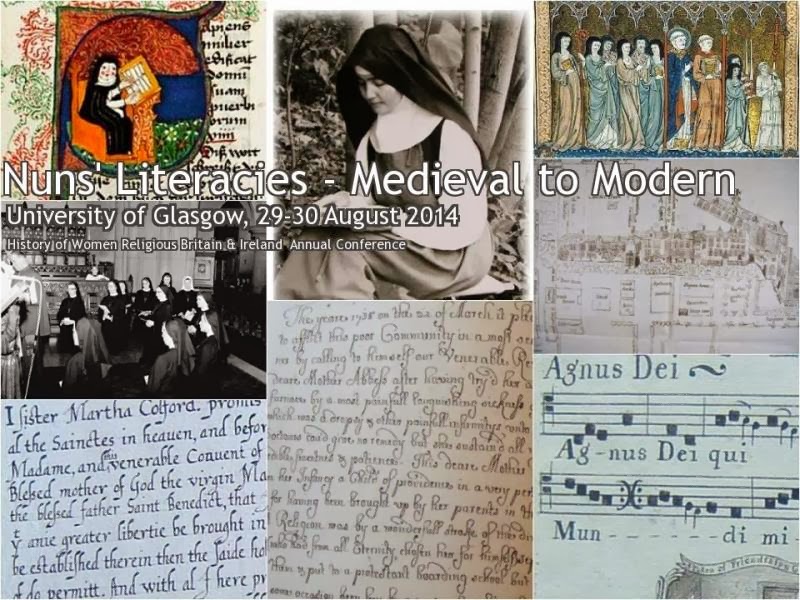
Appel à contributions – Nun’s literacies : Medieval to Modern
Our annual conference will take place on 29-30 August 2014 at the University of Glasgow.
Call for Papers
Any aspect of literacy & women religious of Britain & Ireland including but not limited to:
- Reading
- Writing
- Learning
- Textual cultures
- Book ownership
- Education of women religious
- Visual literacy
- Numeracy
- Texts written by or read by women religious
- Latin and vernacular texts
- Language
- Communication & exchange of texts
- Record keeping & governance
- Letters
- Map and plan making
- Musicology
- Female agency & power
- Codocology
- Community libraries
- Acts of reading and writing
- Community texts
- Printing
- Craft & creation
- Stereotypes of women religious & literacy
Practical information:
Send abstracts* of no more than 200 words to: hwrbi.conference@gmail.com
*Please include title of the paper, email contact details & affiliation
Deadline 28 February 2014
Source: history.ac
Publié dans Appel à contributions
Laisser un commentaire
Séminaire – The Performance of Change: Symbolic enactments of reform and renewal in Medieval Western Monasticism
Dresden, 9/1/2014
This workshop will contribute a new field in the study of medieval Western monasticism by focussing on the role of symbolic enactments of change in the context of reform. The notion of reform occupied a central place in medieval Western monasticism, as its members were encouraged to strive continuously for a more ‘authentic’ experience of the cenobitic ideal. Promoters of reform or renewal of the vita monastica or religiosa strived for change either within pre-existing institutional contexts (for instance a monastery or an order), or in newly- conceived forms of religious life (monastic, canonic, eremitical) initially driven by charismatic leadership or ideals, and ultimately evolving into new institutional realities. So far, these phenomena have been studied primarily from ideological and institutional points of view.
Given the current interest in historical scholarship for the study of symbolic acts as a lever for political change, it is surprising to find that specialists of monasticism have so far shown little interest in the role of symbolic behavior in these aforementioned reformprocesses. As various studies have shown, social and institutional change in secular society was effectuated not primarily through juridical acts of transition, but through a series of public actions (acts) charged with symbolic meanings, enabling the participants to enact change and establish a consensus over its spiritual and practical implications. Symbolic enactments of change expressed reformers’ ambitions for change, but also by means of a system of action and counter-action created opportunities for adjustment resulting from negotiation. Thus, symbolic behavior was not a side effect of actual, deeper-laying processes of reform and renewal, but an essential instrument to these processes.
The organizers of this workshop aim to verify to what extent these observations are equally valid for medieval monasticism, and identify methodological and conceptual opportunities for studying the performative aspects of reform processes. In order to reach this goal, the organisers will gather a group of specialists to discuss the possibilities for further research in this exciting new area of investigation. The aim is to look at a wide range of reforms and renewals of the vita religiosa in Western society, ranging from the ninth century until the fifteenth, and including the broadest possible selection of movements (the monastic reform by Cluny, Gorze etc., the religious renewals of the 11th and 12th centuries, Cîteaux, the Mendicant orders, the reform of observances in the late Middle Ages). To systematize discussion and exchange, participants will be asked to consider four points that are fundamental to this field of study:
- Reform/renewal as embodied transformation, in other words behavioral aspects of reformist thought. Central to the discussion will be the question how reformist thinkers conceived the way in which reformed monasticism was behaviorally different from its non- or pre-reformed counterpart.
- ‘Performed’ reform/renewal: this part of the workshop will look at how reform itself was initiated and negotiated through enactments of ideals and symbols charged with reformist meaning. Particular attention will be paid to the call-and-response mechanisms of these enactments and their negotiative character.
- Breakdowns of symbolic enactments: this part of the workshop will investigate the relation between the enactment of change and the relevancy of a particular reformed/rebooted form of monasticism. In other words, is the end of enactments of change a signal of the end of change itself?
- Perceptions of reform: this part of the workshop will investigate how contemporary accounts of reform have impacted on the representation of the symbolic aspects of reform and renewal in Western monasticism.
Programme :
10.00-10.15 : Prof. Steven Vanderputten (Universiteit Gent) – Reform as performance: conceptual and methodological questions
Session 1: Performing and ‘unperforming’ reform
10.15-10.45 : Drs. Koen Vanheule (Universiteit Gent) – Introducing the abbot: the perfomance of power at the offset of ‘reformist’ leadership (Lotharingia, first half of the eleventh century)
10.45-11.30 : Prof. Brigitte Meijns (KULeuven) – Performing reform in canonical and monastic milieus in Flanders and the North of France (c. 1070-c.1150)
11.30-12.15 : Dr. Cristina Andenna (TUDresden) – Wie lehnt man eine Reform ab? Ausgewählte Beispiele performativen Widerstands
12.15-13.00 : Dr. Tjamke Snijders (Universiteit Gent) – The performance of communal identities and reform: what we can learn from the manuscript evidence
13.00-14:00 : Lunch
Session 2: Symbolic performances of reform and reformist agency
14.00-14.45 : Prof. Nicolangelo d’Acunto (Università Cattolica del Sacre Cuore, Milano) – Mostrare e/o nascondere il cambiamento? Continuità e fratture nelle rappresentazioni simboliche della vita religiosa (secc. XI-XIII)
14.45-15.30 : Drs. Pieter Byttebier (Universiteit Gent) – Pastoring the flock: episcopal presence and performance in the process of a monastic reform in Lotharingia (10th-12th century)
15.30-15.45 Break
15.45-16.30 : Prof. Ludovic Viallet (Université Blaise Pascal, Clermont-Ferrand) – La question de la quête chez les Franciscains, à l’âge des réformes de l’Observance
16.30-16.45 : Prof. Gert Melville (FOVOG, TUDresden) – Conclusions
Organizers :
Prof. Dr. Steven Vanderputten
Department of History (Conventus) – Ghent University Steven.Vanderputten@ugent.be
Prof. Dr. Gert Melville
Forschungsstelle für Vergleichende Ordensgeschichte (FOVOG) gert.melville@tu-dresden.de
Dr. Cristina Andenna
Forschungsstelle für Vergleichende Ordensgeschichte (FOVOG) Cristina.andenna@tu-dresden.de
Sponsors :
Alexander Von Humboldt-Stiftung
Conventus (http://www.conventus.ugent.be)
Location :
FOVOG
Zellescher Weg 21, 01217 Dresden
Source de l’information : Henri Pirenne Institute for Medieval Studies
Publié dans Colloque, Séminaire
Laisser un commentaire
Ouverture des données publiques : La BnF libère ses métadonnées descriptives pour encourager leur réutilisation
Communiqué de presse
Décembre 2013
Décembre 2013
La BnF a choisi de placer les métadonnées descriptives (données bibliographiques et d’autorité) issues de ses catalogues sous la « licence ouverte » de l’État, qui en permet la libre réutilisation avec obligation de citation de la source. A partir du 1er janvier 2014, l’ensemble de ces données – plus de 12 millions de notices bibliographiques et 2,5 millions de notices d’autorité – sera mis à disposition gratuitement pour tout type de réutilisation, y compris commerciale.
La BnF confirme ainsi son engagement dans le mouvement d’ouverture des données publiques, également porté par le ministère de la Culture et de la Communication. En 2011, elle avait été la première institution culturelle à déposer sur le site data.gouv.fr (la plateforme française d’ouverture des données publiques mise en place par la mission Etalab) un premier jeu de données mis à disposition du public sur son site data.bnf.fr. Cette mesure permet aujourd’hui à la Bibliothèque de participer pleinement au mouvement de coopération et de mutualisation bibliographique, dans le cadre de projets nationaux et internationaux. Au niveau national, l’interopérabilité juridique favorisera notamment les échanges avec les catalogues des agences et bibliothèques de l’Enseignement supérieur et de la recherche, qui ont adopté la même licence pour leurs propres métadonnées. Le champ de la coopération s’étend également à tous les acteurs de la chaîne du livre, avec lesquels il convient de partager les bénéfices issus de l’investissement de la puissance publique en matière de catalogage et d’indexation bibliographiques pour le bénéfice de l’édition française. Enfin, l’ouverture des données valorisera les données des bibliothèques et facilitera leur mise en relation avec celles produites par d’autres communautés présentes sur le web.
Plus largement, la BnF favorise ainsi l’usage, via le web, de données de référence et de qualité, tout en permettant le suivi de leurs réutilisations.
Pour savoir quelles sont les données concernées :
http://www.bnf.fr/fr/professionnels/recuperation_donnees_bnf.html
Pour en savoir plus sur l’ouverture et le partage des données publiques :
http://www.gouvernement.fr/sites/default/files/fichiers_joints/feuille_de_route_du_gouvernement_sur_le_numerique.pdf
Feuille de route Open Data du ministère de la Culture et de la Communication, avril 2013 :
cblog.culture.fr/…/2013/07/Feuille-de-route-open-data-MCC.pdf
Contacts Presse :
cblog.culture.fr/…/2013/07/Feuille-de-route-open-data-MCC.pdf
Contacts Presse :
Claudine Hermabessière, chef du service de presse et des partenariats médias
01 53 79 41 18 – 06 82 56 66 17 – claudine.hermabessiere@bnf.fr
Hélène Crenon, chargée de communication presse
01 53 79 46 76 – helene.crenon@bnf.fr
01 53 79 41 18 – 06 82 56 66 17 – claudine.hermabessiere@bnf.fr
Hélène Crenon, chargée de communication presse
01 53 79 46 76 – helene.crenon@bnf.fr
Publié dans Banque de données, Web
Laisser un commentaire


Vous devez être connecté pour poster un commentaire.