Colloque – L’art au service du prince

La politique monumentale, artistique et culturelle des États princiers et seigneuriaux : paradigme italien, expérience européenne (vers 1250-vers 1550)
Université de Paris-Sorbonne – Centre Roland Mousnier (UMR 8596). Labex EHNE 
17-18-19 octobre 2013
Colloque organisé par Élisabeth Crouzet-Pavan (Paris-Sorbonne) et Jean-Claude Maire Vigueur (Roma Tre)

Jeudi 17 octobre 
Maison de la Recherche. 28 rue Serpente. Paris. 75006 : salle D 035 (amphithéâtre)

14h-14h15 : Ouverture – Élisabeth Crouzet-Pavan (Paris-Sorbonne) et Jean-Claude Maire Vigueur (Roma Tre)

Au cœur du pouvoir : résidences princières

14h15-14h40 : Marco Folin (Université de Gênes) – Le residenze del principe : palazzi cittadini e ville rurali
14h40-15h05 : Matthias Mueller (Université de Mayence) – History, space and time: paradigms of the princely castle architecture in the Empire around 1500 and the importance of Italy and France as a model
15h05-15h30 : pause
Au cœur du pouvoir : le service de Dieu

15h30-15h55 : Marc Boone (Université de Gand) – Construire la mémoire d’outre-tombe: les comtes de Flandre, leurs successeurs bourguignons et leurs proches sous les dalles funéraires
15h55-16h20 : Jean-Baptiste Delzant (Université de Paris-Sorbonne. École française de Rome) – La commande religieuse seigneuriale dans les villes italiennes à la fin du Moyen Âge
16h20-16h45 : Laurent Vissière (Université de Paris-Sorbonne) – L’érection des Saintes-Chapelles dans la France des XIVe et XVe siècles
16h45-17h30 : discussion

Vendredi 18 octobre
Maison de la Recherche. 28 rue Serpente : salle D 035 (amphithéâtre)
Les échelles de l’intervention princière : la ville, l’État territorial

9h-9h25 : Irène Strobbe (Université de Paris-Sorbonne-Université de Gand) – « Chacun doit gainier et profiter du prince »: Lille ou le laboratoire d’une politique monumentale bourguignonne à la fin du Moyen Âge
9h25-9h50 : Philippe Lorentz (Université de Paris-Sorbonne) – Des princes sans capitale: les évêques de Strasbourg aux XIVe et XVe siècles. Politique culturelle et commandes artistiques
9h50-10h15 : Serena Romano (Université de Lausanne) – Principi di Lombardia nel Trecento. L’anomalia e lo splendore di Milano.
10h15-10h35 : pause café
10h35-11h05 : discussion
11h05-11h30 : Beatrice Del Bo (Université Bocconi de Milan) – La politique culturelle et artistique des petits États féodaux des marquis de Monferrat et de Saluces.
11h30-11h55 : Guido Castelnuovo (Université d’Avignon) – Amédée VIII et les arts: une stratégie culturelle au service du prince dans la Savoie de la première moitié du XVe siècle
11h55-12h15 : discussion
12h15 : déjeuner-buffet : Maison de la Recherche
14h-14h25 : Léonard Dauphant (Université de Metz) – La politique artistique du roi René II au service de la reconstruction d’un État angevin en Lorraine.
14h25-14h50 : Arturo Calzona (Université de Parme) – La aedificatio dello stato gonzaghesco da Ludovico I (Luigi) a Ludovico II (1360-1468).
14h50-15h15 : Francesco Salvestrini ( Université de Florence) – L’art et la magnificence « contre » le pouvoir du prince. L’abbé général Biagio Milanesi, l’Ordre monastique de Vallombreuse, Laurent de Médicis et le pape Léon X.
15h15-15h30 : pause
15h30-16h : discussion
Programmes décoratifs
16h-16h25: Sabine Van Sprang (Musées royaux d’art des Beaux-Arts de Belgique), Claire Billen (Université Libre de Bruxelles) – Forêt, chasse et tapisseries: la magnificence habsbourgo-bourguignonne au cœur des Pays-Bas méridionaux
16h25-16h50 : Monica Donato (Scuola normale superiore de Pise) – I primi Medici e l’eredità dell’arte civica
16h50-17h15 : discussion
Samedi 19 octobre 
Université de Paris-Sorbonne : Salle des Actes
Artistes et hommes de savoir
9h-9h25 : Rose-Marie Ferré (Université de Paris-Sorbonne) – « Échec et mat »! Le sculpteur Francesco Laurana au service d’Alphonse d’ Aragon et du roi René
9h25-9h50 : Carla Frova (Université de Rome La Sapienza) – Cultura e istituzioni universitarie nel contesto delle esperienze signorili italiane.
9h50-10h15 : Jacques Verger (Académie des Inscriptions et Belles-Lettres) – La culture au service du prince: fondations princières d’universités et de collèges en France, dans les pays bourguignons et dans l’Empire à la fin du Moyen Âge
10h15-10h30 : pause café
10h30-11h : discussion

11h-11h25 : Gian Maria Varanini (Université de Vérone) – Cancellerie signorili trecentesche di area padana.
11h25-11h55 : Clémence Revest (Université de Paris-Sorbonne. École française de Rome) – Le seigneur et ses lettrés. Attraction, soutien et emploi des hommes de savoir dans l’Italie préhumaniste et humaniste.
11h55-12h15 : discussion
12h15 : Enrico Castelnuovo (Scuola normale superiore de Pise) – Conclusions
13h : déjeuner-buffet Club des enseignants de Paris-Sorbonne
Université de Paris-Sorbonne
Centre Roland Mousnier (UMR 8596). Labex EHNE

Colloque organisé par

Élisabeth Crouzet-Pavan (Paris-Sorbonne) et Jean-Claude Maire Vigueur (Roma Tre)
17-18-19 octobre 2013

Jeudi 17 octobre. Maison de la Recherche. 28 rue Serpente. Paris. 75006 : salle D 035 (amphithéâtre)

14h-14h15 : Ouverture (Élisabeth Crouzet-Pavan (Paris-Sorbonne) et Jean-Claude Maire Vigueur (Roma Tre)

Au cœur du pouvoir : résidences princières

14h15-14h40 : Marco Folin (Université de Gênes): Le residenze del principe : palazzi cittadini e ville rurali

14h40-15h05 : Matthias Mueller (Université de Mayence): History, space and time: paradigms of the princely castle architecture in the Empire around 1500 and the importance of Italy and France as a model

15h05-15h30 : pause

Au cœur du pouvoir : le service de Dieu

15h30-15h55 : Marc Boone (Université de Gand): Construire la mémoire d’outre-tombe: les comtes de Flandre, leurs successeurs bourguignons et leurs proches sous les dalles funéraires

15h55-16h20 : Jean-Baptiste Delzant (Université de Paris-Sorbonne. École française de Rome) : La commande religieuse seigneuriale dans les villes italiennes à la fin du Moyen Âge

16h20-16h45 : Laurent Vissière (Université de Paris-Sorbonne) : L’érection des Saintes-Chapelles dans la France des XIVe et XVe siècles

16h45-17h30 : discussion

Vendredi 18 octobre. Maison de la Recherche. 28 rue Serpente : salle D 035 (amphithéâtre)

Les échelles de l’intervention princière : la ville, l’État territorial

9h-9h25 : Irène Strobbe (Université de Paris-Sorbonne-Université de Gand) : « Chacun doit gainier et profiter du prince »: Lille ou le laboratoire d’une politique monumentale bourguignonne à la fin du Moyen Âge

9h25-9h50 : Philippe Lorentz (Université de Paris-Sorbonne): Des princes sans capitale: les évêques de Strasbourg aux XIVe et XVe siècles. Politique culturelle et commandes artistiques

9h50-10h15 : Serena Romano (Université de Lausanne): Principi di Lombardia nel Trecento. L’anomalia e lo splendore di Milano.

10h15-10h35 : pause café

10h35-11h05 : discussion

11h05-11h30 : Beatrice Del Bo (Université Bocconi de Milan): La politique culturelle et artistique des petits États féodaux des marquis de Monferrat et de Saluces.

11h30-11h55 : Guido Castelnuovo (Université d’Avignon): Amédée VIII et les arts: une stratégie culturelle au service du prince dans la Savoie de la première moitié du XVe siècle

11h55-12h15 : discussion

12h15 : déjeuner-buffet : Maison de la Recherche

14h-14h25 : Léonard Dauphant (Université de Metz): La politique artistique du roi René II au service de la reconstruction d’un État angevin en Lorraine.

14h25-14h50 : Arturo Calzona (Université de Parme): La aedificatio dello stato gonzaghesco da Ludovico I (Luigi) a Ludovico II (1360-1468).

14h50-15h15 : Francesco Salvestrini ( Université de Florence) : L’art et la magnificence « contre » le pouvoir du prince. L’abbé général Biagio Milanesi, l’Ordre monastique de Vallombreuse, Laurent de Médicis et le pape Léon X.

15h15-15h30 : pause

15h30-16h : discussion

Programmes décoratifs

16h-16h25: Sabine Van Sprang (Musées royaux d’art des Beaux-Arts de Belgique), Claire Billen (Université Libre de Bruxelles): Forêt, chasse et tapisseries: la magnificence habsbourgo-bourguignonne au cœur des Pays-Bas méridionaux

16h25-16h50 : Monica Donato (Scuola normale superiore de Pise): I primi Medici e l’eredità dell’arte civica

16h50-17h15 : discussion

Samedi 19 octobre : Université de Paris-Sorbonne : Salle des Actes

Artistes et hommes de savoir

9h-9h25 : Rose-Marie Ferré (Université de Paris-Sorbonne): « Échec et mat »! Le sculpteur Francesco Laurana au service d’Alphonse d’ Aragon et du roi René

9h25-9h50 : Carla Frova (Université de Rome La Sapienza): Cultura e istituzioni universitarie nel contesto delle esperienze signorili italiane.

9h50-10h15 : Jacques Verger (Académie des Inscriptions et Belles-Lettres) : La culture au service du prince: fondations princières d’universités et de collèges en France, dans les pays bourguignons et dans l’Empire à la fin du Moyen Âge

10h15-10h30 : pause café

10h30-11h : discussion

11h-11h25 : Gian Maria Varanini (Université de Vérone): Cancellerie signorili trecentesche di area padana.

11h25-11h55 : Clémence Revest (Université de Paris-Sorbonne. École française de Rome): Le seigneur et ses lettrés. Attraction, soutien et emploi des hommes de savoir dans l’Italie préhumaniste et humaniste.

11h55-12h15 : discussion

12h15 : Enrico Castelnuovo (Scuola normale superiore de Pise): Conclusions

13h : déjeuner-buffet Club des enseignants de Paris-Sorbonne
Publié dans Colloque | Laisser un commentaire

Appel à contribution – Religious men in the Middle Ages : networks and communities

Event Date: 3-5 July 2014
Event Location: University of Lincoln, UK
Submission Deadline: 30 September 2013
This conference seeks to explore and re-evaluate the forms and functions of networks and communities for men in the middle ages. We invite papers which consider these in relation to professed religious men and/or laymen of any faith.
Scholars are increasingly engaging with what religion, belief and devotion meant to men as men. Networks and communities both shape and express individual, relational, and collective identities, and therefore shed useful light on the experiences, perceptions or depiction of medieval men. This is the second conference under the auspices of The Bishop’s Eye Network – a research network between the Universities of Huddersfield and Lincoln. The first, ‘Religious Men in the Middle Ages’, was held at Huddersfield in 2012.
We invite abstracts from scholars at all career stages working on the interplay between men in networks and communities; how they are constituted and what they mean. Papers may focus on homosocial networks and communities or male involvement in female networks and communities.
Topics for discussion could include networks and communities defined by:
  • Family and kinship
  • Intellectual connections (e.g. textual communities, scholasticism)
  • Profession and Occupation
  • Orders, universities, monastic, mendicant, and secular houses
  • Patronage and affinity
  • Geography and location
  • Guilds and confraternities
  • Military experience (e.g. comitati, warbands, orders of chivalry)
  • Friendship and emotional bonds (e.g. amicitia, love)
  • Ethnicity and inter-cultural encounters
Papers could consider individuals or groups from any faith, religious tradition, monotheistic, pagan, or heretical, or could focus on men who rejected religion and faith. We encourage proposals from scholars working in any relevant field: history, literature and language, art history, musicology, archaeology, etc., and from any medieval period (c. 500–early 1500s) or geographical setting.
The conference will be held at the Brayford Campus, which is a few minutes’ walk from the train station, and within easy reach of the cathedral and castle. The conference organisers are Dr Philippa Hoskin and Dr Joanna Huntington. For further information on Lincoln visit http://www.visitlincoln.com/ (A conference website is under construction).
We hope to publish a volume of essays based on a selection of the papers delivered at the conference.
Proposals, of 200-300 words, for papers of 20 minutes, should be submitted to bishopseye2014@gmail.com by 30 September 2013.
Source de l’information : Episcopus
Publié dans Appel à contributions | Laisser un commentaire

Colloque – DigiPal Symposium

Monday 16th September 2013
Venue: King’s College London, Strand WC2R 2LS: Room S-3.20
Co-sponsor: Centre for Late Antique & Medieval studies, KCL
With great delight, the DigiPal team at the Department of Digital Humanities (King’s College London) announce the programme for their third Symposium. This year’s theme is the computer-assisted study of medieval manuscripts, and we have a range of papers covering language, manual and automatic script analysis, on-line curation, music notation, image retrieval and palaeography (of course!). 
Places are disappearing rather rapidly, so if you’d like to attend, then please send an email to digipal [at] kcl.ac.uk, including your details as you would like them to appear on your name badge. Oh, and do let us know if you are vegetarian.
Looking forward to seeing you later this month,
Stewart Brookes and Peter Stokes
Programme :
9h30-9h50 : Coffee & registration
9h50 : Introduction
10h00-11h15 – Session 1: Manuscripts and the Digital Age
10h00-10h20 : Sarah Biggs and Julian Harrison (British Library) – Beyond the Reading Room: Medieval Manuscripts in the Digital Age
10h25-10h45 : Tony Harris (University of Cambridge) – Getting to the ‘Hart’ of the Matter – Digitally Speaking
10h50-11h10 : Samantha Blickhan (Royal Holloway, University of London) – Musical Perception and Digital Surrogates: On Using E-Resources for Teaching Early Music Notation
11h15-11h40 : Coffee
11h40-12h55 – Session II: Letter-forms
11h40-12h00 : Jacob Thaisen (University of Stavanger) – A Survey of Middle English Letter-Forms
12h05-12h25 : Peter Stokes (King’s College London) – What is DigiPal, Really? 
12h30-12h50 : Stewart Brookes (King’s College London) – So Long and Thanks For All the F-shaped ‘y’s
12h55-14h00 : Lunch 
14h00-15h45 – Session III: Digital Methods
14h00-14h30 : Lambert Schomaker (University of Groningen) – Computer Methods for Handwriting Analysis
14h35-14h55 : Jean-Paul van Oosten (University of Groningen) – Word Image Retrieval from Historical Handwritten Document Collections: The Monk System
15h00-15h20 : Vincent Christlein (University of Erlangen-Nuremberg) – A Letter Driven Writer Identification in Medieval Papal Charters
15h25-15h45 : Eleanor Anthony (University of Mississippi) – From the Archimedes’ Palimpsest to the Vercelli Book: Dual Correlation Pattern Recognition and Probabilistic Network Approaches to Palaeography in Damaged Manuscripts.
15h50-16h15 : Coffee
16h15-17h25 – Session IV: Analysing Letters
16h15-16h35 : Dominique Stutzmann: (French National Centre for Scientific Research) – Automatic Letter-form Identification in the ORIFLAMMS project »
16h40-17h00 : David Ganz (University of Notre Dame and University of Cambridge) -Polygraphism’: the Scribe Who Can Write Several Scripts
17h05-17h25 : Tessa Webber (University of Cambridge) – The Analysis of Letters: Form, Shape and Stroke
17h30-18h00 : Roundtable discussion with Jane Roberts (Institute of English Studies)
Source de l’information : DigiPal.
Publié dans Colloque | Laisser un commentaire

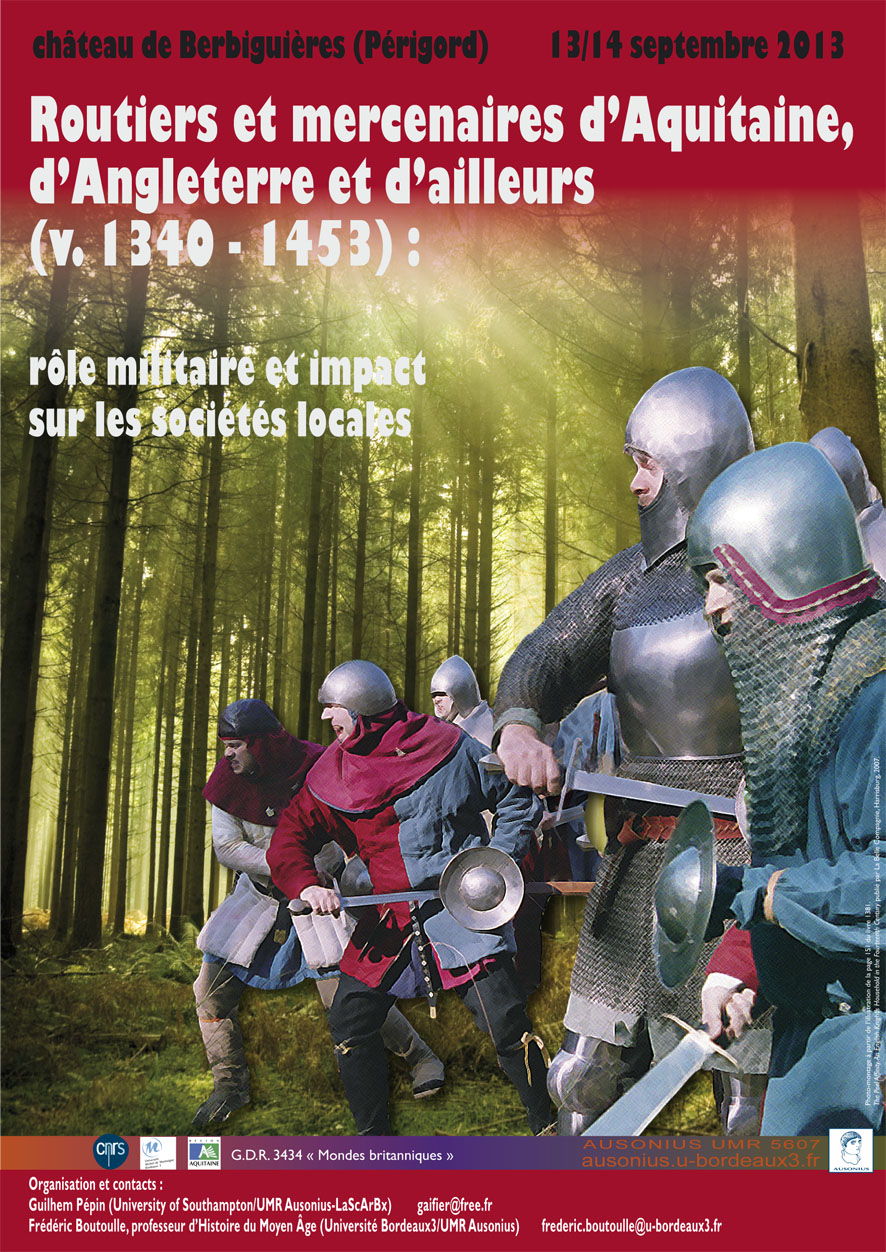
Colloque – Routiers et mercenaires d’Aquitaine, d’Angleterre et d’ailleurs (v. 1340-1453). Rôle militaire et impact sur les sociétés locales

13-14 septembre 2013
Château de Berbiguières  – Berbiguières, France (24)

Ce colloque a pour but d’étudier le rôle qu’ont joué les routiers et mercenaires pendant la guerre de Cent Ans. Leur place au sein de ce conflit a longtemps été quelque peu oubliée, passée sous silence, voire caricaturée, bien que ces troupes « irrégulières » aient joué à l’occasion un rôle essentiel comme lors de la guerre entre le roi de Castille Pierre le Cruel et son demi-frère Henri de Trastamare (1366-1369). Le plus souvent, ils ont perpétué l’état de guerre par une « guerre de basse intensité » quand les moyens des belligérants « officiels » étaient limités. Ce fut particulièrement le cas pour les hommes d’armes reconnaissant officiellement l’autorité du roi d’Angleterre qui occupèrent en son nom de nombreuses forteresses dans le royaume de France entre la bataille de Poitiers (1356) et le traité de Brétigny (1360), puis entre 1370 et 1393. Ce phénomène exista également au XVe siècle, mais sur une zone plus limitée (sur les frontières du duché d’Aquitaine anglo-gascon, Périgord, Angoumois, Saintonge, etc.), et fut parfois d’une nature différente (ex. des “écorcheurs”). La plupart de ces routiers étaient originaires d’un nombre limité de pays et régions : Angleterre, duché d’Aquitaine (Gascogne, Agenais et Périgord) et Bretagne.
Au-delà des mentions plus ou moins anecdotiques de routiers et de mercenaires pendant cette guerre, il est maintenant temps d’aborder ce phénomène sous une approche plus systématique et synthétique. Les routiers ne combattaient-ils que pour l’argent et par esprit de profit ? Ne travaillaient-ils que pour leur compte ? N’existait-il pas des fidélités réelles en faveur d’un camp face à un autre ? A quel point avaient-ils des valeurs différentes du monde guerrier chevaleresque ? Quelle était leur place au sein des armées régulières des rois d’Angleterre, de France, de Navarre, de Castille etc ? A quel point les chefs des armées princières (ex : Du Guesclin) étaient proches d’eux ? Quelles étaient leurs origines sociales et géographiques ? Quelles furent les processus d’ascension sociale de certains d’entre eux ? Quel était leur mode opératoire ? Leur impact sur une région donnée sur le long terme ? Leur importance lors des différentes phases de la guerre de Cent Ans ? Quels furent les châteaux et les régions soumis à leur domination ? Comment les autorités officielles tentèrent-elles de les utiliser et de s’en débarrasser ? Quels étaient les différences et les points communs entre ces « mercenaires » et ceux des autres périodes du Moyen Âge, voire d’autres époques ?
Toutes ces questions méritent d’être abordées et discutées sous une approche plus globale qu’à l’accoutumée d’autant plus que les routiers et mercenaires de cette période ont été présent sur les terrains de lutte entre les rois d’Angleterre et de France (ex : Aquitaine-Gascogne, Bretagne, etc.) mais ont également été actifs dans d’autres régions d’Europe occidentale (Castille, Aragon, Provence, Italie du nord, Allemagne, Prusse, Écosse, etc.). C’est pour cette raison que nous avons fait appel à des historiens confirmés reconnus dans le domaine de l’histoire militaire médiévale ; ces deux journées leur permettront de confronter leur approche à celle d’une nouvelle génération de chercheurs qui s’intéressent plus particulièrement au phénomène routier.
Programme :
Vendredi 13 septembre
9h00-10h00: Accueil et introductions

Jonathan Sumption, Justice of the Supreme Court of the United Kingdom, historien médiéviste – Mot d’accueil 
Valérie Fromentin, directrice de l’Unité Mixte de Recherche Ausonius ; Frédéric Boutoulle, Professeur d’histoire médiévale, directeur du département d’histoire, Université de Bordeaux 3 – UMR Ausonius ; Guilhem Pépin,docteur en histoire de l’Université d’Oxford, chercheur au sein du programme de recherche des Rôles gascons, UMR Ausonius, LaScarBx – University of Southampton – Introduction
10h00-12h00 : Les routiers anglo-gascons et leurs actions dans le « grand » duché d’Aquitaine (ou Guyenne) et les régions voisines 
(Présidence de séance : Frédéric Boutoulle)
Guilhem Pépin, docteur en histoire de l’Université d’Oxford, chercheur au sein du programme de recherche des Rôles gascons, Université de Bordeaux 3 – UMR Ausonius – University of Southampton – Les routiers gascons et périgourdins du parti anglais : leurs origines, leurs rayons d’action et la perception de leur présence (v. 1360 – v. 1440)
Kenneth Fowler, professeur émérite d’histoire médiévale, University of Edinburgh (Édimbourg) – Defending the country against the routiers: war, taxation and representation in southern France in the second half of the fourteenth century
Armand Jamme, directeur de recherche au CNRS (Lyon) – Un capitaine « anglais » face à la reconquête de la Guyenne par les Français : Bernard de La Sale et la papauté
12h00-14h00 : Buffet au château de Berbiguières
14h00-16h00 – La présence routière et son impact sur les populations locales 
(Présidence de séance : Armand Jamme)
Nicolas Savy, docteur en histoire médiévale (Cahors) – La guérilla anglo-gasconne entre Dordogne et Tarn (1355-1390)
Pierre Prétou, maître de conférence en histoire médiévale à l’Université de La Rochelle – Les voisins contre la route : réactions et imprécations communautaires en Gascogne face aux bandes armées pendant la guerre de Cent Ans
Justine Firnhaber-Baker, lecturer en histoire médiévale, University of St-Andrews – Mercenary movements in the Île-de-France and environs from the Battle of Poitiers to the Jacquerie: What we know and what we don’t 
16h00-16h30 : Pause café
16h30-18h30 : Les troupes du roi de France face aux routiers : entre lutte et emploi 
(Présidence de séance : Werner Paravicini)
Loïc Cazaux, ATER Université de Lyon 3 – Antoine de Chabannes, capitaine d’écorcheurs et officier royal : fidélités politiques et pratiques militaires au XVe siècle
Philippe Contamine, professeur émérite d’histoire médiévale à l’Université de Paris IV- Sorbonne – Un « Marmouset » contre les Compagnies : Jean de Blaisy († 1396)
Samedi 14 septembre
9h00-10h30 : Carrières de routiers – première session 
(Présidence de séance : Anne Curry)
Michael Jones, professeur émérite d’histoire médiévale, University of Nottingham – Une petite guerre dans un pays lointain : les soldats bretons au service de Robert, duc de Bar, 1372-1373
Germain Butaud, maître de conférence d’histoire médiévale à l’Université de Nice – Les mercenaires et les routiers actifs dans la guerre de l’Union d’Aix (1382-1388)
10h30-11h00 : Pause café
11h00-12h30 : Carrières de routiers – seconde session
(Présidence de séance : Michael Jones)
Bertrand Schnerb, professeur d’histoire médiévale à l’Université de Lille 3 – Compagnons aventureux et mercenaires dans les armées des ducs de Bourgogne (v. 1400-v. 1420)
Kelly DeVries, professeur d’histoire à Loyola University Maryland (Baltimore) – Routier Perrinet Gressart: Joan of Arc’s Penultimate Enemy
12h30-14h30 : Buffet au château de Berbiguières
14h30-16h00 : Mercenariat et structures militaires
(Présidence de séance : Philippe Contamine)
Françoise Lainé, professeur émérite d’histoire médiévale à l’Université de Bordeaux 3 – Les mercenaires savoyards entre France et Angleterre au début de la guerre de Cent ans
William P. Caferro, professeur d’histoire à la Vanderbilt University (Nashville) – Edward Despenser, the Green Knight and the Introduction of the Lance Unit in Florence
16h00-16h30: Pause café
16h30-18h00 : Hommes d’armes aux limites du mercenariat
(Présidence de séance : Bertrand Schnerb)
Werner Paravicini, ancien directeur de l’Institut historique allemand de Paris – Mercenaires au voyage de Prusse
Anne Curry, professeur d’histoire médiévale, University of Southampton – Foreign soldiers in English pay: identity and unity in the armies of the English crown 1415-1450
18h00-18h30 : Françoise Lainé, professeur émérite d’histoire médiévale à l’Université de Bordeaux 3 – Conclusion 
Source de l’information : Calenda
Publié dans Colloque | Laisser un commentaire

Appel à contribution – Empire of Letters and Tigers of Parchment

As part of the International Medieval Congress 2014 in Leeds, Apices and Cap Digital are pleased to sponsor palaeographical sessions on the specific thematic strand of « Empire ». Script is not a neutral communication medium. Scripts were particularly used throughout the Middle Ages to stage the idea of Empire, power and domination. Well known examples are the litterae caelestes in the late Antiquity, the papal curialis, the litterae elongatae. The concept of Empire in palaebiaisography should, however, not be limited to pragmatic writings and scripts, as illustrated by the ‘prophetic’ alphabet of Hildegard of Bingen for herlingua ignota, connoting the divine Empire, or by the Humanistic script or littera antiqua, which claimed to re‐introduce the Antique script, not only the script of Classical Latin literature, but, as a matter of fact, also the script of a (believed) former formof Empire. The writing hasthe ability to connote authority and Empire and to inspire respect.
That’s why these sessions are placed under both the title of E. T. Bannet’s study on letter manuals (showing how letters unified an Empire) and under the sign of the political irony of the expression “Tiger of paper”, here “tiger of parchment”, as the writings and their layout and staged scripts were able to create admiration,respect and sacred terror.
If the Caroline minuscule is an obvious symbol of a political and cultural endeavour, it also demonstrates how complex the link between Empire and scripts is. At the same time, Charlemagne unified a political space and gave it a common script. In this sense, he unified the Empire by its letters(the Caroline minuscule expelled the use of ‘national’scriptssuch as the Beneventana of the Lombards and other scripts inherited from the Roman Empire, such as the curialis), but he also unified the Empire of letters (the Caroline minuscule expanded from book script to both a documentary and book script). Yet, the Caroline is not an ‘imperial’ creation. It arose before the renovatio imperii and is merely a selection of forms within the multiple evolutions of the time, while the other imperial scripts (litterae caelestes, curiales, elongatae) are the fossilised heirs of prestigious times. They are not only archaizing,they are connoting the authority of Empire.
On the other hand, the scriptural domain is a world in itself with its coherence and history. The idea of an ‘Empire of letters’ (the title of a classical manual of letter writing) may have emerged within this world too. Calligrapher’s manuals and posters, writing models,script types which are specific to a genre (e.g. “gothic liturgical script”, “imperial chancery script”), influences or political pretentions to the Empire (the French “mixte” is coeval with the motto “the king is emperor in his realm”) reflect the claim of a distinct‘imperium’, used to distinguish different hierarchies and spheres of power.
Both parts of this “empire of letters”, that is,the ability to connote authority and Empire through the script, and the structure of a semi‐autonomous world of scripts, are relevant to the theme. 
Papers of 20 minutes in length are invited on any relevant aspect of palaeography and the notion of Empire. 
Possible topics could include, but are not limited to:
  • The typology of empire and related scripts: archaizing processes, canonisation,formalisation
  • Diversity of alphabets and diversity of Empires (perception of non‐Latin scripts; fake scripts assymbols of power)- Influences of Imperial scripts (esp. papal and imperial chanceries) and innovations/resistances
  • The influence of medieval concepts and practices of empire on their post‐medieval successors
  • Writingmasters and posters
To propose a paper, please send a brief abstract (250 words max) to dominique.stutzmann [at]
irht.cnrs.fr or vincent.debiais[at] univ‐poitiers.fr
The deadline for receipt of submissions is 20th September 2013.
Source de l’information : IRHT
Publié dans Appel à contributions | Laisser un commentaire

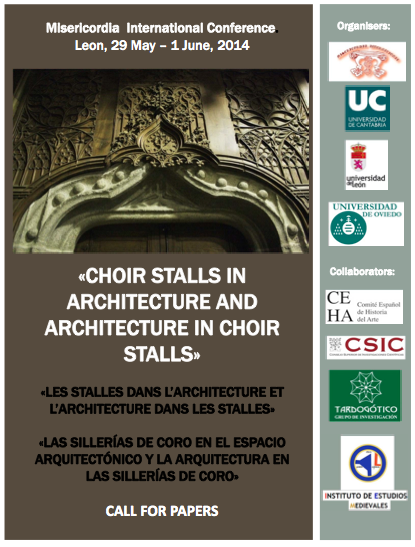
Appel à contribution – Choir Stalls in Architecture and Architecture in Choir Stalls

Misericordia International was founded by Elaine C. Block (1925‐2008) as an association dedicated to the research, diffusion and study of choir stalls and their relation to other artistic manifestations during the Middle Ages.
From its beginnings, Misericordia International has been promoting the celebration of a semi‐annual international conference as a place for scientific exchange among members of the research community interested in this topic from a multidisciplinary approach. The previous editions – Cologne, Barcelona, Amiens, Angers, Sheffield, Rouen, Basel, Paris, Nijmegen and Gdansk – have created a space to delve deep in the study of choir stalls from different points of view.
The next edition, set for 2014 and titled «Choir Stalls in Architecture and Architecture in Choir Stalls», will highlight the importance that choir stalls had in the spatial conceptualisation within cathedrals and how sculptors and carvers tested formal, stylistic and constructive motifs, models and solutions that were later reflected in the architectural constructions.
The celebration of the conference, as a joint activity of the Universities of Cantabria, Oviedo and Leon, will be held in the city of Leon. The total duration will be four days – from Thursday to Sunday –, of which Thursday and Friday morning will be dedicated to sessions on theory (talks and papers); while Friday evening, Saturday and Sunday will be dedicated to practical sessions with visits to different choir stalls in Leon – its Cathedral and the convent of San Marcos – as well as in other places, such as the Cathedrals of Astorga, Zamora and Oviedo.
Those who are interested in presenting a paper should send the title and abstract in Spanish or English (1000 characters max.) accompanied by their personal information (full name, e‐mail address, mailing address and phone number) before 31 December, 2013 to the following e‐mail addresses: welledamuller1@gmail.com, cahille@unican.es and villasenorf@unican.es
Scientific and organisational committee :
Coordination
Fernando Villaseñor Sebastián (University of Cantabria)
Organisational committee
Emma Luisa Cahill Marrón (University of Cantabria)
Welleda Muller (University of Paris‐Sorbonne)
Esperanza de los Reyes Aguilar (University of Leon)
Scientific committee
Begoña Alonso Ruiz (University of Cantabria)
Frédéric Billiet (University of Paris‐Sorbonne)
Pilar García Cuetos (University of Oviedo)
Ma Victoria Herráez Ortega (University of Leon)
Julio J. Polo Sánchez (University of Cantabria)
Wifredo Rincón García (Spanish Council For Scientific Research)
Raquel Saenz Pascual (University of Oviedo)
Ma Dolores Teijeira Pablos (University of Leon)
A certificate will be given for attendance and 2 credits will be acknowledged upon request for the participation in the cultural activities for students from each of the universities.
Publié dans Appel à contributions | Laisser un commentaire

Web – Kunstmuseum Basel and the J. Paul Getty Museum present online access to their collections

Kunstmuseum, Basel
The holdings of the Kunstmuseum Basel can now be consulted via their website. The database contains a total of more than 4000 paintings, sculptures, as well as new media, ranging from the Late Middle Ages through the 21st century. Among its holdings there are a substantial number of works by Dutch and Flemish Masters, many hitherto unpublished. The database has been conceived as a dynamic research instrument any corrections and additions are greatly appreciated.

J. Paul Getty Museum, from their press release
Today the Getty becomes an even more engaged digital citizen, one that shares its collections, research, and knowledge more openly than ever before. We’ve launched the Open Content Program to share, freely and without restriction, as many of the Getty’s digital resources as possible.

The initial focus of the Open Content Program is to make available all images of public domain artworks in the Getty’s collections. Today we’ve taken a first step toward this goal by making roughly 4,600 high-resolution images of the Museum’s collection free to use, modify, and publish for any purpose.

These are high-resolution, reproduction-quality images with embedded metadata, some over 100 megabytes in size. You can browse all available images here, or look for individual “download” links on the Getty Museum’s collection pages. As part of the download, we’ll ask for a very brief description of how you’re planning to use the image. We hope to learn that the images will serve a broad range of needs and projects.


Source de l’information : Codart
Publié dans Web | Laisser un commentaire

Appel à contribution – Henry of Blois and the Twelfth-Century Renaissance

Grandson of William the Conqueror and brother to King Stephen, Henry of Blois (1101-1171) was undoubtedly one of the most significant figures in twelfth-century England, yet no substantial academic study of him in English exists. By turns, kingmaker, ecclesiastical politician, diplomat, and elder statesman, Henry of Blois played a central role in shaping the course of the Anarchy that characterized much of his brother’s reign and, towards the end of his life, presided over the trial of Thomas Becket. For over four decades he held the bishopric of Winchester and the abbacy of Glastonbury in plurality and, between 1139 and 1143, effectively governed the English Church as Papal Legate. Raised and tonsured at Cluny, he considered himself a spiritual son of Peter the Venerable and, if no great thinker or writer himself, he was intimately engaged with those that were. Henry’s influence and activities extended across Europe; he travelled extensively and became twelfth-century England’s most prolific collector and patron of the arts. Despite all this, the only major monograph written on him was published in German (by Lena Voss) as long ago as 1932, and remains untranslated. In part, this surprising omission in the literature results from the extraordinary range of Henry’s own activities and spheres of influence. Scholars have tended to focus on his importance only within their discipline, and as such there remains no comprehensive account of this influential and complex figure, nor any study that posits Henry in relation to the wider intellectual and cultural developments associated with the Twelfth-Century Renaissance. Papers are therefore sought for a volume of collected essays from across the relevant disciplines that explore the breadth of Henry of Blois’ life, influence and legacy. The aim of this volume is to bring together a range of scholars working on Henry of Blois in a variety of disciplines. A number of distinguished academics have already undertaken to contribute, including historians, art and architectural historians, manuscript specialists and archaeologists, from Europe, the United States and Australia. 
Please send a brief CV (no longer than 2 pages) and abstracts of no more than 500 words by 15th September 2013 to henryofbloisconference@gmail.com
We will solicit first drafts in August 2014 in order to go to press in the third quarter of 2015 with a publication date in spring or summer 2016. 
For further details please contact the editors: Dr John Munns (Cambridge) and Dr William Kynan-Wilson (Cambridge) on the email address above.
Source de l’information : Academia.edu
Publié dans Appel à contributions | Laisser un commentaire

Exposition – Les origines de l’estampe en Europe du Nord (1400-1470)

du 17 octobre 2013 au 13 Janvier 2014
Louvre, Paris

L’apparition de l’estampe en Occident constitue un phénomène majeur de l’histoire et de l’histoire de l’art. À partir de 1400, artistes et graveurs expérimentèrent diverses techniques permettant par l’impression d’une matrice gravée et encrée sur un support de créer et de diffuser des images multipliables à l’identique. Si les estampes circulèrent très vite partout en Europe, les régions germaniques en furent le foyer principal, bien avant que cette invention ne fût transposée dans le domaine de l’impression des textes par Gutenberg vers 1450.

L’exposition traite de l’apparition de ce phénomène en l’étudiant sur une période de soixante-dix ans, jusqu’au début de la carrière de Martin Schongauer, graveur rhénan qui changea fondamentalement le statut de l’estampe au sein des arts. En réunissant pour la première fois deux fonds majeurs en France et en Europe – la collection de la réserve du département des Estampes et de la Photographie de la Bibliothèque nationale de France et la collection Edmond de Rothschild du département des Arts Graphiques au musée du Louvre –, elle met en lumière les différentes étapes de l’évolution de l’estampe, ses acteurs et ses modalités de production, ses rapports avec les autres arts et ses usages.

À travers un choix d’oeuvres, l’exposition montre la diversité des thèmes illustrés. Support et instrument de la dévotion du temps, la gravure a aussi servi des sujets plus audacieux, comme celui du désir charnel ou des scènes de genre dont la teneur nous apparaît aujourd’hui encore bien familière.
Commissaire : Séverine Lepape, Bibliothèque nationale de France

En marge de l’exposition, Séverine Lepape (BnF), donnera une conférence le mardi 4 novembre 2013, de 12h30 à 13h30 (auditorium du Louvre). Réservations par téléphone (01 40 20 55 00) ou à la caisse de l’auditorium.

Source : Le Louvre
Publié dans Colloque, Exposition | Laisser un commentaire

Appel à contribution – The Ten Commandments in medieval and early modern culture

International Conference – The Ten Commandments in medieval and early modern culture
Ghent University, Belgium

April 10-11, 2014

Keynote speakers: 
 Robert J. Bast (University of Tennessee, Knoxville)
Lesley Smith (University of Oxford)
The Department of Literature at Ghent University is pleased to announce that it will host an international conference on the Ten Commandments in medieval and early modern culture on April 10-11, 2014. We kindly invite paper proposals exploring this theme from any field of medieval and early modern studies. Selected papers will be published in a volume to be included in the peer-reviewed series Intersections. Interdisciplinary Studies in Early Modern Culture (Brill Publishers). 
The rise to prominence of the Ten Commandments dates back to the 12th century. In that period exegetes such as Hugh of Saint Victor emphasized the importance of the Decalogue as a list of moral principles. A century later the Ten Commandments permeated scholastic learning as well as catechetical teaching. They became a useful instrument for the examination of conscience in preparation for the mandatory annual confession introduced by the Fourth Lateran Council (1215). By the second half of the 15th century, the Commandments were omnipresent in religious culture. Their diverse textual and visual manifestations were found in a variety of media, from manuscripts and printed books, to wall paintings and wooden panels. The prominence of the Decalogue continued amongst the Protestants, albeit with a different emphasis than in Catholic teaching. 
The heterogeneity of the preserved Decalogue material inspires numerous research questions, many of which are vital and yet largely unexplored. It also poses methodological challenges to scholars who seek to explore and understand the role of the Ten Commandments within a broader context of medieval and early modern culture. Bearing this in mind, we would like to invite papers that elaborate on various aspects of textual – both Latin and vernacular – and visual manifestations of the Decalogue in the Middle Ages and the Early Modern period. It is particularly important that the proposed papers put emphasis on the broader cultural context in which the Decalogue functioned, as well as on the methodological and theoretical aspects of the discussed piece of research. Possible topics include, but are not limited to:
  • The relationship (or lack of it) between scholastic and vernacular writings on the Ten Commandments. Recent research has shown that some vernacular writings on the Ten Commandments contain elaborate theological content. Which themes found their way from academic to vernacular theology? Were there independent developments within the vernacular writings on the Decalogue? In which milieus were the ‘learned’ vernacular treatises written and what was their audience? 
  • The Ten Commandments in various textual genres. The typological diversity of writings on the Decalogue is astonishing. These Old Testament tenets were explored in scholastic summae, catechetical mirrors and sermons, put into simple rhymes, combined with images and even interwoven into stage plays. How did different genres treat the Commandments? Was there any genre-specific emphasis on certain aspects of the exegesis of the Decalogue?
  • The Ten Commandments in visual arts. The act of breaking or obeying the precepts was depicted in diverse media. Did the iconography and/or function of the Ten Commandments scenes change depending on the medium? Did the Reformation and Counter-Reformation affect the iconography of the Decalogue-scenes?
  • The Decalogue in medieval and early modern popular culture. The Ten Commandments, like other tenets, penetrated popular (religious) culture. How did the abundantly preserved Decalogue rhymes, some of which could in fact be sung, and cheap prints containing a combination of text and image function? Who used them? 
  • The Ten Commandments in early modern theology. The Decalogue played a vital role in Protestant theology. Did the reformers postulate any major shifts in the interpretation of the Old Testament precepts? If so, did it cause any reaction by the catholic theologians?
Papers should be given in English and should be 20-25 minutes long. Please submit an abstract (max. 300 words) accompanied by a brief CV before October 1, 2013 by e-mail to Marta Bigus (marta.bigus@ugent.be). Successful applicants will be notified by November 1, 2013. 
We look forward to receiving your abstracts, and to a productive meeting on April 10-11, 2014. We hope that you will support our efforts by notifying your colleagues and students about the conference. You are most welcome to contact the organisers for further details. For more information, please visit our website: http://www.tencommandments.ugent.be.
Organising committee:
Marta Bigus, MA (marta.bigus@ugent.be)
Prof. dr. Youri Desplenter (youri.desplenter@ugent.be)
Prof. dr. Jürgen Pieters (jurgen.pieters@ugent.be) 
Publié dans Appel à contributions | Laisser un commentaire