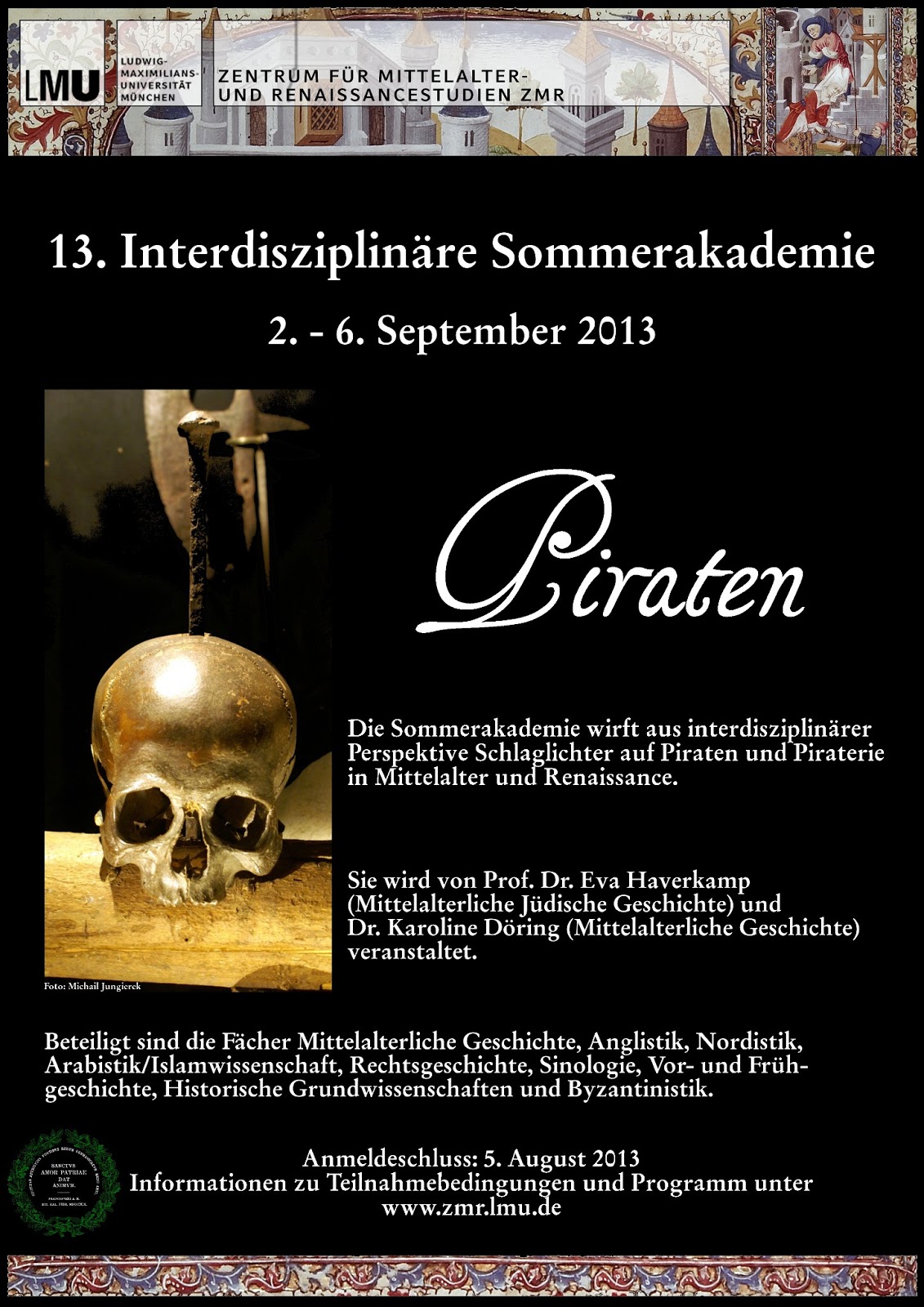
École d’été – Piraten. Dreizehnte interdisziplinäre Sommerakademie

Munich

2.-6. September 2013

Die interdisziplinäre Sommerakademie richtet sich an fortgeschrittene Studierende sowie an Promovierende, die sich in München oder an auswärtigen Universitäten mit Mittelalter und Frühneuzeit beschäftigen.

Dieses Jahr wirft die Veranstaltung aus interdisziplinärer Perspektive Schlaglichter auf Piraten und Piraterie in Mittelalter und Renaissance.
Die Teilnehmer erhalten ein Zertifikat. Mit einer schriftlichen Hausarbeit kann ein Hauptseminarschein in einem der beteiligten Fächer erworben werden. Wichtige Literatur wird zur Vorbereitung in einem Reader zugänglich gemacht.
Anmeldung richten Sie bitte mit Angabe Ihrer Studienfächer und Ihrer Fachsemesterzahl bis zum 5. August per Mail an die Organisatorinnen, die Ihnen gerne auch weitere Auskünfte erteilen:
Prof. Dr. Eva Haverkamp (eva.haverkamp@lrz.uni-muenchen.de)
Historisches Seminar der LMU
Jüdische Geschichte und Kultur
Geschwister-Scholl-Platz 1
80539 München
Dr. Karoline Döring (karoline.doering@mgh.de)
Monumenta Germaniae Historica 
Ludwigstr. 16
80539 München
Für bis zu vier Studierende anderer Universitäten steht ein Reisekostenzuschuss von pauschal 250€ zur Verfügung. Um diesen zu erhalten ist der Anmeldungs-E-Mail ein kurzer Lebenslauf beizufügen. Die Sommerakademie findet in den Räumlichkeiten der LMU statt, der Raum wird rechtzeitig bekanntgegeben.
Hier finden Sie einen Überblick über die geplanten Lehreinheiten der Sommerakademie
Gerne können Sie sich auch unser Plakat downloaden und die Veranstaltung an Ihrer Universität 
bekannt machen!
Source de l’information : Ludwig-Maximilians-Universität München

Publié dans École d'été | Laisser un commentaire

Fellowship offer – One-month Conventus fellowship at Ghent University in 2014

Candidates for a one-month Conventus fellowship at Ghent University in 2014 are cordially invited to submit their candidacy to steven.vanderputten@ugent.be. 
This offer applies to anyone with a PhD in the history of the Early and Central Middle Ages (c. 900-1200), speciality ecclesiastical and/or religious history. 
More information on http://www.conventus.ugent.be.
Publié dans Offre d'emploi | Laisser un commentaire

Appel à contribution – Pastoral Care in the Reforming Centuries

Papers are sought for a panel on the theory and practice of pastoral care in the eleventh and twelfth centuries, for the International Medieval Congress in Leeds, 7-10 July, 2014.
The provision of adequate pastoral care and the duty of a cleric to minister to the needs of his flock is something of a perennial theme in Christian writing. From Gregory the Great to Vatican II, theologians have wrestled with the question of how to strengthen and supporting the connection between the institutional church and the body of the laity, with diverse strategies and with varying degrees of success.
This panel aims to consider pastoral care both in practice and theory in medieval Europe during the long eleventh and twelfth centuries. Historiographical attention has typically focused on the period just before the Fourth Lateran Council, the development of pastoralia as a literary genre, and the institutional implementation of the canons of 1215. 
For this panel, we encourage proposals that go beyond this traditional narrative, look earlier, or consider neglected texts or aspects of pastoral care. How did the reform movements of the eleventh and twelfth centuries, and the burgeoning of new monastic forms of life, transform the ways in which pastoral care was conceived of and implemented?
Papers may deal with any aspect of pastoral care, broadly interpreted, in the period before the Fourth Lateran Council. This may include the writing or thought of specific bishops, abbots, canons, monks or theologians, or may focus on how pastoral care was, or was not achieved, in specific religious communities or provinces. We also welcome contributions which tackle the methodological questions pertaining to this topic, such as how historians can assess the efficacy of pastoral care, and what the care of souls looked like when put into action. Prospective papers may also wish to consider the ways in which later medieval thinkers adapted, modified and renewed classical and patristic doctrines of pastoral care. Papers may treat any area of medieval Europe, broadly defined.
Please send any questions or proposals (approximately 300 words) for 20 minute papers to philippa.byrne@history.ox.ac.uk on or before 9th August 2013.
Source de l’information : H-Net
Publié dans Appel à contributions | Laisser un commentaire

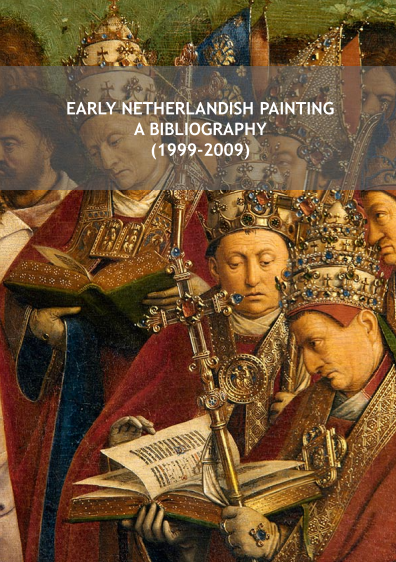
Publication – Early Netherlandish Painting : a Bibliography (1999-2009)

This publication is only available on line and in PDF format. It is the continuation of Early Netherlandish Painting (1400-1500). A Bibliography (1984-1998), assembled by Hélène Mund and Cyriel Stroo and edited by the Centre for Study of the Flemish Primitives in 1998. In recent years the access to bibliographical references has been facilitated by multiple on line resources, databases and catalogues. Nevertheless during the past ten years the Study Centre continued its systematical excerption of publications and its classification of bibliographical references following a well-established method. Although we are now considering new formula for our bibliographical database, it would be a shame to lose the time consuming work that has been done over the past ten years, classifying multiple references into different rubrics and lists of art works. Therefore it has been decided to publish the bibliography as a pdf document assembling all bibliographical references assembled in the period from 1999 to 2009. 

In the Notes to the Reader of the 1998 edition the principle guidelines help to understand the way in which the bibliography is assembled and presented. Hereby we remember the principle ideas from these notes to the reader: 

The bibliography relates to 15th-century panel painting in the Southern Netherlands and consequently includes the œuvre of the « Flemish Primitives », who were active between 1400 and 1500. The list of artists, as published by N. Verhaeghen (Le cadre chronologique et géographique du Corpus des Primitifs flamands, in Institut royal du Patriminoine artistique. Koninklijk Instituut voor het Kunstpatrimonium, Bulletin, 3, 1960, pp. 191-194), was taken as the starting point. A number of new names, drawn from archival sources or attributed in the light of the revised grouping of certain works, together with some borderline cases have been added. 

The work begins with the customary general sections in which overarching art-history studies are classified alphabetically by name of author. The sections headed General Works, Museums and Collections, Sources, Technique, Iconography and Drawings are presented in that order. Next, under the title of Painters, comes the list of publications, arranged alphabetically by artist. Pride of place is given to the identified Masters, who are followed by the Masters with provisional names and lastly the anonymous works. For each artist publications are grouped in accordance with general studies, then alphabetically by the name of town or city, the collection and the standard titles of the various works of art. This arrangement is based on the Group concept, which also underlies the presentation of works of art in the Corpus. In consequence, paintings which have been assembled under the name of a specific artist not only relate to « safe » attributions but also include works which originated in his workshop, whether or not with his cooperation, as well as works from other workshops, in some cases created much later but undoubtedly inspired by him. For the most part this section conforms to the classification of the Centre for the Study of the Flemish Primitives and/or the most usual attributions in the literature. Publications in which a different attribution is preferred are wherever possible followed by (« attributed to…. »). 

With regard to the titles of works, a certain uniformity was sought but this was not always feasible and in places even undesirable. The title is in most cases derived from the iconographic subject, which itself cannot invariably be clearly interpreted. Where there is a more usual title which is wholly unrelated to the iconography, as with the Merode Triptych, this is shown as a second designation. 

In cases of fragments of ensembles spread over a number of collections, the enquirerer is, wherever possible, referred to the work as a whole (fragment/wing/ centre panel from….) and to the places where the various components are located. In such cases the title of the work of art is followed by (« see also … »). This cross-referencing is also employed in cases of works on which several artists have cooperated, and similarly of works which have been loaned (“on loan to”… “on loan from”….). 

In the composition of this bibliography, every effort has been made to achieve completeness, certainly in the recording of all fundamental studies, but in order to keep the overview practical and manageable a number of selection criteria had to be built in. These governed both the choice of publications and the degree to which the studies referred to were excerpted. For instance, publications which appeared to be intended more for the general public but in many cases were enhanced with excellent illustration material were not included. The same also holds good for auction catalogues and unpublished master’s degree dissertations, however interesting some of the latter may be. 

Our concern to ensure that this reference work would be of practical use and to refrain from burdening the enquirer needlessly with entries which were of little or no relevance, and hence superfluous, was the decisive factor governing each of the selection criteria described above. On the other hand, we have endeavoured to spare the enquirer as much fruitless, time-consuming searching as possible and in the final analysis we feel we can rely on his or her common sense. 

The bibliography was finalized on 31 December 2009.

Informations pratiques :
Dominique Deneffe, Bart Fransen, Valentine Henderiks et Hélène Mund, Early Netherlandish Painting : a Bibliography (1999-2009), Bruxelles, Institut royal du patrimoine artistique, 2011 (Contributions to the Study of the Flemish Primitives, 11). 

Accès : ici

Source de l’information : KIK-IRPA
Publié dans Publications, Web | Laisser un commentaire

Appel à contribution – La formule au Moyen Âge. Troisième colloque international interdisciplinaire

Appel à contributions: troisième colloque international interdisciplinaire
La formule au Moyen Âge
Perpignan (France). 19, 20 et 21 juin 2014.
Pour sa troisième édition, le colloque bisannuel sur la formule (GRENDEL – IDEA) aura lieu les 19, 20 et 21 juin 2014, sous l’égide de l’Université de Perpignan (CRHiSM, VECT- Mare Nostrum et l’Institut Des Méditerranées). 

La manifestation se déroulera dans l’université même ainsi que dans d’autres hauts lieux du Moyen Âge catalan. Une demi-journée de découverte du patrimoine (Prieuré de Serrabone, Abbaye de Saint-Michel de Cuxa) et un concert médiéval ponctueront le programme.
Langues: français, anglais, espagnol, catalan.
Les propositions de communication (durée : 25 minutes) sont à soumettre pour le 15 novembre 2013 
(Merci de préciser le domaine de recherche et de ne pas dépasser une feuille A4)
Les modes de pensée et de représentation médiévaux sont profondément marqués par l’usage de reprises et de régularités attendus et reconnaissables, qui sont sources de tensions productives entre expression individuelle et normes collectives, changement et continuité, création et convention. De façon très générale, toute formule se caractérise par un figement ou une régularité plus ou moins marqué laissant la place, en creux, à l’innovation. La définition de la formule se décline différemment en fonction de la discipline considérée, et le colloque sera l’occasion d’en établir les diverses acceptions et de s’interroger sur leur compatibilité éventuelle, ainsi que d’analyser l’effet pragmatique engendré par les répétitions formulaires, entre autres pistes de réflexion possibles.

Ce colloque, qui s’inscrit dans une logique internationale et interdisciplinaire, s’adresse aux médiévistes quels que soient leurs domaines de recherche:
  • littérature (poésie, théorie orale-formulaire, tournures consacrées, topoi…)
  • histoire de l’art (motifs, procédés de production, signatures artistiques…)
  • histoire (médecine, cuisine, magie…)
  • droit et diplomatique (études de serments, de testaments, de préambules de chartes…)
  • codicologie (codex, colophons…)
  • épigraphie (inscriptions funéraires, dédicatoires…)
  • linguistique (politesse et interactions ritualisées, histoire de la langue, études de corpus de textes techniques ou savants…)
  • musicologie (écriture et thèmes musicaux…)
  • pratique et vie religieuses (prédications, liturgie…)
Conférenciers invités: Anne Brenon, Philip Daileader.

Envoi des propositions: carolinedebarrau@gmail.com (Caroline de Barrau, CRHiSM, UPVD).
Contact: o.p.simonin.03@cantab.net (Olivier Simonin, VECT – Mare Nostrum, UPVD).

Call for papers: third international interdisciplinary conference
Formulas in Medieval Culture
Perpignan (France), 19-21 June 2014.
The third biennial conference on formulas in medieval culture (GRENDEL – IDEA), hosted by the University of Perpignan (CRHiSM, VECT-Mare Nostrum & Institut Des Méditerranées) will take place on June 19-21 2014. The event will be held at the university and other locations significant in medieval Catalan culture. The programme will include a half-day of visits to sites including the priory of Serrabone and the abbey of Saint-Michel de Cuxa, as well as a concert of medieval music.
Languages: English, French, Spanish, Catalan.
Proposals for 25-minute papers should be submitted by 15 November 2013. Proposals should be no longer than one side of A4 and state the field of research under consideration.
Medieval modes of thinking and representation rely heavily on the anticipated reiteration of recognizable forms or devices, generating productive tensions between individual expression and collective norms, change and continuity, creation and convention. Such formulas could be broadly characterized as a more or less fixed or recurrent pattern that remains open to innovation. The definition of “formula” is apt to vary depending on the field of inquiry: goals for this conference include describing the diversity of meanings and uses for the term, observing whether they are potentially compatible, and accounting for the pragmatic effect produced by formulaic repetitions, among other possible approaches.
This international and interdisciplinary conference will be of interest to researchers working in Medieval Studies in a range of fields, including, but not limited to:
  • literature (poetry, oral-formulaic theory, set phrases, topoi)
  • art history (motifs, production devices, artistic signatures)
  • history (medicine, cookery, magic)
  • law and diplomacy (studies of oaths, wills, charter preambles)
  • codicology (codices, colophons)
  • epigraphy (funerary and dedicatory inscriptions)
  • linguistics (politeness and ritualized interactions, historical linguistics, corpus studies focusing on technical or scholarly texts)
  • musicology (musical themes and composition)
  • religious life and practices (sermons, homilies, liturgy)
Plenary speakers: Anne Brenon, Philip Daileader.

Proposals should be sent to: carolinedebarrau@gmail.com (Caroline de Barrau, CRHiSM, UPVD).
Contact: o.p.simonin.03@cantab.net (Olivier Simonin, VECT – Mare Nostrum, UPVD).


Convocatoria: coloquio internacional interdisciplinario
La fórmula en la Edad Media
3a edición. Perpiñán. 19, 20 y 21 de junio de 2014.

La tercera edición del coloquio bienal sobre la fórmula (GRENDEL-IDEA) tendrá lugar los 19, 20 y 21 de junio de 2014, bajo la égida de la Universidad de Perpiñán (CRHiSM, VECT-Mare Nostrum y Instituto de los Mediterráneos).

La coloquio se celebrará en la misma universidad así como en otros lugares emblemáticos de la Edad Media catalana. Acompañarán el programa (Una) media jornada de descubrimiento del patrimonio (Priorato de Serrabona, Abadía de Sant Miquel de Cuixà) y un concierto medieval (acompañarán el programa).

Lenguas: inglés, español, francés, catalan.

La fecha límite de presentación (no mas de hoja A4 – comunicaciones : duración: 25 minutos) de propuestas es el 15 de noviembre de 2013 (precisar, por favor, el ámbito de investigaciones)

Las maneras medievales de pensar y representar están profundamente marcadas por el uso de normas, esperados y reconocibles que constituyen fuentes de tensiones productivas entre expresión individual y normas colectivas, cambio y continuidad, creación y convención. En general, cualquier fórmula se caracteriza por algo fijo o una norma, más o menos marcado que deja paso, en negativo, a la innovación. Según la disciplina, la fórmula tiene una definición diferente; el coloquio permitirá, entre otros orientaciones, establecer sus diversas acepciones, indagar sus eventuales compatibilidades o analizar el efecto pragmático creado por las repeticiones de fórmulas.

Este coloquio internacional e interdisciplinario, está dirigido a los medievalistas de cualquier especialidad:
  • literatura (poesía, teoría oral-formularia, giros consagrados, topoi…)
  • historia del arte (motivos, procedimientos de producción, firmas artísticas…)
  • historia (medicina, cocina, magia…)
  • derecho y diplomática (estudios de juramentos, de testamentos, de preámbulos de cartas…)
  • codicología (códices, colofones…)
  • epigrafía (inscripciones funerarias, dedicatorias…)
  • lingüística (cortesía y interacciones ritualizadas, historia de la lengua, estudios de corpus de textos técnicos o doctos…)
  • musicología (escritura y temas musicales…)
  • practica y vida religiosa (predicaciones, liturgia…)

Conferenciantes invitados: Anne Brenon, Philip Daileader.

Enviar las propuestas a: carolinedebarrau@gmail.com (Caroline de Barrau, CRHiSM, UPVD).
Contacto: o.p.simonin.03@cantab.net (Olivier Simonin, VECT – Mare Nostrum, UPVD).

Source de l’information : ici
Publié dans Appel à contributions | Laisser un commentaire

Publication – Manuscrits datés des bibliothèques de France, t. 2 : Laon, Saint-Quentin, Soissons

Les Catalogues de manuscrits datés constituent un instrument de travail primordial des études médiévales. Le répertoriage des manuscrits datés est en effet essentiel à la recherche paléographique et à l’histoire de la culture écrite, qui ne peut progresser qu’en s’appuyant sur des spécimens d’écritures précisément situés dans le temps et dans l’espace. Depuis 1959, sept volumes de Catalogues des manuscrits en écriture latine portant des indications de date, de lieu ou de copiste avaient couvert la majorité de la France.

La présentation de la collection a été reprise et modernisée avec le volume précédent. Elle recense non seulement des manuscrits en écriture latine portant des indications explicites de date, de lieu ou de copiste, mais aussi des manuscrits que des éléments internes ou externes permettent de dater. Les notices accordent une place plus large aux éléments de critique interne et externe ; les planches (toujours à l’échelle 1:1) ont été agrandies.

Les trois bibliothèques dont les fonds sont ici exploités ont livré un ensemble de 142 manuscrits datés, s’échelonnant des années 820 à la fin du XVIe siècle ; le catalogue comprend également 280 notices sommaires.

Les bibliothèques de Laon, Saint-Quentin et Soissons présentent un intérêt majeur en raison de l’importance et de l’ancienneté de leur fonds (86 manuscrits remontent au haut Moyen Âge). L’introduction examine à nouveaux frais l’école de Laon aux temps carolingiens et en relativise l’importance. Elle accorde une très large place aux bibliothèques canoniales laonnoises et, en particulier, à l’activité intellectuelle d’Adam de Courlandon et de Michel Casse.

Une mention toute spéciale doit être faite ici du travail réalisé sur les manuscrits de l’abbaye cistercienne de Vauclair. Une étude des exlibris et reliures médiévales par D. Muzerelle et G. Lanoë, ainsi qu’un catalogue détaillé des reliures médiévales par G. Lanoë accroissent nos connaissances sur la bibliothèque de l’abbaye.

Les planches donnent autant que possible une vue complète de la mise en page médiévale. Le choix des planches n’est pas justifié illustration par illustration, mais, du moins, il a été possible de choisir plus précisément les feuillets reproduits et, dans le cadre du chapitre sur les reliures et marques de provenance de Vauclair, de commencer l’album des ex-libris, souhaité dès le volume de Cambrai.

Denis Muzerelle, archiviste paléographe et ingénieur de recherche au CNRS, a participé à la rédaction de plusieurs volumes de la collection antérieure et assume la direction de l’entreprise depuis 1985.
Informations pratiques :
Denis Muzerelle, Manuscrits datés des bibliothèques de France, t. 2 : Laon, Saint-Quentin, Soissons, Paris, CNRS Éditions, 2013 (Manuscrits datés des bibliothèques de France). ISBN : 978-2-271-07762-2. Format : 21 x 27 cm. 450 pages. Prix : 80,00 euros.

Source de l’information : CNRS éditions
Publié dans Publications | Laisser un commentaire

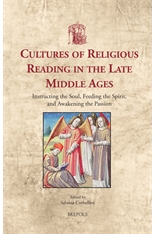
Publication – Sabrina Corbellini (éd.), "Cultures of Religious Reading in the Late Middle Ages. Instructing the Soul, Feeding the Spirit, and Awakening the Passion"

Read often, learn all that you can. Let sleep overcome you, the roll still in your hands; when your head falls, let it be on the sacred page.
St Jerome, 384 AD

With these words, the Church Father Jerome exhorted the young Eustochium to find on the sacred page the spiritual nourishment that would give her the strength to live a life of chastity and to keep her monastic vows. His call to read does not stand alone. Books and reading have always played a pivotal role in early and medieval Christianity, often defined as ‘a religion of the book’.

A second important stage in the development of the ‘religion of the book’ can be attested in the late Middle Ages, when religious reading was no longer the exclusive right of men and women living in solitude and concentrating on prayer and meditation. Changes in the religious landscape and the birth of new religious movements transformed the medieval town into a privileged area of religious activity. Increasing literacy opened the door to a new and wider public of lay readers. This seminal transformation in the late medieval cultural horizon saw the growing importance of the vernacular, the cultural and religious emancipation of the laity, and the increasing participation of lay people in religious life and activities.
This volume presents a new, interdisciplinary approach to religious reading and reading techniques in a lay environment within late medieval textual, social, and cultural transformations.
Table des matières :
Sabrina Corbellini – Introduction 

1. Latin and Vernacular – Orthodoxy and Heterodoxy

Else Marie Wiberg Pedersen – Heterodoxy or Orthodoxy of Holy Women’s Texts: What Makes a Holy Woman’s Text Holy? 
Sabrina Corbellini – Beyond Orthodoxy and Heterodoxy: A New Approach to Late Medieval Religious Reading 
John J. Thompson – Reading with a Passion: Fifteenth-Century English Geographies of Orthodoxy
Eyal Poleg – Wycliffite Bibles as Orthodoxy

2. Print and Public: The Impact of Printing on the Dissemination of Orthodoxy

Koen Goudriaan – The Church and the Market: Vernacular Religious Works and the Early Printing Press in the Low Countries,1477-1540
Mart Van Duijn – Defining the Delft Bible (1477): From Printer-Public Dynamics to Extant Copies
Kristian Jensen – Reading Augustine in the Fifteenth Century 

3. Socio-Cultural Contexts of Production, Acquisition and Reading of Vernacular Religious Books

Suzan Folkerts – The Cloister or the City? The Appropriation of the New Testament by Lay Readers in an Urban Setting 
Werner Williams – The Medieval German Lives and Miracles of St. James
Anna Adamska – Latin and Vernacular – Reading and Meditation: Two Polish Queens and their Books 

4. Religious and Sacred Texts in the Vernacular: Methodological Aspects of a Social History of Reading

Margriet Hoogvliet – “Pour faire laies personnes entendre les hystoires des escriptures anciennes”: Theoretical Approaches to a Social History of Religious Reading in the French Vernaculars during the Late Middle Ages
Andrew Taylor – Displaying Privacy: Margaret of York as Devotional Reader 
Plates
Informations pratiques :
Sabrina Corbellini (éd.), Cultures of Religious Reading in the Late Middle Ages. Instructing the Soul, Feeding the Spirit, and Awakening the Passion, Turnhout, Brepols, 2013 (Utrecht Studies in Medieval Literacy, 25). VI+308 p., 12 b/w ill. + 15 colour ill., 1 b/w tables, 156 x 234 mm. ISBN: 978-2-503-54569-1. Prix : 90,00 euros.

Source de l’information : Brepols
Publié dans Publications | Laisser un commentaire

Appel à contribution – Aux origines de l’artiste dans l’Europe médiévale et moderne (1300-1600)

Appel à communication pour le colloque international « Aux origines de l’artiste dans l’Europe médiévale et moderne (1300-1600). Artistes à la ville et artistes à la cour » organisé par Philippe Lorentz, Paris-Sorbonne, Centre André Chastel et EPHE, et Dagmar Eichberger, université de Trèves, FB III Kunstgeschichte & ERC TAK/ SHARK.
Ce colloque vise à interroger la place de l’artiste / artisan à la fin du Moyen Âge et au début de l’époque moderne dans divers contextes sociaux, en particulier à la ville et / ou à la cour, au sein des corporations et / ou dans l’hôtel du prince. Un certain nombre d’artistes ont répondu à des commandes dans ces deux sphères habituellement jugées distinctes, tels Jean Fouquet, Rogier van der Weyden, Albrecht Dürer, Hans Plock, Jacques Jordaens et Bernard van Orley, pour n’en nommer que quelques-uns. Certains artistes travaillant pour le prince ne détenaient qu’un titre honorifique et leur rattachement à la cour n’était qu’épisodique.
Aux yeux des organisateurs de ce colloque, le moment semble opportun de questionner l’hypothèse centrale du livre de Martin Warnke (Hofkünstler. Zur Vorgeschichte des modernen Künstlers, Cologne, 1985/1996), qui situe l’origine de l’autonomisation de la conscience artistique non dans le cadre corporatif de la ville, générateur de contraintes, mais plutôt au sein de la cour, grâce à la position privilégiée occupée par l’artiste auprès du prince dès les XIIIe et XIVe siècles. Au regard des recherches menées depuis une trentaine d’années, est-il justifié, aujourd’hui, d’opposer de manière aussi tranchée le monde urbain et la cour, les deux terrains de prédilection du formidable développement artistique qui caractérise l’Europe occidentale durant cette longue période (1300-1600) ?
Les points suivants semblent pertinents pour la discussion et pourront faire l’objet de communications. D’autres suggestions sont les bienvenues :
  • Quelles sont les différentes acceptions que recouvre la notion d’artiste de cour ?
  • Quels médias étaient pratiqués par les artistes de cour et comment ceux-ci étaient-ils désignés (orfèvre, peintre, enlumineur, tapissier, brodeur, sculpteur, architecte « du roi », « garde-joyaux », « valet de chambre », etc.) ? 
  • Comment les artistes/artisans négociaient-ils leur poste au sein de la maison du prince ? Quelles conditions pouvaient paraître les plus avantageuses (salaires annuels, journaliers, indépendance vis-à-vis des règlements de corporations, libre choix du lieu de résidence) ?
  • Pourquoi certaines villes comme Bruxelles, Louvain ou Nuremberg ont-elles engagé, à certaines époques, un peintre ou un architecte officiel et quels rôles étaient dévolus à ces artistes ?
  • Le statut des artistes a-t-il une incidence sur les œuvres produites ? Est-il possible de distinguer les œuvres d’art produites pour la cour de celles réalisées dans le cadre des corporations ? La notion d’ « art de cour » est-elle pertinente au regard du statut des artistes ou s’agit-il d’un concept fondé uniquement sur des critères liés à la commande ?
  • Les artistes de cour jouissaient-ils d’une liberté plus grande que les membres des corporations ? Avaient-ils davantage la possibilité d’expérimenter et d’introduire de nouveaux thèmes et de nouveaux styles ?
  • Quel est le lien entre le statut social de l’artiste et la création ? Comment évaluer les hypothèses émises à ce sujet par différents historiens de l’art à l’aune des recherches d’archives ?
  • Que savons-nous des artistes itinérants se déplaçant de ville en ville et de cour en cour ? Comment s’exerçait le jeu des recommandations ?
La période couverte par le colloque est la fin du Moyen Âge et le début de l’époque moderne, de 1300 environ à 1600. Les aires géographiques concernées sont la France, l’Empire germanique et les anciens Pays-Bas, mais d’autres régions de l’Europe occidentale peuvent également être prises en compte.
Conditions de soumission :
Les propositions de communications peuvent être adressés aux deux organisateurs (eichber1@uni-trier.de et philippe.lorentz@paris-sorbonne.fr), sous la forme d’un résumé de deux pages pour une communication de 30 minutes (une ou deux pages maximum), accompagné d’un bref CV indiquant le rattachement institutionnel et comprenant une liste de cinq publications maximum 
jusqu’au 31 juillet 2013.
Les frais de déplacement et d’hôtel seront couverts par l’organisation du colloque. Les meilleures contributions seront publiées dans un volume d’actes.
Le colloque aura lieu à Paris, galerie Colbert, Centre André Chastel, du 19 au 21 juin 2014.
Les langues du colloque sont le français, l’anglais et l’allemand.
Ce colloque fait partie du Labex EHNE (Écrire une histoire nouvelle de l’Europe) et du programme de recherche TAK-SHARC, dirigé par le professeur Andreas Tacke, http://www.uni-trier.de/index.php?id=28117.
Comité scientifique :
Madame Dagmar Eichberger, professeur à l’université de Trèves (Allemagne),
Monsieur Philippe Lorentz, professeur à l’université de Paris-Sorbonne (Paris IV),
Monsieur Dany Sandron, professeur à l’université de Paris-Sorbonne (Paris IV),
Monsieur Andreas Tacke, professeur à l’université de Trèves.
Source de l’information : Calenda
Publié dans Appel à contributions | Laisser un commentaire

Appel à contribution – L’étude des manuscrits enluminés dans l’histoire de l’art, entre original, fac-similé et numérisation

Paris, Deutsches Forum für Kunstgeschichte, October 7-13, 2013
Deadline: 1 août 2013
Du 7 au 13 octobre 2013, le Centre allemand d’histoire de l’art (CAHA) organise un séminaire d’études dédié à l’étude des manuscrits à peintures en histoire de l’art, entre original, fac-similé et numérisation. Le séminaire s’adresse aux étudiants de niveau Master et aux doctorants qui travaillent sur l’enluminure à la fin du Moyen Âge. Il comprendra des exercices pratiques avec des fac-similés et des originaux et permettra d’échanger avec des spécialistes ainsi que d’aborder des questions spécifiques à certaines thématiques de recherche.
Le séminaire, dirigé par le professeur Eberhard König et le docteur Christine Seidel, se tiendra principalement à Paris, avec des excursions d’une journée à Chantilly et à Rennes. Outre la possibilité de discuter de questions méthodologiques et des évolutions historiques de l’enluminure, notamment en France à la fin du Moyen Âge, ce séminaire doit permettre aux jeunes chercheurs d’accéder à différentes collections ainsi que de faire des exercices pratiques avec des originaux, mais aussi d’expérimenter de manière approfondie les méthodes de travail propres à l’histoire de l’art en matière de paléographie et de d’échanger avec le groupe sur leurs propres sujets de recherche.
Les participants devront avoir une bonne connaissance de l’allemand et du français, puisque le cours se déroulera dans ces deux langues. Les frais de transport et de logement seront pris en charge par le Centre allemand d’histoire de l’art à hauteur de 600 euros maximum.
Le séminaire est limité à dix places ; les candidats sont priés d’envoyer un CV abrégé, le dernier diplôme obtenu et une courte lettre de motivation avant le 1er août 2013 à l’adresse suivante :
egbk[at]zedat.fu-berlin.de
Pour plus d’informations veuillez contacter : Christine Seidel
christine.seidel[at]fu-berlin.de
Source de l’information : ArtHist
Publié dans Appel à contributions | Laisser un commentaire

Offre d’emploi – Textielproductie in het Vlaamse Westland (15e-16e eeuw)

Binnen het Centrum voor Stadsgeschiedenis van de Universiteit Antwerpen is volgende voltijdse functie (m/v) vacant:
Een voltijdse doctoraatsbeurs in het kader van het FWO-project

De stad is het platteland. Textielproductie en stads-plattelandsrelaties in het Vlaamse Westland (15e-16e eeuw) (vier jaar, 1 oktober 2013-30 september 2017)
Project:
De opmerkelijke bloei van de rurale en kleinstedelijke textielnijverheid in het Vlaamse Westland – in de rurale omgeving van Ieper, Belle, Waasten en Hondschoote fascineert historici sinds de pioniersdagen van Henri Pirenne, Georges Espinas en Emile Coornaert. Tussen de vijftiende en de vroege zeventiende eeuw kwam in dit gebied een internationaal befaamde exportnijverheid tot bloei, die zowel hoogwaardig luxe-textiel als massa-producten omvatte. Merkwaardig daarbij is dat in dit gebied aan weerszijden van de actuele Frans-Belgische grens, de arbeidsintensieve goedkopere producten (saaien) in een snel uitdijende nieuwe stad geproduceerd werden (Hondschoote), terwijl de productie van de hoogwaardige, zwaardere lakens zich op het platteland afspeelde, met het dorp Nieuwkerke als centrum en uithangbord. De geschiedenis van de textielproductie in het Vlaamse Westland geeft dan ook heel wat stof tot nadenken over functie-verdelingen tussen stad en platteland, over industrie en proto-industrie, over rurale en stedelijke arbeidsmarkten en zelfs over het concept stedelijkheid zelf. Na de jaren 1950 verdween het onderzoek naar de textielproductie van het Westland naar de achtergrond. In dit project wordt de draad weer opgenomen, en wordt gezocht naar nieuwe verklaringen voor dit opmerkelijke industriële succesverhaal. Die verklaringen hopen we te vinden door de textielproductie te kaderen in een systematische analyse van de regionale plattelandseconomie en samenleving. In de rurale geschiedenis werd de jongste decennia heel wat vooruitgang geboekt vanuit het denken rond ‘sociale agro-systemen’ – regionale combinaties van sociale relaties, instellingen en rurale productiesystemen. In vergelijking met het beter bestudeerde Vlaamse Binnenland en de Polders, weten we echter nog zeer weinig over het agro-systeem van het Westland. De integratie van dergelijke analyse met nieuwe inzichten van stadshistorici rond de organisatie en vermarkting van textielproducten, biedt bovendien een unieke kans om de historiografische kloof tussen stadsgeschiedenis en plattelandsgeschiedenis te helpen dichten, en aan te sluiten bij internationaal vernieuwend onderzoek over de relatie tussen stad en platteland in de pre-moderne periode.
Profiel en Jobvereisten :
  • Master in Geschiedenis, gespecialiseerd in de Middeleeuwse en/of Vroegmoderne Geschiedenis
  • Uitstekende studieresultaten
  • Laatstejaarsstudenten kunnen eveneens solliciteren
  • Een passie voor historisch onderzoek, waaronder ook de doorgedreven zoektocht naar weinig voor de hand liggend bronnenmateriaal.
  • Vertrouwdheid met 15e en 16e eeuws archiefmateriaal en inzonderheid met Nederlandstalige of Franstalige documenten uit deze periode is een pluspunt
  • Aanleg voor kwantitatief onderzoek.
  • Academische kwaliteiten in overeenstemming met het universitaire onderzoeksbeleid (www.ua.ac.be/onderzoek)
  • Kwaliteitsgericht, plichtsbewust, creatief en teamgericht.
Wij bieden :
  • Een doctoraatsbeurs voor twee jaar, met mogelijkheid tot hernieuwing voor nogmaals twee jaar na positieve evaluatie
  • Aanvangsdatum: 1 oktober 2013
  • Een maandelijks beursbedrag dat varieert van € 2.124,11 – € 2.265,67;
  • Een dynamische en stimulerende onderzoeksomgeving.
Interesse? :
  • Indien je interesse hebt, kan je solliciteren uitsluitend via e-mail aanpeter.stabel@ua.ac.be EN tim.soens@ua.ac.be en dit zo snel mogelijk en ten laatstevóór 31 augustus 2013
  • Je voegt een uitgebreid CV en motivatiebrief toe
  • Er gebeurt een preselectie op basis van de ingediende kandidaturen; de verdere selectieprocedure is functiegericht en wordt door de selectiecommissie vastgesteld
  • Een volledige projecttekst is te vinden op www.ua.ac.be/tim.soens (Textile West Country). Voor verdere inhoudelijke informatie kan je contact opnemen met prof. dr. Tim Soens ( tim.soens@ua.ac.be ; +32.3.265.4349 ) of prof. dr. Peter Stabel (peter.stabel@ua.ac.be; +32.3.265.4260)
De Universiteit Antwerpen werkt mee aan een open, democratische en multiculturele samenleving. Wij voeren een gezinsvriendelijk en een gelijkekansenbeleid.

Source de l’information : Vlaamse Werkgroep Mediëvistiek
Publié dans Offre d'emploi | Laisser un commentaire