Colloque – Les structures d’accueil et d’hébergement dans les monastères, du haut Moyen Âge au XVIème siècle

L’hospitalité est un des aspects majeurs de la vie religieuse régulière au Moyen Âge. C’est un devoir qui est affirmé et explicité dans les nombreuses règles et coutumiers, et elle se pratique sous diverse formes aussi bien dans le milieu urbain que dans les monastères ruraux. Cependant, la question de l’hébergement dans les établissements religieux est encore peu traitée, mais les travaux consacrés aux structures et à la gestion de l’hébergement dans les monastères en France et en Europe tendent aujourd’hui à se multiplier. Organisée dans le cadre des travaux de l’équipe de recherche sur l’organisation de l’espace religieux au Moyen Âge, dirigée par Nicolas Reveyron, professeur d’histoire de l’art et d’archéologie médiévale (UMR 5138 Archéométrie et archéologie, université Lumière Lyon 2), et coordonnée par Mathilde Gardeux (doctorante en archéologie médiévale, UMR 5138, université Lumière Lyon 2), cette table-ronde s’inscrit dans l’actualité de cette recherche. Les différents travaux présentés s’articulent autour de trois axes de recherche : l’architecture liée à l’hébergement monastique, les fonctions effectives de ces bâtiments appelés « hôtellerie », et l’organisation de la gestion de l’hébergement par les moines. Ces problématiques seront abordées par le biais des études historiques et archéologiques les plus récentes, afin de proposer un premier état de la question.
Programme :

9h00 : Accueil
9h15 : Nicolas Reveyron, professeur d’histoire et d’archéologie médiévale – Présentation des recherches sur l’organisation de l’espace religieux au sein du laboratoire UMR 5138 Archéométrie et archéologie.
Mathilde Gardeux, doctorante archéologie médiévale, université Lyon 2 – Introduction à la table-ronde. 

9h30-10h05 : Claire Fauchon, ATER Histoire ancienne, université de Lorraine – Les xenodocheia monastiques proto-byzantins : état de la question.
10h05-10h40 : Alain Dubreucq, professeur d’histoire médiévale, université Lyon 3 – Xenodochium et hospitium : la norme chrétienne de l’hospitalité dans le haut Moyen Age.
10h40-10h50 : discussion
10h50-11h00 : pause

11h00-11h35 : Eleonora Destefanis, maître de conférence, université du Piémont Oriental – Espace d’accueil dans les monastères entre arc alpin et Italie centrale au haut Moyen Âge.
11h35-12h15 : Mathilde Gardeux, doctorante archéologie médiévale, Université Lyon 2, & Gilles Deshayes, archéologue contractuel, doctorant archéologie médiévale, Université de Rouen – Architecture et topographie de l’aile Ouest de l’abbaye de Jumièges (Seine-Maritime) : une grande salle destinée à l’accueil des hôtes ?
12h15-12h25 : discussion
12h30-14h30 : repas

14h30-15h05 : Jean-Baptiste Vincent, doctorant archéologie médiévale, Université de Caen – L’hôtellerie de l’abbaye de Barbery (Calvados).
15h05-15h40 : Gaël Simon, doctorant archéologie médiévale, Université de Tours – L’hôtellerie de Marmoutier : construction, transformations et environnement (XIème-XVIIIème siècles).
15h40-15h50 : discussion
15h50-16h10 : pause

16h10-16h45 : François Comte, Archéologue, Ville d’Angers, Service Patrimoine historique – Les officiers claustraux et l’accueil dans les monastères bénédictins d’Angers (XIIIème-XVIème siècles).
16h45-17h20 : Hervé Chopin, doctorant histoire médiévale, Université Lyon 2 – L’hôtellerie et l’accueil dans le monde canonial : quelques réflexions à partir de l’exemple du diocèse de Lyon.
17h20-17h30 : discussion

17h30-17h45 : Eleonara Destefanis – Conclusion

Informations pratiques :

Entrée libre
Campus des quais – 18 quai Claude Bernard 
Lyon, France (69007)
Vendredi 08 février 2013

Contact : Mathilde Gardeux (mathilde.gardeux@univ-lyon2.fr).


Source de l’information : ici
Publié dans Colloque | Laisser un commentaire

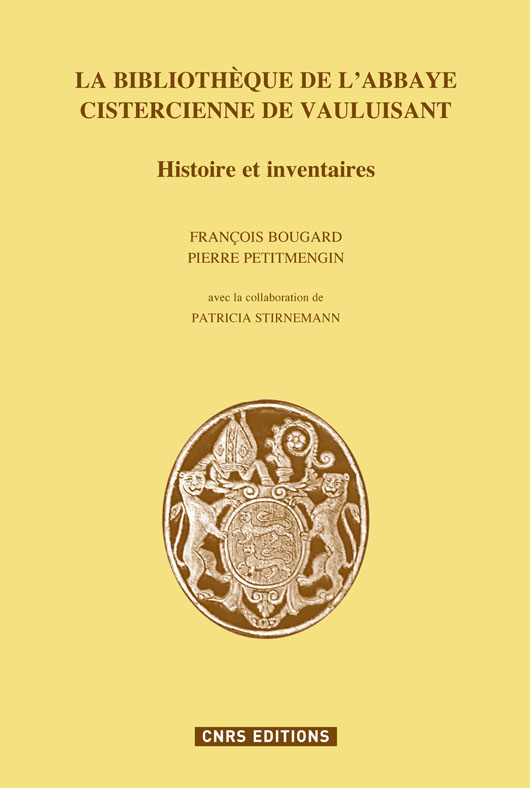
Publication – La bibliothèque de l’abbaye cistercienne de Vauluisant

La bibliothèque de Vauluisant est mise en lumière grâce à des documents en partie inédits et jusqu’à présent inexploités. L’enquête comporte un volet historique qui présente notamment l’abbaye au XVIe siècle, quand elle connut son heure de gloire à la faveur du gouvernement de l’abbé Antoine Pierre (1502-1534), sous lequel elle devint pour François Ier un lieu de séjour privilégié. On doit à cet abbé la construction en 1525-1526 de la « librairie », bâtie sur le modèle de celle de Clairvaux et dont il est possible de restituer l’ordonnancement intérieur. Au XVIIe siècle, la présence d’un prieur très actif dans le monde des lettres, Claude Maillet († 1665), dont est publiée la correspondance, assura un certain renom au fonds de manuscrits que conservait l’abbaye.

Les livres sont connus principalement par deux inventaires, le premier contemporain de la construction de la librairie, le deuxième antérieur à 1680. La chronologie des ouvrages conservés permet de retracer la constitution du fonds au XIIe siècle et de replacer Vauluisant dans le réseau troyen et cistercien. La recherche a été prolongée avec les livres imprimés, conservés en partie à Sens et à Auxerre.

La dispersion des manuscrits les a conduits dans une quinzaine de bibliothèques de l’Ancien et du Nouveau Monde. Elle est marquée par les prélèvements de Pierre Daniel, de Colbert et, durant la Révolution et l’Empire, de Théodore Tarbé, imprimeur-libraire à Sens. Le catalogue des manuscrits Tarbé, vendus en 1849, est publié en annexe.

François Bougard, ancien membre et directeur des études médiévales de l’École française de Rome, est professeur d’histoire du Moyen Âge à l’Université Paris-Ouest-Nanterre-La Défense.

Pierre Petitmengin, ancien membre de l’École française de Rome, est professeur émérite à l’École normale supérieure, dont il a été longtemps le bibliothécaire.

Patricia Stirnemann est chargée de recherche au CNRS (IRHT).

Informations pratiques :

François Bougard et Pierre Petitmengin, avec la collab. de Patricia Stirnemann, La bibliothèque de l’abbaye cistercienne de Vauluisant. Histoire et inventaires, Paris, CNRS Éditions, 2013 (Documents, études et répertoires). Format : 15 x 24 cm, 200 pages. ISBN : 978-2-271-07560-4. Prix : 80, 00 euros.

Source de l’information : CNRS éditions
Publié dans Publications | Laisser un commentaire

Offre d’emploi – Coördinator onderzoeksconsortium ‘Medieval Studies’

Uiterste inschrijvingsdatum: 15-02-2013 23:55
Vakgroep/directie/dienst: LW03 – Vakgroep Geschiedenis
Type contract: bepaald
Diploma: Doctoraat
Bezetting: 100%
Vacature type: wp
Functieinhoud :
De Universiteit Gent heeft in het kader van haar beleidsplan voor de sociale en humane wetenschappen beslist om vijf onderzoeksconsortia, bestaande uit een samenwerking van meerdere onderzoeksgroepen, extra te ondersteunen op het niveau van middenmanagement. Eén van deze consortia betreft het interdisciplinaire vakgebied van de Medieval Studies. 
Deze voltijdse functie als onderzoekscoördinator is beschikbaar op postdocniveau, voor kandidaten met onderzoekservaring in de vakgebieden aanverwant aan dit consortium (postdoc WP). 
De onderzoekscoördinator heeft als taak de kwaliteit en de productiviteit van het onderzoek van dit consortium te bevorderen, niet door zelf onderzoek uit te voeren maar door managementtaken op zich te nemen. De coördinator van dit consortium krijgt als specifieke opdracht: 
  • de samenwerking en de interdisciplinaire onderzoeksfocus van het consortium te stimuleren 
  • proactief op zoek te gaan naar onderzoeksfinanciering 
  • de betrokken promotoren te helpen bij het uitschrijven van projectaanvragen 
  • ondersteuning te bieden in de internationale netwerking van het consortium 
  • de internationalisering van het onderzoeksgerelateerde onderwijs in de Medieval Studies voor master- en PhD-studenten te coördineren 
  • de benutting van de in het consortium aanwezige onderzoeksinfrastructuur en technische expertise te optimaliseren en de strategische uitbreiding ervan te coördineren
  • initiatieven te nemen die de maatschappelijke valorisatie van het onderzoek faciliteren 
  • activiteiten op te zetten in het kader van wetenschapspopularisering,… 
Deze taken kaderen volledig binnen het projectplan van het consortium, een plan dat geïnteresseerde kandidaten kunnen opvragen bij de promotor (contactgegevens onderaan). 
Deze opdrachten zullen in nauw overleg met de stafmedewerkers en beleidsmedewerkers van de directie Onderzoeksaangelegenheden worden vervuld.
Functieprofiel :
  • U hebt een doctoraat binnen het vakgebied van de Medieval Studies (behaald vanuit de Archeologie, Geschiedenis, Kunstwetenschappen, Letterkunde, Taalkunde of een ander studiegebied) 
  • U bent vertrouwd met de beschikbare kanalen voor onderzoeksfinanciering in Vlaanderen en Europa 
  • U communiceert vlot, zowel schriftelijk als mondeling; in het Engels en het Nederlands 
  • U houdt van diversiteit en uitdagingen in uw takenpakket 
  • U neemt initiatief, u kunt zelfstandig werken maar functioneert ook goed binnen een team 
  • Het strekt tot aanbeveling dat u zich niet alleen als onderzoeker hebt geprofileerd, maar ook vertrouwd bent met strategisch management, subsidiedossiers en wetenschapspopularisering


Hoe solliciteren ?

Deze vacature is voor een contractuele aanstelling van 4 jaar met een proefperiode van 6 maanden. De aanwerving zal gebeuren op het niveau van postdoctoraal WP en de geselecteerde kandidaat zal worden aangesteld binnen de vakgroep van de hoofdpromotor van het consortium, prof. Jeroen Deploige. Deze aanstelling biedt de onderzoekscoördinator de kans zich te profileren in de managementaspecten van onderzoek. 
De selectieprocedure bestaat uit een voorselectie op basis van het CV van de kandidaat. Vervolgens wordt een selectie-interview gepland met kernleden van dit consortium en een vertegenwoordiger van de directie Onderzoeksaangelegenheden. Geïnteresseerde kandidaten kunnen bij de hoofdpromotor van dit consortium, prof. Jeroen Deploige, het projectplan opvragen en desgewenst om meer informatie verzoeken omtrent deze functie. 
De kandidaturen – bestaande uit een gemotiveerde sollicitatiebrief, CV en een kopie van het behaalde diploma- worden ten laatste op 15/02/2013 bij voorkeur per e-mail gericht aan: 
Prof. Jeroen Deploige, Vakgroep Geschiedenis, Sint-Pietersnieuwstraat 35, B-9000 Gent 
e-mail: Jeroen.Deploige@ugent.be 
tel.: +32 9 331 02 16
Source de l’information : ici
Publié dans Offre d'emploi | Laisser un commentaire

Offre d’emploi – Charge de cours en Histoire du Moyen Âge occidental (temps plein – Université de Liège)

Université de Liège
Faculté de Philosophie et Lettres
Département des sciences historiques


Une charge à temps plein dans le domaine de « l’Histoire du Moyen Âge occidental » couvrant l’ensemble de la période médiévale. Cette charge comprendra des activités d’enseignement, d’encadrement d’exercices pratiques, de recherche et de services à la Communauté.

Les candidat(e)s devront faire état d’un doctorat et de publications dans le domaine indiqué.

Informations :
Tout renseignement supplémentaire, peut être obtenu auprès du secrétariat de la Faculté de Philosophie et Lettres : Mme Françoise HARTKOPF – tél. : +32 4 366 54 54 – Francoise.Hartkopf@ulg.ac.be

Candidatures :
Le(la) candidat(e) retenu(e) sera :

  • soit désigné(e) à terme sans que la durée du terme ou des termes cumulés ne puisse dépasser cinq ans et à l’issue duquel (desquels) une nomination définitive pourra être envisagée ; 
  • soit nommé(e) à titre définitif.


Les barèmes et leurs modalités d’application sont disponibles auprès de l’administration des ressources humaines de l’Université : Mme Ludivine DEPAS – tél. : +32 4 366 52 04 – Ludivine.Depas@ulg.ac.be

Les candidat(e)s sont prié(e)s de faire parvenir, par envoi recommandé, à Monsieur le Recteur de l’Université de Liège, place du 20 Août, 7, B-4000 Liège, pour le 12 mars 2013 :

  • leur candidature assortie de deux exemplaires de leur curriculum vitae (canevas à télécharger) ; 
  • un exemplaire de leurs publications.
Publié dans Offre d'emploi | Laisser un commentaire

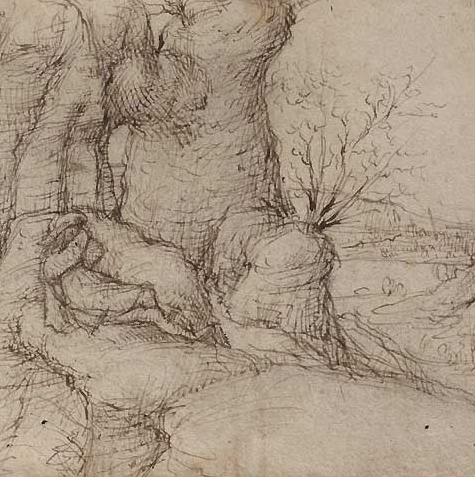
Exposition – The invention of the landscape ca. 1500: on the trail of a contemporary of Hieronymus Bosch

The exhibition shows a small group of seven landscape drawings from the collection of the Kupferstich-Kabinett in Dresden. They are among the oldest landscape depictions in Netherlandish graphic art. Hitherto, the first use of landscape as a motif in its own right was always associated with the name of Joachim Patinir, who was active in the 1520s. Technological and art-historical investigations conducted as part of a research project on the typology of Netherlandish drawings in the sixteenth century suggest, however, that the seven Dresden drawings date from earlier, namely around 1500. The draughtsman himself is not known by name. His makeshift or conventional name, ‘Master of the Dresden Wilhelm von Maleval Drawing’ is due to the motif of a work that shows St Maleval in combat with flying monsters. The exhibition provides an exciting insight into recent scientific investigation methods, which have helped to identify the drawing media and the types of paper used.
‘The Invention of the Landscape c. 1500’ is a cooperative venture between the Wallraf-Richartz-Museum & Fondation Corboud, the Kupferstich-Kabinett in Dresden, and the Bundesanstalt für Materialforschung und -prüfung in Berlin.
Master of the Dresden Wilhelm von Maleval Drawing: Rocky landscape with a sleeping person, in the background a town, c. 1500. Kupferstich-Kabinett, SKD, Inv. C 4003
Informations pratiques : 

The Invention of the Landscape c. 1500. On the trail of a contemporary of Hieronymus Bosch
25 January–21 April 2013
Wallraf-Richartz-Museum & Fondation Corboud

Obenmarspforten
(am Kölner Rathaus)
D-50667 Cologne (Köln)
Germany

Source de l’information : ici
Publié dans Exposition | Laisser un commentaire

Web – InScribe: Palaeography learning materials (free course – University of London)

Medievalists have always found it difficult to interact with primary sources from their period of study due to a lack of training in palaeography (and manuscript studies), that is to say, the reading and understanding of ancient documents. This course provides scholars and the general public interested in medieval books and documents with online training on the diverse areas found within palaeography. Topics covered include general palaeography, the history of medieval scripts, diplomatic, codicology and illumination.

Course details
The difficulty in obtaining palaeographical training at a HE level is increasingly being pointed out as a hindrance for postgraduate medievalists and interested members of the wider public. This distance learning module is aimed at filling this void as a complement to other traditional methods of palaeographical training. Its purpose is to provide the necessary training required by non-specialists to allow them to explore and interact with medieval manuscripts and documents. Thus, after an introductory (free) module presenting general palaeographical topics and an overall view of the evolution of script in the medieval period, you will be able to undertake one of four advanced modules (or pathways) to further your knowledge within the different areas of palaeography and manuscript studies.


The course structure comprises the following modules: 

  • Palaeography: An Overview (training module)
  • Script and Transcription (training module)
  • Diplomatic (training module)
  • Codicology (training module)
  • Illumination (training module)


Palaeography: An Overview: This is the introductory component which all students taking the course will have to do. It presents you with some initial practicalities relating to the process of transcribing from a digital manuscript image as well as a first approach to the evolution of script(s) in medieval books and documents.
Script and Translation: This module is a continuation of the general introduction made in the previous section about history of script. Individual scripts (book-hands and documentary hands) are studied in detail as to ascertain to what extent they can allow us to determine the origin and date of production of a given document. 
Diplomatic: This module introduces the concept of ‘diplomatic’ and presents you with the complex typology of documents produced during the medieval period. Unlike in the other modules, here particular emphasis will be placed on the content of the documents, especially on the formulaic conventions used.
Codicology: This module explores the physical side of the manuscript. Areas such as binding, lay-out, collation will be considered in order to study the physicality of the medieval book and the types of information it can provide us with.
Illumination: This final advanced module is aimed especially at art historians with an interest in the art of manuscript illumination. Topics will include terminology, the decorative elements and different schools and styles.
This course will give you enough knowledge to move forward with your own research with primary source materials in new and exciting ways.

Register for this course
Go to online course

Publié dans Web | Laisser un commentaire

Appel à contribution – Says who ? Contested Spaces, Voices, and Texts

Call for Papers – “Says who? Contested Spaces, Voices, and Texts”
University of California, Santa Barbara Medieval Studies
Annual Graduate Student Conference
May 18, 2013
University of California, Santa Barbara
Keynote Speaker: Professor Steven Justice, Department of English, UC Berkeley
Since Henri Lefebvre’s 1958 The Social Production of Space, medieval scholars have increasingly been interested in the interplay between the political, the economic, and the cultural with the concept of physical space. How is space constructed by social forces, and how is society influenced by either physical or ideological spaces? More specifically among these social forces, our conference focuses on the concept of authority: who gets to say how political, cultural, and economic processes take place within a specific space, and how they are spoken of, written of, and remembered? Conversely, how might speaking itself be a form of resistance against authority? We encourage interdisciplinary discourse around the theme of authority in any aspect(s) of law, culture, and society in the Middle Ages. For example, how do kings maintain authority over their subjects, and how is this authority constructed or contested? How do writers establish the authority of their texts, and why do they even need to? How was God’s authority sometimes challenged or undermined? Or was it?
Possible topics include but are not limited to:
  • war as a means of contesting spaces or territories
  • winners and losers: who gets to tell the story?
  • public versus private space: who controls and defines these spaces and how?
  • God as the ultimate authority: religious discourses and conflicts
  • establishing authorship, auctoritas, and differing roles in the creation of oral narratives, manuscripts, or printed editions
  • alteration of texts (by scribes, commentators, or translators, for example) as a means of contesting authority and asserting one’s power
  • linguistics: code-switching or language use as contesting authority or asserting one’s power or independence
  • process and performance of speech as constructing or resisting authority (such as in court culture, pageantry, or parliament)
  • use of heraldic motifs (how were they used or changed?) in books
  • patronage as a form of contestation or affirmation of one’s power
  • gendered spaces and voices: women patrons, women’s vs. men’s roles
  • the creation, use, and transformation of urban spaces
The conference is open to graduate students studying the Middle Ages (300-1500) in all disciplines, geographical regions, and stages of research.
We welcome 250- to 300-word abstracts for presentations 20 minutes in length. Please submit your name, email, university, and departmental affiliation with your abstract to Anneliese Pollock (anneliese_pollock@umail.ucsb.edu) by February 15, 2013.
Publié dans Appel à contributions | Laisser un commentaire

Appel à contribution – Debating and Disputing: Muslim-Christian-Jewish Relations

The Mediterranean Seminar/UCMRP is proposing two sessions for the 128th Annual Meeting of the American Historical Association to be held in Washington DC, 2-5 January 2014.
The theme of the Meeting is “Disagreement, Debate, Discussion”.
The first session: “Debating Muslim-Christian-Jewish Relations in the Medieval Mediterranean” will focus on the various scholarly interpretations of the nature of such inter-communal relations. Were these relations characterized by convivencia or a “clash of civilizations”? Or are there better paradigms for accounting for such interaction? How did contemporaries see such relationships… as problematic, or paradoxical?
The second session: “Muslims, Christians and Jews Disputing in the Medieval Mediterranean” will look at disputations and debates that were carried out at the time by members of different faiths. This may include formal verbal disputations, polemical writing and correspondence, ideological trends (eg.: crusade, and Jihad), missionizing, and other forms of debates, dialogues and discussions.
Scholars interested in presenting in either of these sessions should submit:
  • a 200 wd abstract
  • a 200 wd biographical statement
  • a 2-3 page CV
  • complete contact information (including phone number)
  • a request for AV equipment (if necessary)
  • and confirmation that the paper will be presented in person, with a length of no more than 20 minutes.
All of this should be submitted in Word (doc) format (not pdf, please) to:
by 7 February 2013.
Faculty and scholars of the University of California who present in these sessions will be eligible to apply for travel support through the Mediterranean Seminar.
Source de l’information : ici
Publié dans Appel à contributions | Laisser un commentaire

Séminaire – Speculum arabicum

Objectiver lʼapport de lʼIslam dans lʼhistoire des sciences et des idées : sources et ressources de lʼencyclopédisme dʼOrient et dʼOccident au Moyen Âge

Université Catholique de Louvain
Toutes les séances se tiendront de 10h à 12h45 salle ERAS 53
Collège Érasme, Place Blaise Pascal 1 – 1348 Louvain-la-Neuve 
Contact : godefroid.decallatay@uclouvain.be


Programme :

Lundi 4 février 2013
Databases et traitement informatique des sources

Isabelle Draelants (CNRS Nancy) – SourcEncyMe : un corpus et une plateforme collaborative en ligne pour l’identification des sources des encyclopédies médiévales latines
Alessandro Vitale Brovarone (Università di Torino) – La base de données RiStorAntI : projet, expérience, perspectives
Lorenzo Mainini (UCL) – Bibliothèques virtuelles du Moyen Âge tardif : manuscrits et bases de données

Lundi 25 mars 2013
Les sources du lexique scientifique
Michèle Goyens (KULeuven) – Médecine et langue de spécialité au Moyen Âge : réussites et échecs des traducteurs
Stephen Dörr (Universität Heidelberg) – De l’Aldébaran au zodiaque – essai d’une typologie des sources du lexique astronomique en ancien français
Gianluca Valenti (UCL) – Histoire des sciences et science dans l’histoire : enquête sur le lexique scientifique dans le deuxième livre du Miroir historial

Lundi 6 mai 2013
Les sources arabes
Daniel König (Goethe-Universität Frankfurt) – Latin et Arabe : essai d’une histoire croisée 
Florence Ninitte (UCL) – Enquête sur les sources arabes et byzantines des biographies de Mahomet en Occident
Grégory Clesse (UCL) – Thomas de Cantimpré et l’Orient : les sources arabes du Liber de natura rerum

Source de l’information : ici
Publié dans Séminaire | Laisser un commentaire

Appel à contribution – Figures, ethos, postures de l’auteur au fil des siècles

Figures, ethos, postures de l’auteur au fil des siècles 
Colloque de relève de la Formation doctorale interdisciplinaire Avec la collaboration du Prof. J.-C. Mühlethaler (projet FNS), du CEMEP et de la Section de français. 

Jeudi 20 et vendredi 21 juin 2013, Anthropos Café, UNIL. 

Des arts antiques à la modernité, ce colloque interrogera les figures, postures et scénographies auctoriales qui régissent aussi bien l’activité artistique (littératures, arts plastiques, cinéma) que les discours philosophiques et historiques. L’auteur est à la fois une fonction (Foucault 1969) et un statut changeant au fil des siècles (Chartier 1998). Il est donc une pièce essentielle d’une pragmatique historique de la communication artistique, telle qu’on l’envisagera ici à la suite de linguistes comme D. Maingueneau (2004) et d’historiens comme Alain Vaillant (2010). 

Un éventail large de questions peut être ouvert, à partir de cet axe, et selon les corpus qui sont les vôtres: Quels régimes d’auctorialité ont cours simultanément ou successivement ?… Peut-on dessiner un répertoire historique des figures et des mises en scène d’auteurs ?… On pourra se pencher sur des aspects plus précis : Quel est le poids des modèles auctoriaux antiques sur les arts et littératures modernes ? Peut-on parler de poètes « engagés » avant que la « littérature » ne représente un champ autonome, c’est-à- dire pour le Moyen Âge et la Renaissance ? Quels emprunts les artistes (philosophes, écrivains, cinéastes, etc.) font-ils aux figures prophétiques, mythologiques ou aux discours religieux? Quel rôle joue la manifestation des émotions dans la posture d’auteur, notamment à partir du XIIIe siècle, quand émerge la subjectivité littéraire (Zink 1985) ? Comment se présentent les figures auctoriales féminines qui apparaissent à la fin du Moyen Âge, puis s’affirment à la Renaissance et par la suite ? Plus généralement : comment se manifeste, dans l’énonciation, l’ethos auctorial ? Comment la prise de parole se justifie- t-elle dans des paratextes comme la préface, le discours préliminaire, voire dans des documents externes comme la correspondance? Pouvons-nous décrire ce travail de légitimation nécessaire à la parole auctoriale des différentes époques ? Quel est le rôle des médias et médiations diverses dans la construction d’une figure d’auteur (par la Cour, les Académies, la presse, les médias, le public, etc.) ? Comment la posture auctoriale modélise- t-elle son destinataire idéal, le lecteur construit par le texte? En quoi les logiques énonciatives sont-elles liées aux cahiers des charges des divers genres littéraires ? 

Agenda et contact 

Les propositions d’exposés (25 min., suivis d’une discussion de 15 min.) sont attendues pour le 1er février 2013 au plus tard, par voie d’e-mail à la triple adresse : Jean-Claude.Muhlethaler@unil.ch, fdi@unil.ch et Jerome.Meizoz@unil.ch 

Elles contiendront vos coordonnées académiques complètes, et pour votre proposition : 1) Un titre, 2) Une problématique de 1200 signes environ ainsi qu’une brève bibliographie de travail, aux références complètes.

Source de l’information et bibliographie : ici
Publié dans Appel à contributions | Laisser un commentaire