Exposition – Splendour and Glory of the Middle Ages (Museum Schnütgen, Cologne)

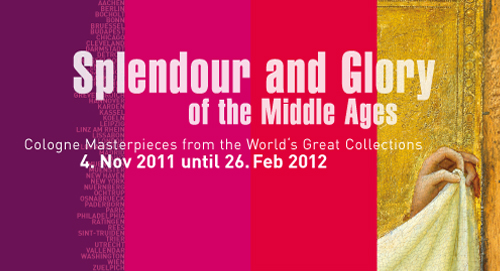
Splendour and Glory of the Middle Ages 

In its heyday from 1000 to 1550, Cologne was one of Europe‘s leading art centres. Today, the master- pieces stemming from this creative period are scattered throughout the great museums of the world. However, around 160 superb works from, among others, Berlin, Bonn, Darmstadt, Budapest, London, Vienna, Paris, Lisbon, New York, Detroit, Philadelphia, Washington, Cleveland, Chicago and Los Angeles are now returning to the Rhine River and will be on exhibit with 60 works from the museum‘s own collection. The Museum Schnütgen will be presenting great works from Cologne‘s best period in a superlative special exhibition – but only for a short while. Many of these works of art have not been seen in Cologne for many decades, others even for centuries.


Significant Artistic Work
On exhibit are precious wooden and stone sculptures, richly detailed treasures of book illumination, goldsmithery and ivory carving, fine textiles as well as valuable pieces of stained glass and panel paintings, all spanning from the Romanesque and Gothic periods to the Early Renaissance. The exhibition examines the significance of Cologne‘s artistic work, the world of its artists and their patrons.

Pulsating Centre
In the Middle Ages, Cologne was one of the largest cities in Europe, influential and widely connected, a pulsating pilgrimage and trade centre. This is also reflected in its art: through exchanges with Paris, Prague, Italy and the Netherlands, its resident masters developed an artistic language typical of Cologne. The exhibition thus becomes a journey back in time to the metropolis of the Middle Ages.

Extensive Exhibition Catalogue

A richly illustrated catalogue will be published for the exhibition with around 540 pages of articles featuring the latest in scholarly research. The special exhibition will help shed new light on the splendour and glory of medieval Cologne, also from an academic standpoint. The catalogue published by Hirmer Verlag will be available for 39 € in the exhibition. (Retail price: 49,90 €). A multilingual activity book for families will be published for the exhibition.

Special Events and Guided Tours
« Splendour and Glory of the Middle Ages » is accompanied by an attractive supporting programme including regular guided tours, lectures, concert highlights and excursions.The complete programme is available here. The Museumsdienst Köln is offering tours for all age groups and an extensive supporting programme for children

Group Tour Offers: 
Group tours (German, English, French, Dutch, further languages on request). Duration 60 or 90 minutes, max. 25 persons. Group visits are only possible with advance notification. 
Please book your guided tour or class visit online. An audio guide for the exhibition is available in German and in English (2 €).


Informations pratiques : 

Hours and Admission – Opening hours

Tuesday to Sunday: 10 a.m. – 6 p.m.
Thursday: 10 a.m. – 8 p.m.
Every first Thursday of the month the museum stays open until 10 p.m.
Closed on Mondays. Open on 26. Dec. 2011.

Admission
Collection: 5 €, reduced: 3 €
Combined Ticket for Museum Schnütgen and Rautenstrauch-Joest-Museum: 9 €, reduced: 6 €
Tickets for the special Exhibition « Splendour and Glory of the Middle Ages »:
Single ticket: 6,80 €, reduced 4 €
Groups (min.10 pers.): 4 €
Combined Ticket for collection and special exhibition: 8 €, reduced 5 €
Combined ticket for Museum Schnütgen and Rautenstrauch-Joest-Museum including all special exhibitions:
12 €, reduced 9 €

Adress for Visitors:
Museum Schnütgen
Cäcilienstraße 29-33
50667 Köln
Publié dans Exposition | Laisser un commentaire

Appel à contribution – Between Families and Institutions : Towards a Comparative History of Urban Communities, 1350-1600

The social organisation of medieval and early modern urban communities has long been debated, particularly the significance of norms, networks and institutions for advancing social integration and cohesion. Pre-modern urban life is sometimes thought to have rested on a lost form of association rooted in kinship, friendship and neighbourhood. Others argue that these relations were particular and primordial: genuine trust and solidarity based on reciprocity are then regarded as properties of modern society. More recently, the emergence of corporation-based institutions (guilds, fraternities, neighbourhoods, etc.) in medieval cities and towns has drawn much attention. These voluntary associations, by generating social capital, gave rise to political stability, fostered economic growth and strengthened societal cohesiveness; and, as such, they shaped urban civil society.


The last conclusion has met with general acceptance, even though we still do not know how voluntary associations contributed to the well-being of both townsmen and urban society as a whole. This workshop, therefore, addresses the question as to how membership of trade and craft guilds and religious fraternities benefited individuals and how these organisations strengthened the cohesiveness of medieval and early modern European urban communities. It aims to scrutinise the social texture of these corporations and how their various roles in urban society developed over time, thereby challenging participants to re-examine existing data and re-evaluate current theories. The comparative perspective of the workshop should also be instructive in determining the factors that explain variations in the role of voluntary associations as integrative forces in urban society, particularly between southern and north-western Europe.

The call for papers, therefore, aims to attract contributions on the following themes:
  1. Structure and membership: Under what conditions did guilds and fraternities emerge as the collective consequence of cooperation between individuals? How did the growth and institutionalisation of these voluntary associations affect their internal organisation and members’ participation? Which segments of urban society had access to guilds and fraternities, i.e. how did mechanisms of inclusion and exclusion operate? And, to what extent were these multi-layered voluntary associations shaped by kinship ties or ingrained in neighbourhoods ?
  2. Functions and beneficiaries: How did the secondary political, social or cultural functions of guilds and fraternities relate to their core economic or religious purposes? Were secondary functions – for example social assistance – important motives for joining voluntary associations? Did benefits of membership also extend to the families of members? And, to what extent and how did these organisations produce public goods that benefited the urban community as a whole?
  3. Institutional contexts: What kind of linkages and interactions (particularly through overlapping social networks) existed between guilds and fraternities and urban religious and secular institutions? To what degree was their organisation and functioning determined by variations in the wider urban institutional framework? And, to what extent did differences in family structures and household formation patterns affect the social role of guilds and fraternities in urban society?
  4. Ideology and culture: Did ideological, religious and cultural norms and beliefs emerge that strengthened cooperation within guilds and fraternities? Were the religious and cultural activities of voluntary associations interwoven with urban festivities, and to what extent did they fit into an overarching urban ideology? And, did these activities contribute to or harm the social cohesiveness of urban communities?
Early career researchers and researchers working on southern Europe are particularly encouraged to participate. Please send abstracts of around 250 words for 20-minute papers to the organiser, Dr Arie van Steensel (arie.vansteensel@eui.eu). Deadline for abstracts is 5 December 2011. The workshop will take place on Friday, 27 April 2012, at the European University Institute (EUI), Department of History and Civilization, Florence, Italy. Selected paper participants will receive reimbursement for accommodation expenses.

Funding is provided by the European Commission under the Seventh Framework Programme as part of the Marie Curie Actions IEF-project ‘Constructing Solidarities. Kinship Ties and Social Networks in the Urban Communities of Italy and the Low Countries, 1250-1550’, and by the European University Institute.
Publié dans Appel à contributions | Laisser un commentaire

Colloque – Feudalism and Feudal Law in Western Europe

Vanaf de 19de eeuw tot op vandaag bestuderen rechtshistorici overal in Europa het leenrecht en de daarmee verbonden feodaliteit. De oorzaak hoeft niet ver gezocht te worden. 

Gedurende 1000 jaar, tot aan de Franse Revolutie, hebben beide de staatsstructuren, maar vooral de privaatrechtelijke verhoudingen gedomineerd. Het onderzoek van de afgelopen twee eeuwen heeft vooreerst aangetoond dat het leenrecht een recht sui generis is, dat in West-Europa bijna even belangrijk is geweest als het romeinsrechtelijke « ius commune ». 

Voorts blijkt het recht talloze kleurrijke regionale verschillen te vertonen. Als dusdanig staat het leenrecht model voor het recht van de Europese Unie: « In verscheidenheid verenigd » « In Vielfalt geeint », « Unie dans la diversité ». Het Comité Rechtsgeschiedenis wil met deze studiedag een aantal recente resultaten van het leenrechtelijk onderzoek in België, Duitsland, Frankrijk en Nederland beter bekend maken, maar bovenal de kennis van die regionale verschillen verder uitdiepen. Zeven internationale sprekers brengen op deze studiedag in vier verschillende talen een overzicht van het leenrecht zoals het functioneerde in verschillende Europese historische regio’s.

Programme : ici !

Informations pratiques :

Le colloque aura lieu le vendredi 25 novembre 2011, à Bruxelles, Palais des Académies – Rue Ducale, n° 1. Inscriptions souhaitées avant le 11 novembre à l’adresse suivante : Karin.Pensaert@UGent.be
Publié dans Colloque | Laisser un commentaire

Colloque – Johannes Tauler. Mobility of Ideas and Transmission of Texts

To mark the 650th anniversary of Johannes Tauler’s death this meeting will take on the form of a conference to highlight Tauler, who has played a significant role as intermediary between various reading communities in the convents, city houses and beguinages he visited on his travels from his hometown Strasbourg to Basel and up the Rhine to Cologne and Brabant where he stayed with the Dutch mystical writer Jan van Ruusbroec. Through his preaching Tauler must have been a key figure in the dissemination of mystical theology among the religious women in the Dominican convents and the Gottesfreunde in the Rhineland and Brabant. Through a presentation of Tauler’s life and works it will be possible to demonstrate the general ideas of the programme Mobility of Ideas and Transmission of Texts to a broad audience. The proceedings of the colloquium will be published in Ons Geestelijk Erf, the journal of the Ruusbroec-genootschap, which will offer the PhD-students a chance to practice editing for academic publishing.


Programme :

Universiteit Antwerpen

On 2 December 2011 the Marie Curie Network Mobility of Ideas and Transmission of Texts (MITT) and the Ruusbroec Institute of the University of Antwerp organize a joint one-day conference on Johannes Tauler, at the occasion of the 650th anniversary of his death.


8.30  Registration
9.00 Opening by Thom Mertens (Universiteit Antwerpen, B)
9.15 Youri Desplenter (Universiteit Gent, B) – The Cook, the Dominican, Their Writings, and Their Connection. Jan van Leeuwen († 1378) and Johannes Tauler († 1361).
9.45 Joni De Mol (Universiteit Leiden, NL) – ‘Closer to God than I ever heard of’. How Johannes Tauler’s Sermons Shaped the Thought of Alijt Bake.
10.15 Anna Dlabačová (Universiteit Leiden, NL) – Tauler, Herp and the Changing Layers of Mobility and Reception in the Low Countries (ca 1460-1560).
10.45 Discussion

11.00 Coffee / Tea

11.30 Rudolf Weigand & Regina Schiewer (Forschungsstelle für Geistliche Literatur des Mittelalters, Kath. Universität Eichstätt, D) – ‘Ich glaube vestiglich, das dise predigen entweder Meister Eckhards oder Taulers sind, dan sich durch auss ire worte gleich lautent’. Zur Problematik der Rezeption und Authentizität der Predigten Johannes Taulers.
12.00 Martina Wehrli-Johns (Universität Zürich, CH) – Tauler als Modell geistlichen Lebens?Überlegungen zur Predigt Ego vox clamantis (Io 1,23).
12.30 Discussion

12.40 Lunch

14.00 Ann-Kristin Badel (Otto von Guericke Universität Magdeburg, D) – Medienwandel und Sprache. Die taulersche Predigt Divisiones ministracionum sunt, idem autem spiritus.
14.30 Markus Polzer (Universiteit Antwerpen, B) –‘Sol mein aug sehen die farb’. Tauler’s Concept of Perception and its Reception in the Early Prints.

15.00  Discussion
 
15.10   Coffee / Tea
15.40 Helga Dierckx (Universiteit Leiden, NL) – Hildesheim, Dombibliothek, 724b.
16.10 Claudia Lingscheid (University of Oxford, GB) – Das Buch von den Neun Felsen – Ein Wegweiser für Taulers Via Mystica?
16.40 Almut Suerbaum (University of Oxford, GB) – Tauler Reception in Religious Lyric: the (Pseudo-)Tauler Cantilenas.
17.10   Discussion
17.25   Conclusion
Informations pratiques : 
Hotel & Congrescentrum Elzenveld – Lange Gasthuisstraat 45 – 2000 Antwerpen

Publié dans Colloque | Laisser un commentaire

Appel à contributions – On the Concept of Space and Place in Art and Visual Culture

International Conference – June 3-4, 2012 – Tel Aviv University, Art History Department


Space has been subject to aesthetic, art-historical, philosophical, anthropological, geographical and political investigations, each with its idiosyncratic definitions. Space maintains a close relation with illusionism, narrativity, and the performative qualities of art. Space is especially interconnected with time, making it impossible to separate one from the other. In the current dynamic reality in which we live, it is hard to remain confined to just one modality of spatial thinking that will capture all of its complexity; yet this problem is not limited to our contemporary globalized moment, but is also relevant to different historical periods. Consequently, in order to engage effectively with the problem of space, recent studies have demonstrated multiple methods of conceptualization, while emphasizing the dialectical relations and tensions between them.

Within the realms of art and culture, the discourse on space has often engaged with problems of representation (artistic genres such landscape, narrative space, chronotopos, interior/exterior, etc), or with political issues relating to territorial conflicts and borders. This conference seeks to investigate the dynamic formation, throughout history and art history, of sites, places, and environments, in which interactive relations, identities and signs are ceaselessly rewritten and redefined. These kinds of processes produce spaces that hover between the specific and the generic, the local and the global, the historical and the contemporary, the real and the virtual, along with the symbolized and the abstract. At the same time, these modalities emphasize the fact that any designation of places and sites is inseparable from the different ways in which they are experienced, perceived, imagined, and represented. We invite papers that consider diverse conceptualization of space and forms of representations, as well as the varied ways in which lived environments trigger different forms of interventions and reconfigurations: legal, political, social, aesthetic and technological.

Suggested topics for papers (but not limited to): 
– Space before and after Giotto
– Liturgical space
– Sacred spaces
– Medieval non-space
– Perspective/Camera Obscura 
– Space and (non) rationalism in post-Albertian art theory
– Emotional space
– Pictorial space and voyeurism
– Islamic space and its absence
– Place and non-place
– Art and culture in public space 
– Urban Planning and Architectural Space
– The absence of place
– Spatio-temporal dimensionalities 
– Memory and monuments 
– Narrative, meta-narrative and space
– De-territorialization and Re-territorialization 
– Finite ¨C infinite space
– Information technology and space 
– Body and territory 
– Cosmopolitanism and globalization 
– Spaces of display 
– Heterotopia and utopia

Informations pratiques :

Abstracts are invited by 15 January 2012 and should be sent to: supra.tau.conference@gmail.com. All abstracts must be in English and should be limited to 300 words. Head your abstract with your name, professional affiliation, and the papers title. Submit with the abstract, a one page curriculum vitae, home and work addresses, and email address. Each paper should be limited to a 20 minute presentation, followed by dialogue and questions. All applicants will be notified of the acceptance or rejection of their proposal by 28 February 2012. For more information or any further inquiries please contact the Conference Chairs: Prof. Hana Taragan (taragan@post.tau.ac.il) and Dr. Tamar Cholcman (cholcman@post.tau.ac.il).

Publié dans Appel à contributions | Laisser un commentaire

Colloque – Les formes régionales de la diplomatique médiévale en France (XIe-XIIIe siècle). Clauses comminatoires, souscriptions, datations

La diplomatique est traditionnellement une discipline géographiquement étroite : le nombre et la diversité des actes conservés sont tels que les travaux, sauf lorsqu’ils portent sur la diplomatique royale ou pontificale, s’inscrivent dans une aire géographique restreinte, égale au plus à l’échelle d’une région ou d’un petit pays.

La création de bases de données permet aujourd’hui d’élargir les horizons et de comparer la pratique de la diplomatique dans des régions diverses, voisines ou même éloignées.

Le projet « Les espaces de la charte », soutenu par l’ANR, a pour but de mettre en place une base de données de chartes relatives à la France actuelle jusqu’à la fin du XIIIe siècle, et de produire de premiers éléments de réflexion sur une comparaison interrégionale de la diplomatique française.

Il ne fait aucun doute qu’il y a, au sein de la diplomatique française, de nombreuses différences régionales. Mais bien des questions restent en suspens : quelles sont ces différences ? Y a-t-il des « régions diplomatiques », c’est-à-dire des régions qui se distingueraient par de nombreuses caractéristiques propres ? Et si oui, quelles sont les limites de ces régions, quels liens entretiennent-elles avec d’autres régions… ?

Le but du colloque, qui prendra la forme d’un atelier de travail, sera de voir dans quelle mesure il est possible de mettre en évidence des similitudes et des différences, des régions clairement dessinées, à partir de travaux portant sur les fins d’actes : clauses comminatoires et eschatocoles. Il n’y aura donc pas de travail portant sur une région particulière, mais étude d’actes venant de toute la France, dans le but de commencer un atlas de la diplomatique française.

Programme du colloque :

Jeudi 17 novembre 2011

14h00 : Accueil 
14h15 : Isabelle Rosé (Rennes) – Les figures-repoussoirs des clauses comminatoires : Simon, Dathan, Judas et les autres 
15h00 : Grégory Combalbert (Caen) – Le vocabulaire juridique de la clause comminatoire
16h15 : Benoît-Michel Tock (Strasbourg) – Les actes donnés publice
17h00 : Marie-José Gasse-Grandjean, Eliana Magnani, Nicolas Perreaux (Dijon) : Le vocabulaire du sceau

Vendredi 18 novembre 2011

9h00 : Chantal Senséby (Orléans) – La mention de la date de lieu dans les actes  
9h45 : Emmanuel Grelois (Rennes) – Les précisions de lieux dans les datations (in ecclesia, in camera…)
11h00 : Pierre-Henri Billy (Paris, LAMOP) – Le jour de rédaction des actes médiévaux
11h45 : Jean-Baptiste Renault (Nancy) : La datation par années de règne ou d’épiscopat  
12h30 : Conclusions

Informations pratiques :
Le colloque se tiendra à Strasbourg, les 17 et 18 novembre 2011. Local: Salle de la Table Ronde, Maison Interuniversitaire des Sciences de l’Homme – Alsace (MISHA), 5 rue Rouvillois, Strasbourg. Renseignements et inscriptions : B.-M. Tock (btock@unistra.fr).
Publié dans Colloque | Laisser un commentaire

Séminaire – Étude et traduction des sources écrites régionales du haut Moyen Âge

Traduction des sources écrites concernant le monastère d’Hamage
Séminaire organisé par l’IRHIS (Université Lille 3)
Les séances auront lieu le vendredi :
2 décembre 2011
6 janvier 2012
7 février 2012
23 mars 2012

 de 10 h à 12 h et de 13 h à 15 h, en la salle de l’équipe 3 de l’IRHIS

Contact : Michèle Gaillard, michele.gaillard@univ-lille3.fr

Publié dans Séminaire | Laisser un commentaire

Conférences – Encyclopédisme arabe au Moyen Âge: classer pour comprendre

Orateurs : Jean-Charles Ducène et Godefroid de Callataÿ

Matière au contour indéfini par excellence, l’encyclopédisme représente toujours un essai de mise en ordre des connaissances et finalement du réel. Si l’encyclopédisme antique et médiéval est étudié depuis longtemps, les entreprises analogues orientales sont inconnues du grand public. Trois de ces réalisations retiendront notre attention.

Le Catalogue des peuples (Tabaqât al-umam) (littéralement les «Catégories des Nations») écrit en Espagne dans la deuxième moitié du XIe siècle, par Sâ‘id al-Andalusî peut être considéré comme une encyclopédie d’un genre un peu particulier, dans le sens où son auteur y propose un bilan général des acquis scientifiques de l’humanité, ordonné par «peuples» ou «races». Après avoir présenté sommairement le plan d’ensemble du Catalogue des peuples, notre propos sera double. Il s’agira, d’une part, de nous interroger sur l’origine lointaine de la théorie des races primordiales que Sâ‛id expose au début du traité. Il s’agira ensuite de parcourir le corps de l’ouvrage et d’illustrer la pertinence plus ou moins grande des renseignements rapportés par Sâ‘id selon les peuples considérés, avec une attention particulière sur la question des Sabéens.

L’époque mamelouke (XIIIe-XVe siècles) voit l’apogée de l’encyclopédisme dans la littérature arabe avec la production d’œuvres impressionnantes par leur ambition, deux ouvrages retiendront notre attention car à la fois exemplatifs et uniques. D’abord Les Voies des regards d’Ibn Fadl Allâh al-‘Umarî (1301-1349) qui est une encyclopédie géographique, littéraire et historique en 27 volumes où sont résumées toutes les connaissances utiles à l’honnête. Ensuite par son Matin de l’héméralope, Qalqashandî (1355-1418) voulait fournir aux secrétaires de la chancellerie les connaissances nécessaires au métier de scribe, aux écritures et à la rédaction des documents. Le plan et la matière des 14 volumes de son ouvrage nous montrent la culture générale et les matières spécialisées jugées nécessaires pour faire un bon fonctionnaire.

Informations pratiques :
La conférence aura lieu le mercredi 09 novembre 2011, de 17h00 à 19h00. Lieu : site Palais des Académies, immeuble Écuries Royales, local Espace Roi Baudouin – 1, rue Ducale, 1000 Bruxelles. Les leçons du Collège Belgique sont accessibles à tous, gratuitement et sans inscription préalable.
Publié dans Colloque | Laisser un commentaire

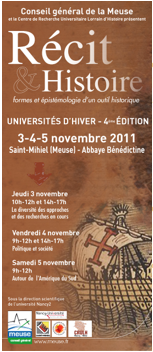
Colloque – Récit et Histoire, formes et épistémologie d’un outil historique

3-5 novembre 2011 – Saint-Mihiel (Meuse) – Abbaye Bénédictine
Sous la direction scientifique de l’Université Nancy2
Le Centre de Recherche Universitaire Lorrain d’Histoire, l’Université Nancy 2, la ville de Saint-Mihiel, les Amis de la bibliothèque bénédictine de Saint-Mihiel, la Région Lorraine et le Conseil Général de la Meuse ont le plaisir de vous inviter au colloque « Récit et Histoire, formes et épistémologie d’un outil historique » organisé du 3 au 5 novembre 2011. L’entrée est libre.

Depuis 2008, les universités d’hiver ont pour but de présenter à l’usage d’étudiants et du public des thèmes de recherche liés au domaine du livre et de l’écrit, dans une perspective historique et  interdisciplinaire. A Saint-Mihiel, du 3 au 5 novembre 2011, il sera question des rapports entre récit et histoire. Les intervenants sont des chercheurs français et européens, qui permettront de mettre en évidence diverses méthodes et approches. »   

Les thèmes abordés seront les suivant : 

  • récits liés aux thèmes de l’histoire religieuse, politique, militaire, des relations internationales
  • mise en forme et en valeur des récits, entre oral et écrit
  • rapports entre littérature et histoire
  • modalités de la narration historique
  • récits de vie, dans une perspective sociologique, anthropologique ou historique
  • rapports entre mythologies historiques et récits
  • espaces et des lieux propres aux récits.

Programme : ici !

Publié dans Colloque | Laisser un commentaire

Enseignement – Master in Netherlandish Art and Architecture in an International Perspective

Radboud University Nijmegen starts a new Master in Netherlandish Art and Architecture in an International Perspective
In September 2012, Radboud University Nijmegen (Netherlands) starts a new Master’s specialisation in Netherlandish Art and Architecture in an International Perspective. This comprehensive, one-year programme explores the history of painting and sculpture, architecture and the decorative arts of the Netherlands from the Late Middle Ages to the present. Taught in English, it gives students from different countries the opportunity to specialise in one of the most fascinating fields in art history.
Prospective students will need a Bachelor’s degree in Art History or Cultural Studies, or at least 45 EC points (or equivalent) in art history courses. In all other cases, portfolio and motivation will determine whether the candidate meets the programme requirements. In addition, students will need adequate English language skills.
Informations pratiques : For more information, visit the website www.ru.nl/masters/naa, or contact the Radboud University’s Student Information Desk (T: +31 (0)24 361 2345; E: sid@dsz.ru.nl).
Publié dans Enseignement | Laisser un commentaire