Appel à contribution – Étonnement naturaliste et merveilles naturelles. Colloque international du réseau international de recherche Zoomathia

5-6 novembre 2025

Organisation :  Pascaline Le Gouar (Université Rennes 1), Nelly Ménard (Université Rennes 1), Sébastien Deregnaucourt ­(Nanterre Université), Arnaud Zucker (Université Côte-d’Azur)

Comité scientifique : Santiago Aragon (Sorbonne Université), Marine Grandgeorges (Université Rennes 1), Michel Kreutzer (Université Paris-Nanterre), Pascaline Le Gouar, Nelly Ménard, Sébastien Deregnaucourt (Nanterre Université), Isabelle Draelants (IRHT), Oliver Hellmann (Trier Universität), Stavros Lazaris (ICP, CNRS), Marco Vespa (Hebrew University of Jerusalem), Arnaud Zucker.

Lieu : Station de Paimpont (Université de Rennes)

La nature est souvent aberrante ou du moins si déconcertante que ce serait être ignorant par un autre tour d’ignorance de ne pas s’en étonner, et la nature des animaux, comme celle des plantes « déborde de tous côtés » (Théophraste). Il existe dans la littérature antique et médiévale une longue tradition de récits et descriptions de bizarreries et merveilles naturalistes et en particulier animales. Ces récits ont été généralement pris à la légère, voire avec condescendance par la critique moderne, par les hommes éclairés des lumières de l’esprit nouveau, scientifique, résolument moderne. Mais l’illusion n’est peut-être pas là où elle semble loger. Cette tradition ancienne témoigne d’une curiosité et d’un étonnement devant la plasticité du vivant et la diversité des organismes et des facultés des êtres vivants : souris rongeuses de fer, animaux guérisseurs, rituels sociaux sophistiqués, alternance sexuelle, dispersion des cerveaux, prémonition animale, biomimétisme, … Si l’on cesse de s’obnubiler avec les monstres exemplaires des bestiaires médiévaux, se découvrent de nombreux récits dont l’étrangeté répond à l’étrangeté de la nature elle-même. L’enjeu de ce colloque est de se pencher, grâce au regard des savants anciens et modernes, sur des questions zoologiques sous l’angle de l’extravagance et dans leurs modes non ordinaires, et de réfléchir à la façon dont les bizarreries naturelles sont perçues, admises, interprétées, et renouvellent parfois le regard porté sur les animaux et le vivant en général. Aujourd’hui comme hier les phénomènes naturels sont et demeurent pour beaucoup étranges et difficiles à expliquer. Dans le domaine des comportements, les biologistes modernes ont forgé le concept d’instinct pour servir de principe explicatif général. Certains aujourd’hui recourent à l’idée d’un ‘sixième sens’ pour situer certaines capacités qui dépassent l’entendement, comme les capacités perceptives ou migratoires de certaines espèces. Les recherches des biologistes sur les facultés atypiques des animaux, qui ont tous développé une forme d’excellence extraordinaire dans un domaine ou un autre, intéressent à juste titre les techniciens du naturel et de l’artificiel (médecins, les industriels, etc.). Précisément parce qu’elles sont « extraordinaires ». Il est plus que probable que les modèles de fonctionnement physiologiques ou éthologiques que nous avons adoptés au 20e siècle soit schématiques et inadaptés à la diversité biologique. Restaurer l’étonnement, non pas comme une émotion d’ignorant, mais un lucide moteur de recherche scientifique, et prendre au sérieux le discours de l’étonné permet de remettre en jeu le savoir très modeste et tâtonnant des spécialistes du vivant.

Cet appel à communication s’adresse donc à tous ceux qui, historiens des sciences, historiens des textes, biologistes, s’intéressent à ce qui n’est pas le « régime ordinaire de la nature » selon les mots d’Aristote, mais ses manifestations déconcertantes. Les communications pourront s’intéresser à des motifs de cette étrangeté naturelle, dans l’expérience ou dans l’histoire, qu’elle touche à des aspects anatomiques, physiologiques, relatifs aux comportements comme dans les domaines de la communication, de la technicité, ou de ce qu’on nomme faute de mieux le « sixième sens animal ».

Les communications pourront être présentées en allemand, anglais, espagnol, français ou italien. Une version écrite des communications sera demandée et soumise à un éditeur rapidement après la conférence. Les communications seront de 25 minutes, avec 10 minutes de discussion.  Les chercheurs intéressés, quel que soit leur niveau académique, sont invités à soumettre un résumé de moins de 500 mots à cepam.zoomathia@univ-cotedazur.fr avant le 05 Mai 2025. Les réponses seront données le 15 Juin 2025. Le logement et les repas pendant toute la durée du colloque seront pris en charge par les organisateurs.

International Conference on Animals. Zoomathia research network
2025, November 6-8

 The Naturalist’s Wonder: Exploring Nature’s Marvels and Oddities

Organisation :  Pascaline Le Gouar (Université de Rennes), Nelly Ménard (Université de Rennes), SébastienDeregnaucourt ­(Université Paris-Nanterre), Arnaud Zucker (Université Côte-d’Azur)

Scientific Committee: Santiago Aragon (Sorbonne Université), Marine Grandgeorges (Université de Rennes), Michel Kreutzer (Université Paris-Nanterre), Pascaline Le Gouar (Université de Rennes), Nelly Ménard (Université de Rennes), Sébastien Deregnaucourt (Université Paris-Nanterre), Isabelle Draelants (IRHT, CNRS), Oliver Hellmann(Trier Universität), Stavros Lazaris (ICP, CNRS), Marco Vespa (Hebrew University of Jerusalem), Arnaud Zucker (Université Côte-d’Azur).

Place : Station de Paimpont (Université de Rennes)

Nature is often aberrant, or at least so disconcerting that it would be a form of ignorance not to marvel at it. The nature of animals, like that of plants, « overflows on all sides » (Theophrastus). In ancient and medieval literature, there is a long tradition of accounts and descriptions of naturalist oddities and wonders, particularly concerning animals. These accounts have generally been taken lightly or even treated with condescension by modern critics, by enlightened minds shaped by the spirit of a new, scientific, and resolutely modern era. However, the illusion may not be where it appears to be.
This ancient tradition testifies to a curiosity and a sense of wonder about the plasticity of life and the diversity of organisms and faculties of living beings: iron-gnawing mice, healing animals, sophisticated social rituals, sexual alternation, dispersed brains, animal premonition, biomimicry, etc. If we stop fixating on the exemplary monsters of medieval bestiaries, we uncover numerous accounts whose strangeness corresponds to the strangeness of nature itself.

The aim of this conference is to explore zoological questions through the lens of extravagance and in their non-ordinary modes, drawing on both ancient and modern scholarly perspectives. It seeks to examine how natural oddities are perceived, accepted, and interpreted, and how they sometimes renew our understanding of animals and life in general.

Today, as in the past, natural phenomena remain strange and difficult to explain for many. In the field of behavior, modern biologists have developed the concept of instinct as a general explanatory principle. Some today invoke the idea of a « sixth sense » to account for certain abilities that surpass human understanding, such as the perceptive or migratory capacities of some species. Biologists’ research on the atypical faculties of animals—each of which has developed some extraordinary form of excellence in one area or another—rightly interests specialists in both natural and artificial sciences (such as doctors and engineers). Precisely because these faculties are « extraordinary. »

It is highly likely that the physiological or ethological models we adopted in the 20th century are schematic and partly inadequate for understanding biological diversity. Restoring a sense of astonishment—not as an emotion of ignorance, but as a lucid driver of scientific inquiry—and taking seriously the discourse of those who marvel at nature allows us to challenge and refine the modest and tentative knowledge of life sciences specialists.

This call for papers is therefore addressed to all those—historians of science, historians of texts, biologists—who are interested in what Aristotle described as « the non-ordinary order of nature, » in its most disconcerting manifestations. Presentations may focus on motifs of natural strangeness, whether in experience or history, addressing anatomical, physiological, or behavioral aspects, as well as fields such as communication, technical skills, or what is vaguely referred to as the « animal sixth sense. »

The organizers welcome proposals (in English, French, German, Italian or Spanish). Note that a written version of the papers will be rapidly submitted to an editor. Conference papers will be 25 minutes, with 10 minutes for discussion.  Interested scholars from all academic levels are invited to send an abstract of no more than 500 words to cepam.zoomathia@univ-cotedazur.fr by May 05, 2025. Participants will be notified in June 15, 2025. Accepted papers will be presented on an equal footing with invited speakers. Accommodation and meal expenses will be covered by the organization.

Source : CEPAM – CNRS
Publié dans Appel à contributions | Commentaires fermés sur Appel à contribution – Étonnement naturaliste et merveilles naturelles. Colloque international du réseau international de recherche Zoomathia

Publication – « La Fabrique de l’espace religieux en Europe centrale », éd. Marie-Madeleine de Cevins, Olivier Marin

Quels critères d’organisation spatiale l’Église latine a-t-elle fait prévaloir en Europe centrale ? En donnant la parole à une vingtaine de chercheurs, le volume propose une approche comparative des paysages religieux et de leurs modes différenciés d’appropriation.

Table des matières : ici

Informations pratiques :

La Fabrique de l’espace religieux en Europe centrale, éd. Marie-Madeleine de Cevins, Olivier Marin, Paris, Classiques Garnier, 2025 ; 1 vol., 448 p. (Rencontres, 640 ; Civilisation médiévale, 59). ISBN : 978-2-406-17374-8. Prix : € 39,00.

Source : Classiques Garnier

Publié dans Publications | Commentaires fermés sur Publication – « La Fabrique de l’espace religieux en Europe centrale », éd. Marie-Madeleine de Cevins, Olivier Marin

Publication – « Medieval French on the Move. Studies in Honour of Keith Busby », éd. Leah Tether , Patrick Moran, Anne Salamon

When Keith Busby published his field-shaping Codex and Context in 2002, the work was referred to as ‘groundbreaking’ and ‘monumental’. It prompted scholars of medieval literature to return to manuscripts in their droves. However, Busby’s Codex and Context would also enact another, more gradual movement. His formulation of the term ‘medieval Francophonia’ to describe the presence, power and effect of French outside France would filter steadily into academic enquiry. The term and concept are now widely recognised and applied in global scholarship, including in multiple major projects dedicated to the topic.

This volume brings together a series of cutting-edge studies of medieval Francophonia, covering in one place and for the first time the fullest scope of the concept’s remit, with contributions on history, historiography, language, literature, culture, society and authority. At the same time as offering a timely contribution to the field, this volume pays tribute to Busby’s life work not only to pioneer medieval Francophonia, but also, and moreover, to encourage the study of the medieval through material philology. Each of the studies here, written by Busby’s friends and colleagues, thus roots its approach in a material context.

Leah Tether, University of Bristol, Bristol, UK; Patrick Moran, UBC, Vancouver, Canada; Anne Salamon, UBC, Vancouver, Canada.

Table des matières : ici

Medieval French on the Move. Studies in Honour of Keith Busby, éd. Leah Tether , Patrick Moran, Anne Salamon, Berlin–Boston, De Gruyter, 2025 ; 1 vol, XIX–439 p. ISBN : 9783111006765. Prix : € 134,95.

Source : De Gruyter

Publié dans Publications | Commentaires fermés sur Publication – « Medieval French on the Move. Studies in Honour of Keith Busby », éd. Leah Tether , Patrick Moran, Anne Salamon

Publication – « Voyages réels et imaginaires – Actes du VIIIe colloque de l’AIEMF (Lafayette College, 2021) » (Le Moyen Français, t. 94, 2024)

Voyages réels et imaginaires. Actes du VIIIe colloque de l’AIEMF (Lafayette College, 2021), Le Moyen Français, t. 94, 2024 ; 1 vol., 290 p. ISBN : 978-2-503-59228-2. Prix : € 144,00.

Table des matières :

Les voyages maritimes dans les Miracles de Nostre Dame de Jean le Conte – Elisabetta Barale

Gender and Travel in Octovien de Saint-Gelais’ XXI Epistres d’Ovide. Textual and Visual Translations of Departures – Cynthia J. Brown

The 1st-Person Voice of the Traveller in Marco Polo and John Mandeville – Kevin Brownlee

Quand le Huon en prose révise l’image du monde et les moyens de le parcourir – Caroline Cazanave

Le monde des héros-voyageurs au XVe siècle. Toponymie, itinéraires et description géographique dans l’Ovide moralisé en prose (version brugeoise) – Stefania Cerrito

Deux voyages en un. Octovien de Saint-Gelais et le problème du bivium – François Cornilliat

Les « voyages » des Rhétoriqueurs. Un genre entre narratio et laudatio – Ellen Delvallée

Quelques problèmes relatifs à la description des realia dans les récits de voyage (1490-1550) – Marie-Christine Gomez-Géraud

Ascending the Mountain in Antoine de La Sale’s Paradis de la Reine Sibylle The Mental Pilgrimage at the Heart of a Secular Text – S.C. Kaplan

Naufrages et captures par des pirates. Les tourmentes et fortunes de mer dans la littérature romanesque bourguignonne du XVe siècle – Matthieu Marchal

La Nef des folz (1497) de Pierre Rivière. Quand le voyage est objet de méfiance – Anne-Laure Metzger-Rambach

La Fleur des estoires de la terre d’Orient illustrée. Étude de miniatures dans le manuscrit Paris, BnF, fr. 2810 – Priscilla Mourgues

La langue de l’Autre dans le Voyage d’Outremer de Bertrandon de la Broquière – Sandra Otte

« Chacun appelle barbarie ce qui n’est pas de son usage ». Voyage, altérité et satire dans la première Renaissance en France – Bernd Renner

Source : Brepols

Publié dans Publications | Commentaires fermés sur Publication – « Voyages réels et imaginaires – Actes du VIIIe colloque de l’AIEMF (Lafayette College, 2021) » (Le Moyen Français, t. 94, 2024)

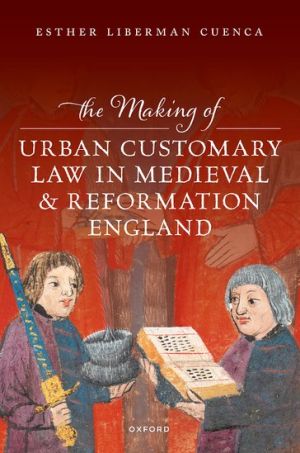
Publication – Esther Liberman Cuenca, « The Making of Urban Customary Law in Medieval and Reformation England »

Drawing on a quantitative analysis of hundreds of printed and archival sources from 77 towns, The Making of Urban Customary Law in Medieval England is the first cross-regional investigation into the history of urban customs since Mary Bateson’s seminal, two-volume work Borough Customs (1904-1906). In contrast to English common law and church law, which both had long institutional and academic traditions devoted to training men in their legal philosophies, customary law constituted local practices that acquired the force of law over time. Urban customary law regulated political officeholding, trade, property holding, and even moral behaviour in English towns.

The Making of Urban Customary Law argues that urban customs, which governed the lives of people in English towns, were crucial to the development of a distinct, bourgeois identity in England-an evolution that this new study tracks from the early twelfth to the late sixteenth centuries. In the years following the Black Death, and especially during the Reformation period, this law became more concerned with defining political authority, maintaining morality, and articulating a consensus about the “common good” for townspeople.

This book makes two principal claims: First, customary law advanced the business interests of an urban oligarchy. These were urban (male) elites who drafted laws and obtained privileges to enhance their wealth and assert their political independence from local lords, and often made claims about the legitimacy of their privileges or laws by rooted them in history or some kind of ancestral past. These lawmakers also made considerable efforts to establish their identities as morally upright and even-handed patriarchs. In so doing, urban customary law played a central role in the development of a distinct bourgeois identity in medieval and Reformation England. Second, this law lent particular meanings to the “common good” in towns, as it helped these lawmakers articulate policies that cohered to their vision of an ideal civic community.

Table des matières :

Introduction
1:The Making of Urban Charters and Custumals
2:The Authorship and Transmission of Urban Custumals
3:Customary Time and Urban Memory
4:Custom, Community, and the Common Good
5:Unenfranchisement: The Gendered and Classed Boundaries of Custom
6:Oath-Taking and the Performance of Urban Customary Law
Coda

Informations pratiques :

Esther Liberman Cuenca, The Making of Urban Customary Law in Medieval and Reformation England, Oxford, Oxford University Press, 2025 ; 1 vol., 288 p. ISBN : 978-0-19891-677-2. Prix : GBP 99,00.

Source : Oxford University Press

Publié dans Publications | Commentaires fermés sur Publication – Esther Liberman Cuenca, « The Making of Urban Customary Law in Medieval and Reformation England »

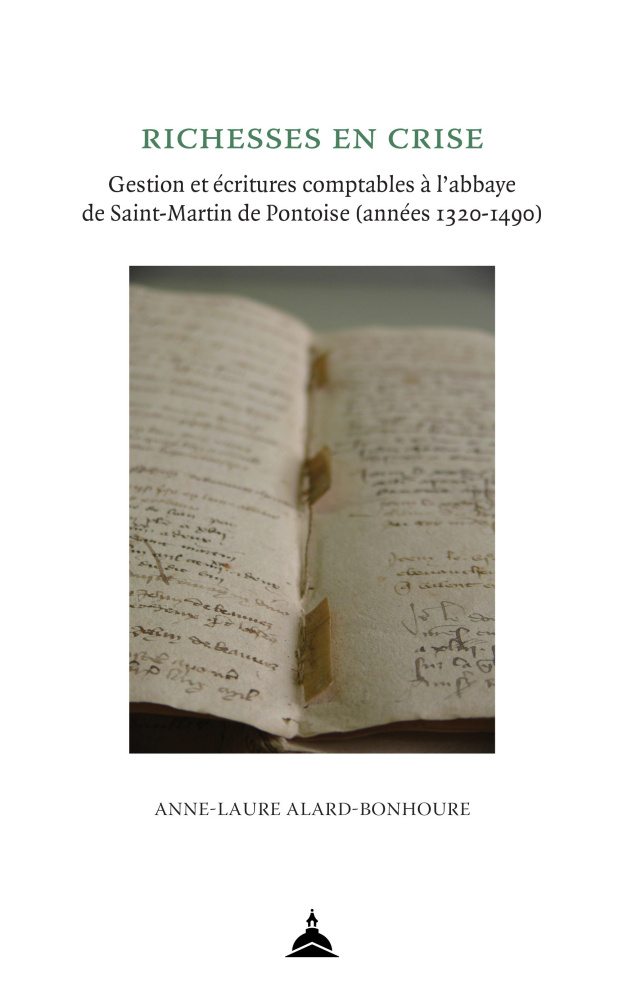
Publication – Anne-Laure Alard-Bonhoure, « Richesses en crise. Gestion et écritures comptables à l’abbaye de Saint-Martin de Pontoise (années 1320-1490) »

La documentation riche et variée qui nous est parvenue de la seigneurie ecclésiastique de Saint-Martin de Pontoise permet de saisir les grands enjeux économiques et sociaux qui traversent les XIVe et XVe siècles, période de crises et de reconstructions. La structure seigneuriale de l’abbaye est ainsi adaptée, à la marge, par les gestionnaires monastiques, sans être fondamentalement transformée, et la variété des pratiques de gestion de l’abbaye se matérialise dans un réseau documentaire dense et structuré autour de la rente.

Par l’étude minutieuse de cette documentation, Anne-Laure Alard-Bonhoure mesure l’ampleur de la crise des années 1320-1490 à l’échelle individuelle : les conditions d’exploitation difficiles mettent durement à l’épreuve notamment les salariés ruraux, qui sont de plus en plus nombreux à l’abbaye, pour répondre aux besoins de la reconstruction. C’est précisément cette vulnérabilité, occasionnant une importante production écrite – rappels d’arrérages, sentences du prévôt, comptes avec l’abbé –, qui met au jour d’une part les exigences seigneuriales de l’abbaye, et de l’autre, la dette contractée par ces exploitants et salariés, de plus en plus inévitable.

Anne-Laure Alard-Bonhoure est agrégée, docteure en histoire de l’université Paris 1 Panthéon-Sorbonne et chercheuse associée du Laboratoire de médiévistique occidentale de Paris (Lamop). Spécialiste d’histoire économique du monde rural, ses recherches portent particulièrement sur les derniers siècles médiévaux dans le royaume de France et l’évolution des pratiques de l’écrit.

Préface

Introduction

Saint-Martin de Pontoise et le Vexin français

La crise de la fin du Moyen Âge à Saint-Martin : l’histoire d’une économie rurale

Le cadre archivistique

Première partie – À l’origine de la rente : des terres, des droits et des hommes

Chapitre 1. Saint-Martin et son milieu : entre maîtrise et exploitation de l’environnement

Les orientations stratégiques d’une seigneurie composite

La discrétion de l’activité religieuse

Chapitre 2. Vivre à l’ombre de Saint-Martin : vie et survie du monde paysan en période de crise

Le fermage au prisme des comptabilités

Le difficile maintien des tenanciers sur le front de la reconstruction

Fermiers et salariés : une précarité systémique ?

Conclusion de la première partie

Deuxième partie – La rente seigneuriale : prélèvement et adaptations

Chapitre 3. Le prélèvement : acteurs, temps, lieux

Les acteurs du prélèvement : collectif gestionnaire et responsabilités individuelles

Temps et lieux du prélèvement

Modalités de prélèvement et domination symbolique

Chapitre 4. La résilience de la rente seigneuriale face à la conjoncture

Les variations de la rente seigneuriale

Rente et domination seigneuriale

Conclusion de la deuxième partie

Troisième partie – Mémoriser, compter et dépenser : la gestion du temporel monastique

Chapitre 5. La gestion par l’écrit : une interaction entre des outils et des pratiques

« Réseau documentaire » et typologie fonctionnelle

La gestion par l’écrit : une interaction entre les outils et les pratiques

Chapitre 6. Mises et despenses : gérer la rente avec raison

Dépenser pour le quotidien : frais de bouche, vêtements et main-d’œuvre salariée

De la rationalité de la gestion monastique

Conclusion de la troisième partie

Conclusion générale

Les fonctions de l’écrit

Profondes destructions, lentes reconstructions

Le moine, le paysan et la dette

Richesses monastiques

Anne-Laure Alard-Bonhoure, Richesses en crise Gestion et écritures comptables à l’abbaye de Saint-Martin de Pontoise (années 1320-1490), Paris, Éditions de la Sorbonne, 2025 ; 1 vol., 418 p. (Histoire ancienne et médiévale). ISBN : 979-10-351-1011-6. Prix : € 25,00.

Source : Éditions de la Sorbonne

Publié dans Publications | Commentaires fermés sur Publication – Anne-Laure Alard-Bonhoure, « Richesses en crise. Gestion et écritures comptables à l’abbaye de Saint-Martin de Pontoise (années 1320-1490) »

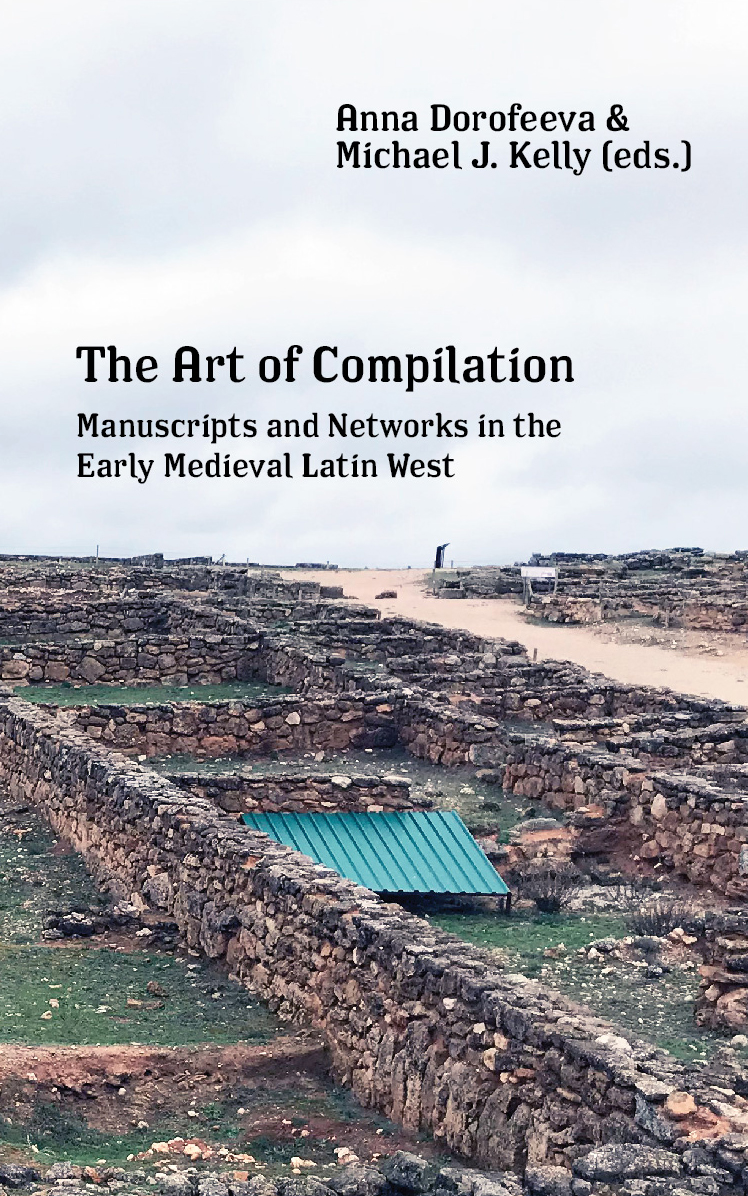
Publication – « The Art of Compilation: Manuscripts and Networks in the Early Medieval Latin West », éd. Anna Dorofeeva, Michael J. Kelly

Accès en ligne : ici

The Art of Compilation: Manuscripts and Networks in the Early Medieval Latin West interrogates the medieval manuscript book as a dynamic, constantly changing object entangled in intellectual and cultural networks, constructed and deconstructed by different people, and transmuting in form and meaning over time. Medieval manuscripts are not static, permanently bound, and delimited, but rather serve as evidence for the layered relationships between texts and their material supports, and when we realize that, we gain a clearer view of medieval manuscript culture as driven by the agency and intellectual exchange of the people behind it. This volume of essays investigates early medieval Western European manuscript culture as a field of entangled objects, focusing on the connections between knowledge selection, material representation, and scribal agency.

The complex road of compiling selected texts into manuscripts (compilatio) in the early Middle Ages is still not well understood, yet it is the key to the historical context surrounding medieval manuscript culture. The practice of knowledge selection consisted of three key stages: the intellectual selection of the textual content of manuscript collections; the pragmatic action of arranging the textual content in a draft form by authors or editors; and the material representation and aesthetic exposition of texts in manuscripts. These stages were part of a linear development, but also exercised reciprocal influence upon one another. By tracing this process in surviving manuscript collections, we can better understand in what practical ways knowledge was encoded and how these often innovative and experimental practices contributed to the emergence and consolidation of intellectual and scribal traditions. This has important implications for how we understand education, reform, and the exercise of power in the early Middle Ages.

Anna Dorofeeva is a Lecturer in Digital Paleography at the Institute for Digital Humanities, University of Göttingen. She has held research fellowships at the University of Frankfurt, University College Dublin, the University of Durham, and the Free University of Berlin. Her research interests center on early medieval book history, especially digital paleography and codicology.

Michael J. Kelly lectures in history, critical theory, and the philosophy of history at Binghamton University (SUNY) and is Director of Networks and Neighbours and Co-Director of Gracchi Books. His publications include Isidore of Seville and the “Liber Iudiciorum”: The Struggle for the Past in the Visigothic Kingdom (Brill, 2021) and Theories of History: History Read Across the Humanities (Bloomsbury, 2018). He is currently preparing a monograph on the concept of “human nature” in Visigothic ontotheology.

Informations pratiques :

The Art of Compilation: Manuscripts and Networks in the Early Medieval Latin West, éd. Anna Dorofeeva, Michael J. Kelly, Santa Barbara (CA), Punctum Books, 2025 ; 1 vol., 454 p. ISBN : ISBN-13: 978-1-68571-158-0. Prix : USD 28,00.

Source : Punctum Books

Publié dans Publications | Commentaires fermés sur Publication – « The Art of Compilation: Manuscripts and Networks in the Early Medieval Latin West », éd. Anna Dorofeeva, Michael J. Kelly

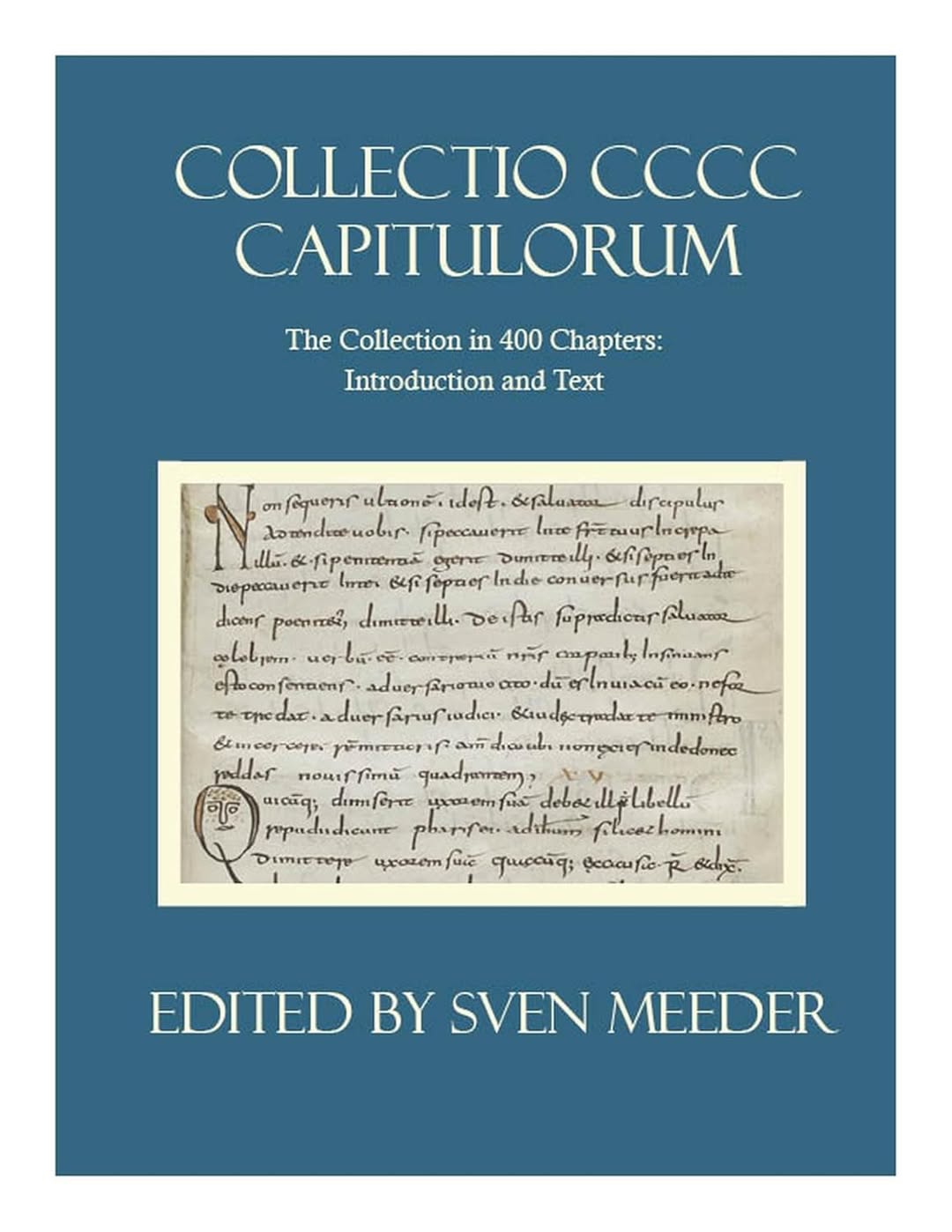
Publication – « Collectio CCCC capitulorum, The Collection in 400 Chapters. Introduction and Text », éd. Sven Meeder

Surviving in three ninth-century manuscripts, the collection of canon law known as the Collectio 400 capitulorum is a remarkable and understudied witness to the scholarly vitality of the Carolingian period. Its 404 chapters offer ecclesiastical rules and moral guidelines taken from an unusually wide variety of authoritative sources. In addition to the customary canonical texts, such as the acts of the ecumenical councils and papal letters, the compiler of this collection drew his canons from the bible, Roman law, local Gallic synods, the Church Fathers, as well as Frankish and Insular penitential works.

Although the Collectio 400 capitulorum is a so-called systematic collection, eminent scholars of canon law commented on its lack of structure. Even ‘with the best will in the world’, the collection’s system eluded them. Despite its flaws, however, there is evidence that the collection gained some popularity in the ninth century, apparently providing the basis for the Poenitentiale Martenianum, directly or indirectly influencing Hrabanus Maurus and Benedictus Levita. The ninth-century appreciation is understandable for, as one of the many products of the vigorous canonical activity of the eighth and ninth centuries, the Collectio 400 capitulorum impresses in its handling of the canonical material as well as the breadth of sources and the topics covered.

This book constitutes the first in-depth study of this intriguing canonical collection, with a detailed description of the extant manuscript witnesses, its sources, and its influence. The critical edition offers scholars of the early Middle Ages in general and canon law in particular access to an instructive, if unpolished, product of Carolingian legal thought.

Collectio CCCC capitulorum, The Collection in 400 Chapters. Introduction and Text, éd. Sven Meeder, washington DC, The Catholic University of America Press, 2025 ; 1 vol., 300 p. ISBN : 978-0-81323-847-0. prix : USD 85,00.

Source : The Catholic University of America Press

Publié dans Publications | Commentaires fermés sur Publication – « Collectio CCCC capitulorum, The Collection in 400 Chapters. Introduction and Text », éd. Sven Meeder

Publication – Aurora Panzica, « De la Lune à la Terre. Les débats sur le premier livre des Météorologiques d’Aristote au Moyen Âge latin (la tradition parisienne, XIIIe-XVe siècles) »

La météorologie ancienne et médiévale se distingue de son équivalent contemporain par un domaine d’études autrement plus vaste, s’étendant bien au-delà des phénomènes atmosphériques. Le premier livre des Météorologiques d’Aristote aborde en effet des sujets aussi divers que l’action de la sphère céleste sur la région terrestre, les liens entre mouvement, lumière et production de chaleur, les rapports quantitatifs entre les quatre éléments, la formation des comètes et de la Voie lactée, l’origine et le mouvement des fleuves, les variations périodiques dans la répartition entre mers et terres sèches. Fondée sur l’analyse d’une grande quantité de textes inédits, et prenant la forme d’un voyage de la Lune à la Terre, la présente étude explore les débats que ces sujets ont suscités chez les maîtres scolastiques qui, de la fin du XIIe au milieu du XVe siècle, se sont confrontés au texte aristotélicien dans le cadre de leur enseignement à la Faculté des arts.

Aurora Panzica (docteur de l’Université de Fribourg en 2020 ; membre de l’Institut Suisse de Rome en 2020-2021 ; chercheuse du Fonds National Suisse de la Recherche Scientifique et de l’Académie Tchèque des Sciences entre 2020 et 2023), est une historienne de la pensée médiévale. Ses recherches, de nature catalographique, philologique et doctrinale, portent sur la culture universitaire du XIIIe au XVe siècle, avec un accent sur la transformation de la philosophie naturelle d’Aristote et les processus de transferts scientifiques entre les centres culturels au Moyen Âge latin.

Table des matières :

I. La météorologie : son objet et sa scientificité

1. L’objet de la météorologie

2. La nature des phénomènes météorologiques

3. La scientificité de la météorologie

4. La place de la météorologie au sein de la science naturelle

5. L’utilité de la météorologie

II. Le ciel et ses alentours

6. Le problème de la contiguïté des régions céleste et terrestre

7. La causalité céleste

8. L’hypothèse de la cessation de l’action céleste

9. Le mouvement et la production de la chaleur

10. La lumière

11. La transmission de la chaleur solaire : un défi au contiguïsme aristotélicien

III. La matière et les dimensions de l’univers

12. Les discussions médiévales sur les rapports entre les quatre éléments

13. Le rapport entre les dimensions de la Terre et des astres

14. La nature des astres

IV. La descente vers la Terre : les phénomènes atmosphériques

15. Les principes fondamentaux de la météorologie aristotélicienne : la double exhalaison et l’antipéristase

16. La région médiane de l’air

17. Les phénomènes causés par l’exhalaison sèche

18. Les phénomènes causés par la vapeur

V. Quelques lieues sous la terre : éléments d’hydrologie et de géologie

19. Les fleuves

20. Les transformations périodiques de la Terre

VI. Atterrissage

VII. Annexe : Les commentaires médiévaux aux Météorologiques d’Aristote

Bibliographie

Index

Informations pratiques :

Aurora Panzica, De la Lune à la Terre. Les débats sur le premier livre des Météorologiques d’Aristote au Moyen Âge latin (la tradition parisienne, XIIIe-XVe siècles), Turnhout, Brepols, 2025 ; 1 vol., XXXVIII–821 p. (Studia Artistarum, 53). ISBN : 978-2-503-60627-9. Prix :€ 105,00.

Source : Brepols

Publié dans Publications | Commentaires fermés sur Publication – Aurora Panzica, « De la Lune à la Terre. Les débats sur le premier livre des Météorologiques d’Aristote au Moyen Âge latin (la tradition parisienne, XIIIe-XVe siècles) »

Bourse – 2025-2026 Visiting Research Fellowships at the Schoenberg Institute for Manuscript Studies

The Schoenberg Institute for Manuscript Studies (SIMS) is pleased to announce that the call for applications to the2025-2026 Visiting Research Fellowship program is now open. Guided by the vision of its founders, Lawrence J. Schoenberg and Barbara Brizdle Schoenberg, SIMS aims to bring manuscript culture, modern technology, and people together to provide access to and understanding of our shared intellectual heritage. Part of the Penn Libraries, SIMS oversees an extensive collection of premodern manuscripts from around the world, with a special focus on the history of philosophy and science, and creates open-access digital content to support the study of its collections.

Starting this year, SIMS is partnering with the American Trust for the British Library (ATBL) to offer SIMS Visiting Research Fellows the opportunity to apply to the ATBL for a further $2,500 to support research on the same project at the British Library. The ATBL fellowship will be awarded in the following year. If a SIMS fellowship is awarded, then the ATBL will reach out to the applicant and request that they apply.

ELIGIBILITY: Fellowships are open to scholars living outside of the greater Philadelphia-area whose research would benefit from direct access to our collections and staff expertise in manuscript studies and the digital humanities. Applicants must have completed a Ph.D. or an equivalent professional degree by the time the fellowship begins. The fellowship offers $5000 to spend 1 month (minimum of 4 work weeks) at SIMS between July 1, 2025, and June 30, 2026. Up to 3 fellowships will be awarded this year.

For more information and to apply, please visit https://schoenberginstitute.org/visiting-research-fellowships. Applications are due Friday, May 16, 2025.

Source : The Medieval Academy of America

Publié dans Bourse | Commentaires fermés sur Bourse – 2025-2026 Visiting Research Fellowships at the Schoenberg Institute for Manuscript Studies