Publication – Antoine Brix, « Devenir l’histoire de France. La fortune des Grandes Chroniques de France au Moyen Âge »

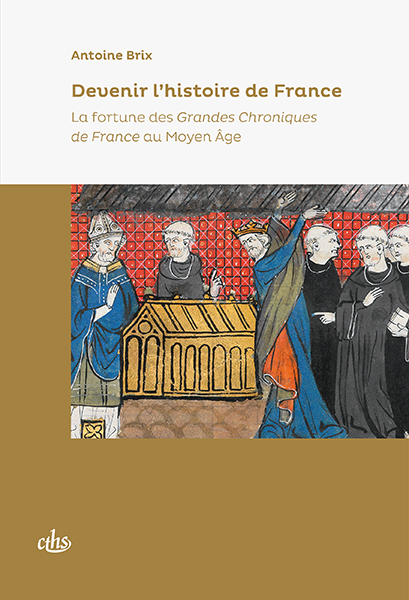
« Presque un livre sacré », « bible de la France », « lieu de mémoire » : les Grandes Chroniques de France exercent depuis des siècles un irrésistible pouvoir de fascination. Cette histoire de la couronne des lys, commencée dans les années 1270 à l’abbaye de Saint-Denis, a connu durant le bas Moyen Âge un succès considérable dont témoignent plus de cent manuscrits conservés. La renommée de ce champion du patrimoine littéraire et documentaire n’était cependant pas acquise dès les origines. Au fil d’une patiente enquête qui bouscule nombre d’idées reçues, Antoine Brix remonte aux sources du prestige qui continue d’auréoler les Grandes Chroniques, et révèle comment un ouvrage de tradition monastique a fini par déterminer tout le récit de l’histoire de France.

Docteur de l’Université catholique de Louvain (2018), Antoine Brix a été membre de l’Institut de recherche et d’histoire des textes (Paris) et professeur d’histoire du Moyen Âge européen à l’Université normale de la capitale (Pékin). Il poursuit ses recherches à l’Université de Namur.

Prix de thèse 2019 de la Fondation des travaux historiques et scientifiques. Préface d’Olivier Mattéoni.
Préface d’Olivier Mattéoni

Introduction

Chapitre Ier
Les Grandes Chroniques de France textuelles
Élaborations, ambitions et réifications d’un objet philologique

Chapitre II
Les Grandes Chroniques de France livresques
Patrimoine manuscrit et conditions matérielles du succès

Chapitre III
Les Grandes Chroniques de France conquérantes
Les publics d’une œuvre à succès

Chapitre IV
Les Grandes Chroniques de France protéennes
Réceptions contrastées d’un texte labile en potentialités

Chapitre V
Les Grandes Chroniques de France universelles
De l’œuvre mythologique à la mythologie de l’œuvre

Conclusion
Les Grandes Chroniques de France démythifiées

Bibliographie

Index

Informations pratiques :

Antoine Brix, Devenir l’histoire de France. La fortune des Grandes Chroniques de France au Moyen Âge, Paris, Comité des Travaux historiques et scientifiques, 2024 ; 1 vol., 416 p. (CTHS Histoire, 70). ISBN : 978-2-7355-0972-0.

Source : Comité des travaux historiques et scientifiques

Publié dans Publications | Laisser un commentaire

Offre d’emploi – Postdoctoral Position in Medieval History (University of Aarhus)

University of Aarhus – Department of History
Deadline : 12th September 2024

The Department of History, School of Culture and Society, Aarhus University invites applications for a fixed-term postdoctoral position in medieval history, lasting for three years. The position is full-time (37 hours/week) and begins on 01.01.2025 or as soon as possible thereafter. Aarhus University is keen for its staff to reflect the diversity of society and thus welcomes applications from all qualified applicants regardless of their personal background. Members of the academic staff at the School of Culture and Society are expected to contribute to a vibrant, enjoyable and friendly work environment. We emphasise the importance of active participation in the daily life of the department.


Place of employment

Nobelparken, Jens Chr. Skous Vej, 8000 Aarhus C. The successful applicant is expected to be present at the department on a daily basis.

The position

The position is affiliated with the AUFF research project “Undeutsche – racism as social practice in Medieval Prussia and Livonia” (link) headed by Professor Cordelia Hess.  The research project studies the development of concepts of race and racism in the colonial contact zones in Eastern Europe, namely, the historical landscapes and territories of Pomerania, Prussia and Livonia. The postdoc project will specifically work with the sources of the urban administrations in the region during the fifteenth and sixteenth centuries.

Qualifications and requirements

The successful applicant is expected to:

  • Develop their research within the general framework of the project, in close cooperation with the project team
  • Present their research at national and international events and publish results in peer-reviewed, international scientific journals in a timely fashion
  • Actively participate in the daily on-site working environment at Aarhus University
  • Contribute to research grant applications
  • Initiate and help to organize research workshops, conferences and other such activities.

Applicants for this position must hold a PhD degree in History or related fields (Medieval Studies, European Studies etc.) or be at PhD level, and must be able to document:

  • Language skills relevant for the project (Latin, German, and/or a Slavic language)
  • The ability and willingness to engage in close collaboration with the team and the local
  • Research environment, and
  • Fluency in written and spoken English

Ideally, applicants should also be able to document:

  • Experience of working with medieval manuscripts and archives
  • Familiarity with postcolonial theories and methods
  • Experiences in writing research grant applications 

Teaching

The position will involve some teaching as agreed upon with the department head and the PI of the project.

Source : Jobs.ac.uk

Publié dans Le réseau | Laisser un commentaire

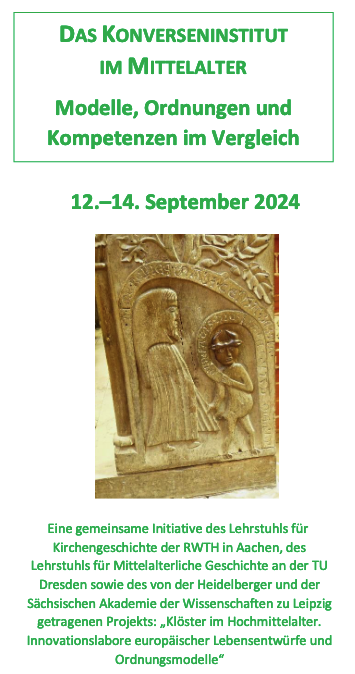
Colloque – Das Konverseninstitut im Mittelalter. Modelle, Ordnungen und Kompetenzen im Vergleich

12.–14. September 2024

ABTEI MARIENSTATT
57629 Marienstatt

Über die Nachahmung Christi und der Heiligen versuchten Mönche und Nonnen in den Klöstern des Mittelalters, ein Leben der Selbstheiligung zu führen, welches ihnen entlang der via perfectionis den Himmel erschließen sollte. Nicht alle aber wollten, konnten oder durften so leben. Dies gilt gerade für die wohl größte Gruppe der mittelalterlichen Klosterleute, nämlich die Konvers:innen. Nicht wenige mittelalterliche wie moderne Denk- und Interpretationsmuster wiesen diesen Laienbrüdern und Laienschwestern die Funktion arbeitender, den Konvent unterstützender Analphabeten zu, und doch waren sie – als Strukturmerkmal religiösen Lebens – so viel mehr.

Der Workshop stellt dieses hochkomplexe Phänomen systematisch komparativ in verschiedene kulturelle Kontextzusammenhänge, wie Sozialisation, Recht, Wirtschaft, Gender, Heiligkeit, Zeichenhaftigkeit und Kunst.

Ziel des Workshops ist zugleich die Konstituierung eines Netzwerkes von Wissenschaftler:innen mit verschiedenen Forschungsansätzen, die sich gegenseitig inspirieren und zur weiteren Entschlüsselung des‚Konversenkultur‘ und ihres ‚Sitzes‘ im religiösen Leben beitragen können.

14:30 Registrierung und Stehkaffee

15:00 Begrüßung und Einführung

Grußwort : P. Benedikt Michels OCist

Grußwort und Einführung in die Tagung : Jörg Sonntag (Dresden)

SEKTION I
Fundamentals: Ursprünge und Hintergründe des Konserveninstituts im Mittelalter

15:30 Before the lay brothers. Social diversity and functional stratifications in tenth- and early eleventh-century monasticism – Steven Vanderputten (Gent)
16:15 Innere und äußere Beweggründe einer conversio mit Beispielen einzelner Biographien aus Schweizer Männerabteien – Guido Gassmann (Luzern)

17:30 Vesper

18:00 Abendessen im Gästehaus

18:45 Bibliotheksführung

Freitag, 13. September 2024

06:10 Laudes und Messe

08:15 Frühstück

SEKTION II
Zisterziensische Konserven:
Tätigkeitsfelder, Bildung und Heiligwerdung

09:00 Von Weinzapfern und Webern. Die Marienstatter Konversen bis zur Säkularisation – Christian Hillen (Köln)
09:45 Von Mund zu Ohr und Feder. Wissensvermittlung im Umfeld zisterziensischer Konversen – Julia Bruch (Köln)
10:30 Kaffeepause

10:45 Warum werden Konversen als heilig verehrt? Ein Werkstattbericht zum „Dictionary of Cistercian Saints“ mit Beispielen der Abtei Himmerod – Jörg Sonntag (Dresden) / Thomas Richter (Aachen)
12:00 Mittagessen
13:30 Orgelkonzert

SEKTION III:
Konversinnen: Autoritäten, Rituale und Sozialstrukturen

14:15 Viventes non secundum statuta conversarum ordinis, sed secundum statuta abbatisse. Lebensweisen von Konversinnen in Zisterzienserinnenklöstern – Margit Mersch (Bochum)

15:00 Nonnen, aber keine Bräute Christi. Professriten der Konversinnen im Spätmittelalter im Vergleich – Emma Gabe (Toronto)
15:45 Kaffeepause

16:15 Zur Rolle der Konversinnen in süddeutschen Frauenkonventen des späten Mittelalters – Maria Magdalena Rückert (Ludwigsburg)
17:30 Vesper
18:00 Abendessen im Brauhaus

Samstag, 14. September 2024

06:10 Laudes und Messe
08:15 Frühstück

SEKTION IV:
Das Konverseninstitut im Prisma der mittelalterlichen Ordenswelt

09:00 Ordensleben zwischen kartäusischer und zisterziensischer Tradition: Die Konversen der Cauliten im 12. und 13. Jahrhundert – Ingolf Esser (Aachen)
09:45 Kontroverse Erinnerung: Kleriker und Konversen in den narrativen Texten des Grandmontenserordens (12.-14. Jahrhundert) – Daniela Hoffmann (Dresden)
10:30 Kaffeepause

10:45 Almosenfahrt und Krankenpflege. Das laikale Element im Antoniterorden – Nathalie Schmidt (Dresden)
11:30 Ein Cursus honorum? Zum Verhältnis von Konverseninstitut und Drittorden bei den Dominikaner:innen – Adrian Kammerer (Göttingen)
12:15 Mittagessen

Source : H-Soz-Kult

Publié dans Colloque | Laisser un commentaire

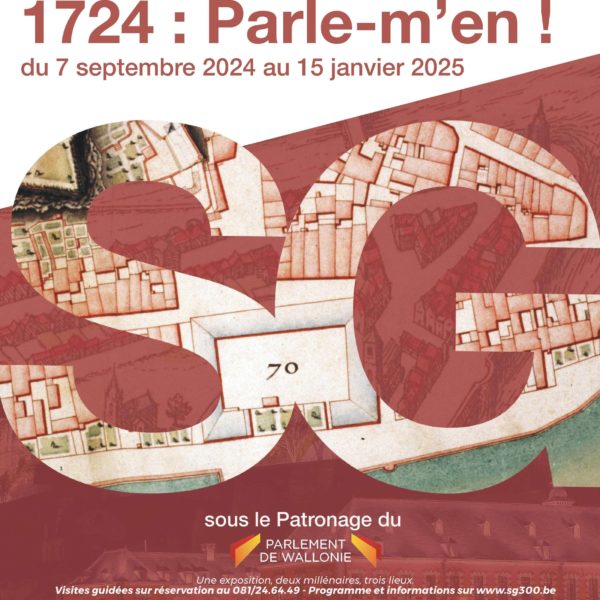
Exposition – Saint-Gilles 1724 : Parle-m’en !

A l’occasion du Tricentenaire de la fin du chantier de reconstruction du Grand-Hôpital de Namur, devenu Hospice Saint-Gilles, les Archives de l’Etat à Namur et le Service public de Wallonie s’associent pour célébrer cet anniversaire (1724-2024), avec tous les partenaires institutionnels concernés : le Parlement de Wallonie, la Province de Namur, la Ville de Namur, son CPAS et la Commission Namur-Capitale. 

Trois lieux accueilleront le résultat des études archéologiques et historiques récentes, relatives à deux millénaires d’occupation du lieu et de l’Institution. 

Au 7ème Ciel du Delta, l’évolution architecturale, documentée par l’archéologie et les autres sources écrites et artistiques, plongera dans les racines matérielles de l’Institution et de ce qui l’a précédée. Au Parlement de Wallonie, les vestiges médiévaux in situ seront remis en contexte grâce, notamment, à une évocation 3D du Grand-Hôpital et son environnement bâti, et leur évolution à travers les âges. Enfin, aux Archives de l’Etat, l’histoire de l’Institution hospitalière, illustrée par les sources écrites, archivistiques et archéologiques, abordera sa genèse, son fonctionnement et son développement. 

Ces trois lieux de découverte peuvent être approchés de manière complémentaire, ou ciblés individuellement. 

Source : Le Delta – Namur

Publié dans Exposition | Laisser un commentaire

Publication – « The Chronicle of John of Worcester », t. 4, « Chronicula », éd. †P. McGurk, D. A. Woodman

John of Worcester is celebrated for his work on the Worcester Chronica Chronicarum, which was put together in stages in the first half of the twelfth century, and which became one of the most important historical texts to have survived from Britain of that period. A great deal of our understanding of early medieval British history, from before and after the Norman Conquest, depends upon it. At a late stage in the production of the Chronica Chronicarum, John turned his hand to the writing of an abbreviated chronicle, which he called his Chronicula, and which survives in a single, autograph manuscript in Trinity College, Dublin. The Chronicula interacts with its parent text, the Chronica Chronicarum, in interesting ways: it reassembles the Chronica according to the reigns of the emperors, it splices together information from different annals and sometimes redrafts the Chronica‘s entries, thus providing an altered emphasis. The Chronicula also contains unique details (notably a set of poems and two long miracle episodes) and makes use of sources in ways that are not seen in the Chronica. In editing, translating, and providing a full introduction and commentary to the Chronicula for the first time, the volume provides both crucial access to twelfth-century historiographical material and unprecedented detail concerning the working methods of a twelfth-century monastic historian.

David Woodman is Associate Professor in History at Robinson College, Cambridge, and Affiliated Lecturer in the Faculty of History at the University of Cambridge. He has held visiting research positions at Harvard, Trinity College, Dublin, and, most recently, New York University. Woodman has published extensively in the field of early medieval British history, with a particular focus on manuscripts, historiography, Latin literature, and documentary practices. He is a Fellow of the Royal Historical Society and Honorary Secretary of the British Academy Anglo-Saxon Charters Committee.

Patrick McGurk, formerly Reader in Medieval History at Birkbeck College, University of London, was a leading palaeographer and historian of the early medieval period. As well as his important work on volumes two and three of the Worcester Chronicle, he specialised in the study of early medieval gospel books. In 1998 a number of his articles were published under the title Gospel Books and Early Latin Manuscripts.

Table des matières :

Preface
Abbreviations
Introduction
Sigla
THE CHRONICULA OF JOHN OF WORCESTER
Bibliography

Informations pratiques :

The Chronicle of John of Worcester, t. 4, Chronicula, éd. †P. McGurk, D. A. Woodman, Oxford, Oxford University Press, 2024 ; 1 vol., 304 p. (Oxford Medieval Texts). ISBN : 978-0-19891-614-7. Prix : GBP 130,00

Source : Oxford University Press

Publié dans Publications | Laisser un commentaire

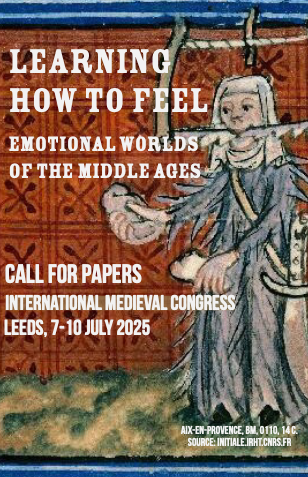
Appel à contribution – Learning How To Feel. Emotional Worlds of the Middle Ages

The history of emotions has emerged as one of the most prolific research topics in recent years. Building on our understanding of the cultural production of emotional expressions, we seek to explore how people in the Middle Ages learned about emotions, how they managed and manifested them. We aim to place special emphasis on the textual aspects of socialization towards specific emotions and their expressions across different contexts and communities of the medieval world.

We invite submissions on a wide range of topics related to learning about emotions and their expression in medieval society, including but not limited to: 

  • Learning How to Feel in Medieval Society: recognizing, expressing, naming, and controlling emotions
  • Variation of Practices Across Social Groups:
    • woman v. man
    • laypeople v. clergy
    • young v. old
    • rich v. poor
  • Emotional Communities
  • moving between different communities
  • modes of socialization to feeling
  • Loca Discendi: places and institutions: court, monastery, school and university.
  • Emotions in Religious Experience
    • feelings about/towards God
    • emotions of sainthood
    • emotions as sins
  • Medieval Science on Emotions
    • medical and philosophical discourse
    • moral and political science
    • theology
  • How to Feel About Feeling
    • avoiding feelings
    • repentance and regret
    • learning about oneself
  • Feeling (of) the Other: cultural encounters with queer, monstrous, unknown
  • Expressing Emotions through Language: genres, modes, styles
  • Universal, Cultural, and Individual in Medieval Emotions
    • communities of feeling
    • emotions in Latin v. emotions in vernacular
    • emotional dialects

Submission guidelines

Abstracts (200-400 words, excluding references) should be sent to the organizers Kalina Słaboszowska (k.slaboszowska@iaepan.edu.pl), Krzysztof Nowak (krzysztof.nowak@ijp.pan.pl)

before September 1, 2024

Important Dates

  • Submission Deadline: September 1, 2024
  • Notification of Acceptance: September 8, 2024
  • Conference Dates: July 7-10, 2025

Organizers

  • Kalina Słaboszowska (k.slaboszowska@iaepan.edu.pl), Institute of Archeology and Ethnology, Polish Academy of Sciences 
  • Krzysztof Nowak (krzysztof.nowak@ijp.pan.pl), Institute of Polish Language, Polish Academy of Sciences

Source : Calenda

Publié dans Appel à contributions | Laisser un commentaire

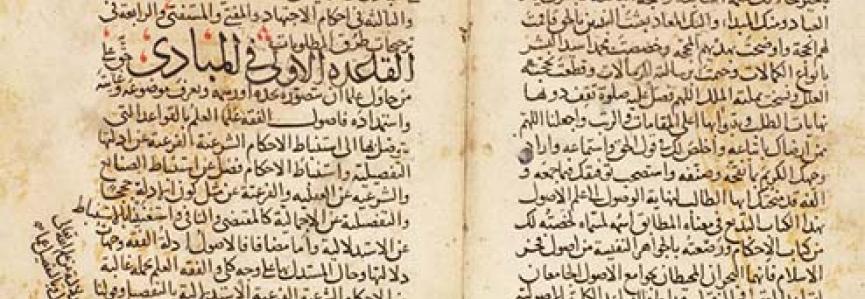
Séminaire – L’introduction au droit musulman : les textes de la pensée juridique (fiqh) à l’épreuve de l’histoire

Le séminaire “Introduction au droit musulman” animé par Christian Müller (section arabe) débute mardi 11 mars 2025 de 15h à 17h et a pour thème les textes de la pensée juridique (fiqh) à l’épreuve de l’histoire.

Informations pratiques :

Organisateur : Christian Müller

IRHT, Campus Condorcet

Dates des séances : 11/03/2025 – 15:00 ; 18/03/2025 – 15:00 ; 25/03/2025 – 15:00 ; 01/04/2025 – 15:00 ; 08/04/2025 – 15:00 ; 15/04/2025 – 15:00 ; 22/04/2025 – 15:00 ; 29/04/2025 – 15:00 ; 06/05/2025 – 15:00 ; 13/05/2025 – 15:00 ; 20/05/2025 – 15:00 ; 27/05/2025 – 15:00.

Source : IRHT

Publié dans Séminaire | Laisser un commentaire

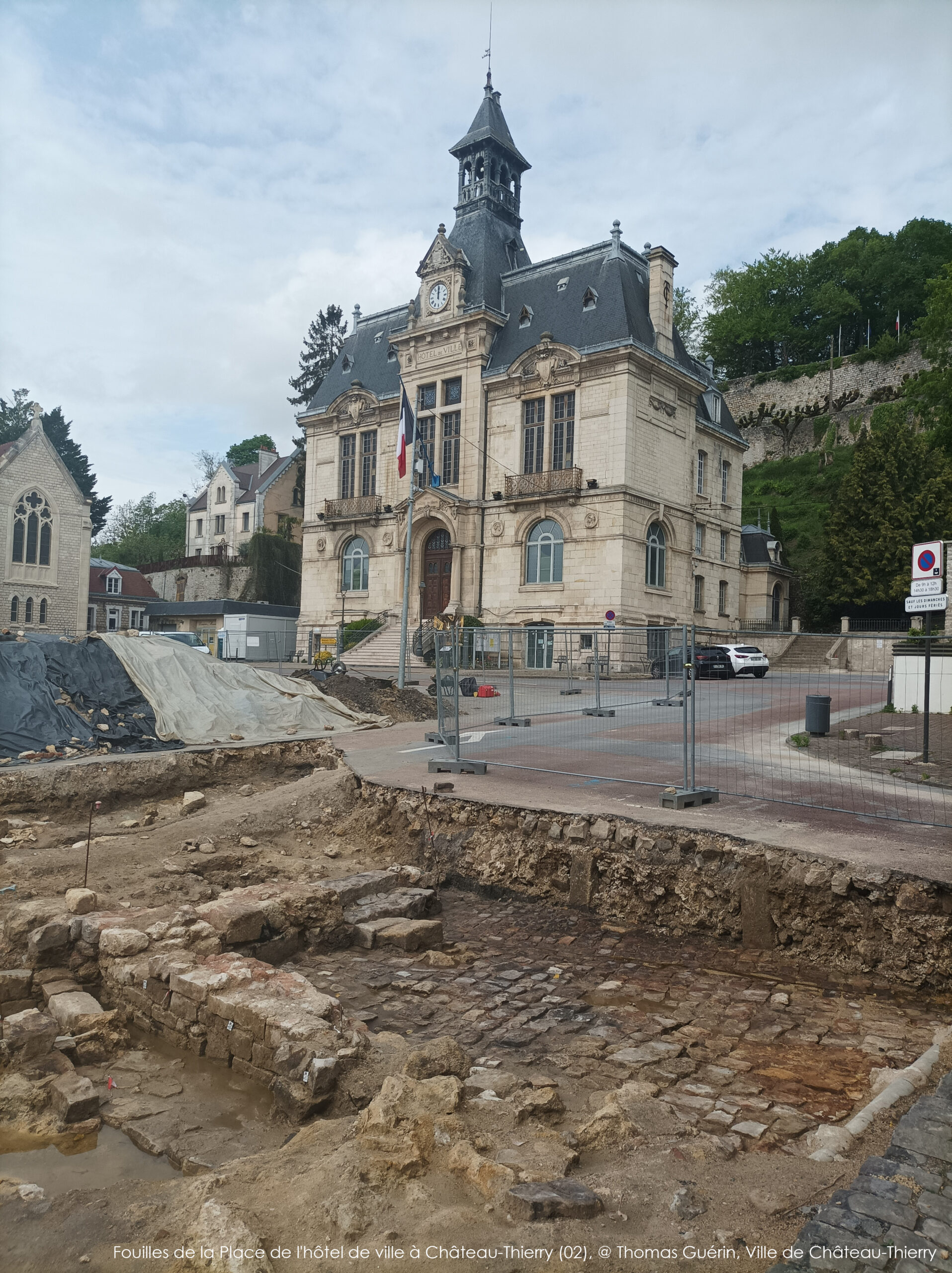
Rencontre – Journées régionales de l’archéologie Hauts-de-France 2024

La Drac Hauts-de-France/Service régional de l’archéologie a le plaisir de vous informer que les Journées régionales de l’archéologie des Hauts-de-France se tiendront cette année, les jeudi 21 et vendredi 22 novembre 2024 à Laon.

La manifestation organisée par la DRAC, en partenariat avec le département de l’Aisne, se déroulera à la Maison des Arts et Loisirs (MAL) près de la cathédrale.

Ces journées organisées une fois par an sont l’occasion de découvrir l’actualité archéologique de la région et de rencontrer l’ensemble des acteurs de cette science.
Les résultats des principales fouilles de l’année sont présentés par les archéologues eux-mêmes et des temps d’échanges avec le public sont prévus.
Des brochures destinées à tous les publics sont également mises à disposition gracieusement. On peut aussi y trouver des publications scientifiques, notamment régionales.

Cette rencontre est ouverte à tous, gratuitement, dans la limite des places disponibles.

Le programme détaillé de cette manifestation sera disponible sur le site internet de la DRAC dans le courant du mois d’octobre ainsi que sur le portail documentaire Nordoc’Archéo.

Manifestation : Journées régionales de l’archéologie Hauts-de-France 2025
Dates : les 21 et 22 novembre 2024
Lieu :
Maison des Arts et Loisirs (MAL)
2 place Aubry
02000 Laon

Publié dans Exposition | Laisser un commentaire

Publication – John Eldevik, « Reading Prester John. Cultural Fantasy and its Manuscript Contexts »

During the Middle Ages, many Europeans imagined that there existed a powerful and marvel-filled Christian realm beyond the lands of Islam ruled by a devout emperor they called “Priest John,” or “Prester John.” Spurred by a forged letter that mysteriously appeared around 1165 and quickly “went viral” in hundreds of manuscripts across Western Europe, the legend of Prester John and his exotic kingdom was not just a utopian fantasy, but a way to bring contemporary political and theological questions into sharper focus. In this new study, John Eldevik shows how the manuscripts that transmitted the story of Prester John reflect the ways contemporary audiences processed ideas about religious conflict and helped them imagine a new, global dimension of Christianity. It includes an appendix with a new translation of the B recension of The Letter of Prester John.

John Eldevik is Professor of History at Hamilton College in Clinton (New York State), and has previously published on medieval social and religious history.

List of Illustrations

Acknowledgements

Introduction

Chapter 1. Wonders of the East: Visions of Global Christendom in the Early Middle Ages

Chapter 2. The Letter of Prester John and its Reception in the Twelfth Century

Chapter 3. Reading and Reimagining Prester John in the Twelfth and Thirteenth Centuries

Chapter 4. Prester John, the Mongols, and the Resilience of Wonder

Chapter 5. The New Horizons of Christendom: Prester John in Africa

Conclusion

Appendix: The Letter of Prester John (B Recension)

Bibliography

Index

Informations pratiques :

John Eldevik, Reading Prester John. Cultural Fantasy and its Manuscript Contexts, Leeds, ARC Humanities Press, 2024 ; 1 vol., 170 p. (Beyond Medieval Europe). ISBN : 978-1-94240-183-4. Prix : GBP 104,00.

Source : ARC Humanities Press

Publié dans Publications | Laisser un commentaire

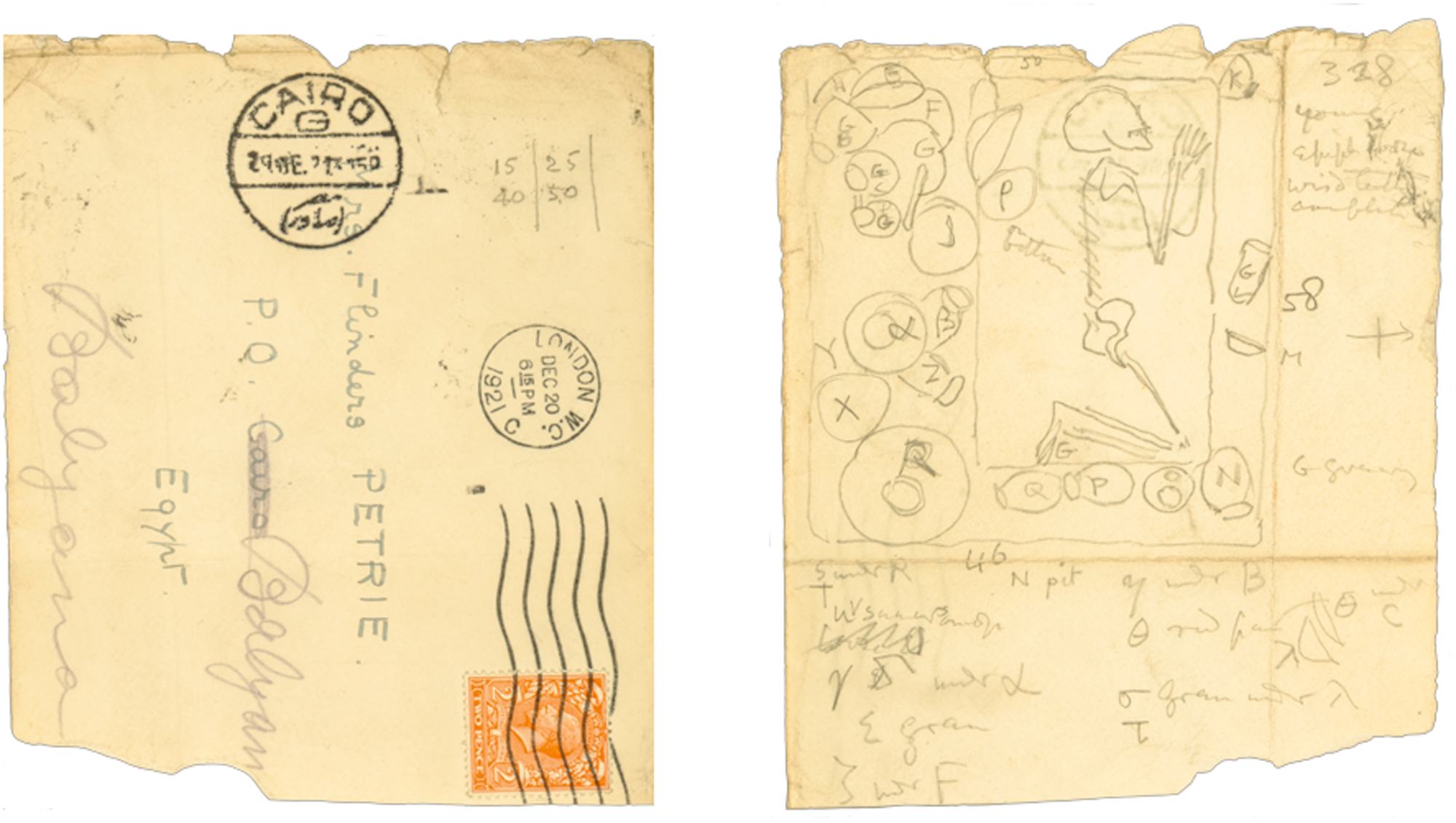
Journée d’étude – Old Excavations and Finds, New Data and Interpretations. The Use of Archives in Current Archaeological Research Projects

Old Excavations and Finds, New Data and Interpretations: The Use of Archives in Current Archaeological Research Projects” is a session of the 30th European Association of Archaeologists Conference, to be held the 31 August 2024, 8:30-16:00, at the Sapienza University (Room 50, Maths building) in Rome, Italy.

This session is organised in collaboration with the “History of Archaeology” commission of the International Union for Prehistoric and Protohistoric Sciences.

The history of archaeology is a growing field of investigations which provides a range of studies and insights based on rigorous historical methodologies, drawing on archival materials, and organised into a veritable community with its research programs and widespread publications. Besides providing new knowledge on the practices and theories of archaeology worldwide, these empirical (archive-based) investigations have also focused attention on the production, conservation, dissemination and re-use of a range of documents produced by past archaeologists in the course of their excavation or collection activities. In turn, this has generated renewed interest in the archives of archaeology, be it in order to better understand the scientific, cultural and social implications of the discipline, or to make practical use of archival materials as a source of evidence and interpretations about the past. This session aims to address both these conceptual and pragmatic dimensions of the archives-based history of archaeology. Contributors will address issues such as:

  • the scientific use of archival information: how, in our age of open science and (digital) data-reuse, are the results of past research integrated in the current production of knowledge?
  • the organisation of archive-based research projects: who leads such projects, and what division of labour between archaeologists, historians or archivists are at stake?
  • publication policy: to which audiences (scientific, laypeople) and in what publications are presented the results of projects combining new and old archaeological data?

8:30-16:00

Informations pratiques :

Maths Building (CU006), Room 50 – Sapienza University
Rome, Italie

31 août 2024

Organisers :
Maddalena Cataldi
Nathan Schlanger
Kertsin Hofmann
Chloé Rosner
Sébastien Plutniak

This session is organised in collaboration with the “History of Archaeology” commission of the International Union for Prehistoric and Protohistoric Sciences.

Source : Calenda

Publié dans Colloque | Laisser un commentaire