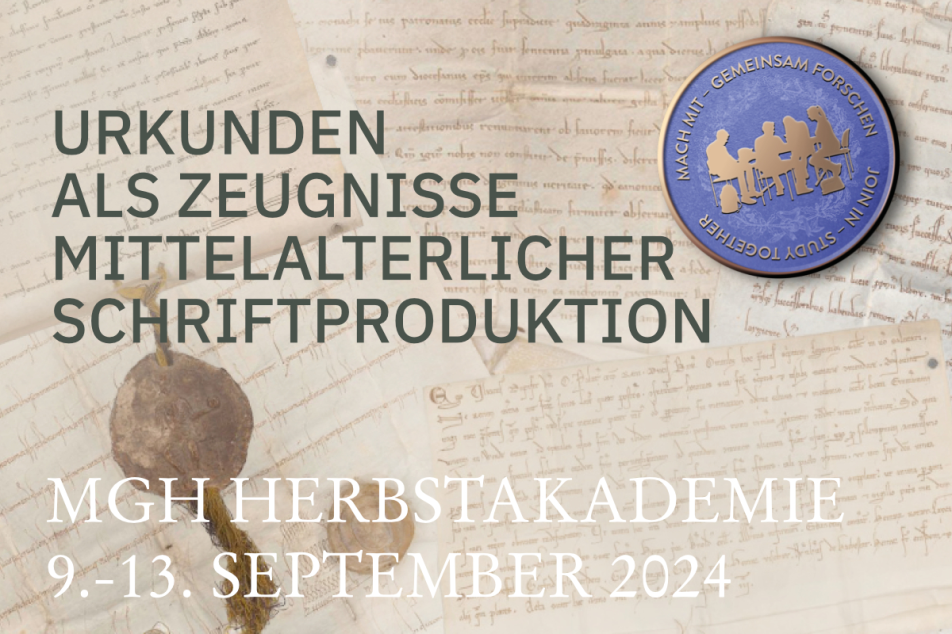
Colloque – Urkunden als Zeugnisse mittelalterlicher Schriftproduktion

Urkunden sind wichtige Zeugnisse mittelalterlicher Schriftproduktion. Sie dokumentieren ein ungewöhnlich effizientes Rechts- und Kommunikationssystem, dessen formale und materielle Charakteristika sich im Lauf des Mittelalters entwickelten. Daher zählt die Urkundenlehre bzw. Diplomatik zu den zentralen historischen Grundwissenschaften.

In der Herbstakademie gewinnen die Teilnehmenden vertiefte Einblicke in die Spezifika der unterschiedlichen Urkundenarten König-, Kaiser-, Papst- und Privaturkunden. 

Dabei wird auf zentrale grundwissenschaftliche Fertigkeiten wie das Lesen mittelalterlicher Schriften (Paläographie), Urkundenlehre (Diplomatik) im engeren Sinne, Siegelkunde (Sphragistik) und Editionstechnik eingegangen. Im Mittelpunkt steht die Vermittlung grundlegender Kenntnisse und praktischer Kompetenzen im Hinblick auf die wissenschaftliche Arbeit mit Urkunden. Ausgewiesene Experten eröffnen den Teilnehmenden den Zugang zu unterschiedlichen Themen, Quellen und Methoden und regen zur Diskussion aktueller Forschungsansätze an. In Übungen arbeiten die Teilnehmenden mit ausgewählten Urkunden, betreut von den Referentinnen und Referenten. Arbeitsmaterialien werden bereits im Vorfeld der Herbstakademie zur Verfügung gestellt.

Montag, 9.9., bis Freitag, 13.9.2024
Institut der Monumenta Germaniae Historica, Ludwigstraße 16, 80539 München
Montag, 09.09.2024

15:00     Begrüßung, Besichtigung des Münchner Instituts der MGH, Einführung in das Thema sowie in die Grundlagen von Paläographie und Chronologie

18:00     Abendempfang in den Räumen der MGH

Dienstag, 10.09.2024

9:00      Kaiser- und Königsurkunden I mit Prof. Dr. Stefan Petersen (München): Äußere und innere Merkmale von Königsurkunden bis zur Mitte des 12. Jahrhunderts

12:00    Mittagessen

14:00    Kaiser- und Königsurkunden II mit Dr. Katharina Gutermuth (München): Im Spannungsfeld zwischen Nord und Süd. Die Urkunden der älteren Staufer und der Sonderweg Friedrichs II. Einblick in die Entwicklung der Kaiserurkunden vom 12. bis zum 13. Jahrhundert und Grundlagen der Editionsarbeit

17:00    Ende des Sitzungstages

Mittwoch, 11.09.2024

9:00      Papsturkunden I mit Prof. Dr. Jochen Johrendt (Wuppertal) und Prof. Dr. Harald Müller (Aachen): Begriffliche Grundlagen – Überlieferung – Formen (ca. 1050-1200)

12:00    Mittagessen

14:00    Papsturkunden II mit Prof. Dr. Jochen Johrendt (Wuppertal) und Prof. Dr. Harald Müller (Aachen): Formen der Papsturkunde (ca. 1150-1300) und ihre Überlieferung in den Registern

17:00    Ende des Sitzungstages

19:00    Abendvortrag von Prof. Dr. Mark Mersiowsky (Stuttgart): Die Urkunden der Karolingerzeit

Donnerstag, 12.09.2024

9:00      Privaturkunden I mit PD Dr. Roman Zehetmayer (St. Pölten): Bischofs- und Adelsurkunden

12:00    Mittagessen

14:00    Privaturkunden II mit Prof. Dr. Magdalena Weileder (Darmstadt): Spätmittelalterliche Notariatsurkunden

17:00    Ende des Sitzungstages

Freitag, 13.09.2024

9:00      Besuch des Bayerischen Hauptstaatsarchivs

11:30    Abschlussrunde

12:30    Ende der Herbstakademie

Fortgeschrittene Studierende, Doktorandinnen und Doktoranden der Mittelalterlichen Geschichte mit einschlägigen Vorkenntnissen im Bereich der Paläographie und der Diplomatik sowie ausreichenden Deutschkenntnissen sind herzlich zur Teilnahme eingeladen. Die Teilnehmerzahl ist auf 12 Studierende beschränkt, die Arbeitssprache ist Deutsch. Die Teilnahme ist kostenlos, ein Reisekostenzuschuss kann u. U. auf Antrag gewährt werden.

Voraussetzungen für die Bewerbung:

  • Beherrschung der deutschen Sprache (in Wort und Schrift)
  • Lateinkenntnisse im Umfang des Latinums
  • Empfehlungsschreiben der betreuenden Dozentin/des betreuenden Dozenten
  • Lebenslauf und Studiennachweis

Bewerbungen (in einem PDF) sind zu richten an Prof. Dr. Stefan Petersen (sekretariat@mgh.de).

Bewerbungsschluss ist der 30. Juni 2024.

Source : Monumenta Germaniae Historica

Publié dans Colloque | Laisser un commentaire

Appel à contribution – Montrer les collections médiévales (revue exPosition, n° 11)

En France, les événements révolutionnaires de 1789 ont accéléré une prise de conscience, dans les milieux érudits, de l’existence d’un patrimoine local, médiéval, dit « gothique ». Dès lors, des consignes ont été établies par le gouvernement révolutionnaire pour recenser les monuments et autres œuvres d’un passé jusque-là plutôt méprisé. Ils ont été désormais considérés comme des supports à la connaissance de l’histoire nationale et comme des exemples pour les artisans et les artistes, notamment dans le cadre de projets de restauration. Parallèlement, des publications sous forme d’articles dans les revues des sociétés savantes ou de manuels se sont multipliées et ont réveillé la convoitise de collectionneurs vis-à-vis de pièces originales. Le cas d’Alexandre du Sommerard (1779-1842), évoqué dans l’ouvrage d’Honoré de Balzac, Le cousin Pons, est bien connu, puisqu’à l’origine du musée de Cluny, créé en 1844, actuel musée national du Moyen Âge à Paris. D’autres collections ont été créées au cours du XIXe siècle sur le territoire français, par des particuliers, souvent membres de ces sociétés savantes si florissantes, ou à l’occasion de restaurations. Certaines sont devenues des musées de site (musée de l’abbaye de Gellone à Saint-Guilhem-le-Désert, musée lapidaire de Vézelay etc.), d’autres sont entrées dans le commerce de l’art, non seulement national mais aussi international. Ainsi voit-on des sections entières dédiées au Moyen Âge dans les plus grands musées du monde, et même un musée entier les Cloisters, à New York, où des œuvres françaises côtoient des pièces issues d’autres pays européens. Ceux-ci n’échappèrent pas à ce même attrait pour le passé médiéval et ses objets, suivant des protocoles différents de ceux de la France, du moins en partie, mais aboutissant à des résultats semblables.

De nos jours, avec le recul et les questions d’appropriation culturelle et de restitution qui touchent d’autres types d’œuvres, provenant d’autres continents (notamment les biens africains accumulés dans les musées européens du temps des colonies), quel regard porte-t-on sur les collections médiévales créées en France et à l’étranger au cours des XIXe et XXe siècles ? Quel(s) discours a-t-on cherché(s) et cherche-t-on encore à proposer au(x) public(s) à travers leur mise en scène renouvelée ou des expositions temporaires ? Comme l’exprime Elsa Guyot en introduction de l’ouvrage, issu de sa thèse de doctorat en histoire de l’art, Rejouer l’histoire. Le Moyen Âge dans les musées du Québec (2021, p. 7) : « les musées et les expositions muséales sont loin d’être des espaces neutres : ils participent à la construction d’un discours sur l’art, sur l’histoire et sur la société ». Les propositions d’articles pourront porter tout à la fois sur les choix scénographiques, sur les formes et le contenu des outils de médiation, sur le propos des expositions (permanentes ou temporaires) et leur mise en perspective avec l’actualité de la recherche, etc.

Orientations bibliographiques :

Carmen Berlabé Jové, Del Museu Diocesà al Museu de Lleida. Formació i legitimitat del seu patrimoni artístic, Lleida, Pagès Editors ; Museu de Lleida, 2018.

Elsa Guyot, Rejouer l’histoire. Le Moyen Âge dans les musées du Québec, Montréal, Leméac éditeur, 2021.

Elizabeth C. Parker (éd.), The Cloisters. Studies in Honor of the Fiftieth Anniversary, New York, The Metropolitan Museum of Art / The International Center of Medieval Art, 1992.

Calvin Tomkins, Merchants and Masterpieces. The Story of the Metropolitan Museum of Art, New York, Henry Holt and Company, 1989 (1970).

Alberto Velasco, A la recerca de l’obra perduda. Històric sobre el patrimoni artistic, Barcelone, Raval Edicions, 2023.

Les propositions pourront être soumises à Géraldine Mallet et Sylvain Demarthe, qui assurent la direction de ce dossier thématique, jusqu’au 30 juin 2024 aux adresses suivantes : geraldine.mallet@univ-montp3.fr ; sylvain.demarthe@univ-montp3.fr. Ces textes prendront la forme d’un résumé de 3000 signes maximum, contenant un titre – même provisoire – et une problématique précise.

En cas d’avis positif (courant juillet 2024), l’auteur·e s’engagera à remettre son article entièrement rédigé (30 000 signes maximum, espaces et notes incluses) en s’assurant impérativement du respect des normes de la revue pour le 28 octobre 2024.

Une fois reçu, le texte sera anonymisé et soumis à une évaluation en double aveugle assurée par les membres du comité de rédaction et les expert·es extérieur·es formant le comité de lecture propre à chaque numéro. À l’issue du processus d’évaluation, l’auteur·e recevra les avis argumentés de ses deux relecteurs et/ou relectrices, ainsi que celui des deux responsables du numéro. Son texte pourra être accepté, soumis à correction ou refusé.

Retour des évaluations : janvier 2025

Retouches des textes par les auteur·es : avant le 30 mars 2025

Dernières relectures et mise en ligne : entre avril et juin 2025

Publié dans Appel à contributions | Laisser un commentaire

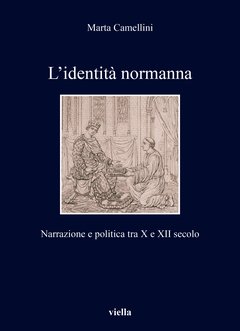
Publication – Marta Camellini, « L’identità normanna. Narrazione e politica tra X e XII secolo »

Ormai da lungo tempo ci si interroga su quali siano i legami tra la memoria del passato, l’identità di un gruppo che ambisce a definirsi come popolo e le esigenze politiche delle sue élite. Questi tre elementi danno forma uno all’altro in un groviglio di relazioni che li rende uniti in una rete inestricabile: ricordare il passato e dare un’immagine di sé sono operazioni fortemente orientate dalle esigenze del presente e spesso strumentalizzate da chi vuole raggiungere e mantenere il potere.

In questo studio ci addentreremo nei processi che legano memoria, identità e politica attraverso il caso della dinastia normanna. I duchi, attraverso i loro storiografi, guidarono l’elaborazione di un’identità della gens strumentalizzando il passato, così da poter diventare i signori incontrastati della regione che avevano conquistato come violenti pirati pagani.

Marta Camellini, laureata in Lettere moderne e successivamente in Scienze storiche a Bologna, ha conseguito un dottorato di ricerca in Scienze storiche presso l’Università del Piemonte orientale. Attualmente lavora come docente nella scuola superiore e continua l’attività di ricerca in collaborazione con l’UPO.

Table des matières : ici

Marta Camellini, L’identità normanna. Narrazione e politica tra X e XII secolo, Rome, Viella, 2024 ; 1 vol., 312 p. (I libri di Viella, 475). ISBN : 979-1-25469-533-3. Prix : € 34,00.

Source : Viella

Publié dans Publications | Laisser un commentaire

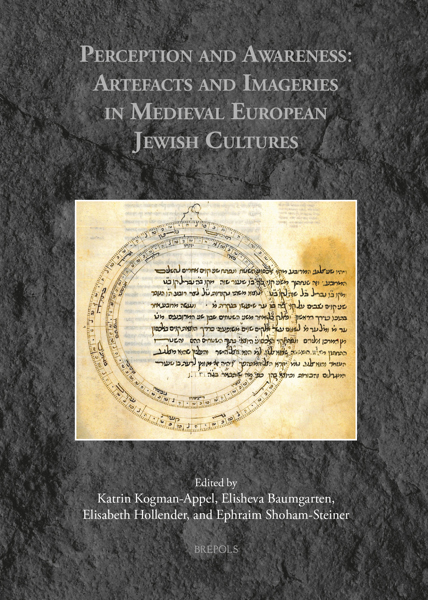
Publication – « Perception and Awareness: Artefacts and Imageries in Medieval European Jewish Cultures », éd. Katrin Kogman-Appel, Elisheva Baumgarten, Elisabeth Hollender, Ephraim Shoham-Steiner

What did the world look like for Jews living in medieval Europe? How did they perceive and make use of the elements of their daily life, from items on the street to religious iconography within holy spaces — in particular synagogues and at the exterior of churches — and profane elements from the home? And how did they experience the visual and material cultures of their non-Jewish neighbours?

These questions form the core of this volume, which explores pre-modern Jewish approaches to images and material objects from a variety of perspectives. From clothing to manuscripts, and from lighting devices to the understanding of the invisible, the chapters gathered together in this multifaceted volume combine analyses of images and artefacts together with in-depth analyses of texts to offer fresh insights into the visual cultures that informed the world of European Jews in the Middle Ages.

Elisheva Baumgarten is a social historian of the Jews of medieval northern Europe at the Hebrew University of Jerusalem.

Elisabeth Hollender is a Professor of Jewish Studies at the Goethe University Frankfurt specializing in medieval Jewish religious culture.

Katrin Kogman-Appel is a Professor of Jewish Studies at the University of Münster with an expertise on medieval Jewish visual culture.

Ephraim Shoham-Steiner is a historian specializing in the History of Jews in Medieval Europe at the Ben-Gurion University of the Negev in Beer Sheva

Preface and Acknowledgements

List of Illustrations

Introduction
Elisheva Baumgarten, Elisabeth Hollender, Katrin Kogman-Appel, and Ephraim Shoham-Steiner

Part One: The Perception of the Visual, the Material, and the Tangible in Shared Public Spaces

1. The Writing on the Wall A Mahzor, a Bimah, and a Privilege.
A Look at Social Processes in the 13th-Century Jewish Community of Cologne

Ephraim Shoham-Steiner

2. Illuminations: Lights, Identities, and the Society of Spectacle in the Late Middle Ages
Eleazar Gutwirth

3. Materialization of Memoria
Memory and Remembrance of Benefactors in Building Inscriptions in Medieval Ashkenaz
Rainer Josef Barzen

4. Differing Perceptions of Church Garments and Worship Implements in the Writings and Thought of the Tosafists
Ephraim Kanarfogel

5. Not Black and White
Clothes and Difference in Medieval Ashkenaz
Elisheva Baumgarten

Part Two: Utilizing the Faculties of Visual Means

6. Jewish Chivalry in Late Medieval Illuminated Manuscripts
Sara Offenberg

7. The Handling of Diagrams in Medieval Scientific Manuscript Transmission
The
Sefer ha-marʾim le-Eqlides and its First Proposition
Sabine Arndt

8. Non-Verbal Aspects of Astrolabe Knowledge (Fifteenth- to Eighteenth-Century Hebrew Manuscripts)
Josefina Rodríguez-Arribas

9. Artifacts that Desire
Medieval Perspectives
Kalman P. Bland (OBM)

10.The Agency of Images
The Temple Vessels in Hebrew Bibles from Roussillon (c. 1300)
Katrin Kogman-Appel

11.Visualizing the Invisible: Portrayals of Elijah the Prophet in Fifteenth-Century Ashkenazi Haggadot
Chana Shaham-Rosby

12.Visualizing Divine Communication in Medieval Jewish Art
Shulamit Laderman

Index

About the Authors

Informations pratiques :

Perception and Awareness: Artefacts and Imageries in Medieval European Jewish Cultures, éd. Katrin Kogman-Appel, Elisheva Baumgarten, Elisabeth Hollender, Ephraim Shoham-Steiner, Turnhout, Brepols, 2024 ; 1 vol., 360 p. (Medieval Identities: Socio-Cultural Spaces, 11). ISBN : 978-2-503-58394-5. Prix : € 105,00.

Source : Brepols

Publié dans Publications | Laisser un commentaire

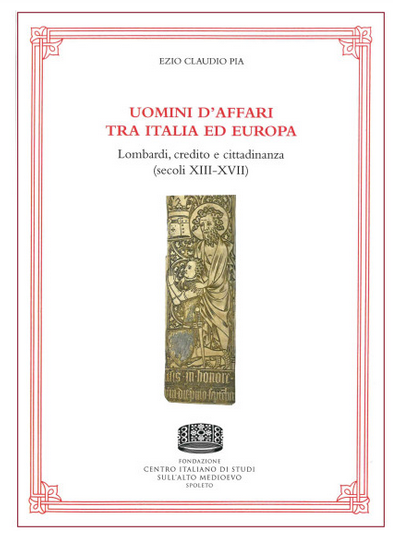
Publication – Ezio Claudio Pia, « Uomini d’affari tra Italia ed Europa. Lombardi, credito e cittadinanza (secoli XIII-XVII) »

Lo stretto legame tra appartenenza civica e pratiche economiche, intese come rapporti di credibilità e fiducia, innerva le relazioni sociali e politiche del pieno Medioevo. Un quadro testimoniato dalla vicenda dei lombardi, gli uomini d’affari originari dell’Italia settentrionale attivi tra Duecento e Seicento nel mercato finanziario europeo. Reputati «viri providi et discreti», necessario sostegno di città e regni, o al contrario stigmatizzati come usurai e avvicinati agli stereotipi del credito ebraico, i lombardi sono caratterizzati sul lungo periodo da un’inclusione patteggiata, onerosa e a termine. È la conferma del nesso tra cittadinanza, credito e politica, fondato sulla valutazione dei comportamenti economici che orienta o definisce un ordine comunitario. Un itinerario che presenta permanenze e mutamenti e che può essere decodificato attraverso i lessici politici, teologici e creditizi che per secoli hanno modellato criteri e pratiche di inclusione ed esclusione sociale.

Table des matières :

Introduzione – I. Lombardi in Europa: una lettura storiografica -1. Un percorso tra intersezioni e cesure – 2. Storiografia locale e valutazioni di rango – 3. Prospettive della nuova medievistica: le scuole di Torino e di Trier – 4. Un punto di avvio: le fiere di Champagne – 5. L’avvicinamento all’attività creditizia – 6. Un’identità articolata – 7. «Viri providi et discreti» o usurai manifesti? – II. «Multam pecuniam (…) multa mala»: tra credito e politica – 1. Lombardi e altri operatori: convergenze e peculiarità – 2. Politica e finanza: un quadro conflittuale – 3. Pratiche, costi e linguaggi del credito: tensioni e sperimentazioni – III. Radicamento e marginalizzazione: Paesi Bassi, secoli XIV-XVII – 1. L’acme dell’attività lombarda – 2. Tra Inghilterra e continente – 3. Brabante e Fiandra: un laboratorio tra politica ed economia – 4. Etica economica e xenofobia – IV. Ai limiti della cittadinanza: lombardi come ebrei – 1. Ebrei e «cristiani giudaizzanti» – 2. Lombardi: uno status incerto – 3. Ebrei: «sicut cives» – 4. Esiti di una controversa appartenenza – V. Restituzione: i lessici della reintegrazione e della Cittadinanza – 1. «Bonum caritatis et societatis»: la ricostruzione di un ordine – 2. Usura e società – 3. Valutare per restituire: mercanti “probati” – 4. Teoria e pratica della restituzione – 5. Credito e contabilità tra appartenenza ed esclusione – 6. Paradigmi di una cittadinanza incerta – Conclusioni. Tra pratiche creditizie e stereotipi – Bibliografia – Indice dei nomi di persona e luogo.

Informations pratiques :

Ezio Claudio Pia, Uomini d’affari tra Italia ed Europa. Lombardi, credito e cittadinanza (secoli XIII-XVII), Rome, Centro italiano di studi sull’alto medioevo, 2024 ; 1 vol., VI–158 p. (Collectanea, 39). ISBN : 978-8-86809-409-6. Prix : € 22,00.

Source : CISAM

Publié dans Publications | Laisser un commentaire

Appel à contribution – Defend sacred spaces: Fortified churches and monasteries in the medieval Mediterranean (9th-14th centuries)

Starting from the end of the 9th century, important events including the disintegration of the Carolingian empire and the advance of populations from northern and eastern Europe and the Arab world triggered a phase of insecurity and political instability. The Mediterranean, a place of meetings and exchanges between culturally and geographically distant populations, was particularly affected by these events. In a climate full of tension, threatened by internal conflicts and the advance of non-Christian populations, it became essential to defend the “home of God”. This concept translated architecturally into the adoption of design solutions inherited from military architecture. Throughout the eastern and western Mediterranean, numerous monasteries, abbeys, and churches acquired the appearance of fortresses, marked by high defensive towers and wall-walks, often integrated with the walls and defensive structures of the cities. Architectural innovations, useful for the defense of a single monument or entire villages and cities, spread quickly across the Mediterranean and its areas of influence, acquiring territorial specificities.

Considering the historical context between the 9th and 14th centuries, the II International “Mm3a” Conference in Lipari proposes the development of a framework on fortified religious architecture through: the analysis of the relationships between the regional architectural solutions and the socio-economic contexts, the studies of exchange methodologies and models dissemination and their adjustments according to local building traditions.

To this end, the study topics on fortified religious complexes are:

  • the formation of the architectural phenomenon in relation to the respective regional, cultural, and religious contexts;
  • the main players: commissioner, creators, users;
  • the diffusion of architectural models and construction techniques;
  • the contributions of the ecclesiastical and knightly religious orders in the architectural field;
  • restoration as a tool for knowledge;
  • historical sources, ecclesiological doctrines, and monastic culture.
  • art, iconography, and forms of representation

The Conference will include papers and a poster session. Proposals for participation relating to reports or posters must include:

  • the title;
  • adhesion to one of the thematic areas;
  • an abstract of a maximum of 2000 characters;
  • five key words;
  • a curriculum vitae of the proposer (not exceeding 500 characters); and must be sent by June 16th to the address: mediterraneomedievale@gmail.com

Papers of a maximum of 20 minutes are expected. The Scientific Committee will evaluate the proposals sent by June 30th and will communicate their possible acceptance, as a report or as a poster, inserting them in the Conference session deemed most suitable. The Conference includes the publication of the contributions in a monographic volume within the “Architettura Medievale” series (directed by Silvia Beltramo and Carlo Tosco), published by “All’insegna del Giglio”. Adequate space in the publication will also be reserved for posters admitted to the specific session.

Source : Medieval Art Research

Publié dans Appel à contributions | Laisser un commentaire

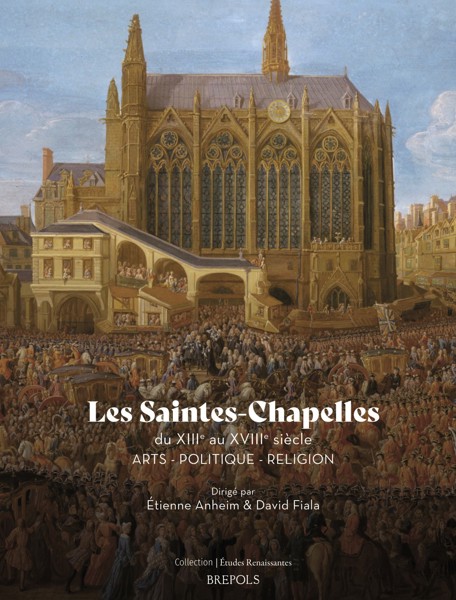
Publication – « Les Saintes-Chapelles du XIIIe au XVIIIe siècle », éd. Étienne Anheim, David Fiala

Si la fondation de la Sainte-Chapelle de Paris par Louis IX pour accueillir la couronne d’épines au milieu du XIIIe siècle est bien connue et si l’on sait qu’à l’imitation du saint roi, plusieurs princes de France fondèrent des chapelles dites « saintes » entre la fin du Moyen Âge et le début de la Renaissance, l’histoire longue et complexe de ces chapelles est encore mal connue et mal comprise. Il ne s’agit pas de nier la possibilité de construire un idéal-type de « la » Sainte-Chapelle, mais plutôt de s’interroger sur l’écart entre ce que les documents du passé appellent « Sainte-Chapelle », sans préjuger d’un sens stable et univoque à travers le temps, et ce que les périodes postérieures et la recherche actuelle peuvent désigner sous ce nom. Une Sainte-Chapelle, des Saintes-Chapelles ? Ces contributions cherchent à répondre à cette question en s’interrogeant sur la définition de la notion, sa circulation, ses transformations dans le temps et dans l’espace. En comparant les différentes « Saintes-Chapelles », ce volume veut défendre l’idée que les Saintes-Chapelles sont des objets historiques particulièrement révélateurs parce qu’elles ont été des rouages discrets mais fondamentaux : leur statut hybride, entre cour et Église, de même que leur histoire longue, de la couronne d’épines à la Révolution, en font un observatoire idéal pour mieux comprendre et expliquer les évolutions à l’œuvre dans l’exercice du pouvoir et la célébration de Dieu par la monarchie capétienne entre le Moyen Âge et les Lumières.

Étienne Anheim est historien. Il est directeur des Éditions et directeur d’études à l’École des Hautes Études en Sciences Sociales (Paris), où il enseigne la sociologie historique de la culture en Europe du XIIe au XVIe siècle.

David Fiala est maître de conférences en musicologie au Centre d’études supérieures de la Renaissance (Université de Tours/CNRS). Ses travaux portent sur la musique, les musiciens et les institutions musicales de la fin du Moyen Âge et de la Renaissance, ainsi que les humanités numériques.

Étienne Anheim et David Fiala,“Introduction” : “A la recherche des Saintes-Chapelles”.

Elizabeth A.R. Brown, “La Sainte-Chapelle de Paris, ses appelations et son renom aux XIIIe et XIVe siècles”.
Anne Massoni, “Les Saintes-Chapelles, des chapitres collégiaux comme les autres ?”.
Murielle Gaude-Ferragu, “Les cérémonies extraordinaires à la Sainte-Chapelle de Paris (XIVe-XVe s.)”.
Christophe Boucheron, “Jean Mortis et le ‘Cartulaire de la Sainte-Chapelle de Paris’ de 1457”.
Meredith Cohen, “What Saint Louis Saw. The Sainte-Chapelle and the Palais de la Cité in the Thirteenth-Century”.
Étienne Hamon, “La montée de la Sainte-Chapelle de Paris : fonctions, symboles et formes”.
Étienne Anheim, “La maîtrise d’enfants de la Sainte-Chapelle de Paris (XIIIe-XVIIIe s.). Institution et discipline entre la cour et l’Eglise”.
Xavier Bisaro, “Le vitrail et l’image : la Sainte-Chapelle de Paris dans les sources cérémonielles du XVIIe siècle”.
Dany Sandron, “Notre-Dame et la Sainte-Chapelle au XIIIe siècle”.
Paul Binski, “Perspectives anglaises sur la Sainte-Chapelle”.
Jean-Bernard de Vaivre et Laurent Vissière, “Dévotions aristocratiques à la Sainte-Chapelle de Dijon”.
Olivier Mattéoni, “Géographie sacrale et Saintes-Chapelles dans les territoires des Bourbons à la fin du Moyen Âge”.
Jean-Vincent Jourd’heuil, “La fondation de la Sainte-Chapelle de Bourges (1392-1405) : une fondation princière durant le Grand Schisme”.
Yves Pauwels, “Le porche de la Sainte-Chapelle de Champigny-sur-Veude : un manifeste de modernité architecturale”.
Julien Noblet, “La Sainte-Chapelle de Chambéry et le projet d’Amédée VIII : nouvelles observations archéologiques”.
Laura Gaffuri et Paolo Cozzo, “De Chambéry à Turin. La Sainte-Chapelle et la Chapelle Royale de la Cour de Savoie (XVe-XVIIIe s.).
Bernard Dompnier, “Les calendriers festifs des Saintes-Chapelles aux XVIIe et XVIIIe siècles”.

Étienne Anheim et David Fiala,“Conclusion” : “Les Saintes-Chapelles, des institutions imaginaires”.

Les Saintes-Chapelles du XIIIe au XVIIIe siècle, éd. Étienne Anheim, David Fiala, Turnhout, Brepols, 2024 ; 1 vol., 294 p. (Études Renaissantes, 39). ISBN : 978-2-503-60536-4. Prix : € 95,00.

Source : Brepols

Publié dans Publications | Laisser un commentaire

Publication – « Marxism and Medieval Studies. Marxist Historiography in East Central Europe », éd. Martin Nodl , Piotr Węcowski, Dušan Zupka

This volume is a unique publication as it examines the Marxist attitudes in East Central European historiography and archaeology for the first time, with an emphasis on the co-existence of Marxist and other methodologies between the 1950s and 1970s in the local historiographies in question. Its approach is to distinguish between pseudo-Marxism as an ideological tool on the one hand, and Marxism in the form of historical materialism as a way to interpret the medieval world on the other.

Contributors are: Florin Curta, Piotr Guzowski, Adam Hudek, Tereza Johanidesová, Jitka Komendová, Jiří Macháček, Andrzej Marzec, Martin Nodl, Attila Pók, David Radek, Tadeusz Paweł Rutkowski, Iurie Stamati, Rafał Stobiecki, Gábor Thoroczkay, Przemysław Wiszewski, Piotr Węcowski, Martin Wihoda, and Dušan Zupka.

Martin Nodl, Ph.D. (2011), is a research associate professor at the Centre for Medieval Studies Academy of Sciences CR, Prague. He is the author of six monographs, including Das Kuttenberger Dekret von 1409 (2017), Średniowiecze w nas (2020), and Praha 15. století. Konfliktní společenství (2023).

Piotr Węcowski, Ph.D. (2004), is a professor at the University of Warsaw. He has published three monographs and many articles on medieval history and history of historiography, including The Origins of Poland in the Historical Memory of the Late Middle Ages (Cracow 2014).

Dušan Zupka, Ph.D. (2009), is an associate professor at Comenius University in Bratislava. He has published monographs, journal articles and edited volumes on power, ritual and war in medieval East Central Europe, including Rulership in Medieval East Central Europe (Brill, 2021).

Table des matières : ici

Informations pratiques :

Marxism and Medieval Studies. Marxist Historiography in East Central Europe, éd. Martin Nodl , Piotr Węcowski, Dušan Zupka, Leyde–Boston, Brill, 2024 ; 1 vol., XIV–392 p. (East Central and Eastern Europe in the Middle Ages, 450-1450, 93). ISBN : 978-90-04-68918-3. Prix : € 147,00.

Source : Brill

Publié dans Publications | Laisser un commentaire

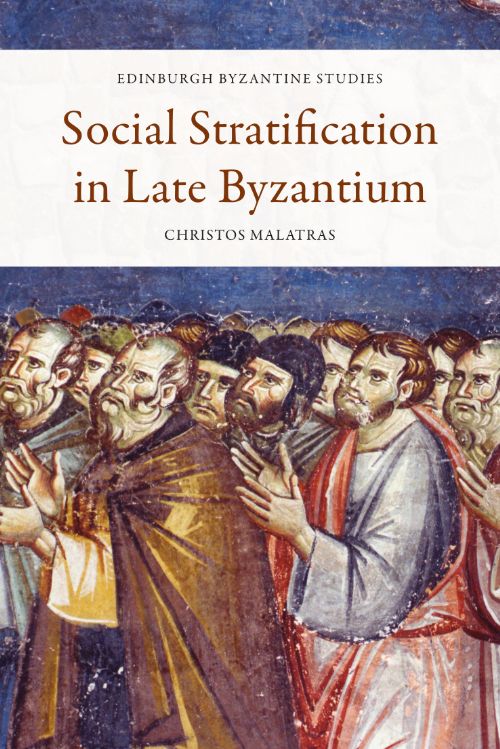
Publication – Christos Malatras, « Social Stratification in Late Byzantium »

Introduces the basic patterns, ideas and gestures that governed the system of social relations and the construction of social profiles and roles of Byzantine society

  • Identifies the main traits of Late Byzantine society and the ideas of the Byzantines about their social system, the social values and the organisation of their society.
  • Explores the use of modern sociological and anthropological theories in order to better understand Byzantine society.
  • Provides thorough and up-to-date analysis of the different social groups in the Late Byzantine society (character, composition, relation to the economic, political and ideological resources).
  • Emphasises the networks of patron-client relations and their effect on the structures of Byzantine society.
  • Offers a new explanation of the collapse of Byzantine society and the state in the face of external threats.

This book provides an in-depth analysis of the social structure of Late Byzantine society (mid 13th – mid 15th c.), including the norms and ideas that governed social relations, and the Byzantine perceptions of their society. It includes an analysis of all social groups, the social networks and the patron-client relations proliferating in this period, and the distribution of social and political power between the different social groups and the state. The deficiencies inherent in Byzantine society are recognised as one of the main factors behind the fragmentation and the collapse of the Byzantine empire.

Christos Malatras, Social Stratification in Late Byzantium, Édimbourg, Edinburgh University Press, 2024 ; 1 vol., 608 p. (Edinburgh Byzantine Studies). ISBN : 978-1-47446-088-0. Prix : USD 165,00.

Source : Edinburgh University Press

Publié dans Publications | Laisser un commentaire

Publication – Gazette du livre médiéval, 67 (2024)

Gazette du livre médiéval, t. 67 (2024). ISSN : 0753-5015. Prix : € 30,00.

Table des matières :

  • Mesurer la production livresque, un enjeu majeur de la cultumétrie (E. Ornato)
  • I codici della pantegni tra tradizione e innovazione (A Gili)
  • L’antica biblioteca di San Paolo in Monte a Bologna: ricerche preliminari sul fondo manoscritto (M Tursi)
  • Quelques remarques sur la constitution des bibliothèques au Maroc et leurs traditions manuscrites (I Benyahia)

Notes et discussions

Conserver, restaurer et documenter les fragments médiévaux : le cas des Archives nationales [L. Moruzzis et I. Scappazzoni]

Chronique

Travaux en cours. — Vient de paraître. — In memoriam. — Abstracts – résumés.

Nota bene — Prix Denis Muzerelle

Source : IRHT

Publié dans Publications | Laisser un commentaire