Publication – Thomas D’Aquin, « Commentaire du Traité Du ciel d’Aristote », trad. Barbara Ferré, Emmanuel Brochier

Le Commentaire du Traité Du ciel d’Aristote rédigé par Thomas d’Aquin aux alentours de 1272-1273 est une énigme. Pourquoi le théologien, qui est alors au faîte de sa carrière, entreprend‑il le commentaire littéral d’un texte sur la nature qui, manifestement, n’était pas destiné aux étudiants en théologie ? Avait-il, comme Albert le Grand, le projet de « rendre Aristote intelligible aux Latins » ? Cherchait-il à préciser ce qu’on peut appeler à la suite de Wilfrid Sellars « l’image manifeste de l’homme-dans-le-monde » ? Ou était‑il en train d’accorder la vision aristotélicienne d’un Univers clos et éternel avec le Ciel de la Foi chrétienne ? Dans cet ouvrage, où il est question d’explorer conceptuellement l’Univers corporel à partir de la lettre d’Aristote, Thomas livre un témoignage très singulier de son propre style de pensée. À ce titre, le texte présente un intérêt à la fois historique et philosophique. Parce qu’il aborde la question de la nature et la place des mathématiques dans son traitement, ce commentaire thomasien est aussi une source d’information intéressante pour l’histoire des sciences.

La présente traduction fait le choix de la précision, laissant ainsi au texte thomasien le style caractéristique d’un commentaire à haute voix écrit sous la dictée.

Barbara Ferré, agrégée de Lettres Classiques, maître de conférences à l’IPC (Paris), membre titulaire de l’ER IPC (RNSR : 201624341T). Elle travaille actuellement sur la traduction de la Physica d’Albert le Grand.

Emmanuel Brochier, maître de conférences en philosophie, doyen de l’IPC (Paris) et directeur de l’ER IPC (RNSR : 201624341T). Il poursuit ses travaux sur la réception de la Physique d’Aristote au XIIIe siècle.

Informations pratiques :

Thomas D’Aquin, Commentaire du Traité Du ciel d’Aristote, trad. Barbara Ferré, Emmanuel Brochier, Paris, Les Belles Lettres, 2024 ; 1 vol., 678 p. (Sagesses médiévales, 27). ISBN : 978-2-25145-574-7. Prix : € 55,00.

Source : Les Belles Lettres

Publié dans Publications | Laisser un commentaire

Publication – Christopher Sprecher, « Emperor and God. Passion Relics and the Divinisation of Byzantine Rulers, 944–1204 »

Diese Studie untersucht, wie sich das Verständnis des byzantinischen Kaisers als heilige oder göttliche Figur in der mittelbyzantinischen Periode veränderte. Sie stützt sich dabei auf die genaue Lektüre und das Studium dreier mittelalterlicher Passionsreliquien, die in Konstantinopel aufbewahrt wurden: des Mandylions, des Reliquienensembles der Limburger Staurotheke sowie des Heiligen Steins. Begleitet von ins Englische übersetzten mittelalterlichen griechischen Quellentexten, die sich auf diese Reliquien beziehen, zeigt Sprecher, dass die Passionsreliquien in dieser Zeit dazu dienten, den Kaiser nicht nur als von Gott ernannten und gesalbten Herrscher zu präsentieren, sondern ihn auf überraschende Weise auch selbst als göttlich erscheinen zu lassen.

Christopher Sprecher wurde 2023 an der Universität Regensburg in Geschichte promoviert, wo er seit 2019 zu Reliquien und kirchenpolitischen Themen in Byzanz und im Kaukasus am Lehrstuhl für Mittelalterliche Geschichte forscht.

Table des matières : ici

Informations pratiques :

Christopher Sprecher, Emperor and God. Passion Relics and the Divinisation of Byzantine Rulers, 944–1204, Heidelberg, Heidelberg University Press, 202 ; 1 vol.,, XX–241 p. (Kulturelles Erbe: Materialität – Text – Edition). ISBN : 978-3-96822-226-4. Prix : € 46,00.

Source : Heidleberg University Press

Publié dans Publications | Laisser un commentaire

Publication – « Monde canonial, monde monastique. Mutations et conversions de statuts IXe-XIIe siècle », éd. Noëlle Deflou-Leca, Anne Massoni

Dans l’organisation de l’Église, séculiers et réguliers sont réputés avoir chacun leur spécificité et tenir de manière parallèle et bien distincte leur place au sein de l’Ecclesia, clercs et chanoines d’un côté, moines et moniales de l’autre. Or, dès les temps carolingiens mais plus encore aux XIe-XIIe siècles, poussées par leurs protecteurs, évêques ou grands laïcs, ces communautés ont parfois été amenées à changer de propositum vitae, pour passer du siècle à la règle ou, plus rarement, abandonner celle-ci pour vivre en clercs. Ces processus de régularisation ou de sécularisation entrent dans le champ des phénomènes historiques de réforme qui entraînent réticences et résistances et conditionnent la mise en œuvre de ces mutations, leur réussite ou leur échec. En abordant un champ quasiment inexploré de l’histoire religieuse médiévale, il s’agit ici de décloisonner les catégories séculiers/réguliers pour aborder autrement les pratiques de la vie communautaire médiévale et analyser les contacts entre ces deux mondes, canoniaux et monastiques.

Avec le soutien de l’ANR.

Table des matières : ici

Informations pratiques :

Monde canonial, monde monastique. Mutations et conversions de statuts IXe-XIIe siècle, éd. Noëlle Deflou-Leca, Anne Massoni, Rennes, Presses universitaires de Rennes, 2024 ; 1 vol., 364 p. (Histoire). ISBN : 978-2-75359-558-3. Prix : € 26,00

Source : Presses universitaires de Rennes

Publié dans Publications | Laisser un commentaire

Appel à contribution – Digital Transformations and Teaching in Medieval Studies

This call for papers invites contributions for an in-person session on the topic of teaching in medieval studies in times of digital transformations to be held at the IMC in Leeds, taking place from 7th to 10th July 2025 (https://www.imc.leeds.ac.uk/imc-2025/)

Digital Transformations and Teaching in Medieval Studies
With digitalization and the rapid development of artificial intelligence (AI) in all sectors of society, different factors have emerged in the areas of both research and teaching which are expected to have a lasting and ever greater influence on the humanities in both internal and non-university contexts. The sessions aim to address the challenges facing university teaching in the field of medieval studies. These challenges include

– changing expectations of students regarding university teaching
– the use and development of digital tools in and for university teaching
– training students in the application of digital tools
– independent creation of digital tools by students
– redefining the role that university teachers will assume in the future
– changes (possibilities and/or limits) in university teaching due to the emergence of chatbots such as ChatGPT

We are planning to convene sessions at the International Medieval Congress in Leeds://www.imc.leeds.ac.uk/imc-2025/. Proposals are welcome that present new avenues of research relating to teaching in medieval studies in times of digital transformations.

Titles and abstracts (c. 150 words) for 20-minute, in-person papers should be sent to
Miriam Weiss (miriam.weiss@uni-saarland.de)

Please include your name, academic status, institutional affiliation and a short curriculum. A selection of papers will be made on the basis of the abstracts submitted. The deadline for proposals is 15 September 2024.

Source : H-Soz-Kult

Publié dans Appel à contributions | Laisser un commentaire

Bourse – Bourses de l’École française de Rome – sélection pour le premier semestre 2025

Date limite de candidature : 30 septembre 2024 à 12 h (heure de Rome)

Bourses de l’École française de Rome en histoire, archéologie et sciences sociales

L’École française de Rome propose chaque année année un dispositif de bourses mensuelles destiné à assurer l’accueil temporaire de jeunes chercheurs dont les travaux nécessitent un séjour en Italie.


Ces bourses ont pour mission principale d’accompagner les jeunes chercheurs afin de leur permettre de mener à bien leurs travaux dans de bonnes conditions et de compléter leur formation à la recherche.

Deux dispositifs sont proposés :

  • Des bourses sont ouvertes à des doctorantes et des doctorants : elles sont destinées à soutenir leurs recherches, en priorité au cours des premières années de thèse ;
  • Des bourses dites « sénior » s’adressent aux titulaires d’un doctorat des pays du Maghreb et des pays du Sud-Est européen proches de la mer Adriatique.

Les domaines concernés par cet appel à candidature sont les suivants : l’histoire, l’archéologie, la géographie, l’urbanisme, la sociologie, l’anthropologie, le droit, l’histoire de l’art, les lettres, la philosophie et plus généralement les sciences humaines et sociales.

Pour un séjour de bourse au premier semestre 2025, la réception des dossiers de candidature est ouverte. Les dossiers seront à envoyer via la plateforme en ligne jusqu’au 30 septembre 2024 à 12 h (heure de Rome).

En savoir plus et candidater →

Source : École française de Rome

Publié dans Bourse | Laisser un commentaire

Publication – « The Rijmbijbel. The Oldest Illustrated Manuscript in Dutch », éd. Bram Caers, Jan Pauwels

The oldest illustrated manuscript in Dutch contains a 13th-century Rijmbijbel (Rhymed Bible) by Jacob van Maerlant, a biblical paraphrase in paired rhyme, followed by a history of the First Jewish-Roman War, some decades after the death of Christ. The manuscript is lavishly illustrated, featuring no fewer than 159 precious miniatures. Due to its famous author, luxurious character, and the high artistic quality of its illuminations, it ranks among the international masterpieces of that period.

The introductory essay of this book provides an explanation for a general audience: it takes the reader to the time of the manuscript’s creation, its composition, the authorship of the text, its illustrations, subsequent owners, and how it gained recognition. The introduction is followed by a selection of 40 full-colour miniatures, each accompanied by the Middle Dutch text, a contemporary English translation, and a brief commentary to guide the reader. The oldest illustrated manuscript in Dutch contains a 13th-century Rijmbijbel (Rhymed Bible) by Jacob van Maerlant, a biblical paraphrase in paired rhyme, followed by a history of the First Jewish-Roman War, some decades after the death of Christ. The manuscript is lavishly illustrated, featuring no fewer than 159 precious miniatures. Due to its famous author, luxurious character, and the high artistic quality of its illuminations, it ranks among the international masterpieces of that period.

The introductory essay of this book provides an explanation for a general audience: it takes the reader to the time of the manuscript’s creation, its composition, the authorship of the text, its illustrations, subsequent owners, and how it gained recognition. The introduction is followed by a selection of 40 full-colour miniatures, each accompanied by the Middle Dutch text, a contemporary English translation, and a brief commentary to guide the reader.

Bram Caers is Universitair Docent Middelnederlandse Letterkunde aan de Universiteit Leiden. Hij schreef over middeleeuwse ridderepiek, stedelijke geschiedschrijving en vroegmoderne handschriftcultuur.

Jan Pauwels is germanist en beheert de collectie handschriften en oude drukken van de Koninklijke Bibliotheek van België (KBR).

Informations pratiques :

The Rijmbijbel. The Oldest Illustrated Manuscript in Dutch, éd. Bram Caers, Jan Pauwels, Amsterdam, Amsterdam University Press, 2024 ; 1 vol., 96 p. ISBN : 978-9-04856-796-6. Prix : € 24,99.

Source : Amsterdam University Press

Publié dans Publications | Laisser un commentaire

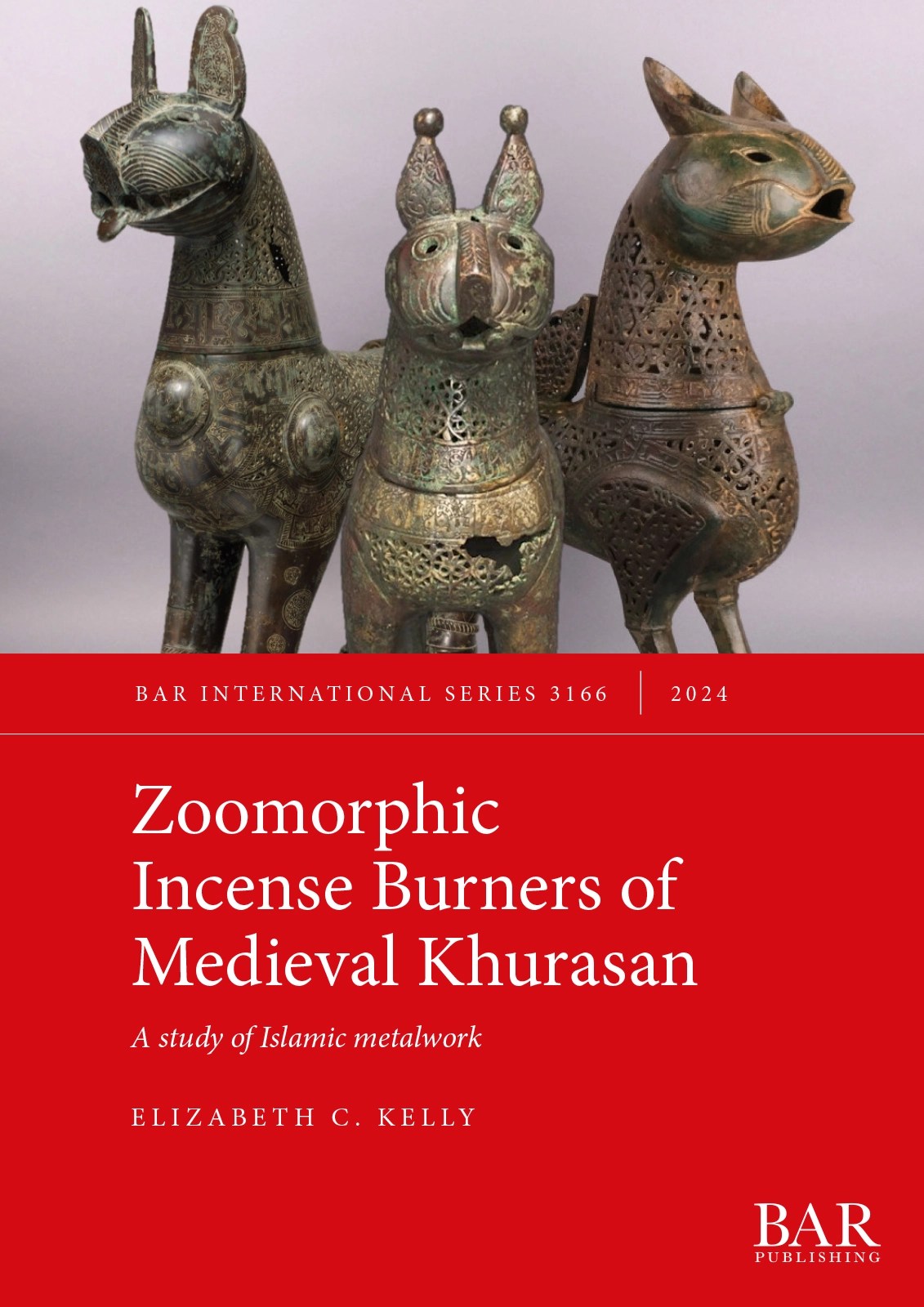
Publication – Elizabeth C. Kelly, « Zoomorphic Incense Burners of Medieval Khurasan. A study of Islamic metalwork »

Zoomorphic incense burners were produced in medieval Khurasan between c.441-597/1050-1200. This book examines their role, function and meaning. It includes a database with defined classification criteria that enables them to be contextualised with other contemporaneous metalwork.

Multicultural medieval Khurasan prospered from mercantile activities facilitated by the trade routes. The increased wealth, including middle-class patronage, movement of artisans and goods, along with the resultant transcultural exchanges, all contributed towards a changing aesthetic in artwork that reflect interests and lifestyles. The zoomorphic incense burners that emerged during this time displayed a hybridised iconography of feline and equine characteristics. The analysis indicates they are associated with symbols of power, sovereignty, the military and hunting. Their decorative palmette motifs provide representations of esfand, a plant considered to have talismanic and apotropaic properties known for inducing bravery amongst warriors.

Elizabeth C. Kelly has a PhD in History of Art and Archaeology and a Master’s in History of Art and Architecture of the Islamic Middle East from SOAS University of London.

Table des matières : ici

Elizabeth C. Kelly, Zoomorphic Incense Burners of Medieval Khurasan. A Study of Islamic Metalwork, Oxford, BAR Publishing, 2024 ; 1 vol., 360 p. (International Series). ISBN : 978-1-40735-368-5. Prix : GBP 98,00.

Source : BAR Publishing

Publié dans Publications | Laisser un commentaire

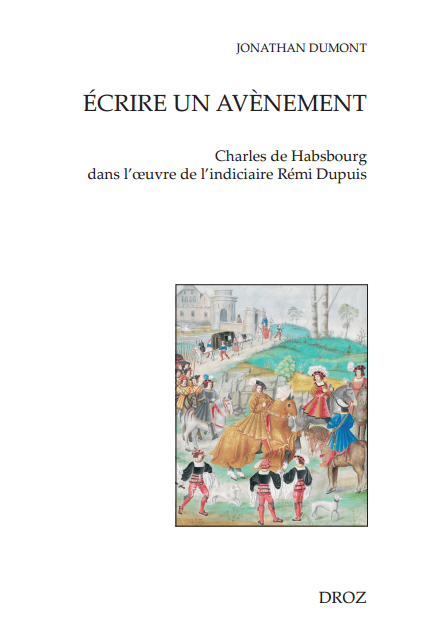
Publication – Jonathan Dumont, « Écrire un avènement. Charles de Habsbourg dans l’œuvre de l’indiciaire Rémi Dupuis »

Le 5 janvier 1515, en la grande salle du palais du Coudenberg à Bruxelles, Charles de Habsbourg atteint sa majorité politique, devenant pleinement souverain des Anciens Pays-Bas. Débute ainsi, de 1515 à 1517, une ascension fulgurante qui va lui conférer une envergure continentale. Jonathan Dumont nous éclaire ici sur la manière dont l’avènement de Charles a été mis en récit et commenté dans les Anciens Pays-Bas, durant les années qui précèdent l’élection impériale (1519), en particulier dans l’œuvre de Rémi Dupuis, dernier « indiciaire de Bourgogne ». Son œuvre, tout entière dédiée à la célébration de Charles de Habsbourg, est le témoin privilégié du passage de la dynastie de Bourgogne-Habsbourg à une autre échelle de pouvoir. Tout en proposant une étude historique et littéraire de l’œuvre de Dupuis, cet ouvrage fournit également au lecteur une édition de son œuvre conservée, jusqu’ici inédite.

Docteur en histoire, art et archéologie, Jonathan Dumont est chercheur à l’Académie des Sciences d’Autriche et à l’Université de Liège. Il s’intéresse à l’histoire politique et à l’histoire des idées politiques dans l’Europe de la Renaissance, en particulier au sein de la Monarchie des Habsbourg.

Un prince, son indiciaire, leur récit

Une oeuvre pour ouvrir un règne

Rémi Dupuis, dernier indiciaire de Bourgogne

La tryumphante et solemnelle entree (1515) Une entrée princière sous forme de chronique Justifier la monarchie de Habsbourg Remodeler le portrait du prince Un rapport de force déséquilibré Établissement du texte

Les exeques et pompe funerale (1516) Ferdinand d’Aragon, miroir de vertu Le programme politique d’une monarchie nouvelle Des funérailles antiques et chrétiennes Le rituel de transmission du pourvoir: une innovation symbolique Établissement du texte

S’ensuyt une description poetique (ca 1517) La cour mythifiée Créer la monarchie, créer la nation L’armada, une utopie monarchique Établissement du texte

Principes d’édition

Abréviations et sigles

La tryumphante et solemnelle entree (1515)

Les exeques et pompe funerale (1516)

S’ensuyt une description poetique (1516)

Index personnae et rerum

Glossaire

Figures

Bibliographie

Jonathan Dumont, Écrire un avènement. Charles de Habsbourg dans l’œuvre de l’indiciaire Rémi Dupuis, Genève, Droz, 2024 ; 1 vol., 320 p. (Cahiers d’Humanisme et Renaissance, 201). ISBN : 978-2-600-06555-9.

Source : Droz

Publié dans Publications | Laisser un commentaire

Offre d’emploi – Gutenberg University Mainz Academic staff member in Art History

Johannes Gutenberg University Mainz (JGU) is one of the largest universities in Germany. Thanks to its location in the Rhine-Main science region, the university can unfold to its full potential and showcase its innovative power and dynamism. Its status as a comprehensive university allows for multidisciplinary learning and teaching and has great potential for internationally renowned, interdisciplinary research. Almost all of its institutes are located on a single campus close to the Mainz city center – creating a lively academic culture for researchers, teaching staff, and students from every continent.
Faculty 07: History and Cultural Studies / Institute of Art History and Musicology
Academic staff member in Art History
Full-time (100 %)

The Department of Art History at Johannes Gutenberg University Mainz with currently four professorships represents the discipline in its full width from the Middle Ages to the present in all genres with an interdisciplinary and transregional orientation. The advertised position complements teaching, research and administration. The teaching duties of 8 SWS cover introductory courses as well as in-depth seminars and other teaching formats. In addition, permanent responsibilities include study advice, support for international students and administration.

Your tasks:
■ Collaboration in research according to the orientation of the department
■ Teaching in the area of introductory courses of the Bachelor’s degree programme, seminars of the Master’s degree programme and other course formats in the scope of 8 SWS
■ Advising, especially in the Bachelor’s degree programme and international students
■ Supervision of final examinations and examination coordination
■ Work in the administration, budget management of the Department of Art History
■ Student recruitment
■ Academic organisation and communication
Your profile:
In addition to the general requirements according to public services law, applicants must meet the recruitment requirements stipulated in § 57 of th Hochschulgesetz of Rhineland-Palatinate.
■ Excellent university degree in art history or a related field (Master level)
■ A very good doctorate in a field relevant to the position
■ Post-graduation full-time work experience of at least,2.5 years
■ A strong academic profile related to the Institute’s areas of expertise
■ Several years of teaching experience in B.A. and M.A. seminars in art history with a proven teaching profile

Desirable are:
■ Interest in methodological questions and the history of art historical scholarship
■ Experience in the field of digital humanities
■ Very good knowledge of written and spoken German and English
■ Experience in administration and budgetin

What we have to offer:
■ Stimulating international and interdisciplinary, working environment
■ Collegial cooperation in a committed team
■ Jobticket, optional for the entire Rhine-Main area
■ Extensive human resources development offer

The position is paid according to EG 13 TV-L and to be filled from 01/11/2024 on. The position is permanent.
JGU is diverse and welcomes qualified applications from people with varied backgrounds.
We aim to increase the number of women in the field of research and teaching and therefore encourage female researchers to apply.
Candidates with severe disabilities and appropriate qualifications will be given priority.

Submit your complete application [cover letter, CV, relevant (work) certificates (with German recognition if applicable)] until 22/09/2024, preferably via the „Apply now“ button.
For questions and further information please contact
Univ.-Prof. Dr. Gregor Wedekind:
gregor.wedekind@uni-mainz.de

Data protection information
Apply now

Source : Blog de l’ApAhAu

Publié dans Offre d'emploi | Laisser un commentaire

Appel à contribution – British Archaeological Association sponsored sessions at the International Medieval Congress (Leeds)

The BAA is now welcoming paper proposals for the BAA-sponsored sessions at the International Medieval Congress, which will take place at the University of Leeds (7th-10th July 2025).

The IMC’s research theme for 2025 is ‘Worlds of Learning’ and the IMC’s suggested themes include, but are not limited to:

  • Ideals, practices, and rituals of teaching and learning
  • Gendered ideals of learning and gender in learning
  • Pedagogical techniques for different age groups
  • Technical and artisanal knowledge
  • Oral transmission, practice, and performance in learning processes
  • Medieval epistemologies and systematisations of knowledge
  • Religious conceptualisations and interpretations of learning
  • Forms of learning and/about the self
  • Languages and their role in the acquisition of learning
  • Representations of learning in literature and art
  • Learning materials, including instructional objects, texts, images, and diagrams
  • Schools and universities and their local and regional networks
  • Financial and political networks supporting communities of learning
  • Lieux de savoir and locales of learning, including (permanent or situational) material and spatial arrangements
  • Printing and publishing learned materials
  • Distribution and circulation of knowledge traditions (Digitally) Mapping intellectual networks
  • Cross-cultural and interreligious learning
  • Cultural transfer and cultural appropriation
  • Different national and confessional/religious historiographies of learning, their continuing impact, and their problems

A full list of suggested topics and more details can be found here: https://www.imc.leeds.ac.uk/imc-2025/ 

It is hoped that we can organise several sessions, with similar papers grouped together (either methodologically or by subject). Before submitting a proposal, please ensure you have familiarised yourself with the conference fees and the available bursaries for the IMC, details of which are available here: https://www.imc.leeds.ac.uk/imc-2025/proposals/bursary 

Proposals should consist of a paper title, your affiliation (if any), your contact details, and a short abstract (50-100 words). Please send paper proposals to Harriet Mahood (hpmahood@gmail.com) by Friday 20th September 2024.

Source : Medieval Art Research

Publié dans Appel à contributions | Laisser un commentaire