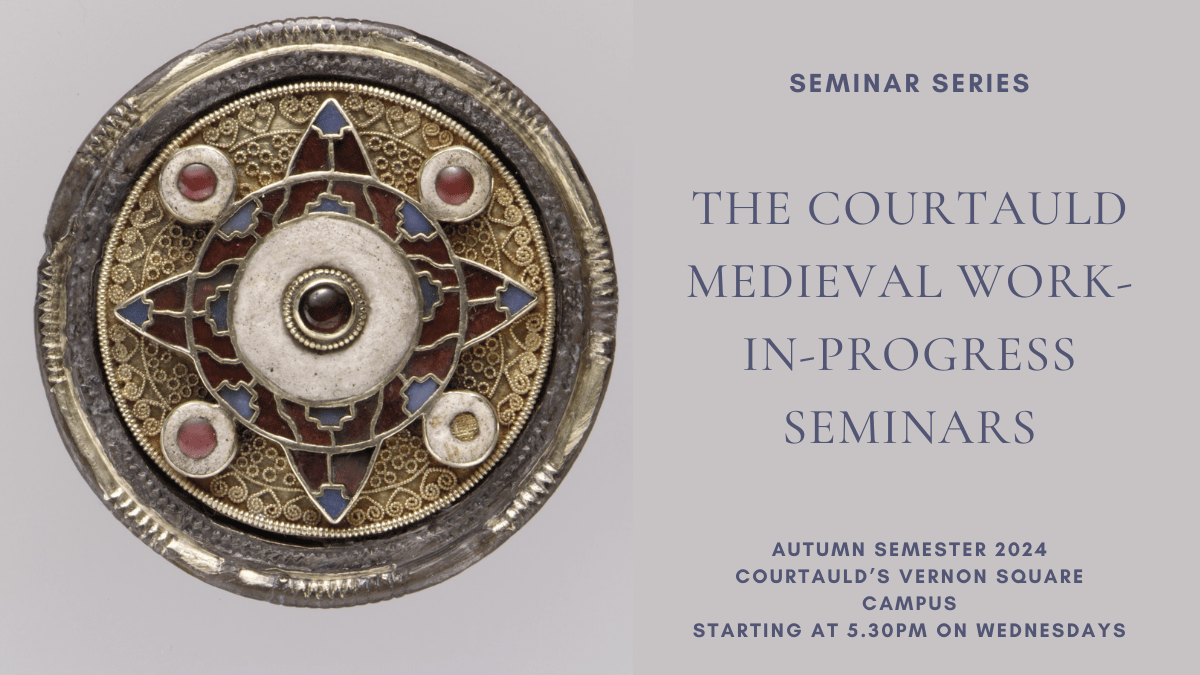
Seminars are free and open to all. They are held in the Research Forum of The Courtauld Institute of Art’s Vernon Square campus, starting at 5.30pm on Wednesdays.
Autumn Seminar Programme:
9th October 2024: Helen Gittos (Oxford), ‘Christianity before Conversion’
23rd October 2024 (Paul Crossley Memorial Lecture): Gabriel Byng (Vienna), ‘The Four Walks of the Cloister: Paradise and Practice in the Medieval Monastery’
20th November: Evelin Wetter (Abegg-Stiftung): ‘“Material Illusionism”: On the oeuvre of Hans Plock, court embroider to Cardinal Albrecht of Brandenburg’
Adelsporträts sollen beim VII. Kolloquium des Deutsch-Niederländischen Adelskreises für Adelsgeschichte thematisiert werden – an einem Originalschauplatz, (möglichst Schloss Nordkirchen), wo eine bedeutende adelige Porträtsammlung zu sehen ist.
Die Tagung soll Adelsbildnisse in jeglicher Form, in diachronen und synchronen Perspektiven behandeln: Gemälde, Stiche, Skulpturen, Silhouetten, Fotografien, ihre kulturellen Kontexte vom Mittelalter bis zur Gegenwart, beispielsweise Sammlungen von Familienbildern, Potentaten und Netzwerken, adelige Selbstdarstellung und Außensichten, Porträts in Stammbüchern und Alben. Wie ist eine Ahnengalerie strukturiert, ist die Vorfahrensammlung auch eine Vorbildersammlung oder „nur“ Abbild der Familie? Wie wird adeliger Habitus, Lebensweise, Kleidung, Distanzierungsverhalten sichtbar gemacht? Was sagen Bildnisse über Berufe aus? Was macht das adelige Damen- und Kinder-Bildnis aus? Wie werden die Bilder präsentiert, was charakterisiert eine adelige Bildnisgalerie? Wie geht man mit Bildnissen prominenter Familienmitglieder um, wie mit den „schwarzen Schafen“ einer Familie? Lassen sich anonyme Bildnisse identifizieren, gibt es falsch identifizierte Bildnisse in Adelsbesitz? Was lässt sich aus der schriftlichen, archivischen Überlieferung feststellen, etwa aus Inventaren und Rechnungen? Geben Adelstheorien und Adelsspiegel Normen für den Umgang mit Bildnissen vor?
Themen mit Bezügen zu den Deutsch-niederländischen Grenzregionen sind besonders willkommen, es sollen aber auch überregionale und internationale Bezüge hergestellt werden. Die Vorträge können auf deutsch, niederländisch und englisch gehalten werden.
Meldungen mit einem ca. 15-20zeiligen Abstract und kurzer Vita sind bis zum 15. Oktober 2024 erbeten.
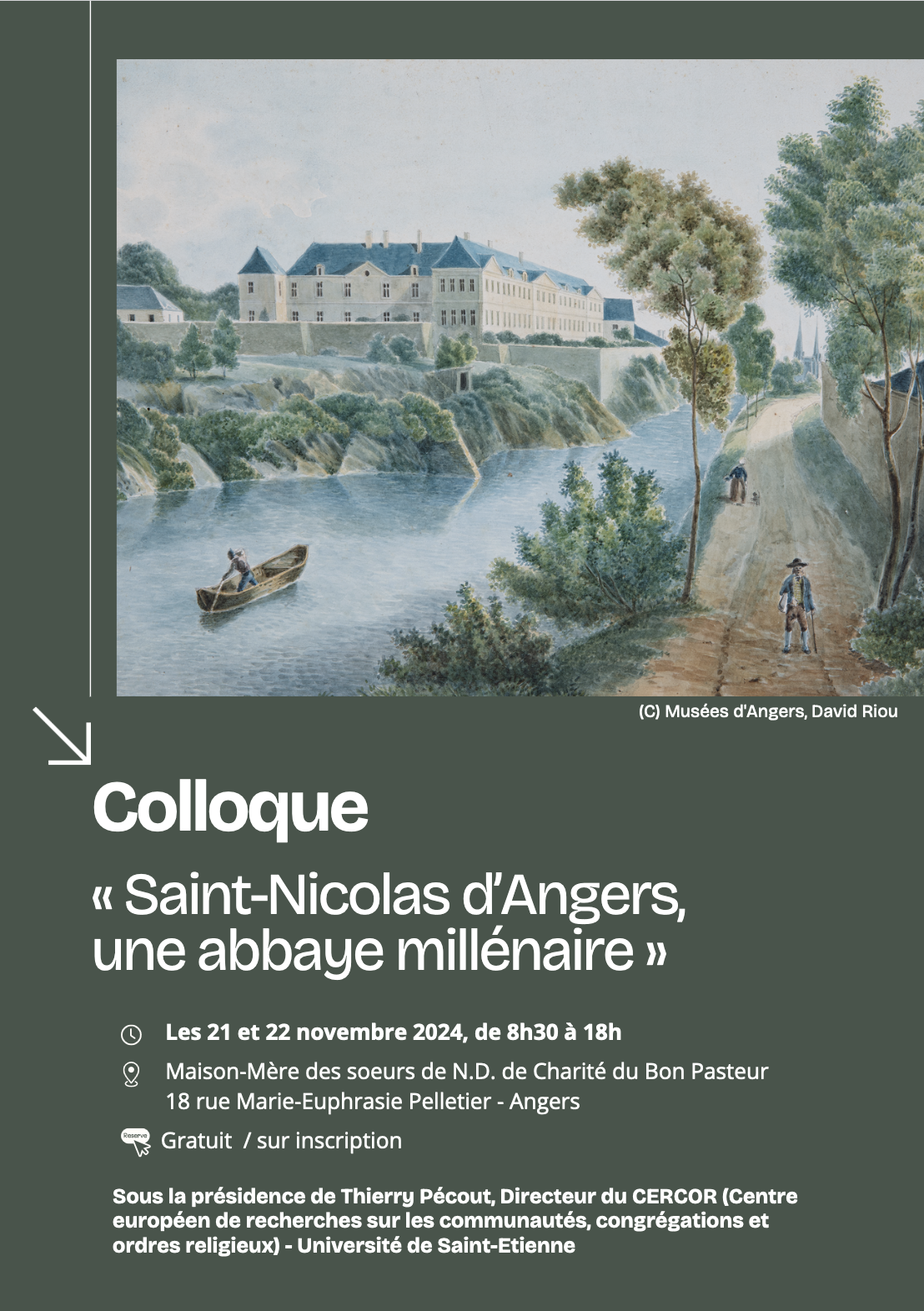
Ce colloque entend faire un état des lieux des travaux existants et mettre en lumière de nouvelles perspectives de recherche, en croisant différentes disciplines (histoire, histoire de l’art, archéologie). Le programme s’attachera à retracer la vaste histoire de ce monument, de sa fondation par Foulque Nerra pour des moines bénédictins à son rachat par les sœurs de Notre-Dame de Charité du Bon Pasteur au XIXe siècle, en passant par sa réforme par la congrégation de Saint-Maur au XVIIIe siècle. Cette rencontre accordera une large place aux recherches menées depuis les années 1950 sur l’histoire et le site archéologique et valorisera les sources archivistiques et bibliographiques encore méconnues. Elle posera aussi les questions de l’avenir de ce lieu.
Programme :
Jeudi 21 novembre 2024
Accueil 8h30
9h Introduction « Une abbaye médiévale « dans et hors la ville d’Angiers » » par François Comte, conservateur en chef du patrimoine aux musées d’Angers
Origines et sources
Présidence d’honneur et de séance : Thierry Pécout, directeur du CERCOR
9h20 « Saint-Nicolas d’Angers : les péripéties d’une fondation (vers 1020 – vers 1040) », Guy Jarousseau, maître de conférences en Histoire médiévale à l’Université catholique de l’ouest – Angers ; Centre de recherche Humanités et Sociétés (CHUS-UCO) ; LEM (Laboratoire d’Études sur les Monothéismes) CNRS – UMR 8584 – Campus Condorcet
9h45 « La constitution du patrimoine de l’abbaye aux XIe et XIIe siècles », Noël-Yves Tonnerre, professeur émérite d’histoire médiévale de l’université d’Angers
10h10 « Les manuscrits liturgiques de l’abbaye Saint-Nicolas d’Angers », Laura Albiero, chercheure à la Schola Cantorum Basiliensis
11h « Le chartrier de l’abbaye aux Archives départementales du Maine-et-Loire », Élisabeth Verry, directrice honoraire des Archives départementales de Maine-et-Loire
11h25 « Témoignages de l’ameublement de l’abbaye Saint-Nicolas d’Angers aux XVIIe et XVIIIe siècles », Anna Leicher, conservatrice des antiquités et objets d’art à la Conservation départementale dupatrimoine
11h50 questions, échanges
12h15 déjeuner
Architecture et archéologie
Présidence de séance : Emmanuel Litoux,responsable du pôle archéologie à la Conservation départementale du patrimoine
14h « L’abbaye Saint-Nicolas 1020-2020 : proposition pour un millénaire d’évolution du bâti », Tiffanie Le Dantec, architecte du patrimoine, docteur en histoire, chargée de patrimoine à la Ville d’Angers
14h25 « Quelques apports de l’archéologie à la connaissance de l’abbaye Saint-Nicolas », Jean Brodeur, archéologue à l’Inrap (institut national de recherches archéologiques préventives)
15h10 « L’abbatiale enfouie », Daniel Prigent, conservateur en chef honoraire du patrimoine
15h35 « Comprendre l’abbaye à travers sa parure sculptée », Bénédicte Fillion-Braguet, chercheuse indépendante – associée au CESCM UMR 7302 –Université de Poitiers
16h questions, échanges
16h30-18h Visite guidée de l’abbaye Saint-Nicolas
Vendredi 22 novembre 2024
L’abbaye et la réforme mauriste
Présidence de séance : Nathalie Le Luel, maîtresse de conférences en Histoire de l’art à l’UCO
9h « L’abbaye Saint-Nicolas d’Angers dans la congrégation de Saint-Maur et dans la province de Bretagne : prieurs et communauté », Daniel-Odon Hurel, directeur de recherche auCNRS, directeur du Laboratoire d’excellence Histoire et anthropologie des savoirs, des techniques et des croyances (LABEX HASTEC), directeur-adjoint du LEM (UMR 8584)
9h25 « La congrégation de Saint-Maur dans l’ancien diocèse d’Angers : contextes de la réforme et destinées nouvelles des établissements monastiques », Dom Thierry Barbeau, moine bénédictin de l’abbaye Saint-Pierre de Solesmes
9h50 « Entre héritage et réforme : l’église de Saint-Nicolas d’Angers dans la congrégation de Saint-Maur », Pierre-Marie Sallé, docteur de l’École pratique des hautes études, chercheur associé au CERCOR (CNRSUMR 8584)
10h40 « Réflexions sur les décors de quelques abbayes mauristes du Maine-Anjou », André Lévy, agrégé d’histoire, docteur en histoire, directeur de La Province du Maine
11h « Faire de l’histoire à Saint-Nicolas d’Angers (XVIIe-XXe s.), de l’érudition bénédictine moderne aux notices historiques contemporaines », François Comte, conservateur en chef du patrimoine aux musées d’Angers
11h25 questions, échanges
12h déjeuner
De la Révolution à aujourd’hui
Présidence de séance : Marc-Édouard Gautier, directeur de la Bibliothèque municipale d’Angers
13h45 « Au cœur de la guerre civile, l’abbaye de Saint-Nicolas, une prison de Vendéennes à Angers sous la Révolution française (1793-1794) », Anne Rolland-Boulestreau, professeur d’Histoire moderne à l’UCO
14h10 « Des laïcs aux limites de l’abbaye Saint-Nicolas : la maison de la Garenne et la chapelle funéraire », Étienne Vacquet, conservateur du patrimoine à la Conservation départementale du patrimoine
14h55 « Paradoxes à l’étang Saint-Nicolas. Un nouveau parc public, entre projets urbains et préservation de la nature », Sylvain Bertoldi, archiviste-paléographe, directeur des Archives patrimoniales de la ville d’Angers
15h20 « Le rachat par la congrégation Notre-Dame de Charité du Bon Pasteur, un nouveau départ pour l’abbaye », Sarah Elbisser et Sibylle Gardelle, responsable du patrimoine et archiviste à la congrégation Notre-Dame de Charité du Bon Pasteur
15h45 questions, échanges
16h10 Perspectives, par Gabriel Turquet de Beauregard, architecte des bâtiments de France, conclusion par la congrégation Notre-Dame de Charité du Bon Pasteur
16h30-18h Visite guidée de l’abbaye Saint-Nicolas
Informations pratiques :
21-22 novembre 2024
Salle Neuville – Maison mère des soeurs de N.D de la charité du bon padteur 18, rue Marie-Euphrasie Pelletier Angers, France (49100)
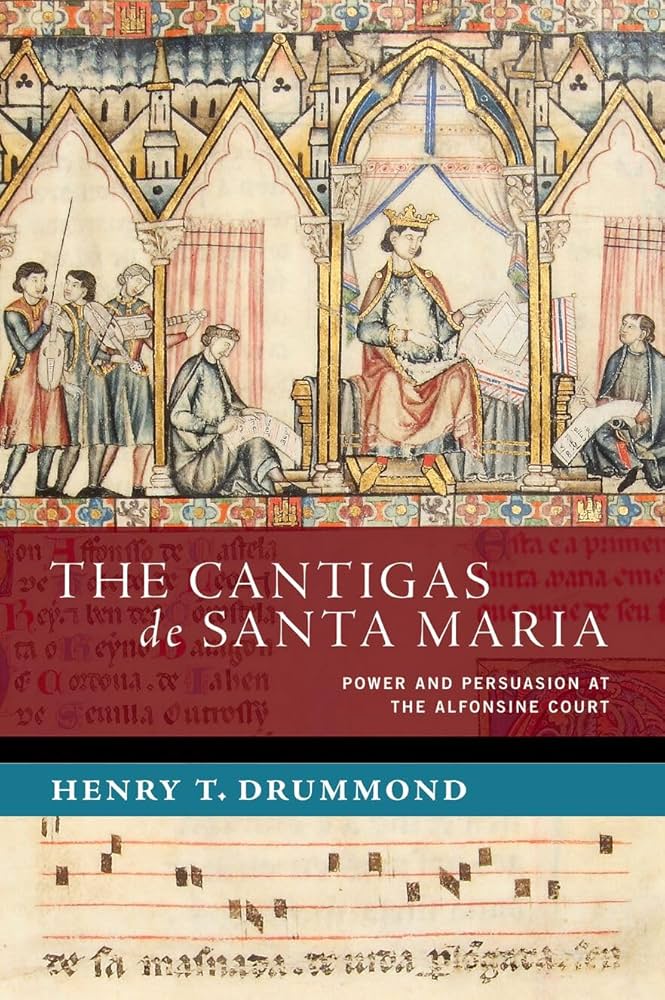
Alfonso X (1221-84) ruled over the Crown of Castile from 1252 until his death. Known as « the Wise, » he oversaw the production of a wealth of literature in his scriptorium. One of the most impressive of these literary outputs is the collection of songs known as the Cantigas de Santa Maria, which by most counts comprises 429 songs preserved in four manuscripts. The miracle songs (or cantigas de miragre) form the focus of this book. While the Cantigas have been the subject of much scholarly attention, only a handful of studies have looked at the repertory through an interdisciplinary lens. Fewer still have probed how the Cantigas use the power of song as a communicative medium, one that functions as a social tool within the erudite environment of the Alfonsine court.
This book offers a new perspective to the song collection, probing how the Cantigas use their music and text, together with rhetorical devices, to communicate with their desired audience. Author Henry T. Drummond builds upon previous methodologies, adopting a novel and holistic assessment of the songs’ melodies, poetic features, and narrative logic to assess a wide selection of songs. He presents a nuanced understanding of a song form that effectively conveys its narratives to its listeners via a diverse combination of tools, embracing medieval rhetoric, rhyme-based play, and song’s inherent ludic potential. Such devices, Drummond argues, allow for the Cantigas to loom large as propaganda pieces, designed to dignify Alfonso X through an elaborately devised courtly ritual.
Henry T. Drummond is a postdoctoral researcher at the KU Leuven and a participant in the cross-institutional « Sound of Music » FWO-funded project, which analyses and valorizes large bodies of liturgical chant repertory through digital technology. He completed his DPhil in Music in 2018 at the University of Oxford. His research interests include vernacular song of the later Middle Ages, musical mobility across medieval Europe, music and liturgy, and digital humanities.
Table des matières :
List of Figures List of Tables List of Abbreviations A Note to the Reader Preface Chapter 1 Songs of Persuasion Chapter 2 Sung Rhetoric Chapter 3 The Place of Rhyme Chapter 4 Three Jewish Conversion Songs Chapter 5 Cantigas and Image-Building Chapter 6 Crusades and Kingship Epilogue Bibliography Index
Informations pratiques :
Henry T. Drummond, The Cantigas de Santa Maria. Power and Persuasion at the Alfonsine Court, Oxford, Oxford University Press, 2024 ; 1 vol., 304 p. (New Cultural History of Music). ISBN : 978-0-19767-059-0. prix : GBP 71,00.
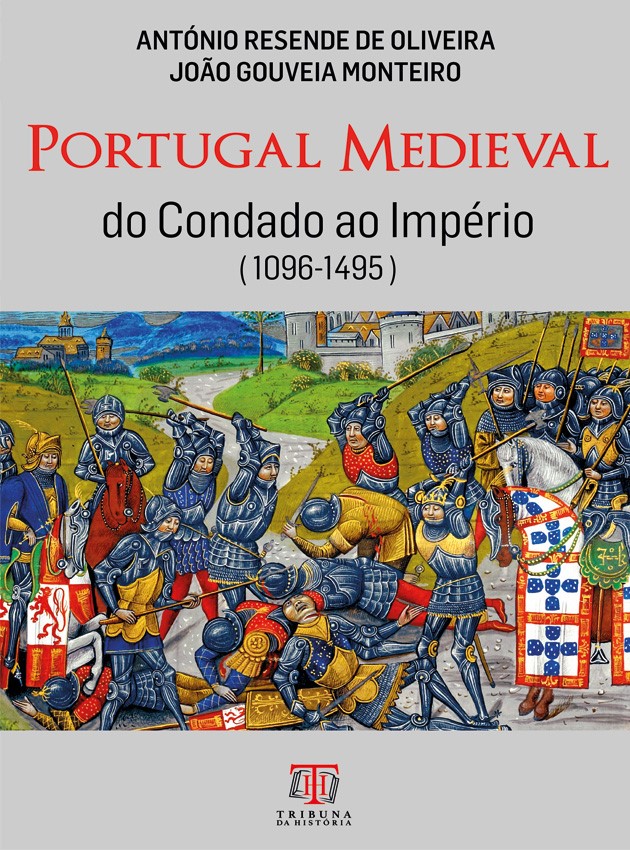
Este livro é uma síntese didática da história medieval portuguesa, desde os tempos remotos da fundação do Condado Portucalense até ao início da grande aventura dos Descobrimentos e à inerente construção de um Império no além-mar.
Por abarcar uma cronologia tão ampla (1096-1495) considerou-se preferível centrar a narrativa sobretudo nos acontecimentos políticos que permitirão aos leitores compreender com maior facilidade quais foram os momentos mais importantes na formação do reino de Portugal e do seu território, na construção do Estado, e no seu desenvolvimento e expansão. No entanto, não foram esquecidos os aspectos mais relevantes do contexto económico e social, e dedicou-se uma atenção especial à cultura. Em todos os capítulos, enquadra-se a história medieval portuguesa no contexto ibérico.
Para apoiar o relato, servir de base a futuras investigações e respeitar o espírito didático da obra, inclui-se também uma extensa bibliografia , uma extensa cronologia, uma tabela dos Reis de Portugal, um glossário e um amplo conjunto de ilustrações e mapas explicativos.
Informations pratiques :
António Resende de Oliveira, João Gouveia Monteiro, Portugal medieval. Do condado ao império (1096-1495), Lisbonne, Editoria Tribuna da Historia, 2024 ; 1 vol., 408 p. ISBN : 978-9-89821-968-8. Prix : € 25,50.
Call for Papers, International Medieval Congress (Leeds) 2025, 7-10 July 2025
In recent years, scholars have begun to revisit sources from Late Antique and Merovingian Gaul from a perspective of intellectual history. Scholars including Danuta Shanzer, Helmut Reimitz, Philip Wynn, Guy Halsall, and Yaniv Fox have drawn attention to the ways in which Late Antique and Medieval authors such as Gregory of Tours, the anonymous author of the Liber Historiae Francorum, and Venantius Fortunatus constructed history. This post-structuralist approach argues that the consumption and production of history is malleable, as it is highly dependent on the subjective worldviews of the author and audience. Thus, analysing how authors interpreted and narrated events of the distant and recent past, and the ways in which they spoke about the future and its potentialities, can unlock the individual worldviews of those who constructed these foundational texts ﹘ some of which contain the only accounts we have of their era.
We intend to submit a three to four-strand session to the IMC 2025 entitled ‘Narrating Gender and Temporality in Late Antique and Merovingian Gaul: 300-750 AD’. In this series of panels, we will extend this existing work by focusing specifically on the relationship between gender and temporality. The ways in which authors conceptualised time, either as something that is malleable or fixed, linear or layered, shaped the way they narrated gendered histories. In like manner, each individual’s theories on gender were inherently linked to time, whether past texts or people that informed these opinions, contemporary models, or beliefs about the afterlife of individuals and the eventual apocalypse of mankind.
We encourage participants to consider how a narratological approach to Late Antique and Merovingian texts, whether literary or non-literary, anonymous or clearly authored, can offer a new angle on the significance and mutability of gender performance, expectations and potentials in the past, present, and future of Gallic thinkers and their various imagined and intended audiences. To do so, we encourage participants to think about the specific techniques used, and how these shape the relationship between gender and temporality or construct gendered temporalities. These techniques can include the manipulation of chronology, authorial intrusion, and naming and namelessness, and reveal the unspoken theories and frameworks which underpin an author’s thinking.
We are particularly interested in pagan, Christian, and Jewish narratives and stories that relate to life cycles, the afterlife, intercession, and the ways in which the spiritual and secular collide in fatal moments or moments of trial. However, we are also interested in other suggestions and ideas that speak to the theme of gendered temporality and what that could entail. Some suggested questions are: How does the lens of gender change the way we (and other audiences) read such narratives? How do narrative techniques (such as omission or digression) comment on or emphasise gendered temporalities? What is the relation of fate, gender, agency and predestination in these narratives? We invite all interested scholars of Late Antique and Merovingian Gaul to submit their proposals for consideration by 8 September 2024. Replies will be returned within approximately one week.
Our intention is to turn these conference proceedings into a special edition in subsequent years. More detail will be given on this closer to the time.
What we are looking for:
250-word proposal abstract
Please include how your proposal relates to the narration of both gender and temporality.
Proposals must demonstrate a topic primarily related to Late Antique or Merovingian history in the time period from 300-750 AD. While we will consider topics that offer a comparative approach to other periods, preference will be given to topics that primarily focus on the period outlined.
Your university affiliation, position (i.e. PhD, Postdoc, Lecturer, Professor), and preferred email address (ideally one that will remain active for the next year).
Whether you wish to attend the IMC virtually or in person, and any accessibility needs
N.B. Presenters will need to secure their own funding to attend the Leeds IMC. We advise all applicants with insecure funding backgrounds to consider applying for the IMC bursary scheme.
Nördlich der Alpen ist König Manfred eher ein Unbekannter. Ein sizilischer König mit so einem Namen? Ja, der Urenkel Friedrich Barbarossas. Ach so, aha. Südlich von Rom hingegen ist die Erinnerung an Re Manfredi lebendig. Straßen und Plätze sind ebenso nach ihm benannt wie Bars, Hotels und Pizzerien, es gibt Wein, der seinen Namen trägt, und die herzhafte Torta di Re Manfredi. Ein Sympathieträger, der tragisch ums Leben kam. Ganz in der Nähe ist ein Kastell von Manfred, hier in der Kirche soll er auch gewesen sein … Wer auf den Spuren Manfreds im ehemaligen Königreich Sizilien unterwegs ist, wird gern ein wenig ausgefragt, erntet erfreutes Erstaunen, kann Anekdoten lauschen. Ach, es soll um die Grafen an Manfreds Seite gehen? Auch da sind einige Namen bekannt: Corrado d’Antiochia, Galvano Lancia, Manfredi Maletta. Sie wirken wie strahlende Ritter: mutig, edel, treu, musikalisch. Doch welche Aufgaben übernahmen diese Adeligen im Königreich Sizilien, in diesem durchorganisierten „Modellstaat“, in dem es für die Verwaltung doch eigens eingesetzte Funktionsträger gab? Was unterschied die Grafen von anderen Adelsgruppen, was verband sie untereinander? Wozu benötigte der Herrscher sie, wenn er sie doch ebensogut ein- wie absetzen konnte? Und wer gehörte überhaupt zu diesem prekär-illustren Kreis?
Um eine Studie über einen Teilbereich der Organisation des Regni Siciliae am Ende des Hochmittelalters – in Person der Grafen – anfertigen zu können, müssen verschiedene Spezifika dieses Königreiches beachtet werden: 1) das noch vergleichsweise junge Königtum und die vielfältigen kulturellen Einflüsse in der Region; 2) die gut organisierte Verwaltungsstruktur; 3) die – von den Königen nicht zwingend anerkannte – Lehnshoheit des Papstes. Alle diese Aspekte hängen mit der Thematik der Grafen und Grafschaften zusammen: sie wirkten auf die Lehensstruktur und die Verankerung der Adligen in ihrer Region; sie konnten Anreize für die Ausgestaltung von Ämtern und Würden geben; sie gaben das organisatorische Gefüge vor, in welches die Grafen als eine von verschiedenen Gruppen eingegliedert waren; sie boten den Großen des Königreiches eine Alternative, indem neben der königlichen auch die päpstliche Autorität ins Feld geführt werden konnte.
So spielen also sowohl im Reich als auch in (Ober-)Italien wieder die bekannten Faktoren Amt, Erblichkeit, militärische Zuständigkeit, Gerichtsbarkeit und Veränderlichkeit eine Rolle. Die Grafen waren im Reich anderen Adelsgruppen nachgeordnet, jedoch machten die Grafen im Untersuchungszeitraum die ranghöchste Adelsgruppierung im Regno Siciliae aus. Es gab im Mezzogiorno weder Herzöge noch Markgrafen und der einzige Fürst war Manfred selbst, bis dieser Titel unter Konradin bzw. den Anjou wieder anzutreffen ist. Die Inhaber der sizilischen Lehen waren die comites, im Rang gefolgt von den barones und den milites. Diese drei Gruppen von sizilischen Lehensträgern unterstanden aufgrund der Art ihres Lehens direkt dem Herrscher. An der Spitze dieser Rangfolge standen die Grafen. Jenseits der Titulatur sind die Grenzen in der Rangordnung allerdings nur schwer zu ziehen. In der Forschung finden sich zwar einige Kriterien für die weitere Hierarchisierung der Lehensinhaber, doch sind diese eher weicher Natur.
Welche Rolle übernahmen also die Grafen, um die seit dem Tod des Kaisers so gerungen wurde, deren Position dabei jedoch stets vom Wohlwollen des Regenten abzuhängen schien und die dennoch an der Spitze der Adelshierarchie standen, im Königreich Sizilien? Handelte es sich vor allem um eine Auszeichnung oder waren mit der Grafenwürde auch konkrete Rechte und Pflichten verbunden? Zunächst wird zu fragen sein, um wen sich die um den Vorrang im Regno streitenden Kräfte bemühten. Und andersherum: auf welche Seite schlugen sich die Grafen, zu welchen Zeitpunkten wechselten sie die Fronten? Wer – und dies gilt es, sowohl auf der Herrscher- als auch auf der Adelsebene zu betrachten – profitierte von den Erhebungen? Was zeichnete diese Adligen aus, waren sie besonders einflussreich, besonders fähig, hegten sie eine besonders enge Beziehung zum Herrscher, worauf gründeten sich also die Ansprüche auf einen Grafentitel? Mit welchen Aufgaben wurden sie betraut und wo hielten sie sich auf? Auch nach dem Verschwinden der Staufer im Regno stellte sich für die Grafen erneut die Frage der Anerkennung und der Parteinahme. Waren sie in der Lage, ihre gesellschaftliche Position zu verteidigen? Welche Möglichkeiten standen ihnen als Anhänger Manfreds überhaupt noch offen?
Neben strukturellen Fragen soll auch dem gräflichen Urkundenwesen Aufmerksamkeit zuteil werden. Über die gräflichen Aktivitäten und das Itinerar hinaus stellen sich hier Fragen nach der formalen Gestaltung. Traten die Grafen hier durch die Anwendung bestimmter Symbole, Formate, eines einheitlichen formalen Aufbaus u. ä. als geschlossene Gruppe auf? Wer schrieb die Urkunden eines Grafen? Was lässt sich anhand der verwendeten Formeln über die politische Parteinahme der Grafen ableiten? Am Ende steht der Versuch, die Gruppe der sizilischen Grafen zu charakterisieren, ihren Platz und ihre Funktion im Gefüge des Königreiches zu bestimmen.
Informations pratiques :
Marie Ulrike Jaros, Aristokratie auf Abruf. Die Grafen und Gräfinnen Manfreds von Sizilien, t. 1, Text, t. 2, Katalog und Verzeichnisse, Leipzig, Eudora Verlag, 2023 ; 2 vol., 276 p. + 276 p. (Italia Regia, 7). ISBN : 978-3-938533-71-0. Prix : € 139,00.
Pour leur 36e édition, les Journées européennes du Patrimoine en Wallonie se veulent plus inclusives que jamais. Nous avons choisi de mettre en lumière un public cible qui mérite toute notre attention : les personnes à besoins spécifiques. Que vous soyez une personne à mobilité réduite, sourde ou malentendante, aveugle ou malvoyante, ou encore que vous présentiez des difficultés de compréhension, cette édition est pensée pour vous. Cette démarche vise à rendre le patrimoine accessible à tous. Les sites participants, qu’ils se déclarent adaptés ou qu’ils renforcent leur accessibilité pour l’occasion, seront marqués du pictogramme « public cible 2024 ». Ce dernier est plus qu’un simple indicateur : il témoigne de notre engagement à faciliter l’accès aux richesses patrimoniales de notre région pour tous les publics, sans exception. Les Journées du Patrimoine sont une occasion unique de célébrer la diversité de notre patrimoine, qui reflète l’histoire et la culture de la Wallonie. En ouvrant ces trésors à un public plus large, nous reconnaissons et valorisons les richesses liées à la diversité humaine. Notre patrimoine est un témoin des échanges, des influences et des connexions qui ont façonné notre société. En le rendant accessible à tous, nous soulignons l’importance de l’inclusion et de la diversité dans notre héritage culturel. L’importance de cette initiative s’étend au-delà de nos frontières. À travers le monde, des efforts similaires montrent l’impact positif de l’inclusion dans les domaines culturels. Par exemple, le Louvre à Paris a mis en place des visites tactiles pour les personnes aveugles et malvoyantes, permettant à ces visiteurs de toucher des reproductions de sculptures célèbres. En Australie, la National Gallery à Victoria a développé des programmes pour les enfants autistes, en créant des espaces sensoriels et des visites adaptées pour répondre à leurs besoins spécifiques. Ces efforts internationaux nous rappellent que l’accessibilité est un droit fondamental et une valeur universelle. En Wallonie, nous sommes déterminés à suivre cette voie, en collaboration avec des experts et des organisations locales, pour offrir des expériences enrichissantes et inclusives à tous nos visiteurs. Notre engagement se traduit également par une collaboration renforcée avec Access-i, une association spécialisée dans l’évaluation de l’accessibilité des sites et des événements. Cette coopération garantit que les informations fournies sur l’accessibilité sont précises et fiables. Cette année encore, la brochure des Journées du Patrimoine propose plus de 280 activités, y compris 14 en Ostbelgien. Chaque page regorge de découvertes. En outre, une publication en Facile à Lire et à Comprendre (FALC) accompagne cette brochure, rendant le patrimoine wallon accessible au public présentant des difficultés de compréhension. Nous espérons que cette édition des Journées du Patrimoine vous permettra de découvrir ou redécouvrir notre patrimoine avec une approche plus inclusive. Que ces journées soient pour chacun d’entre vous une belle occasion de partage, de découverte et de rencontre. Ensemble, célébrons la richesse et la diversité de notre patrimoine wallon.
This book traces the history of encounter between Eastern and Western cultures by closely examining a body of medieval travel writings penned or related by Europeans and by inhabitants of East Asia. Whilst these texts are usually considered in the context of kindred European or Chinese literature, this study will make a case for considering them as a common literature of medieval encounters with foreign people. For the modern historian writing in a world that so consciously thinks of itself as ‘global’, these accounts offer a precious lens through which to enter into the world before globalization. In particular, the book shows that these narratives show the similarity in how Eastern and Western travellers thought and behaved in the face of difference, and will show that individuals often held somewhat different views, shaped by their particular experience or agendas, than those of their government or of local cultural convention.
Dr Na Chang was educated at Gonville and Caius College, University of Cambridge, UK. She worked on encounters between the East and the West, relations between the Mongols and Christian Europeans, and maritime history during her PhD studies. She is a research fellow at the School of International Studies and the Collaborative Innovation Center of South China Sea Studies, both at the Nanjing University of China. Na’s current research interests include encounters between the East and the West and maritime relations between great powers.
Informations pratiques :
Na Chang, The East and West in Late Medieval Travel Writings, Cambridge, Cambridge Scholars Publishing, 2024 ; 1 vol., 222 p. ISBN : 978-1-5275-7686-5. Prix : GBP 64,99.
Avec le soutien du FNRS, du CRHiDI (UCLouvain – Saint-Louis, Bruxelles), d'INCAL (UCLouvain), de PraME (UNamur), de sociAMM (ULB) et de Transitions (ULiège)









Vous devez être connecté pour poster un commentaire.